Monthly Archives: December 2018

Web Browser Ecology After Microsoft Ditches EdgeHTML for Blink

In re: https://css-tricks.com/the-ecological-impact-of-browser-diversity/

I think the issue of ecological diversity as you presented in your post is complicated by the issue of open- and closed-source web browser engines.

MacOS would not have existed in the first place if Apple had not acquired NeXT and its partially open-source, BSD-derived OS NeXTSTEP, nor would Safari have accomplished basic compliance with W3C specs if they had not used KHTML and other web utilities from the KDE project. Similarly, Android and Chrome would not have gotten anywhere near what they have become if they hadn’t used Linux and WebKit as a launching pad.

I know that you wrote this post months before Microsoft announced that they were ditching EdgeHTML for Chromium/Blink, but I don’t know whether to feel sorry or a sense of schadenfreude over this moment.

If Opera had open-sourced Presto or Microsoft had open-sourced EdgeHTML, Trident or even Tasman (for IE for Mac), maybe those platforms would have seen a longer future of investment from interested developers like Gecko and KHTML/WebKit/Blink all have. Maybe Microsoft would have had a better experience in developing Trident and not need to fork it into EdgeHTML after years of neglect. Maybe they would have had a better competitive fight against the monoculture which now trends in Google’s direction. I wish that they would had finally opened up their browser development to the open source community and continued their evolution.

But they’ve both cut themselves off from their own proprietary engines to use the popular open-source one that anybody can use. That makes sense for the bottom line and is good for extending Blink and Chromium into more hardware applications, but it’s shameless and sad that the open-source community will never get to see/build/extend/distribute Presto nor Trident/EdgeHTML into longer-lasting, more evolved engines; it’s even more shameless given how Microsoft spent so many years trying to defend IE from both Firefox and Chrome using unethical practices.

I also expect that MS will eventually fork Blink, just like Google forked it from WebKit and Apple forked WebKit from KHTML, since the open source ecosystem allows for this to happen in a way that would take place differently with closed-source regimes. But I think the dynamic open source developer community has been denied a massive opportunity to further the evolution and competition of browser engines with this forced exit of EdgeHTML into obscurity. 

A Need for Validation

I’m pretty sure that my “crybaby” shading of South Georgia is going to be a liability of some sort someday.

But it’s not like I’m in the place to run for anything anytime soon.

What I’ve done this year was mostly a volunteer effort, a labor of love (and revenge) in the best year and with the best candidate(s) to do it, but in the worst area to do it in and against the worst bunch of opponents (and their base) to do it against and at the significant disadvantage of time and money to start doing it. But a labor of love that I don’t regret.

But throughout this campaign, a lingering feeling that both Valerie and I had was that, besides the Stacey Abrams campaign, we were not receiving the validation that we needed from outside of this campaign, at least not until the last minute.

I’ve felt validation from Valerie, Summer, Ellen and our campaign team in so many ways. I’ve felt validation from the Caffe Amici Dems, especially when they bought that birthday cake for me at the John Barrow event at the UU. I’ve felt validation from the campaign staff this year at the field office.

But outside of the $107.99/month that I get paid for maintaining the website (everything else I do for their PR is for free, I guess), I haven’t felt all that validated by the county committee for a long time.

In fact, except for Saundra, I feel like I’m intruding and making a mess of the post committee’s palaver, just as I have since 2014.

So why do I keep doing this?

Because 1) Local organizations here do a poor job of their own media/PR unless they hire good help, local Dems need all the help they can get in media/PR, and Laura and I can only do so much 2) I hate the current shape of this state, and I’ve felt like I’m obligated to try to improve it 3) I’ve felt like web design and content management is still relevant 4) I want to be paid for my work.

But at some point, I’ve got to give it up. I’ve got to delegate this to more people, train more people to eventually take over the website, media and PR for the county committee.

And, contrary to what I’ve felt, it’s apparent that web design is becoming a dead-end profession. And the tech sector increasingly disturbs me.

And the more I feel that my work goes without validation from this organization, the less invested I feel about the importance of public relations and media for this organization.

And the more that we lose, the less faith that I have in the Democratic Party of Georgia to ever fix this state’s stupid, aristocratic culture.

And the more I feel like this, the more radicalized, cynical, pessimistic and nasty I become.

But for as long as I stayed in this area, this was going to happen anyway, right?
Post-Reconstruction White Republicans in the South

Fannin, Pickens, Gilmer and Towns counties in Appalachian Georgia are Deep-red counties which I can respect. They’ve consistently voted for Republicans since the 1870s, and their ancestors, like East Tennesseeans, were more sympathetic to the Union. Fannin, in particular, was the ONLY county in the entire Deep South and West South Central states to not vote for FDR, only voting for Democrats William Jennings Bryan (1900) and Jimmy Carter (1976) since 1868.

Similarly, East Tennessee – the most mountainous and least plantation-friendly region of the state – contained the most solidly-Republican congressional districts – CD-01 and CD-02 – in the ex-Confederate South. They have always elected Republican representatives – and never elected a Democrat – to Congress since 1870. They also had a history of seeking separation from Tennessee over the issue of Confederate secession.

They are literally the only counties whose white people can say “I’m a Republican because my great-great-great-great grandpapa voted Republican, none of them were slaveowners, the Confederate bastards killed my 3rd cousin x-times removed for desertion or draft resistance, and we resisted their children’s kleptocratic Dixiecrat rule by holding the only Republican primaries in the whole state”.

They were likely racist, too (of course!), but perhaps not to the extent that the Dixiecrats in plantation-land were. Maybe they didn’t feel so much of an impulse that poor white people should vote with the rich white people for the same party to preserve the Deep South’s pecking order.

So they were OG Southern Republicans – Appalachian folk who resisted outside governance and monied aristocrats alike – who voted that way loooooong before the Second Reconstruction made the Democratic brand less popular among the Dixiecrats’ descendants and made it hip to vote GOP.

My Hot Take: Split Georgia in Half

I’m going to be heartless like a liberal Ann Coulter (or more like Michael Tomasky?) in this post, so prepare to yikes:

I’m not going to blame black voters for this, be they rural or urban.

I’m going to blame white rural voters in Georgia, especially in rural South Georgia. They will never change their vote, not even for a conservative white “good-ole-boy” Democrat has-been who “won’t bite” like John Barrow.

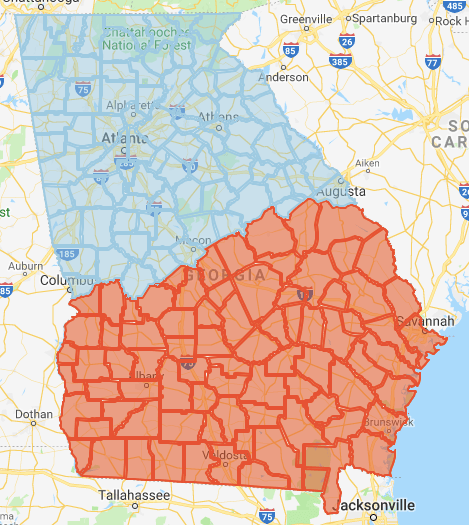
I’m tired of this state. Split Georgia in half. Pull a “3 Californias” on it.

South Georgia is still outvoting Metro Atlanta statewide, no matter who we will put out there in 2020 or 2022 for Senate or any executive position. Stacey Abrams, if she runs for U.S. Senate, won’t replace David Perdue with this map.

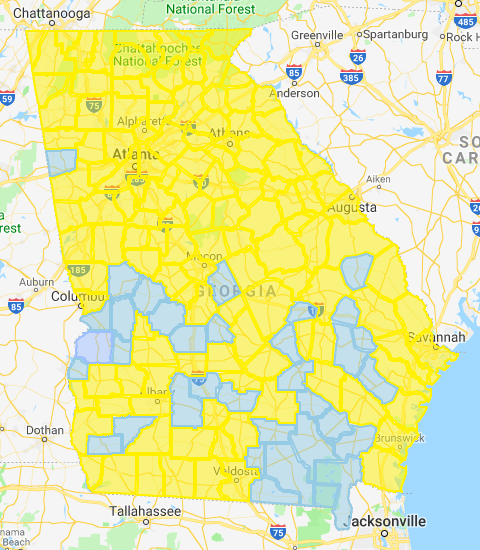
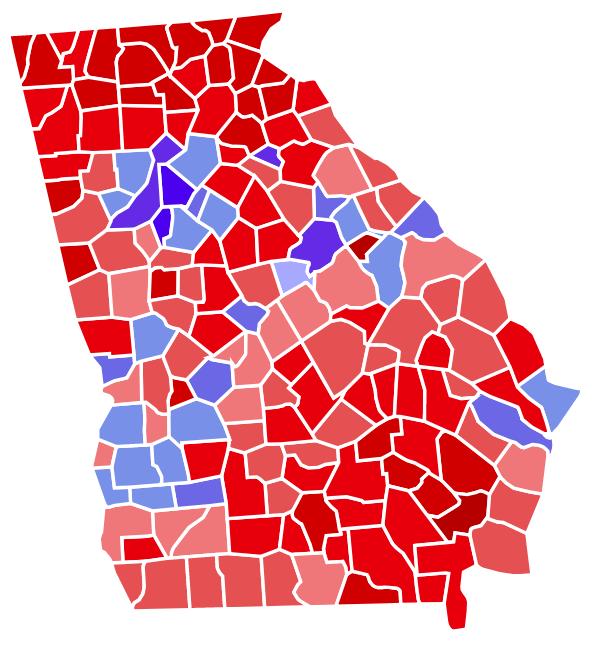
Meanwhile, this is the map of active and inactive Democratic county committees, and a map of how Georgia voted in the gubernatorial.

(Where are the county committees for Talbot, Stewart, Macon? They voted in the majority for Stacey Abrams, but there are no Democratic committees there.)

As far as looking at counties is concerned, I still don’t see the benefit of the “organize-organize-organize” strategy. People are voting the way they’re voting whether or not we are organizationally present. How many more votes can we squeeze out of Democratic voters that don’t fall victim to the next scummy Secretary of State Brad Raffensperger? South Georgians aren’t stupid and are voting for their culture and their beliefs, just like they always have (even when they prevented black people from voting). They’re voting so deeply red for a reason, making the rest of the state look like a joke, and that can’t be ignored or glossed over by assuming that they are stupid.

Republicans are adept at picking their voters (and justifying it, too!), just like their conservative Democratic parents were. I’m open to doing the same thing. Let’s pick our residents. Let’s cut off South Georgia, south of Augusta-Macon-Columbus, into its own state so that they won’t rule the rest of us with their messed-up choices anymore.

I want to win something at least one goddamn election. I want my values to at least be marginally represented in the governor’s mansion at least once every 100 years. We are too large, we have too many counties, and we are still paying the price for the Union not breaking up some Confederate states.

South Georgia ruled the rest of Georgia during the years of the County-Unit System, during the height of Jim Crow apartheid. Brian Kemp ignored urban and suburban Georgia and pulled the votes of rural white South Georgia. Almost all of his mandate comes from South Georgia. I want to bid them adieu so that we can go our own separate ways, so that my political values are more competitive in statewide elections. #2Georgias #BreakItUp

How a black woman took down one of America’s most notorious mob bosses

From Elliot Ness to Robert Kennedy, America has a long history of crusaders against organized crime, but one name is far less known. Back in the 1930s, Eunice Carter, a granddaughter of slaves, became New York’s first African-American assistant district attorney. She’s credited with helping take down one of America’s most notorious mob bosses, known as “Lucky Luciano.” It’s just one of the fascinating stories told in a new biography of Carter, “Invisible,” written by her grandson, Yale law professor Stephen Carter. Michelle Miller reports.

Subscribe to the “CBS This Morning” Channel HERE: http://bit.ly/1Q0v2hE
Watch “CBS This Morning” HERE: http://bit.ly/1T88yAR
Watch the latest installment of “Note to Self,” only on “CBS This Morning,” HERE: http://cbsn.ws/1Sh8XlB
Follow “CBS This Morning” on Instagram HERE: http://bit.ly/1Q7NGnY
Like “CBS This Morning” on Facebook HERE: http://on.fb.me/1LhtdvI
Follow “CBS This Morning” on Twitter HERE: http://bit.ly/1Xj5W3p
Follow “CBS This Morning” on Google+ HERE: http://bit.ly/1SIM4I8

Get the latest news and best in original reporting from CBS News delivered to your inbox. Subscribe to newsletters HERE: http://cbsn.ws/1RqHw7T

Get your news on the go! Download CBS News mobile apps HERE: http://cbsn.ws/1Xb1WC8

Get new episodes of shows you love across devices the next day, stream local news live, and watch full seasons of CBS fan favorites anytime, anywhere with CBS All Access. Try it free! http://bit.ly/1OQA29B

Delivered by Norah O’Donnell and Gayle King, “CBS This Morning” offers a thoughtful, substantive and insightful source of news and information to a daily audience of 3 million viewers. The Emmy Award-winning broadcast presents a mix of daily news, coverage of developing stories of national and global significance, and interviews with leading figures in politics, business and entertainment. Check local listings for “CBS This Morning” broadcast times.

via YouTube

Rendering Techniques for augmented reality and a look ahead at AR foundation – Unite LA

Have you ever wondered why your virtual and real-world objects look disconnected from each other? Are you curious about how to blend virtual and physical spaces to create a seamless experience? This video covers advanced techniques using lighting, depth masks, occlusion, shadows and more to create a sense of immersion. You’ll also get an introduction to a set of tools that will improve your development process when using Unity and AR Foundation.

Speakers: Jimmy Alamparambil (XR) and Lukasz Pasek (AR/VR) – Unity Technologies

Learn more: https://ift.tt/2z2hINx

via YouTube