
Full Opinion from SCOTUS (PDF).
I couldn’t imagine this decision happening under this court, but I guess “bullying works” (sometimes). Plus, it’s a sign that SCOTUS’ right-wing majority may be more monstrous in Moore v Harper (independent state legislature theory), SFAI v. Harvard/SFAI v. UNC (affirmative action in higher ed), and Haaland v. Brackeen (Indian Child Welfare Act constitutionality), all to be announced this month.
Reactions:
- Politicians, officeholders and party activists: Pres. Biden and VP Harris, House Minority Leader Jeffries, Senate Majority Leader Schumer, DNC, Louisiana Gov. John Bel Edwards, AG Merrick Garland, U.S. Reps. Sewell and Horsford (NV), Congressional Black Caucus, Congressional Hispanic Caucus, Congressional Asian American and Pacific Islander Caucus.
- Civil society groups: Fair Fight, Black Voters Matter, FairDistrictsGA, American Constitution Society, W.F. Kellogg Foundation, APIAVote, Sierra Club, FairVote, Lawyers’ Committee, American Bar Association, The Leadership Conference, ACLU, ACLU of Alabama, Elias Law Group, Legal Defense Fund, Alliance for Justice, Georgia Redistricting Alliance, Union of Concerned Scientists, SPLC, Asian Americans Advancing Justice, League of Women Voters, NAACP, Religious Action Center of Reform Judaism, Power Coalition for Equity and Justice, Native American Rights Fund, Southern Coalition for Social Justice, Open Society Foundations, National Urban League, America Votes, Common Cause, National Redistricting Foundation, IGNITE, LatinoJusticePRLDEF, National Black Justice Coalition, NALEO
 (PDF).

Notable: Given it’s Pride Month, The National Black Justice Coalition may be the only LGBT rights organization to issue a statement in response to Allen v. Milligan. I would have expected The National LGBT Task Force, who organized the Queer the Census project for both 2010 and 2020, to have issued a statement as well. Even with the anti-LGBT backlash going on right now, this decision does have implications for Black LGBT people in the South, increasing somewhat the chances that they can run for and win higher office. Davante Lewis’ 2022 win in the runoff for Louisiana’s PSC was a big, understated victory for Black LGBT people in this region.
Impact(s)
What is happening or is most likely to happen nationwide, based on Election Twitter’s ideas:
- Alabama legislature will be forced to redraw their congressional map to add a second VRA district.
- Louisiana is asking SCOTUS for oral argument in their appeal against the Ardoin case regarding Louisiana’s own congressional map. Highly likely that SCOTUS will dismiss the appeal and force Louisiana legislature to redraw for a second VRA district.
- North Carolina legislature likely to not go as hard as they wanted to go on obliterating most remaining Dems in congressional and legislative maps.
- Florida’s state and federal cases regarding the former FL13 will be slightly supported by this decision, but not too much, since those cases rest on other laws, such as the federal 14th Amendment as well as the state constitution’s analogues to Section 2 and (the former) Section 5 of the VRA (citing Andrew Pantazi of the Jacksonville Tributary).
- Dems were worried about their chances for winning back the House next year after the North Carolina Supreme Court gave Republicans multiple wins. After this, there’s a potential net gain of at least 2.5 seats. Or, if we want to go crazy with wishcasting, as many as +10-12. Maybe enough to wash the gains to be made by Republicans in North Carolina.
- Very unlikely to see any redistricting in Arkansas, Mississippi, Oklahoma, Ohio or Wisconsin resulting from Allen.
- There is ongoing litigation in North Dakota by Native American nations on Section 2 grounds regarding legislative maps.
Credit to U.S. Rep. Terri Sewell (D), who actively campaigned for a plurality-minority second district in Alabama and against packing Black voters into a single district, as highlighted in this 2021 Atlantic article.
Now on to Georgia:
- It’s debatable how the Republican legislature could redraw their congressional map to do the bare minimum of complying with the Allen decision. The best-case scenario is perhaps restoring Lucy McBath and Carolyn Bordeaux’s old districts, restoring the 2020 status quo of 8 GOP-6 Dem. The shortest-term worst case is simply re-packing Black Metro Atlanta voters into four districts, but that would leave lots of other left-trending territory surrounding these districts vulnerable in the longer term to Dem candidates.
- There is ongoing litigation (Georgia State Conference of the NAACP v. Georgia) challenging the 2022 congressional and legislative maps, filed by the NAACP state conference, GALEO, and Georgia Coalition for the Peoples Agenda. Also ongoing against these maps: Grant v. Raffensperger, Alpha Phi Alpha v. Raffensperger, Prendergrass v. Raffensperger. There’s ongoing VRA Section 2 litigation in 30 cases across 10 states, and there are more to come.
Public Service Commissions
Let’s talk about the PSC, both in Georgia and other states:
- PSC At-large voting: There has been radio silence from the 11th Circuit on the state’s appeal in Rose v. Raffensperger since oral arguments last December. Hopefully the Allen decision will make an impact. At least two of the plaintiffs to whom I’ve talked, Rev. James Woodall and Wanda Mosley, are confident that this decision will help them prevail against the state. Also, I wonder if Judge Nancy Abudu, a Biden appointee who was just confirmed to the 11th Circuit, will join in or recuse herself from whatever ruling that comes out on the appeal.
- PSC Redistricting: There’s a petition that has been filed by plaintiffs in Rose v Raffensperger with Judge Grimberg in the Northern District of Georgia to redraw the PSC map which had been approved in 2022 during qualifying week (which placed Democratic PSC District 2 nominee Patty Durand at odds with Raffensperger).
- Dems filed a bill (HB 841) to change the PSC election method this past session, but it died before getting heard in committee.
- See my prior posts about the GA PSC and VRA: 1, 2.
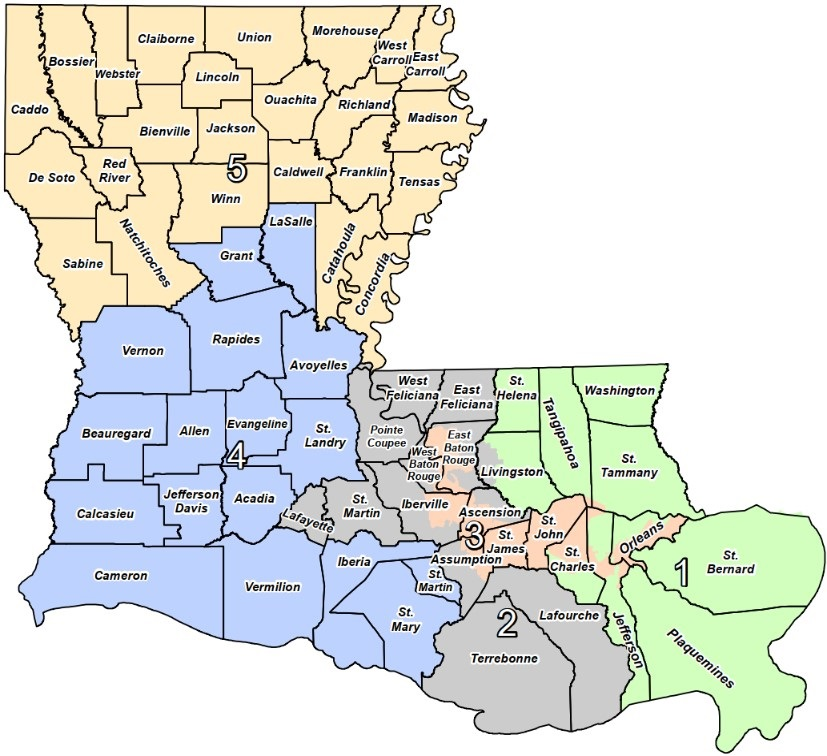
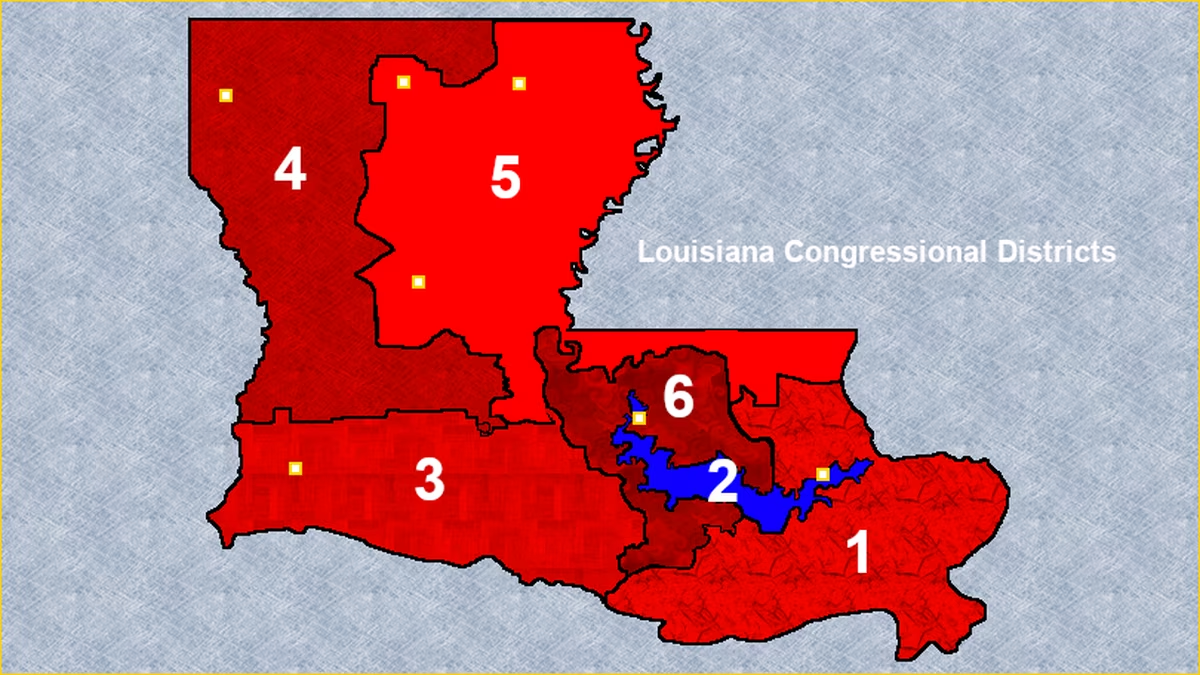
There’s also a question as to whether the Georgia PSC should be entirely drawn around entire counties. To compare, Louisiana’s PSC districts are mostly drawn around entire counties, except for Davante Lewis’ District 3, which, similarly to Troy Carter’s Congressional District 2, snakes through portions of Orleans Parish all the way into East Baton Rouge Parish. If, resulting from Allen, LA-CD2 may be redrawn in order to accommodate a second VRA opportunity district stretching from Baton Rouge up Louisiana’s border with Mississippi all the way to the northeast corner of the state (As proposed by FiveThirtyEight and in multiple proposals by both Democrats and Republicans last year), then what of Louisiana’s current LPSC map? Should Foster Campbell’s District 5 be redrawn into a second VRA-compliant LPSC district?

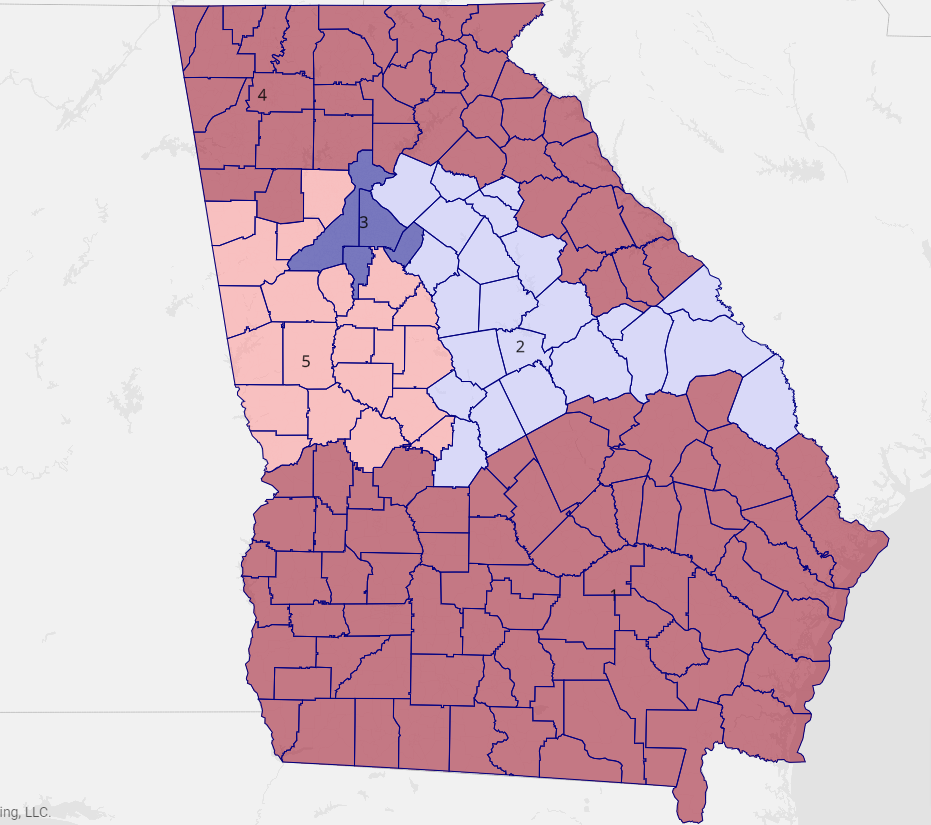
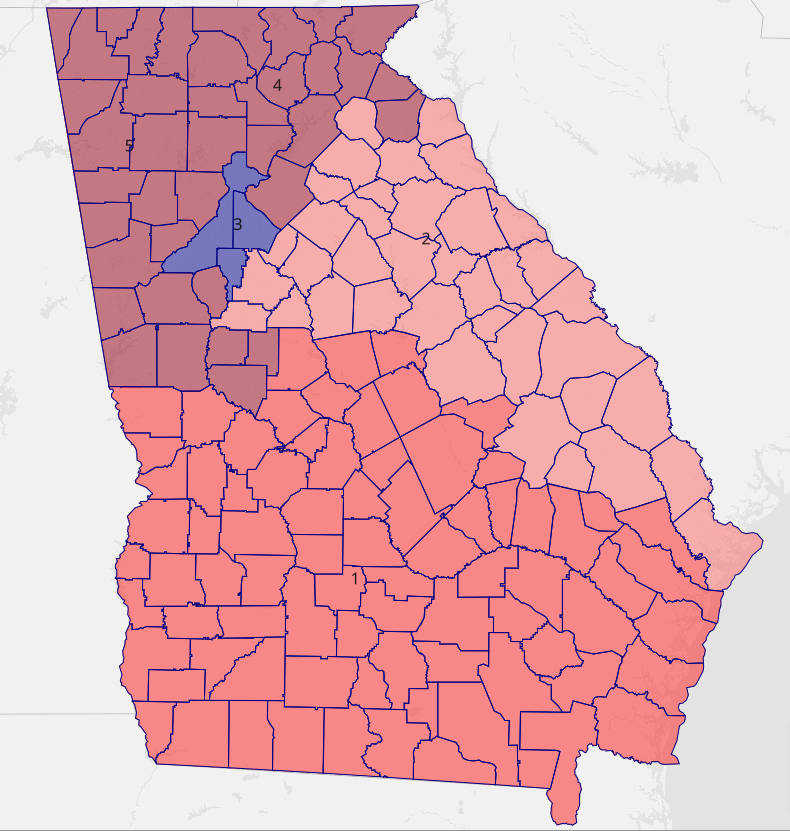
And if so, what of Georgia’s PSC map? Could Districts 3 and maybe 2 be redrawn to create VRA-compliant opportunity districts? District 3, centered around only Fulton, Clayton and DeKalb counties, could count as a racial packing of Black voters in a state where Black people account for 33% of the population. The legislative Democratic caucus submitted a map in which District 2 would obviously be an opportunity district with 33% Black VAP. And does District 3 really need to be contiguous with the core counties of Metro Atlanta? Lots of opportunities here.
And finally, should Alabama’s PSC, an at-large body of 3 members with no districts, be given this treatment as well? If the plaintiffs prevail in Rose and force changes in Georgia, there is an opportunity for Black Alabamians to sue under Section 2.
