All posts by Harry Underwood

Unknown's avatar

About Harry Underwood

Website designer, blogger. Columbus, GA. #LGBT #p2 #wordpress

nobonoko – Music For Animal Cafés [FULL]

nobonoko – Music For Animal Cafés

01. 00:00 We’re Opening
02. 00:15 It’s Time O’clock
03. 05:55 B-Meowsic I
04. 10:30 Chat au Chocolat
05. 15:13 Planarian Cut
06. 19:11 Birthday Dog
07. 20:17 Waterfront Booossa
08. 23:30 Sylvester the Cat
09. 28:06 Storm
10. 31:44 COFFEE MACHINE
11. 32:38 B-Meowsic II
12. 35:39 Peanut
13. 37:36 Music For Animal Cafés (Feliz Cumpleaños Ariana Grande) (ft. Devious)
14. 44:42 Three Tigers Ate Three Plates
15. 48:25 Thank You!
16. 49:06 Raccoons Broke In

Get the album: https://ift.tt/wkp7lqn

Album art by me

My most important album so far. It takes heavy influence from Picopop and Shibuya-kei, mainly on acts such as Capsule and COPTER4016882.

I was conceptualizing this idea as early as 2020 with my dear friend Luok, guy behind beepbox classic Dr. Worm (https://ift.tt/5Mr4d2f). Our idea was a café themed album where each hour corresponded to an hour of the day.

I started making songs for this in mid to late 2020, during my Shibuya-kei obsession peak, with its lounge inspired compositions and toy-like instrumentation. In 2021 Devious and I started working on a little jazz song. It eventually reached (nearly) 7 minutes in lenght and became my longest song (for a while, disconsidering the megalovania remix). This song became the album’s titular song. Most progress on this album was seen between 2021 and 2023.

Waterfront Booossa is a cover of .numa’s Waterfront Booost from 2019, originally started in 2020. https://ift.tt/fBkJZqS

Track 13 was made with Devious and is one of the best things we’ve ever made https://ift.tt/YEz0pw5

All songs were made on Jummbox (1-3, 5-16) and Ultrabox (4) between 2020 and 2023.

via YouTube

8th Circuit Decides to Gut Section 2 of the Voting Rights Act

The 8th Circuit just ruled that there is no private right of action under Section 2 of the Voting Rights Act. 2-1, Bush and Trump appointees in the majority, Bush appointee dissenting. Affects litigation in the following states: Arkansas, Iowa, Minnesota, Missouri, Nebraska, North Dakota and South Dakota. Almost the entire 8th Circuit is Republican appointed. Expect SCOTUS action.

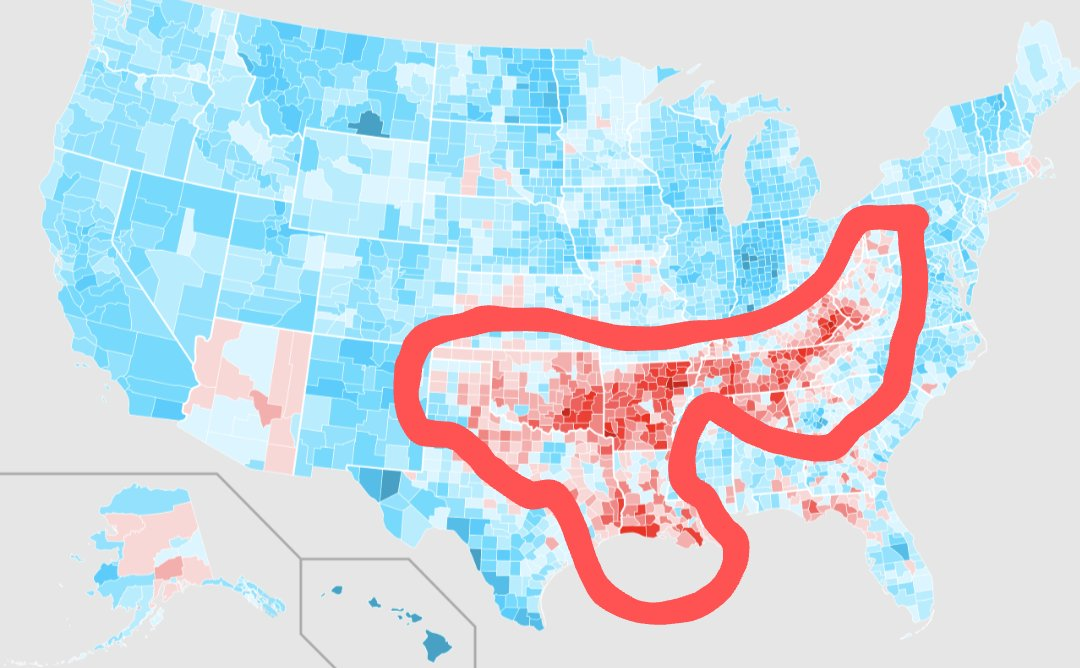
This was in response to the Arkansas NAACP suing the state over racially-biased legislative maps. Between this and both Georgia and Louisiana outright claiming on appeal that Section 2 is unconstitutional, the VRA is under direct Southern-Appalachian right-wing assault.

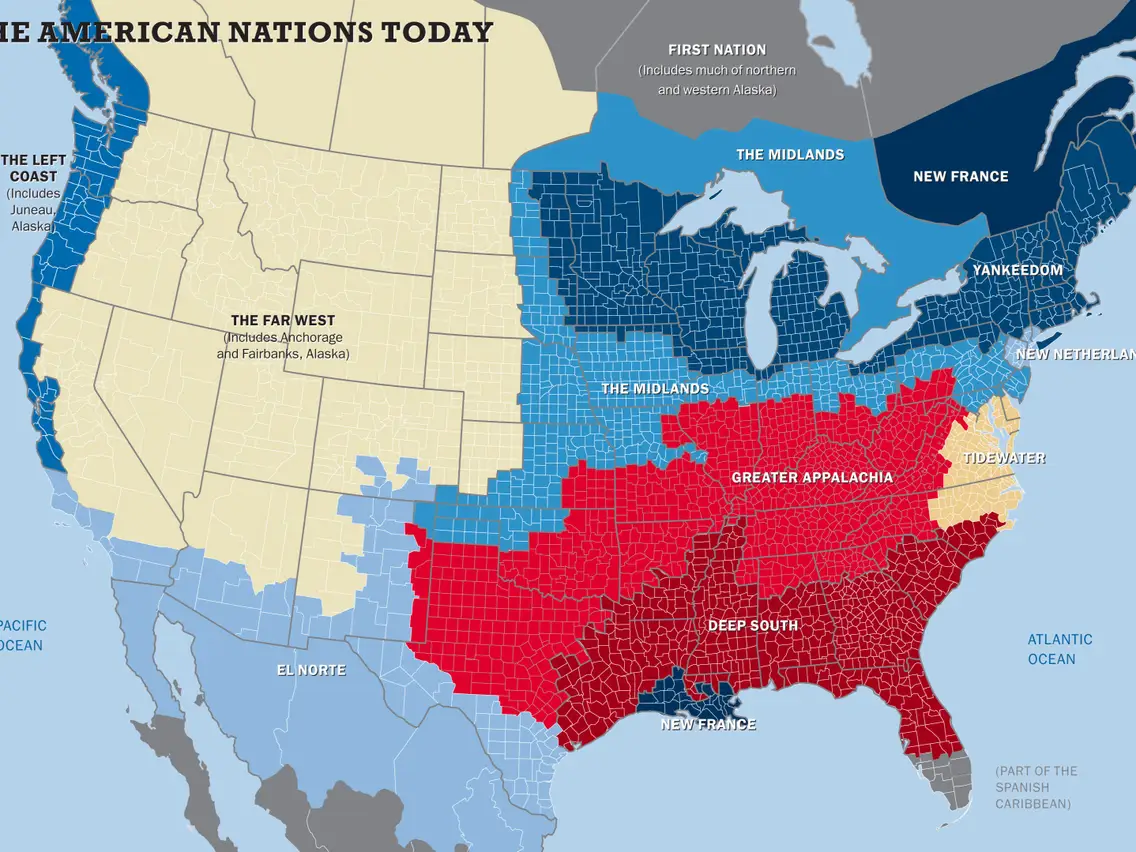
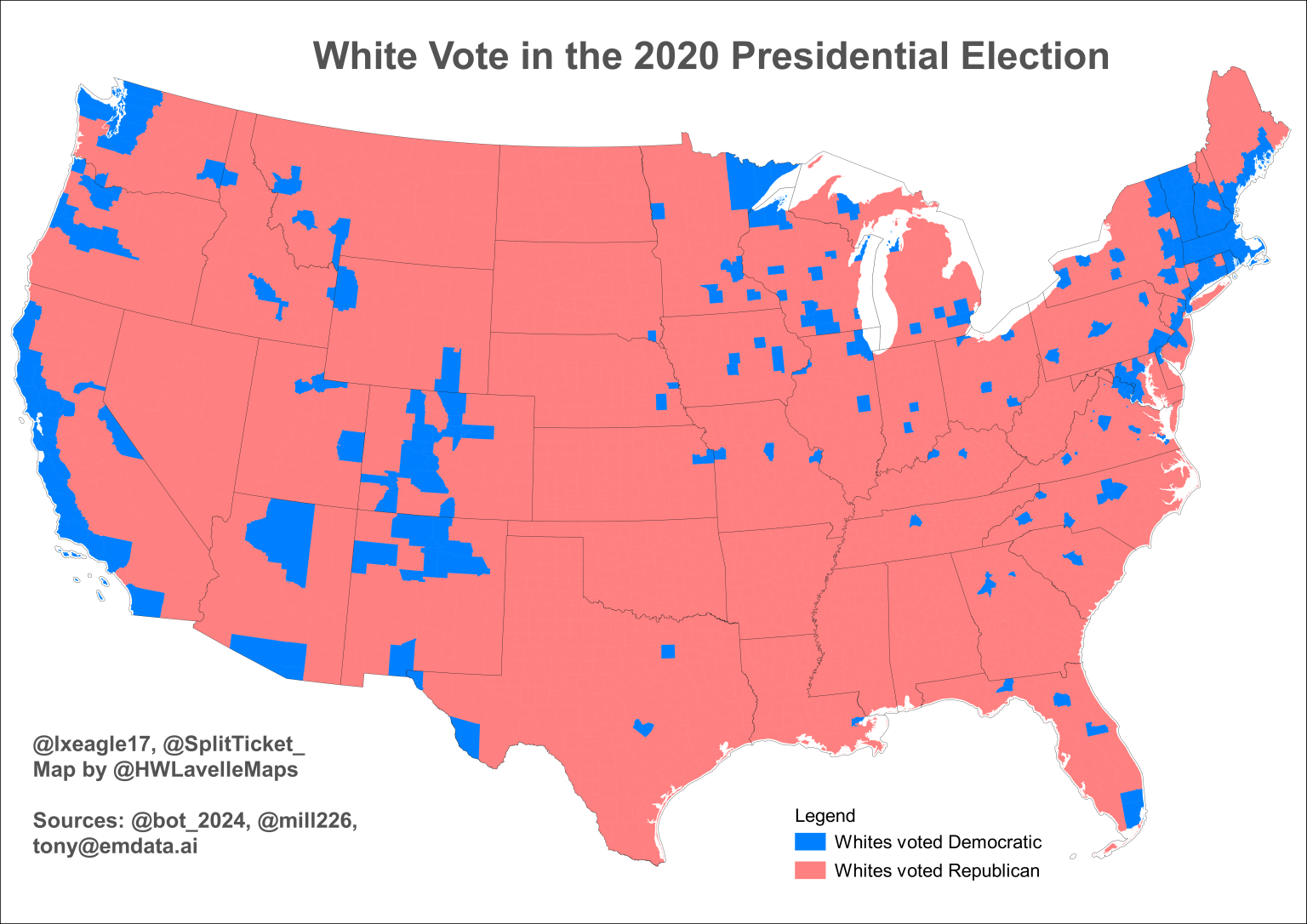
These full-frontal attacks on the Voting Rights Act, in the majority, come from white Southern Republican state legislatures and federal judges. The VRA did the bare minimum of forcing an imperfect compromise between white Southern rural voters and their Black neighbors, and we’re now paying for its loopholes which are now being exploited.

Pics related.

Estimated White Vote in the 2020 Presidential Election by County. Source: SplitTicket
Party swing in the 2004-2008 presidential elections by county, with the most Republican counties being singled out. Source: @vanillaopinions/Twitter
American Nations, as defined by Colin Woodard.

Tourism and the future Ocmulgee National Park and Preserve

Georgia currently has the following federally-protected areas:

  • 1 National Forest (Chattahoochee-Oconee)
  • 6 national historic parks, historic sites and/or military parks (Andersonville, Jimmy Carter, MLK, Kennesaw Mountain, Chickamauga-Chattanooga, and Ocmulgee Mounds)
  • 2 national monuments (Fort Frederica and Fort Pulaski)
  • 10 national wildlife refuges
  • 5 national natural landmarks
  • 12 federal wilderness areas
  • 1 wild and scenic river
  • 2 national trails
  • 1 national recreation area
  • 1 national seashore
  • 1 national marine sanctuary
  • 1 national estuarine research reserve

But apparently Georgia does not have any “national parks”. Also, most of the national forests are located north of Macon and the Black Belt.

Last year, the National Park Service commenced a study to estimate the feasibility of expanding the Ocmulgee Mounds National Historical Park as a full-on national park and preserve. This study also estimated the feasibility of expanding the protected area down the Ocmulgee River to south of Robins AFB. The study, which was completed and sent to Congress this week, ultimately estimated that both would be unfeasible due to cost and landowner opposition, but, in the interest of providing some form of protection for the river, recommended designating a smaller area as a National Heritage Area, a form of public-private partnership in which the NPS plays an advisory role while most of the work is carried out by a government or non-profit organization.

The group which advocates for this expansion has a website. And the congressional cohort which supports this initiative – Sens. Ossoff (D) and Warnock (D), Reps. Bishop (D) and Scott (R) – are not accepting the NPS study and are seeking for approval of the park in Congress. And if that doesn’t work, there’s always presidential designation as a national monument via the Antiquities Act, which could overrule opposition from local landowners and the Georgia Department of Natural Resources.

Political implications of national parks

Ever since first coming across research regarding how Democratic candidates for president (with the exception of Hillary Clinton in 2016) have done very well in rural counties whose economies depended on ecotourism, I have become deeply interested in how “new rural economies” which draw population have different economic outcomes and political interests than counties in “old rural economies” which depend on agriculture, livestock and/or mining. This held true for Joe Biden in 2020 as well, going so far as winning Teton County, Wyoming, the location of Grand Teton National Park and the most Democratic county in the deep-red state.

Granted, this doesn’t exactly seem to apply to ex-Confederate states, with several national parks and national forests in the Appalachians (i.e., Tennessee, North Carolina) not translating to rural gains for Democrats in presidential elections, or at least not drawing many transplants residents from outside of the region. But it somehow seems to work elsewhere in the United States.

National Heritage Area?

As stated, a National Heritage Area (NHA) affords fewer protections and restrictions on development, but can cover larger areas. An example is the new Alabama Black Belt National Heritage Area, which spans 19 counties and their cities in Alabama’s Black Belt region, is one of two NHAs in Alabama and is administered by the University of West Alabama (based in Livingston).

The NHA system, compared to the national park system, is very new, with NHAs first being designated in the 80s under Reagan and the NHA system only being established in January this year through the National Heritage Area Act (which also established the Alabama Black Belt NHA).

  • What tourism can NHAs draw compared to national parks?
  • Why are there so many more NHAs located east of the Mississippi than west?
  • Conversely, why are these so few national parks east of the Mississippi compared to west?

At the very least, NHAs seem to be easier to establish in the eastern U.S. because they don’t seem to require strict preservation of historic or natural properties, which works just fine for a much more densely populated and farmed region like the eastern U.S. Apparently, NHAs can even overlap each other (odd).

We need a park and preserve

IMO, Georgia needs a park and preserve which extends south of Macon:

  • the Southern half of the state is absent of any national parks, national preserves or national forests;
  • Dependence on mass agriculture is a population loser;
  • Federal protection of land would be a massive method of economic diversification
  • the Black Belt, which also forms a concentration of African-American majority counties stretching from Louisiana to South Carolina, does not have enough natural preservation and ecotourism going on;
  • The colleges and universities in the Macon-Warner Robins area (Middle Georgia State, Mercer, Wesleyan, Fort Valley State) would benefit from this as well.

If an Ocmulgee National Park and Preserve extending to south of Warner Robins is the way to make this diversification happen, then so be it. A National Heritage Area can be secondarily added to the surrounding area, but the park and preserve should also become a reality.

Are Alabama’s Democrats Ready? Are the South’s Democrats Ready?

I think about the following:

  • Out of the former Confederate states in the period between 1870 and 1901, only South Carolina sent at least two or more members to the U.S. House.
  • Georgia, Alabama, Louisiana, Mississippi, Florida, North Carolina and Virginia all sent one member at a time.
  • Texas and Tennessee never sent any members in the (post-)Reconstruction era
  • and Arkansas has never sent any African Americans to Congress to the present day

Now, Alabama will likely send two Black members to the U.S. House for the first time. And Louisiana is within spitting distance of doing the same for the second time in their history; the first time such a thing happened was in 1993, when William Jefferson (D-LA02 and Cleo Fields (D-LA04) went to the 103rd Congress.

The big question which sticks out for me is whether the Alabama Democratic Party will be prepared for this moment.

They certainly weren’t when Doug Jones won the once-in-a-blue-moon Senate special election in December 2017. In fact, the Alabama Democratic Party, the statewide Black Democratic club ran by Joe Reed, actively fought Jones for influence over the party’s bylaws and structure. The fight continues to this day, years after Jones lost his Senate seat to some bigoted football coach. And it seems like the DNC will have to pry some control of the ADP from the Conference. The Conference also tried to intervene twice in the Allen v. Milligan case to advocate for a more Black-majority 2nd and 7th district (to no avail), which went against the strategy of the plaintiffs as well as Rep. Terri Sewell in favor of two opportunity districts.

Now, however, with Sewell likely to win again in the 7th, the question remains as to the impact of whoever wins the 2nd congressional district. It’s most likely that the winner may be Black, or that whoever wins will have the support of the Black voting-age population in the 2nd district. But will the winner have more of a role in the Alabama Democratic Party? Will the campaign to defend both the 7th and the new 2nd district arouse the party out its current shape?

The same can be asked about Louisiana’s Democratic Party. It is heading to another era in the statewide wilderness with the terming-out of Governor John Bel Edwards and the likely election of a Republican governor. The party has been beaten down badly in other political aspects due to a massive decline in white rural support. Besides retaining Foster Campbell on the PSC in 2026 (he had his closest election in 2020), the other favorable political aspects above the state legislature have been:

  • the election of Davante Lewis to the PSC in 2022
  • the possible creation of a second opportunity congressional district around Baton Rouge for 2024

This is why I look forward to the impact of Allen v. Milligan on Southern elections. All of these issues can be challenged in federal court:

  • the potential second opportunity district in Louisiana
  • the reform of Mississippi’s State Supreme Court districts
  • Alabama’s Public Service Commission election method
  • Georgia’s Public Service Commission election method and maps
  • Texas’s Supreme Court election method
  • Texas’ State Board of Education maps
  • Texas’s Railroad Commission election method
  • Louisiana’s Supreme Court election method

Michigan Democrats at the halfway point

The Michigan Legislature adjourned sine die early this session because of the election of two Democratic House members to mayorships, which ended up splitting the House until replacements win their special elections.

Unfortunately, due to a combination of constitutional and statutory constraints, the special elections may not be held for months into 2024, and the next session will be significantly cut short.

I’m thinking about what bills didn’t make it to the finish line:

  • bills to end prison gerrymandering
  • bills to repeal sodomy laws on the books
  • a more comprehensive bill to repeal bans on abortion

Michigan voters of whatever persuasion still have time to place citizen initiatives on the 2024 ballot. A few examples from Ballotpedia:

    • National Popular Vote Interstate Compact Initiative
    • Legalization of Psilocybin Mushrooms and Other Plants and Fungi Initiative
    • Allow Prisoners to Earn Sentencing Credits Initiative
    • $15 Minimum Wage Initiative
    • Decertify 2020 Election Initiative
    • Prohibit Installation of Utility-Scale Solar Installations on Agricultural-Zoned Land Initiative
    • Provide that the Executive Branch and State Legislature are Subject to Public Information Requests Initiative
    • Prohibit Property Taxes Amendment

    Ohio’s Direct Democracy Survives and Thrives

    Ohio defeated a proposed amendment meant to make ballot initiatives impossible, despite the state government using every possible trick to help it pass, including placing the question on the ballot for August.

    Apparently, the turnout exceeded most primary votes in the last several election cycles since 2016. The result also largely broke down by population density, with Democratic-heavy counties joined by voting No. The result largely bucked the trend of past presidential and statewide elections, with substantial crossover voting from Republicans who opposed the ballot question.

    Winners:

    • Both November 7 ballot initiatives:
      • Right to Make Reproductive Decisions Including Abortion Initiative, on the ballot November 7 (passed)
      • Marijuana Legalization Initiative, on the ballot November 7 (passed)
    • At least 3 potential ballot initiatives working for the 2024 ballot:
      • Citizens Redistricting Commission Amendment
      • Minimum Wage Increase Initiative (for $15)
      • Constitutional and Legal Rights Relating to Public Safety, Including Prohibiting Qualified Immunity Initiative
    • former Ohio Supreme Court Chief Justice Maureen O’Connor, who is leading the effort for the Citizens Redistricting Commission Amendment and was infamously snubbed by the Ohio Republican-supermajority legislature

    Losers:

    • Ohio Secretary of State Frank LaRose (R)
    • Governor Mike DeWine (R)
    • Attorney General David Yost (R)
    • The Ohio Republican Legislative Supermajority
    • Ohio Chamber of Commerce
    • Anti-choice reactionaries

    Thoughts on Meta Quest 3

    VR devices like the Meta Quest 3 are out of my priority zone right now, but I remain fascinated in the advances made with augmented/mixed reality over the last decade.

    It took so much technology and so many price reductions, but now we’re so much closer to the Dennou Coil future. Some are now taking their Quest 3 headset outside and out of their homes, even to public places, risking being called “glassholes”, at least to test the limits of current mixed reality headsets.

    (At the very least, Meta backed off of making heavy references to work/enterprise when launching the Quest 3, so this is likely to be more successful a device than the ill-fated Quest Pro.)

    The Apple Vision Pro, when it comes out, will likely exceed the Quest 3 in polish and some technology features (I.e., the 12 cameras inside the Vision Pro). The one I look forward to the most is the “Spatial Video” format, or 3D semi-volumetric video which you can zoom in to see different angles and plays in a sort of foggy box at the edges. I’m seeing demos alleging comparative spatial video in Meta Quest 3, but it doesn’t exactly seem as apparent to me.

    I’m still wondering exactly who, or which demographic, will likely afford a laptop-on-the-face like the Vision Pro, compared to the game-console-on-the-face that is the Quest 3. I guess we’ll find out.

    Third Time’s the Charm for Citizen Redistricting Initiatives in Ohio

    What will be the difference between 2005, 2012 and 2024 for citizen redistricting in Ohio?

    Let’s look at the 2012 proposal.

    The Voters First Ohio campaign went to court against the Ohio Ballot Board over the language of the measure. The Ohio Supreme Court ruled for the campaign, but when the Ballot Board met again, the ballot language was doubled in length. 

    The opponents of the 2012 measure, including both big business lobbies and the boards of at least two major newspapers, decried the alleged “lack of [electoral] accountability” of a citizen redistricting commission, as well as the mandated funding for the commission’s work. 

    Both newspapers instead extolled the idea of requiring a bipartisan supermajority from a politician-majority commission for passage of a map, and the proposal went down in defeat.

    This was said before Ohio, in two legislatively-referred amendments in 2015 and 2018, replaced the Ohio Apportionment Board with the Ohio Redistricting Commission, which did no better in 2021-2023 at drawing fairer maps despite requiring bipartisan supermajority approval. Wonder if they changed their tune?

    The CNP initiative seems to keep most of the 2012 proposal. Differences:

    • The CNP proposal would involve a bipartisan panel of only retired judges to screen potential candidates for the commission. The 2012 plan would have involved sitting appellate court judges in the selection of commissioners.
    • CNP’s plan bans prison gerrymandering. 

    The use of retired judges effectively sidesteps one of the sticking points of the 2012 plan, which drew the opposition of both the Ohio Judicial Conference and the Ohio State Bar Association for this reason. This amendment, certainly, needs as many supporters, or as few opponents, as possible.

    There is no telling whether the big business lobbies have changed their tune. The Ohio Farm Bureau Association and Ohio Chamber of Commerce, both of which publicly opposed Issue 2 in 2012, both backed August 2023 Issue 1, which would have seriously hobbled direct democracy in the state. The failure of that amendment may not say too much about the fate of CNP’s initiative, but it does show the deep entrenchment of the political elite in Ohio that such a blatantly anti-democratic proposal as August 2023 Ohio Issue 1 would see the light of day.

    But the repeated failures of citizen redistricting proposals at the ballot box, or at least the failures of their campaigns, need to be considered as teaching moments for those who assume that it will win this round in 2024. In addition, the chicanery of oppositional officeholders like the Secretary of State, who changed the ballot summary language of November 2023 Ohio Issue 1 to reflect Christian right-wing beliefs about abortion, should not be ignored (even if his actions failed to stop the measure from victory at the polls). Victory is not certain, and what those past campaigns endured should help this campaign improvise, adapt and overcome in 2024.

    Let’s also see if the CNP proposal makes it to the ballot at all. After being approved by the Attorney General (who accepted it after previously rejecting it twice) and Ohio Ballot Board, the campaign recently voluntarily reset the clock after discovering a typo, then rewrote the petition and sent it back to the Attorney General, who approved it a second time. It now awaits the Ohio Ballot Board’s decision before it is finally set to begin collecting signatures.

    Saporta Report: “A decision on the races that time forgot may be near”

    Saporta Report cites attorney Bryan Sells regarding when we can hope for an impending decision in Rose v Raffensperger.

    It would make sense for a decision in Rose v Raffensperger to come before Thanksgiving, which quickly precedes the start of the special legislative session on November 29. As stated in Saporta Report, this decision will be cited for decades. It will have an impact on voting rights, redistricting and other types of litigation, not only in the 11th Circuit but elsewhere. 

    But I go back to the VRA litigation saga from 2011-2016 against at-large FPTP elections in jurisdictions like Fayette County, GA, or to the 100+ court cases since 1982 in Georgia alone which replaced at-large districts with single-winner district elections for city councils, school boards, county commissions and legislative districts. 

    I would be very surprised if the 11th Circuit sided with Georgia on the PSC’s at-large election method. But the clock is ticking on the 11th Circuit to make a decision: 

    • the special session on congressional and legislative districts starts on 29 November;
    • then a regular session to start in January 2024 for 40 days, which is a chance to change statute law regarding PSC elections;
    • then a general election to be held in November in which at least another PSC seat (District 5, held by Republican Tricia Pridemore) will be on the ballot (and maybe the two held by Echols and Johnson?), as well as a chance for voters to change Article IV Section 1 of the state constitution regarding the PSC.

    On the flip side, the 11th Circuit could rule the case unjusticiable and remove itself from the case. Or they could rule for the plaintiffs but then the state could simply move the PSC to an appointed body instead (like most states). Who knows.

    The next few weeks will be interesting to watch.

    Idea: A Trans-African Waterway

    Perhaps more than any other Pan-African political or economic unification, I would think that a canal network linking the Congo, Zambezi and (maybe) Nile Rivers would be the biggest economic coup for the African continent.

    Inland canals are perhaps one of the biggest reasons for the ridiculous amount of power of the United States. The Eastern portion of the United States is technically an island surrounded by ocean and sea on one side, rivers and canals on the other.

    So linking the Congo to the Zambezi would essentially make southern Africa an island separate from the rest of the continent. Same for eastern Africa from Egypt to northern Mozambique if the Congo is linked to the Nile.

    But if it is ever built, I have questions:

    • what inland cities would grow from this waterway? (DR Congo has quite a few inland port cities)
    • what environmental impact would likely happen?
    • how much traffic would it divert from the Suez Canal, or around the Cape of Good Hope, for those ships which want to cross into the Indian from the Atlantic?
    • how would this impact agriculture?
    • how would this impact mining?
    • how would this impact hydroelectric power, especially with Kariba Dam?

    I’ve found some articles on the subject:

    I’ve also had fantasy/scifi ideas about what Africa would look like with more islands (and maybe archipelagos) like East and Southeast Asia. Maybe this is the closest that we can possibly get to that idea.

    For the Southern portion, I would call it “SADC Island”, after the Southern African Development Community, of which all the countries touching the – Angola, DR Congo, Zambia