In 2008, California voters established the California Citizens’ Redistricting Commission to redraw state legislative districts, and in 2010, extended its powers to redraw congressional districts.
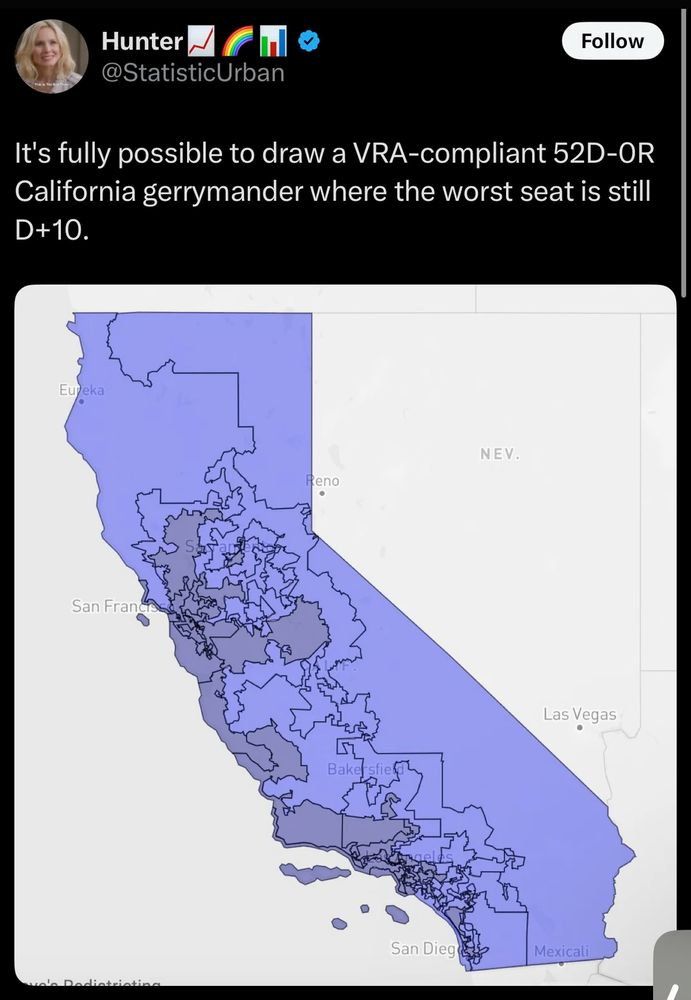
Within portions of the California Democratic Party in 2025, the latter power to redraw congressional districts is widely perceived as an act of unilateral disarmament when it comes to the empowered Republican legislative majorities in Florida, Texas and North Carolina. And now that both Trump’s White House and the Texas Republican Party want to eliminate as many as five more Democratic-held metropolitan seats in Congress, the idea of Newsom calling a special legislative session to refer an amendment to the voters to restore partisan gerrymandering powers to the legislature is being trafficked to news outlets.
In my opinion, California should keep their citizens’ redistricting commission, but should amend their constitution to provide for a “congressional redistricting emergency” period for legislative redistricting of congressional districts until the majority of congressional districts nationwide (217 out of 435 seats), or more broadly, every state assigned three or more congressional districts through reapportionment after each census, are covered by state constitutions which provide for citizens’ redistricting commissions.
Based in part off of the 2016 Interstate Compact for Fair Representation Act (SB 0322), which was proposed by then-Illinois State Senator (now Illinois Attorney General) Kwame Raoul, and passed the State Senate before dying in committee in the State House, here’s how I would amend the California State Constitution Article XXI Section 1 to carve out this exception:
“(b) In the year following the year in which the national census is taken under the direction of Congress at the beginning of each decade and in which at least one state with three or more congressional districts at the time of redistricting has not enacted the terms of Article XXI in substantially the same form in their own state constitution as applies to the constitutional districts of their state, the Legislature shall retain the right to amend a map of congressional boundary lines as proposed by the Citizens’ Redistricting Commission and to approve said amendments by majority vote of both houses and approval by the Governor. The Legislature shall retain the right to amend said boundary lines in an intervening year if any state enacts a similarly-timed adjustment of congressional boundary lines which fails to espouse the terms of Article XXI. Such compliance with this subsection shall be determined by the Secretary of State, who shall declare a state of congressional redistricting emergency to terminate upon determination of such compliance.”
This way:
- only a small portion of Article XXI would be amended to carve out the time-dependent congressional exception, since we’re wanting more states to adopt Article XXI in substantially the same form for their state government.
- Furthermore, it would encourage more Democratic-led states to keep their congressional gerrymandering powder dry for when it is needed for when interstate and anti-presidential conflicts arise.
- it would allow the Legislature to respond to mid-decade redistricting by another state if necessary.
- Finally, it would empower the Secretary of State to determine if any state has failed to adopt the terms of Article XXI in their state constitution to trigger legislative intervention.
This power should not be held by the legislature in perpetuity. This should be an emergency power that is used to stabilize Congress in a time of interstate conflict. It would be a departure from unilateral disarmament, instead treating interstate relations as a theater in which to seek diplomacy, mutual defense and good government.
But I can see such a move irking those who have pushed for decades in the trenches to unilaterally enact citizen redistricting by ballot initiative or legislation. I also acknowledge that Republican-led states like Arizona and Montana would be within their right to adopt similar exceptions to nonpartisan redistricting for congressional gerrymandering. Yes, this could become a “race to the bottom” as put by State Assemblymember Alex Lee.
In the Anglophone hell that is our first-past-the-post, single-winner elections for legislative branches nationwide, unilateral disarmament is no virtue, and keeping your gerrymandering powder dry to force concessions from other states is no vice.
I encourage readers to read this Penn State Law Review paper by Zachary J Krislov as well as this University of Chicago Law Review paper by Samuel P. LeRoy for great breakdowns on these “interstate compact” trigger laws on redistricting, the histories of such proposals and their potential efficacy.