Category Archives: Politics

What is, What Isn’t in the NDAA FY22

The U.S. House passed an amended version of the National Defense Authorization Act for Fiscal Year 2022 (“NDAA”) 363-70, with 51 Democrats and 19 Republicans voting against. This version, which authorized expenditures of around $770 billion, would remove key portions which were passed in a prior version passed by the House in November, and faces a Senate vote this week.

Sex and gender in the NDAA FY2022

In regards to sex and gender relations, the current version of the bill does the following:

  • encodes sexual assault into the Uniform Code of Military Justice (UCMJ) as a crime for the first time
  • requires each military branch to establish an office to handle such crimes,
  • bans military commanders from making decisions about prosecutions in these and other “covered crimes”
  • directs DoD to track allegations of retaliation by victims of sexual assault and harassment, including demographic information on both the purported perpetrator and victim

To gain support from Republicans, Senate Democrats removed key provisions from the House’s earlier version of the NDAA FY2022, including provisions mandating the removal of language in the Selective Service Act only requiring men to register for Selective Service by the age of 18. While the NDAA had passed with bipartisan support in the House, several key Republican senators such as Josh Hawley of Missouri objected to this language on sexist grounds, while Rand Paul of Kentucky objected to the maintenance of the Selective Service System in its entirety.

Far-right Republican members of both houses objected to the bill for purported financial support of gender-affirming surgeries for transgender servicemembers, even though the bill did not include such language and merely failed to include a transphobic amendment banning such support. The bill also fails to codify President Biden’s re-integration of transgender servicemembers.

The provisions in regards to sexual assault and harassment have the support of DoD leadership.

Other provisions

The bill also includes:

  • the establishment of a “multi-year independent Afghanistan War Commission” to examine the beginning, procedure and U.S. withdrawal from the war over the last 20 years.
  • authorizing a 2.7% pay increase for servicemembers
  • authorizing DoD to provide a “basic needs allowance” for qualified low-income servicemembers who have experienced setbacks from the pandemic
  • establishes an “office, organizational structure, and provides authorities to address unidentified aerial phenomena,” aka UFOs
  • requires the President to develop a “Grand Strategy with Respect to China,” including assessments of Chinese activities in military, security, and foreign and economic relations in Central and South America
  • bans the U.S. military from buying equipment made by forced labor camps in Xinjiang Province (a provision added at the behest of Republican senator Marco Rubio)
  • reinforces U.S. policy against Chinese attempts to find a fait accompli against Taiwan

However, Senate Democrats removed a repeal of the 2002 Authorization to Use Military Force in Afghanistan from the most recent version. They also removed a provision legalizing marijuana banking, which was pushed by NJ Rep. Ed Perlmutter and passed the House.

Several House progressives voted against the bill due to the largesse of the funding to the military compared to the repeated cuts to the Build Back Better Act which has yet to pass the Senate.

Abrams Announces 2nd Bid for Georgia Governor, 1st to Enter the Democratic Primary

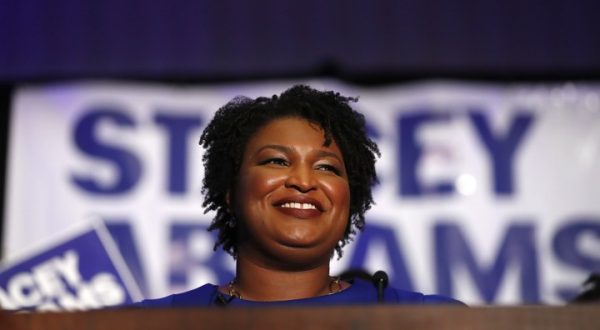
Stacey Abrams

Ending years of speculation, Fair Fight CEO and former state House Minority Leader Stacey Abrams announced her 2022 bid for governor, an announcement timed on the day after the 2021 municipal runoffs. She is widely expected in the press to be the leading candidate in the May 24 2022 Democratic gubernatorial primary.

Despite her renown and the possibility that she could have no primary competition, Abrams will face an uphill battle against the eventual Republican nominee, whether it is incumbent Brian Kemp, former U.S. Senator David Perdue, or the conservative former Democratic state legislator-turned-Republican candidate Vernon Jones. The Abrams campaign currently expects an uncontested primary for governor, preferring that more of the primary infighting occurs on the Republican side in the coming months.

Abrams also faces an uphill battle against stagnant national poll numbers for President Joe Biden and downballot Democrats. History shows an emerging Democratic Party in Georgia which only began in recent years to rebuild itself in a new image.

16 Years in the Wilderness, Then a Path Forward

The last time that Democrats in Georgia ran for governor and state row offices under a Democratic president’s first midterm was in 2010, which resulted in a poor showing, with Republican former congressmember Nathan Deal defeating the Democratic former one-term governor Roy Barnes by 10 percentage points, and the downballot Democrats performing worse in their popular vote share. The 2014 gubernatorial election also saw a poor showing by Democrats, with Nathan Deal defeating Democratic state senator Jason Carter by 8 points.

On the other hand, 2006, which was a Democratic downballot wave year nationally, also saw Georgia Democrats massively underperforming the national environment from the governor downward, with Republican incumbent Sonny Perdue dealing a 19-point defeat to Democratic Lieutenant Governor Mark Taylor, the worst result for a Democratic gubernatorial nominee in Georgia history. The Democratic popular vote percentages for U.S. House, Georgia Senate and Georgia House all exceeded Taylor’s.

In general, the 2000-2016 period was a doldrum period for Democrats, only experiencing an infusion of energy beginning in 2017 with Trump-era special elections ending the Republican supermajority in the State Senate and a spirited push by then-candidate Jon Ossoff for Georgia’s 6th congressional district. At the same time, the vote share difference between the parties has declined in each successive gubernatorial contest since 2006, from that year’s 57.9 – 38.2 difference between Perdue and Taylor to 2018’s 50.2 – 48.8 difference between Kemp and Abrams.

Abrams in 2018 was the first Democratic nominee for Georgia governor who had neither any ties with the pre-21st century political establishment within the party nor any electoral experience prior to 2000. Barnes was a state senator from 1975-1991, state representative from 1993-1999 and governor from 1999-2003; Taylor served as state senator from 1987-1999 and Lieutenant Governor 1999-2007; and Carter is the grandson of former U.S. president Jimmy Carter, and shared the 2014 ballot with Michelle Nunn, who ran for U.S. Senate and is the daughter of former U.S. senator Sam Nunn (who served in the Georgia House from 1969-1973 and the U.S. Senate from 1973–1997).

Even the other state row offices have seen improvements. The last Senate-Governor year in a Democratic president’s first midterm (2010) saw Michael Thurmond bottom out with 39% of the vote for U.S. Senate, followed closely by Georganna Sinkfield for Secretary of State with 39.4%. The last Georgia state row office election in a Senate-Governor year (2014) saw Democrats’ worst-performing statewide candidates – Christopher Irvin for Agriculture Commissioner and Liz Johnson for Insurance and Safety Fire Commissioner – each gaining 41.7% of the vote. In contrast, the 2018 election saw Fred Swann improve on the state row office floor with 46.92% for Agriculture Commissioner.

The Political Environment in Georgia

The task before Georgia Democrats is to maintain the Trump-era momentum in the Biden era, overperform against national polls, and accomplish the difficult task of putting a Democrat in the governor’s mansion, but the national environment sometimes offers mixed surprises. 2010, while a disaster for downballot Democrats across most of the country, did see Democrats pick up governorships in five states, while Republicans took governorships in eleven other states. Similarly, in 2021, Democrats lost the Virginia governorship, but retained the governorship of New Jersey in that state’s first Democratic re-election win in 40 years, a mixed early national result for Democrats downballot heading into 2022.

And the current state-level environment offers early positive signs for Georgia Democrats, with self-identified Democrats flipping 48 municipal seats in 25 counties in 2021, including a close historic win for the Warner Robins mayorship, while Republicans flipped 6.

2022 will also be the first time since 2014 that both offices of governor and U.S. senator will be on the ballot in Georgia. The Democratic nominee for governor will likely campaign at the top of the Democrats’ Georgia ticket alongside the Democratic Senate nominee, widely expected to be the incumbent Raphael Warnock, who is running for a full six-year term in office. Warnock and his fellow senator Jon Ossoff both forced Republican then-incumbents Perdue and Kelly Loeffler into runoffs and pulled off wins in January 2021.

A slew of Democratic candidates have announced bids for all executive row offices to the press throughout the year, with likely competitive primaries for Lieutenant Governor, Attorney General, Secretary of State, and the Commissioners of Agriculture, Insurance and Labor. Surprisingly, only one Democrat, Cobb County Public Schools Board member Dr. Jaha Howard, has announced for State Superintendent of Schools, an office for which there is usually a competitive Democratic primary.

General Assembly Passes Pro-Republican Gerrymanders for Legislature and Congress, Columbus and West Georgia Set for Status Quo

Despite party-line opposition from Democrats, the Republican majority in the General Assembly passed all three of their proposed maps for U.S. House, State Senate and State House with very little dissenters. Notable controversies:

  • the de-facto ousting of Lucy McBath from GA-06 (she has since announced a primary challenge in GA-07, currently held by Carolyn Bordeaux who has also announced her own re-election bid)
  • the cracking of Cobb County into four congressional districts, with a largely-Democratic area in West Cobb being placed into Marjorie Taylor Green’s GA-14 (to her objection)
  • the packing of Democratic voters in Gwinnett et al into GA-07
  • the postponing of a Republican attempt to shoehorn electoral reforms for Gwinnett’s County Commission and Board of Education into the next session, for which outgoing Lt. Governor Greg Duncan has helped organize a bid to make all county boards of education nonpartisan
  • The redrawing of Democratic State Senator Michelle Au’s Gwinnett-based SD48 into a Republican-leaning district, which is notable because Au is Georgia’s first and only Asian American woman state senator
  • The splitting of Coweta County into five State House districts, combining a northern portion with Democratic districts extending into South Fulton County.

State House

In Columbus, the current legislative partisan makeup of the county will likely be retained, with Reps. Carolyn Hugley’s HD136 (now renamed HD141) and the retiring Calvin Smyre’s HD134 (renamed HD140).

Rep. Hugley’s district will undergo one key change: the entirety of Gentian/Elizabeth Bradley Turner precinct will move into her district from Richard Smith’s HD134 (renamed HD139), including the main campus of Columbus State University. Under the outgoing map, this precinct was split between the two districts.

Rep. Debbie Buckner’s HD136 will undergo the biggest map change: her district, currently stretching from east Columbus-Muscogee into eastern Harris, southern Meriwether, and all of Talbot, will now consist of eastern Columbus-Muscogee, all of Talbot County, a smaller portion of Meriwether County (cutting out Greenville, Gay and Woodbury), and southeastern Troup County stretching into African-American majority parts of southern LaGrange, completely excluding Harris County. This results in an odd hook shape for the district.

Under this rewrite, Harris County loses a House district while Troup County gains a district. Buckner’s former portion of Harris (Waverly Hall precinct) goes to Richard Smith’s district. Vance Smith’s HD133 (renamed to HD138) as well as David Jenkins’ HD132 (renamed to HD136) both lose chunks of southern Troup to Buckner’s district.

State Senate

Sen. Ed Harbison’s SD15 has undergone minor changes, with the Salvation Army precinct (formerly Blackmon precinct), Gentian/Elizabeth Bradley Turner precinct (formerly Gentian/Reese precinct) and Epworth precinct all being shifted to SD15 from Randy Robertson’s SD29.

Congress

With those maps passed, the General Assembly Republicans introduced on Wednesday Nov 18 a congressional map which, besides notably nuking Lucy McBath’s re-election chances in GA06 and making the GA07 much more Democratic, also shifts Sanford Bishop’s GA02 into a more interesting position: moving a bit more of northern Columbus-Muscogee into GA02 from Drew Ferguson’s GA03, but also shifting Warner Robins, northern Houston County and Thomas County into GA02 from Austin Scott’s GA08. While the addition of Thomas County would shift the African-American share of the population to under 50% and increase the Republican presence in the district, the addition of the strongly-blue precincts of Warner Robins would likely help keep Bishop in office and the district blue.

As far as Columbus is concerned, the new GA02 would pick up Moon/Morningside precinct as well as most of Cornerstone precinct north of J.R. Allen Freeway, while splitting a northern bit of the Columbus Tech precinct into GA03, cutting through the streets of the Crescent Ride neighborhood.

Aftermath

The entire process of redistricting by Republicans in the General Assembly was centered around protecting incumbents through anti-competitive measures such as packing and cracking while taking out a few Democratic casualties. New York Magazine notes that the Republicans’ treatment of voters in GA-06, among other plans, may invite a new round of litigation under the Voting Rights Act to combat instances of racial gerrymandering, although any of the challenges under the VRA face a high threshold to succeed in federal court, with nearly 2/3s of 11th circuit district judges being appointed by the last three Republican presidents (the largest share being appointed by Trump).

On the “bright side” for Democrats, this year’s redistricting process was not as brutal as in the 2011 cycle, which further sunk Democrats to such a historic nadir from 2013 to 2017 that Republicans enjoyed a supermajority of 38 seats in the State Senate, was one seat shy of a 120-seat supermajority in the State House, and held 10 congressional seats. Under the General Assembly-approved map for next year, Republicans are clearly favored for 9 seats in Congress, 33 Senate seats (with Au’s SD48 being the most competitive) and 85-97 House seats. Even though historic levels of public scrutiny and partisan intrigue were ignored by the legislative majority, they could not ignore the massive growth in population by over a million new Georgians, largely moving to the Atlanta region.

Meanwhile, redistricting for Columbus City Council and Muscogee County School District may continue into next year, as will other local redistricting processes across the state, due to the delays of the 2020 Census by the COVID-19 pandemic. This will either 1) push primaries and nonpartisan local elections later by a month or 2) force local elections across the state to be held under the current map and delay implementation of the new maps into the 2023 and 2024 elections.

Comment Now on Redistricting

Gerrymandering diagram

The clock is ticking for making your voice heard in how you are represented at the Gold Dome and U.S. Capitol.

The Georgia General Assembly has a public form for submitting comment online regarding redistricting, which for most Georgia residents may be the only means by which they can shape an otherwise tightly-controlled process.

To date, only three comments have been submitted from Columbus-Muscogee:

A. Russell of Muscogee County:

we would like all of Muscogee to be in one district. it would be my idea for Muscogee, Harris, and Meriweather to all 3 move to the 2dd Congressional District. thank you for this meeting.

A. Corley of Muscogee County:

I have bodycam footage of the kidnapping that was concealed during the TPR. I have SAAG Kent Lawrence and Mathias Skrowneak signatures on orders that they prepared for the Judges to sign. Kidnapping is a felony and placing my daughter up for an unlawful adoption is human trafficking. I have everything properly documented and authenticated with certification and seal. I also have audio recordings. Gov. Kemp was forwarded everything from Senators Johnny Isakson and Kelly Loeffler’s office as, federal government had to give the the State opportunity to investigate before they could. Gov. Kemp can do something as, he appointed the Commissioners for DHS. Gov. Kemp can do something as, he is head of the State of Georgia and is the executive level. Gov. Kemp had the authority and responsibility to enforce the laws made by the General Assembly. The executive branch which Gov. Kemp is under is defined as: Executive Georgia’s main executive official and head of state is the governor.

H. Underwood of Muscogee County (yours truly):

Good evening committee members, my name is Harry Underwood. I’m a resident of Columbus, a resident of Georgia since 1993 and a board member of Better Ballot Georgia, which advocates for instant-runoff voting, also known as ranked-choice voting. I’d like to take this opportunity to tell you how shameful and tiring I find this practice of redistricting by elected legislators, and how we Georgians ought to know better that this political system – of winner-take-all elections, of partisan redistricting by legislators, of restrictive ballot access laws – perpetuate a baked-in culture of constant two-way factional disrespect, drowning out the needs of our state’s residents. Other than these United States, no other political system on earth has quite the amount of unilateral temerity shared among so many elected legislators to bake in incumbent advantages for their own (and their friends’ own) benefit over the next ten years. The people of this state – no matter what party we may support – should feel upset that our elected legislators won’t let themselves compete on competitive grounds nor let themselves be judged by their ideas and goals for legislation across whole communities, not partitioned neighborhoods who are traded between districts because of their partisan lean. We have done this for over 200+ years, with one party having done this for most of this time, and another party which gained power in the early 2000s now doing the same thing. It is time to say “enough”. The people of this state should demand a better political system than that being exhibited through this committee. Georgia should adopt independent, nonpartisan redistricting by a jury of citizens representative of our state’s demographics. Georgia should adopt multi-winner districts and proportional elections systems including ranked-choice voting. Georgia should let those who want less compromise on their political principles register their own political parties with less cost and overhead than is currently, irrationally demanded under state law, so that we could have even more competitive elections. Georgia should adopt rules which count our state’s prisoners, who are currently barred from the voting franchise, as residents of their last voluntary residence rather than of their current prison, so that prison-hosting districts are not artificially inflated in their numbers during the redistricting process. And finally, Georgia should join 30 other states, including our neighbors in South Carolina, North Carolina and Tennessee, in adopting a state constitutional amendment requiring all elections in this state to be free, fair and open without civil or military interference. These five reforms could make for more elections which are reflective of our communities and demographic changes without legislators feeling the need to create maps which bake in their own advantages over the course of at least the next five successive legislative elections. These reforms could make for elections in which candidates feel more of a need to seek consideration from all voters, not merely those who “look” like they would vote for a certain party. And these reforms could set the guardrails for how our demographics are represented in our General Assembly without pitting our legislators against their constituents. I ask the members of this committee to consider the adoption of nonpartisan redistricting, instant-runoff voting, fairer ballot access laws, a ban on prison gerrymandering, and a free elections amendment to our state constitution. Thank you.

By comparison:

  • 89 from Fulton
  • 72 from DeKalb
  • 46 from Athens-Clarke
  • 25 from Cobb
  • 25 from Forsyth
  • 18 from Macon-Bibb
  • 17 from Gwinnett
  • 11 from Rockdale
  • 10 from Augusta-Richmond
  • 9 from Cherokee
  • 9 from Glynn
  • 8 from Chatham
  • 6 from Dougherty
  • 6 from Whitfield
  • 5 from Camden
  • 5 from Fayette
  • 5 from Hall
  • 5 from Henry
  • 4 from Baldwin
  • 4 from Bartow
  • 4 from Clayton
  • 4 from Columbia
  • 4 from Oconee
  • 3 from Barrow
  • 3 from Floyd
  • 3 from Houston
  • 3 from Jackson
  • 3 from Madison
  • 3 from Newton
  • 3 from Tift
  • 2 from Decatur
  • 2 from Pickens
  • 2 from McIntosh
  • 2 from Morgan
  • 2 from Towns
  • 2 from Walker
  • 2 from Ware
  • 1 from Bryan
  • 1 from Bulloch
  • 1 from Burke
  • 1 from Carroll
  • 1 from Chattooga
  • 1 from Coweta
  • 1 from Crisp
  • 1 from Dade
  • 1 from Douglas
  • 1 from Effingham
  • 1 from Gilmer
  • 1 from Harris
  • 1 from Johnson
  • 1 from Jones
  • 1 from Monroe
  • 1 from Montgomery
  • 1 from Toombs
  • 1 from Walker
  • 1 from Walton
  • 1 from Washington
  • 1 from White

In the meantime, a special session of the General Assembly has been called by Governor Kemp for November 3 to redraw congressional and legislative districts for the next ten years. Partisan gerrymandering is likely, with no constitutional guardrails in place at the state level and the process being controlled by Republican legislators.

In addition, it will be the first redistricting process since the U.S. Supreme Court gutted the Voting Rights Act’s preclearance provisions, meaning that state legislatures do not have to submit their maps to the U.S. Justice Department for review for any racial bias prior to implementation. Finally, it is possible that bills will be filed to ban local governments from issuing mask or vaccine mandates, a bete noire of Republicans nationwide.

Liberals and progressives are losing against the voter ID regime

The Voter ID mongers seem to have won the longer narrative war when Joe Manchin tees it up as a federal compromise for voting rights reform and Democrats treat it as something worthwhile if feds can set the standards.

I don’t think we appreciate how deeply and broadly that Voter ID has been mainstreamed since 9/11, and how opponents have not done a good job countering the demand for it or rebutting the arguments of pro-Voter ID advocates, despite the pro-Republican bias of most advocates. Even the ACLU has done a terrible job countering the Voter ID narrative.
It has been successful in arguments such as “Mexico and Canada have identification, why don’t we?” and “Democrats assume minorities are too stupid to get ID” and “Democrats register dead people and ‘illegals’ to vote”. Now it has progressed to “Black people are in favor of Voter ID according to polls”.

It has been a long and sustained campaign. But for the first time since the 2nd Bush admin, we’re now talking about federally tightening and streamlining laws on voter ID to mollify “both sides”, even though at least 14 states have never adopted (or have ditched) ID requirements at polling places (most recently Virginia).

And maybe the Voter ID supporters are right something that numerous other countries with varying levels of political freedom require at the polling place, including Mexico and Canada. Maybe those 14 states are backwards-facing in terms of election administration.

But the United States, as a whole, is uniquely obstinate, stubborn and backwards-facing in terms of voter registration. And even HR1 gets it wrong by not including one thing that could move voter registration forward: a federal voter roll.

But we never developed a rebuttal to the argument that “maybe you think minorities are too stupid to get ID”.

Something about that argument sends me up the fucking wall. Maybe that was the intent.

The logic is that minorities should prove their intelligence by obtaining “free” ID because white conservatives are inconvenienced by having to use ID to buy a gun, buy a beer or go through TSA. And if “welfare is slavery” and the Democratic Party is a “plantation”, then Black people are “slaves” who are not really intelligent and who need to prove our ability to cast the “right” vote, so we must prove our intellectual worth by jumping through the “simple”, “free” exercise of obtaining an ID.

This is weird. For so many Dems, Voter ID is a costly, anti-working-class poll tax. For Republicans, it’s a literacy test of intelligence, a shibboleth, and a necessity.

A History of Georgia’s Party Primary Ballot questions

I’m writing this post to document the history of the limited access to direct democracy in the U.S. state of Georgia, and especially about the potential small-d democratic opportunities which can be used to advise city, county and state legislators. For reference, here is a Google Drive folder of all the party advisory questions placed on the ballot in Georgia at state and county levels since 2000 (ongoing at the moment).

History of direct democracy in Georgia

Georgia mostly missed the boat, or rather, the tide of the initiative & referendum movement which took more westward states by storm in the late 19th-early 20th century. From 1911-1913, the General Assembly moved to extend initiative, referendum and recall rights to the residents of four cities, including Atlanta. The first ballot measures for legislatively-referred constitutional amendments took place in 1924. The first amendments to be rejected at the ballot were five out of 13 proposed amendments on the November 4, 1930 ballot. The most recent proposed amendments to fail at the ballot was Amendment 1 on the November 8, 2016 ballot, which would have established the so-called “Opportunity School District” as a statewide at-large school district over public schools deemed “chronically failing”.

In addition, county and city governments can place questions on the ballot for all voters, and can choose a date. Counties can place a question on the ballot (whether in the nonpartisan section of a primary ballot, or on the general election ballot) by one of the following means:

  • county commissioners voting to place the question on the ballot
  • citizens gathering a required number of petition signatures to amend (or veto changes to) local ordinances, resolutions, and regulations.

Either option requires a majority of the city or county’s delegation in the General Assembly to file a bill in support of the referendum, and for the General Assembly to approve the bill.

In addition, there is a third way to put a question on the ballot, one which is advisory in most ways but can have an indirect, motivating impact on legislation.

Party Advisory Questions on Primary Ballots

Around April 1997, a law allowing for parties to place advisory questions on the primary ballot was passed by the General Assembly, making Georgia only one of three states to allow parties’ chairs to place questions on primary ballots (alongside Texas and South Carolina). In 2000, the Richmond County Republican Party became the first recorded county party to use this law to place a question on the primary ballot, doing so with 6 questions that year. The practice increased across many counties over the next five primaries, and in 2012 questions were placed for the first time on statewide primary ballots, with both the Democratic Party of Georgia placing 4 questions and the Georgia Republican Party placing 5.

On a few occasions in a few counties, both parties have placed the same question on the ballot, including Rockdale in 2012 and Pickens in 2018, both of which were related to the form of government to be taken by the county government. To date, no statewide primary ballot has had both parties place the question on the same ballot.

Due to the way that such polls are written, they’re usually fluffy questions which do not deviate from the party’s already-established platform. The few times that a question is fielded from outside of party orthodoxy is usually intended to gin up primary voter opposition to the question.

Marijuana/Cannabis on the Georgia Ballot

Only a few good-faith questions which deviate from party orthodoxy have been fielded by county parties, such as Henry County Republicans’ 2020 Question 4, asking Republican voters whether marijuana should be legalized and taxed to the same extent as alcohol. Republican voters approved this question 9,849 to 9,415 (51.13%-48.87%). However, in 2018, two similar questions (one asking whether medical marijuana should be legalized, and another asking the same for recreational marijuana) provided a more complicated picture among Republican voters in multiple, largely-rural counties, with 6 counties’ Republican primaries registering lopsided support for medical marijuana but the same voters in 3 of those counties registering lopsided opposition to recreational marijuana (those being the only counties which polled Republicans on recreational marijuana that year).

By comparison, marijuana has been on at least one county’s Democratic ballot every year since 2014, all winning lopsidedly at the polls:

  • Cherokee and Whitfield Dems on recreational, Richmond Dems on medical (2014)
  • Catoosa Dems on medical marijuana (2016)
  • Forsyth and Glynn Dems on recreational (2018)
  • Forsyth and Walton Dems for recreational (2020)

How to capitalize on advisory questions

I think that party advisory questions, while incredibly flawed in only being placed by party leaders on separate primary ballots, offer an opportunity for massive polling of the primary-voting public on issues, not only for well-established party platforms but also for newer ideas which have yet to be incorporated into party platforms. In addition, polling of the primary-voting public through advisory questions can offer glimpses into regional divides, nuances and knowledge about newer ideas.

For example, Cobb4Transit’s post on the results of two 2020 Democratic advisory questions in Cobb County – Question 7 on a one-center sales tax for transit funding, and Question 8 on MARTA expansion into Cobb – provides an in-depth look at the nuances of support for these positions on the Democratic side in Cobb County.

A 2020 Republican statewide question (Republican Question 2), which called for establishing closed party primaries to determine primary winners, failed by 1-2%. The data shows that the idea has support among Republicans in northern and coastal Georgia, with the greatest opposition coming from western, middle and southern Georgia Republicans. A similar question was asked to South Carolina Republicans in the 2018 and 2020 primaries, receiving 92.30% and 86.47% respectively.

I expect marijuana legalization to be on the Democratic statewide party primary ballot in 2022. It may be the biggest question that the Democratic Party of Georgia hasn’t yet asked on the statewide ballot, after a near decade of asking primary voters their position on already-settled party positions such as Medicaid expansion, expanding HOPE access and gun control.

Similarly, for LGBT civil rights activists, Whitfield’s 2014 Democratic Question 6 and Cobb’s 2020 Democratic Question 11, both of which asked voters whether their county should pass a non-discrimination law covering sexual orientation and gender identity (Cobb’s listed more categories), received resounding endorsements, winning 75.58% in Whitfield and 97.41% in Cobb. This is another question that the DPG State Chair should be encouraged to ask to Democrats statewide, in regards to the proposed Georgia Civil Rights Act.

But finally, more county commissions should be encouraged to follow Wisconsin’s example in placing advisory questions on the November general election ballot.


An End to American Exceptionalism

So….

That happened.

I hope this is an end to American exceptionalism. I hope it’s an end to the idea that we could never have a(n auto)coup attempt against the U.S. government take place, that we’re not built like that.

Numerous people around the world can tell first-hand about how things went when a coup or coup attempt took place, when the constitutional order was seized and abrogated, when the reset button was pressed, when the machine was unplugged because someone felt it was acting too buggy.

This is the first time that someone tried to abrogate the constitutional order of the United States, and it unfortunately was the fascist side which made this attempt. And it is pretty damn symbolic that only 24 hours earlier, Georgia voters played by the same damn rules which had been decried for giving Biden the win in November and gave a giant L to two Republican Senators. Yet, such an event as happened on Tuesday was not on the front pages of the struggling newspaper industry on Wednesday.

And now we see how buggy and limited in functionality the constitutional order is when it comes to responding to such an incident as what happened Wednesday, as well as our current chronic inability to fix the limitations of the 25th Amendment. We’re likely not going to see it invoked before January 20th.

But yet, we’re forced to live with the garbage structure of the 1787 Constitution, because we’re scared of how people who decided to flex their perceived privilege and assault police inside the Capitol building and are now in various levels of dispersion from scrutiny are more than willing to kill people and avoid consequences in the attempt to seize power.

I fear impunity. They may get away with it, Congress may do nothing, and we’ll be effectively living under a different set of rules than what applies to Trump and his shitty supporters, even after he leaves office.

And we also won’t be exceptional in that regard. After all, despite her family’s crimes in office (including her husband, “our man in Manila” who we effectively rescued from the consequences of his actions), Imelda Marcos was allowed to come back and serve in the Philippine Congress twice.

(Fun fact: Mom was living in Clark AFB, and still remembers the curfew enforced on the base the night that the Marcos family fled Malacañang Palace 83 km north to Clark AFB, where they spent two days and then flew to Guam, then to Hawaii. I was born in California almost a year after the People Power Revolution.)

Script Idea for Ossoff/Warnock

Please make this a script idea for a joint #OssoffWarnock ad:

Ossoff and Warnock walk along forked paths in a park which converges to a point.
Ossoff: “We believe the American people deserve more money from federal COVID relief.”
Warnock: “But Senate Republicans think that only $600 are good enough for you, even when Donald Trump and Joe Biden say it ain’t!”
Ossoff knocks over standee of Perdue: “David Perdue says no to $2000”
Warnock knocks over standee of Loeffler: “Kelly Loeffler ALSO says no to $2000”
Ossoff and Warnock stop at the fork.
Ossoff: “You know who will say yes to $2000?”
Ossoff/Warnock fist bump each other, saying together: “We will!”
Warnock: “We will vote for it”
Harris: “I will break the tie”
Schumer and Pelosi together: “We will pass it”
Biden: “And I will sign it”
Ossoff: “But none of this happens unless you vote to send us to the Senate by January 5th”
Warnock: “Vote for Ossoff and Warnock in the runoff so we can-“
Biden: “Run”
Harris: “You”
Schumer/Pelosi: “Your”
Ossoff/Warnock: “Money!”
Ossoff: “I’m Jon Ossoff”
Warnock: “I’m Raphael Warnock”
Ossoff/Warnock: “And we approve this message”

We Can Have National “Referendums” in America

Thinking about how the 2017 Australian Marriage Referendum was carried out, besides the impact it had on LGBT mental health (like these sorts of referenda so often have). But officially, it was not a referendum: it was carried out by the federal government entirely by mail, it did not have the force of law, was not subject to Australia’s mandatory voting law, and did not need enabling legislation to be conducted. Yet, the federal government in Australia did make use of Australia’s national voter database to send the survey out, and a deadline was selected for citizens to register to vote in order to participate.

Technically, the United States federal government could carry out a national postal survey, mostly bypassing the states. However, it would have to be carried out with voter rolls purchased from the states.

Currently, besides the consultations carried out by federal agencies as required prior to approving or rescinding a rule, the only existing federal attempt at direct democracy is the “We the People” petition site. I wonder if the Biden admin will improve on this site or let it languish as it has.

  1. It only requires that someone create a whitehouseDOTgov account in order to create a petition, and it doesn’t even require one to be signed in in order to sign a petition. Signers should be signed-in first.
  2. There is no verification of identity in order to create an account. I’d tie it to one’s social security number and that one be a registered voter in one’s state in order to create an account.
  3. The only response that could currently be asked for is a statement from someone in the White House if it reaches 100k signatures in 30 days. If it were to reach 1 million signatures within, say, 60 days, a higher response should be required. And if a certain threshold of signatures were reached, such as 8% of popular vote turnout in the last presidential election, a national non-binding postal survey on the petition question should be triggered.
  4. Require two-factor authentication for accounts.