The pattern that I’ve noticed about Bill Maher is that he seems to be stuck between a rock and a hard place. Every time he criticizes Christians or Muslims, he is criticized in return by the targeted parishioners and praised by the other group of parishioners, and he is almost always criticized by “liberals/progressives/etc” who take him to task for either his “literalism” or his “excuses for American empire”.
The praise heaped upon him by conservative cultural Christian blogs whenever he calls the Quran a “hate-filled holy book” or describes equating religious terrorism between Christians and Muslims “liberal bullshit”, and the praise heaped upon him from progressive blogs whenever he calls the Abrahamic God a “psychotic mass murderer” and Christians “hypocrites”, all come in spades.
I wonder if people will get that his critique of religion is primarily squared against Abrahamic religion in its entirety, ripping apart all of the sanctimonious rhetoric and ideologies espoused in Abrahamic religion regarding personal (and corporate) morality (not just the mythological stuff). Muslims criticize his critique based on the fact that one of his parents practiced Judaism (???? I mean, he was raised Catholic, he hates both Catholicism and Judaism), the Christians espouse everything from merely “praying for that sinner” to wishing torture on the guy.
I’m not an “admirer” of Maher – the “Gay Mafia” bit during the Brendan Eich-Mozilla-Prop 8 issue was rather ignorant and gave ammo to so-called “Persecuted Christians(TM)” – but he does attack Abrahamic religions in both their “conservative” and “liberal” manifestations. He criticizes the Jim Wallises and Tariq Ramadans, the Anjem Choudurys and John Hagees, and does not give one inch to their rationalizing bloviations about their Abrahamic religions.
And he doesn’t mind being called “hateful against” so-called “people of faith” (which is pretty much code for “Abrahamic religionists and their self-appointed leaders” anyway).
So when it comes to critiquing Abrahamic religions, the concept of “faith/belief”, and their often-unfortunate impact upon civil and cultural life in the world, I wish more people would have as similar of an equal-opportunity secularity as that espoused by people like Bill Maher.
I just came across the Spectrum of theistic possibility, also known as the Dawkins spectrum due to Richard Dawkins popularizing the spectrum in his book The God Delusion. According to Dawkins, the spectrum has seven milestones of range in which one may often find their ideas regarding (a)theism:
Strong theist. 100 per cent probability of God. In the words of C.G. Jung: “I do not believe, I know.”
De factotheist. Very high probability but short of 100 per cent. “I don’t know for certain, but I strongly believe in God and live my life on the assumption that he is there.”
Leaning towards theism. Higher than 50 per cent but not very high. “I am very uncertain, but I am inclined to believe in God.”
Completely impartial. Exactly 50 per cent. “God’s existence and non-existence are exactly equiprobable.”
Leaning towards atheism. Lower than 50 per cent but not very low. “I do not know whether God exists but I’m inclined to be skeptical.”
De facto atheist. Very low probability, but short of zero. “I don’t know for certain but I think God is very improbable, and I live my life on the assumption that he is not there.”
Strong atheist. “I know there is no God, with the same conviction as Jung knows there is one.”
But after reading about the political compass, which expands the range of one’s political ideals to a wider map than the political spectrum, I realized that the Dawkins spectrum could also use a similar expansion of range for placing one’s ideas about (non-)belief, spirituality, ethics and so on.
Potentially, there are quite a few axis to add to the Dawkins spectrum:
From Accommodationism to rejection – regarding the question of whether it would be better to work alongside religious persons/forces for the uplift of society with or without a critique of religious ideologies;
State involvement with religion – Ranging from full separation of religion and state to outright institutionalization of religion in state affairs.
Trust of scientific advances – Ranging from full trust of modern science to outright distrust and hostility.
Social integration – Ranging from proactive integration of diversely-traited groups of people (women, ethnicities, LGBT) into society to hostility against integration and related “liberal” policies.
General supernatural encounters – Ranging from personal accounts of certain events in one’s life as being of a supernatural nature to dismissing similar phenomena as being of a natural or psychological origin.
These questions very often come up in a lot of the atheist/freethought blogs which I’ve read over the years (especially Hemant Mehta’s The Friendly Atheist), and they come up repeatedly. The replies from commenters in these blogs reveal a lot about their individual perceptions regarding the role of religious-motivated institutions in society (and secular alternatives/analogues). So I think expanding the spectrum to a Dawkins compass would allow people to reveal more about their belief systems.
Watching Marques Brownlee review the concept of Phonebloks and modular smartphones in this video from last year, I became a bit depressed about the facts which would severely curtail any corporate interest in modular smartphones. That said, even if Brownlee is correct on how the market is not available for modular, easily-disassemblable smartphones, I think the focus for fully-modular mobile hardware – specifically the Phonebloks concept that is now known as Google’s Project Ara – should move to larger form factors such as tablets.
Personally, I wouldn’t mind a thick-set, heavy tablet. I only want to see a mobile device which has enough space for me to replace parts such as the camera, the screen, the accelerometer, etc.
I realize that maintaining a separate personal blog apart from BigMinds Media would be a bit redundant. Granted, I know that importing a personal blog into this one will result in a greater variety of topics to cover, and that it may be distracting to readers, but I think I’m OK with that.
BigMinds will become a personal blog + portfolio, more frequently updated with the widest-possible variety of topics imaginable: Secularity, tech, LGBT, politics, feminism, science, films and books, family, health, events, and so on.
Pretty much, this will become an experiment in maintaining an online presence outside of (not separate from) Facebook, Twitter and G+. A space that I can call my own and can import to my own site in the future.
I use to blog at LiveJournal in the 2000s, and that blog documents a lot of my life during that time, even though I’m reluctant to import those posts to this blog due to some of the embarrassing stuff I posted at that time. Maybe a few will be imported in the future, but not at the moment.
But for now, BigMinds will serve a greater duty for me and for my portfolio as well.
David Kato’s murder in January 2011 was a brutal footnote in the ongoing attempt to fully criminalize homosexuality in countries which are heavy in Abrahamic religion and light in liberal arts education. U.S. President Barack Obama’s statement of support for same-sex marriage in May 2012 was a touchstone in the history of LGBT people’s relationship with the U.S. electorate.
Two events in LGBT history involving two men of color of renown in two different political climates, in two years.
But I think that they, both Kato and Obama, are examples of what can happen when someone decides not to hide, but to stay, come out and fight.
Some time before his murder, Kato told filmmakers Malika Zouhali-Worrall and Katherine Fairfax Wright this:
And defend he did, even to his last breath, even as the threat of the upcoming Anti-Homosexuality Law continued to enshadow so many LGBT people in Uganda. It has gotten worse since his death, with the bill now law and more Ugandans seeking asylum in neighboring Kenya or elsewhere.
By contrast, Obama was one of countless beneficiaries of those in the United States who did not run away from their home communities, but stayed and fought for better conditions. By the time he stated his support for marriage equality for same-sex couples, tens of thousands of couples had already gotten married and challenged other states’ prohibitions on their marriages. Several more jurisdictions – state, county, city – had placed non-discrimination laws into their books. But none of these laws would have been instituted had the LGBT residents of these jurisdictions had ran away or focused on their vacations in more LGBT-friendly destinations rather than sought change in their own neighborhoods.
California would not have overthrown Proposition 8 had safer conditions had not been fought for in the 1960s and 1970s by the likes of Harry Hay, Harvey Milk and Jose Sarria. New York would not have gained marriage equality in 2011 had the Stonewall riots not happened against gross police brutality. No anti-discrimination laws would have been sought to the present without a bunch of activists getting them put into law in Ann Arbor and Lansing, Michigan in 1972.
People stuck it out and fought for their posterities when their own sexualities and gender identities were proscribed under state law, when they were subjected to police abuse, when there was nothing to protect them from violence or discrimination.
So if someone stuck it out here in the Southeast, if someone waited for all these years somewhere in a region which tends to be the last to do anything that is politically inclusive and progressive until after every other region has written such legislation into law, then why can’t I?
My friend Edric from Macon, who runs PFLAG Macon and MaconOUT, tells me often about how so many LGBT people in Middle Georgia would rather indulge in Atlanta Pride every year rather than have a pride festival in Macon or Middle Georgia. But is there nothing in Middle Georgia that is positive for LGBT people?
Nothing at all?
This is why I’m torn right now. I will put myself more into website design, make some money, pay for my expenses, and spend the rest on LGBT-related or UU-related work. But when I have the opportunity to leave for a greener pasture, will I leave? Or will I stay and fight?
Politically, I want to stay, whether it is in Columbus or in Macon, but I want to stay and help the LGBT community here in Georgia.
I want to help build a better, more inclusive community for HIV+ people in the community, LGBT people, women, people of color, organized labor, secular atheist, etc. – in Middle and West Georgia.
By the day, I revisit my interest in going to places like California, with its enticing tech sector, but right now, it’s only half a place I’d want to live in and half a place to visit. The people there are leaps and bounds ahead of where we are here in Georgia, but their experience of equality is only one experience by people who already have a lot more going for themselves.
I think these two regions of Georgia, if we pulled hard and long enough, can go much further. I think this place can be much more inclusive. We can have non-discrimination ordinances, and domestic partnership registries, and more pride/diversity events, and LGBT people being elected to office, and less homeless or destitute LGBT adults and young people on our streets.
I hope to help with that, just as I’ve already helped as President of a Gay-Straight Alliance in college. I plan to stay and fight, whether in Columbus or in Fort Benning, until more people are awakened to the possibilities and can fight for themselves.
David Kato stated “If we keep hiding, they will say we are not here”. That can accurately describe the present situation in Middle and West Georgia.
Edric, let’s not hide. Let’s stay and fight. For Middle Georgia and West Georgia.
Because I have a strong interest in seeing devices like the Roku and Chromecast allow for cheaper access to television distribution (both on-demand and live), and especially in seeing greater religious diversity on television (even though I criticize religion on a regular basis), I’m making this list of non-Christian channels on the Roku platform that I’ll continually update with more information in the future.
This list involves channels which fall under the Religion and Spirituality section of the Channel Store as well as similar subchannels on Nowhere TV, plus private channels found through Rokuguide and other guides. I also include “Alternative Health”, “Occult” and “Conspiracy theory” channels because they also tend to involve religious woo.
My stance on #StandYourGround, in reply to an insulting comment under 13WMAZ.com’s story:
I have lived most of my life without needing or using a gun. I have lived with the expectation that 1) the police are supposed to give the proper reaction to a criminal act and 2) disrupting the conditions which lead to violent cultures lessens the need for both police and handguns.
And for the record, I lived as a civilian in Warner Robins with my mother from 1992 to 2013. Even when we lived in a troubled low-income neighborhood for part of that time (Oldtown), we never had a gun in the house. I didn’t end up getting trapped in what so many other families found themselves, so I never needed a gun for self-defense.
What separates me from those who ended up going to jail for gun-related or drug-related crimes, the type that is supposed to be addressed by this expansion of gun laws? They didn’t have a support network to draw upon during their turbulent years, they were easily drawn into violent cultures, they weren’t engaged in their youth, they were in poverty-driven homes. This is a perfect breeding ground for petty violence in defense of self, of “honor”, of one’s gang, or of one’s trade in drugs.
I saw the cycle with my own eyes while a teenager, and I’m sick of the cycle. Why aren’t we addressing the instability and poverty in our neighborhoods? SYG only reacts with fire when we should be healing our neighborhoods, our schools. SYG, in the longer run, makes no sense, and only adds more guns to the violence and instability.
So I see no part of my comment as being “stupid”. I’m 27, I lived without needing to defend myself with a gun in the house or pocket, and I managed to make it out OK in the heart of Georgia. Your anger at me is unjustified.
I say “Yes” to “Fix Our Neighborhoods”. I say “Yes” to “#RaiseTheWage“. I say “Yes” to “Two-Year National Service“. I say “Yes” to “Affordable Healthcare“. I say “Yes” to “Decriminalization of Marijuana“. I say “Yes” to “#BanTheBox“. I say “Yes” to “Banning Discrimination in Employment, Rental Housing, Public Accommodations and other aspects”. I say “Yes” to “More Youth Centers”. I say “Yes” to measures that break the cycle of violence and poverty.
I say “No” to “Stand Your Ground” and the further weaponization of our neighborhoods.
This interview was conducted by Daniel Landreth for The Macon Statement, March 16, 2012.
1. What do you think the major issues of inequality are and what do you see in the future if inequality isn’t resolved?
The major issues of inequality are the following:
Lack of protection against anti-gay discriminatory behavior by co-workers and superiors in the workplace.
Lack of protection against anti-gay bias-motivated violence and intimidation.
Lack of robust pubilc education in favor of welcoming and affirming peers of all orientations and gender identities or expressions and against intimidatory rhetoric or behavior.
Lack of legal and institutional recognition for domestic relationships (including marriage, civil unions, domestic partnerships) for gay couples.
Lack of institutional provision and accomodation for LGBT people and relationships.
Lack of presence, clout or positive imagery for LGBT people in local telecommunications channels.
What I see as the future of any polity if such inequalities are not rectified is the continued intimidation of people of differing sexual orientations and gender expressions into silence and closeted darkness. I also see us staying in a state of ignorance or malice against LGBT people and relationships because of the lack of equality and equal treatment. I see LGBT people continuing to be demonized, dehumanized, dispossessed, ostracized and destroyed by their peers and authority figures because their sexual orientation or gender expression are misrepresented as “bad”, “loathsome”, “evil” aspects.
2. What government policies/programs affect the ability to resolve this problem?
The government, as the institution charged with the defense of its citizens and institutions from uninvited, massively-impactful dangers, is the top institution of power to look in regards to why any legal inequality exists. Right now in Georgia, there is no state-level hate crime law to more closely regulate crimes motivated by malicious hatred against sexual orientation or gender expression. In Georgia, there is no state-level recognition or protection for relationships between two people of the same sex; in Georgia, there is no legal protection from discrimination or firing by public or private employers on the basis of sexual orientation or gender identity. The state government practically pales in comparison to the protections being afforded in many states throughout this country: even Texas, the one of the largest states in the Union, has a hate crimes law which covers sexual orientation.
This inactivity towards protections for LGBT people has the effect of relegating LGBT people to second-class citizenship in the native state of Dr. Martin Luther King, Jr., who fought against such in his lifetime for both African Americans and for low-income laborers.
Furthermore, pandering to reactive political movements which dehumanize and illegitimize whole swaths of the population as “freaks” who do not deserve so-called “special rights” does no one, not even the participants in such campaigns, any long-term good. The so-called “defense of marriage” amendment which restricted marriage to heterosexual couples in Georgia and many other states does no one, not even those who back such amendments, any good by forcing the government to remain legally oblivious and ignorant to close, mutual relationships between two persons who simply happen to be of the same gender. Such amendments are anti-marriage and anti-human, and fly in the face of the science which affirms and supports the humanity of LGBT people both in our neighborhoods and all around the world.
3. What could we as a society do to help?
We, as a society, can help toward recitifying inequality by reconsidering our past thinking and rhetoric about homosexuality, bisexuality, transgender people. We can at least begin building social groups of solidarity and affirmation around our gay, lesbian, bisexual and transgender family members, peers, neighbors and service custodians, as well as their mutual, consensual relationships. We can do such in our homes, our workplaces, our places of worship or reverence, our schools, our political chambers, our social and political gatherings, and so on.
We can also speak up for equality when we know that other rhetoric is being directed against LGBT people. We can also press our lawmakers for laws which affirm and dignify LGBT people and relationships. We can even press people in positions of influence to change their assumptions or rhetoric about LGBT people until they realize that sexual orientation is not a choice, a fetish or a preference, but an immutable characteristic which is not a bad or avoidable thing.
Frankly, if one feels that equality and equal treatment for all people are good things to embrace, it is no longer enough to say that we know gay people or have gay friends or coworkers. We actually have to be there for our LGBT citizens and act when they are in danger.
4. How does inequality affect families?
Inequality affects families in not only their treatment of their LGBT members, but also affects whatever positive developments or rhetoric that could occur between members. Family members who are not knowledgeable of what equality can be for LGBT people can give off wrong, incorrect or downright-terrible information to their younger or older peers, miscoloring their worldview and affecting how they treat openly-LGBT, closeted or simply non-conformative people both inside and outside of their families. Such can have a snowball effect of rolling from a simple naivete and ignorance to a full-blown malice against “fags”, “faggots”, “homos”, “queers”, “freaks” and others.
For families who consist of at least one same-sex couple, such misinformation ultimately snowballs into their relationships by affecting the confidence and integrity of the relationship, the treatment of their children at school, the treatment at the hands of neighbors and landlords, the treatment at the hands and mouths of other family members, and so on.
5. How have people who support equality of the LGBT community been affected?
Inequality provides a disappointment for supporters of LGBT equality. The lack of equality means that our society will continue to lack grace and dignity for our citizens, that our society will continue to ignore the plight of those who do not fit within antiquated, inadequate and diversity-averse molds. Such molds do not address the long, lurid and ghastly history of treatment of LGBT people by our government, our institutions of power or influence or our channels of conversation. Inequality also makes for the frustrating statistics of deprivation and despair of LGBT people in our society, aspects which taint and miscolor our society as being anti-freedom, anti-liberty, anti-empathy, and anti-human. Such views are not what we who support equality for American LGBT citizens should project or allow to be projected without a challenge.
But, at the same time, inequality also provides a continuing opportunity for advocates and supporters of equality to push even harder and reach even farther and wider for support. Inequality provides advocates and supporters the opportunity to expand their vocabulary and reclaim the language for hope and equality rather than shame or inequality.
Ultimately, inequality or the threat of inequality, once recognized, is the only reason for any civil rights movement to exist. When equality prevails, the whole society benefits, and the civil rights movement can either stay on as a vanguard for the gains of equality in the years ahead, or can expand to other long-running civil rights issues, or both. The movement for equality did not start nor end with women’s rights, it did not start nor end with ethnic minority rights, and it did not start nor will it end with LGBT civil rights. These aspects of equality affect us all both now and in the future, no matter who we are, and we and our children will be better off when equality is accomplished and enshrined as the norm of everyday living.
This interview was conducted by Andrew Willis for The Statement, February 24, 2013.
1. What is the general purpose of the GSA?
The purpose of the Gay-Straight Alliance is to be a safe space of discussion and support for lesbian, gay, bisexual, transgender and questioning individuals. We say that “Yes, it’s OK to be gay, and who you love or what gender you identify as does not affect the content of your character.”
2. Do you have to be gay to be in the GSA?
No, it is open and welcoming for straight, transgender and bisexual individuals to join and participate, and we encourage straight students to do so. However, it is expected by myself and our organization that our discussions and actions will be affirming and welcoming of both same-sex and opposite-sex sexuality as well as gender non-conformity. We will support, not condemn, your sexual orientation or gender identity.
3. How would you describe the GSA’s involvement in MGSC? (What events have you put on in the past? Do you have any plans for the near future?)
Members have engaged in advocacy both on and off campus. In the past, our members have protested against anti-gay hate speech in our student newspaper, participated at protests against so-called “reparative” or “ex-gay” therapy as advocated by various misguided religious institutions, advocating before the Bibb County School Board for safer schools and, as done in February 2012 by our former president Amanda Studebaker last year, advocated before the General Assembly in Atlanta for the Georgia Fair Employment Practices Bill (HB 630), a bill which would outlaw employment discrimination against state government workers on the basis of sexual orientation. Our GSA actively supports its passage into law, and members signed letters to our representatives calling for its passage.
In addition to regular meetings, where we discuss news, personal experiences, history and activism, we have held an LGBT Movie Night in the Residence Life Game Room, a welcoming event for a cross-state bike ride ridden by members of Georgia Equality (a civil rights advocacy organization from Atlanta), a trip to the LGBTQ and Allies Conference at Georgia Southern University in November 2012, and a “NOH8” protest against anti-gay bullying during the “Day of Silence” on April 19. In the future, we will hold another Movie Night and more events, and we invite ideas for more LGBT-inclusive events and activities on our campuses. We hope to extend this in the future to Warner Robins, Cochran and other campuses.
4. How would somebody get involved with the GSA at MGSC?
I would suggest coming to one of our meetings, usually on the Macon campus, in order to get a feel for what we discuss. But since the Macon and Warner Robins campuses have a history as commuter-friendly campuses, we also encourage people to get into contact with us on Facebook, Google+, and by email at mscgsa@googlegroups.com. For personal, one-on-one inquiries, I can also be contacted by personal email at harry.underwood1987@gmail, and our advisor Dr. Sheree Keith can be reached at sheree.keith@maconstate.edu. We invite honest, good-mannered questions and messages of support.
Also, could I get your major and age for the article? And just to clarify, what is the title of your position in the GSA? Thanks again for answering these questions!
My name is Harry Underwood, I’m a senior majoring in New Media and Communications (NMAC) and pursuing a Bachelor’s degree in Science, and I’m the president of the GSA since Fall 2011. I will be graduating this semester.
An evaluation of historical fandoms and fan consumption of multimedia
By Harry Underwood
HUMN-3460
Honors Final Project
December 8, 2010
Introduction
The Fursuit Parade at Anthrocon 2009 in Pittsburgh, PA. Photo by Karl “Xydexx Squeakypony” Jorgensen.
The furry fandom is a modern phenomenon with long historic roots and sources of reference. Having been consolidated by 1989 with the launch of the first furry convention, it originated from the speculative fiction fandom subculture that had exponentially grown in geographic representation since 1969. However, instead of a focus upon literary inspirations or cross-media adaptations thereof, the furry fandom has been primarily driven by recognition of a long-running cultural appeal for graphical representations of the anthropomorphic, semi-animal beings that populated a wide variety of artistic depictions from the earliest artistic works created by Homo sapiens.
A Doctor Who fan in a Fourth Doctor costume, at the Gallifrey One 2006 convention in Los Angeles. Photo by Josiah Rowe.
Differences and similarities in origin, focus and treatment have influenced the characteristics of both fandom subcultures, and re-evaluation or appropriation of past and present corporately-distributed cultural works by fandom subcultures in general have been widely discussed and debated among scholars and experts as pertaining to legal, political and economic ramifications. They have also been perceived by various scholars as being part of modern-day “folk” subcultures by way of adapting and deriving cultural works to non-canonical real-life situations or experiences. Since the 1970s, media fandoms have largely constituted a large minority, if not a majority, of the speculative fiction fandom demographic, and have come to play an increasingly-important role in the interaction between fandom and corporate distribution outlet.
Three examples of the developing nature of fandom subculture and influence are found in the furry, speculative (science fiction, horror fiction, fantasy fiction, etc., also known as “SF”) and media fandoms. All three symbolize specific but gradual stages in the 20th century development of modern fandom, ranging from the 1930s to the present day. All fandoms were created to assemble those who found the works of their favorite genres to be both truly attractive and genuinely misunderstood by those who simply didn’t “get” the appeal of the work, and they ended up becoming hotbeds of cultural appropriation and derivation for the majority of their history, often becoming the basis for fans to later become artisans in their own right. However, they each focused on specific features, characteristics or contexts of media works which were specific to each fandom’s main concern, and magnified such features to life-sized, life-relevant proportions, changing the Western world’s sense of popular fiction for the foreseeable future.
SF and Media fandom
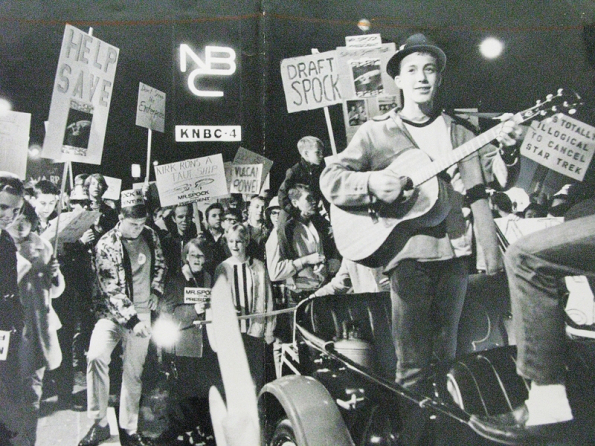
Star Trek anti-cancellation protest in front of KNBC 4 Los Angeles in 1968. Photo by Harry Chase, Los Angeles Times, used under fair use.
1969 was the year when Star Trek was finally cancelled after three seasons of low ratings on NBC. But it was also the year that dedicated science fiction fans had realized the importance of their viewership in the era of television, due to the fan campaign which kept the series on the air for one more season. Thus, the Star Trek fan groups around the US began to help in organizing various science fiction conventions, with a growth in “Trekkie” attendees and various personnel from the series being in high demand at these conventions. This was the start of an unprecedented period in fandom history, with fans deriving from a larger number of media outlets and franchises than ever before. This trend would continue into the 1980s, buoyed by the impact of 1977’s Star Wars.Throughout the history of SF fandom, the seeming “lifeblood” of the culture has been the literary publication industries, as writers for science fiction or superhero works were the usual guests and vendors at the few SF conventions which existed between 1936-1969, and many future writers, such as Isaac Asimov, often got their start as fandom organizers. Costumes based upon franchise characters (film, comic book/novel/short story, TV) were worn by regular attendees at such conventions from the first SF conventions in the 1930s onward (Flynn).
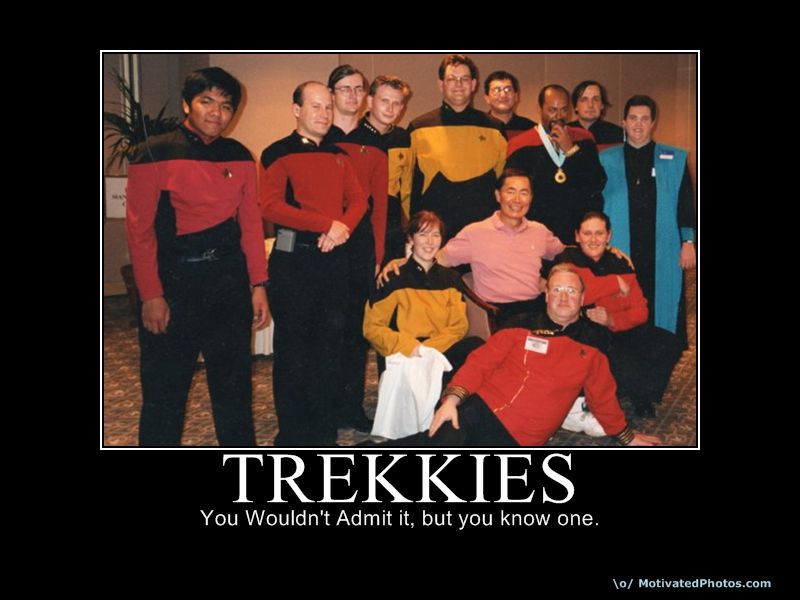
The growth of science fiction conventions from 1969 onward, however, is most likely due to the growth of another meta-fandom: the media fandom. As Star Trek’s cancellation had served as a catalyst for fascinated viewers in the United States and elsewhere to court the cast and crew of the series in anticipation of news on upcoming releases and events in the Star Trek canon, the science fiction fandom was infused with far larger numbers of convention attendees than in the last 40 years of science fiction history. Cast and crew of television serials were invited to a geographically- and demographically-growing circuit of conventions, and convention goers dressed up in television and film character costumes to celebrate the appeal of the series. This signified a growing split in focus between the fans of the older literarily-oriented concept-driven science fiction (which had predominately constituted the bulk of the fandom until the 1970s) and fans of visual character-driven science fiction. This spilled over into the establishment of the first franchise-specific media fandom conventions in the 1970s for fans of Star Trek, Doctor Who, The Man from U.N.C.L.E., and other franchises.
George Takei, who played Hikaru Sulu in Star Trek: The Original Series, with fans in full costume.
This also signified the beginning of the corporate interaction to fandom conventions, whereby the distributors of franchises interfaced with the fandoms through the cast and crew who manned franchise booths and panels for autographs and memorabilia. However, as shown with the litigation exercises of George Lucas concerning both fan tribute and commercial appropriation from the watershed Star Wars film series, corporations began to fire the first salvos in the war on infringement of intellectual property, one which notably involved fans who wrote non-canon depictions of Star Wars characters, often in pornographic situations (this phenomenon was not new, as the first fan-fictitious work in fandom history was published in 1967 in the fanzine Spockanalia, and the first homoerotic fanfic to depict the two leading characters of Star Trek in a close relationship was published in 1974, leading to what became known as “Kirk/Spock”). This campaign was further magnified by the rise in popularity of home recording cartridges after 1977, which enabled budding videographers to film their own fan tributes to the franchise for convention exhibition.
The 1980s saw further hints toward diversification that would be entrenched in the 1990s. Roleplaying became a serious pursuit – he RP and video game fan communities partly drew from already-existing wargaming conventions as well as SF – , Japanese animation was increasingly shown to be a highly-developed industry showcasing a wide range of topic and emotion that was sorely lacking in the West, and funny animals, those characters of semi-animal semi-human constitution who were exhibited in animated works throughout the entire history of animation, were extended to become more serious and diverse in emotion and topic than ever previously. All three emerged from the general speculative fiction fandom community with their own conventions and their own fandom subcultures.
Furry fandom
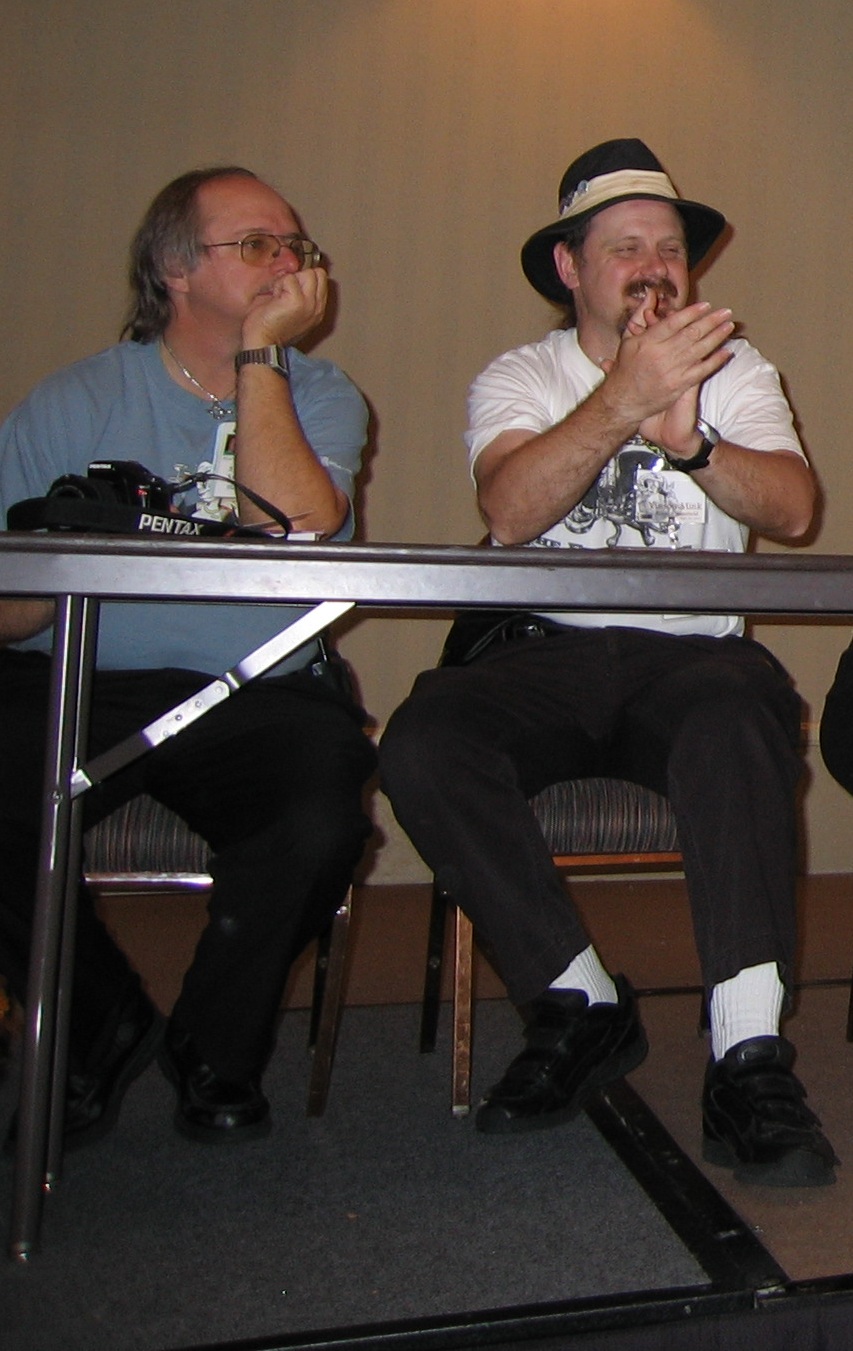
Mark Merlino and Rod O’Riley, co-founders of ConFurence. Photo by RainRat.
The funny animal fandom, in its transition into the furry fandom, showed several distinctive features. Prior to the introduction of funny animals into serious works of speculative fiction, funny animals were primarily used as a stock trope in various, usually humorous works of fiction for television, film and printed works.
Through the usage of original anthropomorphic characters in serious works of speculative fiction and romance fiction, the humorous or light-hearted stereotype of anthropomorphic characters in fiction was forced to share room with topically and emotionally diverse subject matter. However, at the same time, this newer revision of the anthropomorphic character was not welcomed or expressly promulgated by most multimedia vendors in their own lagging offerings of anthropomorphic characters in film, television and comic books. Thus, the primary couriers of the serious anthropomorphic characters were independent, often amateur graphic artists and writers who self-published or placed their works in the fledgling amateur press associations (APAs) and fanzines of the late 1970s and 1980s (Merlino); unlike the general SF fandom, the products of this movement were far from SF’s major franchise characters (save for rare occasions, when Teenage Mutant Ninja Turtles, originally independently-published, became one of the rare serious anthropomorphic titles to become self-sustaining for its artists), and artists within what became the furry fandom generally drew their own or others’ original characters.
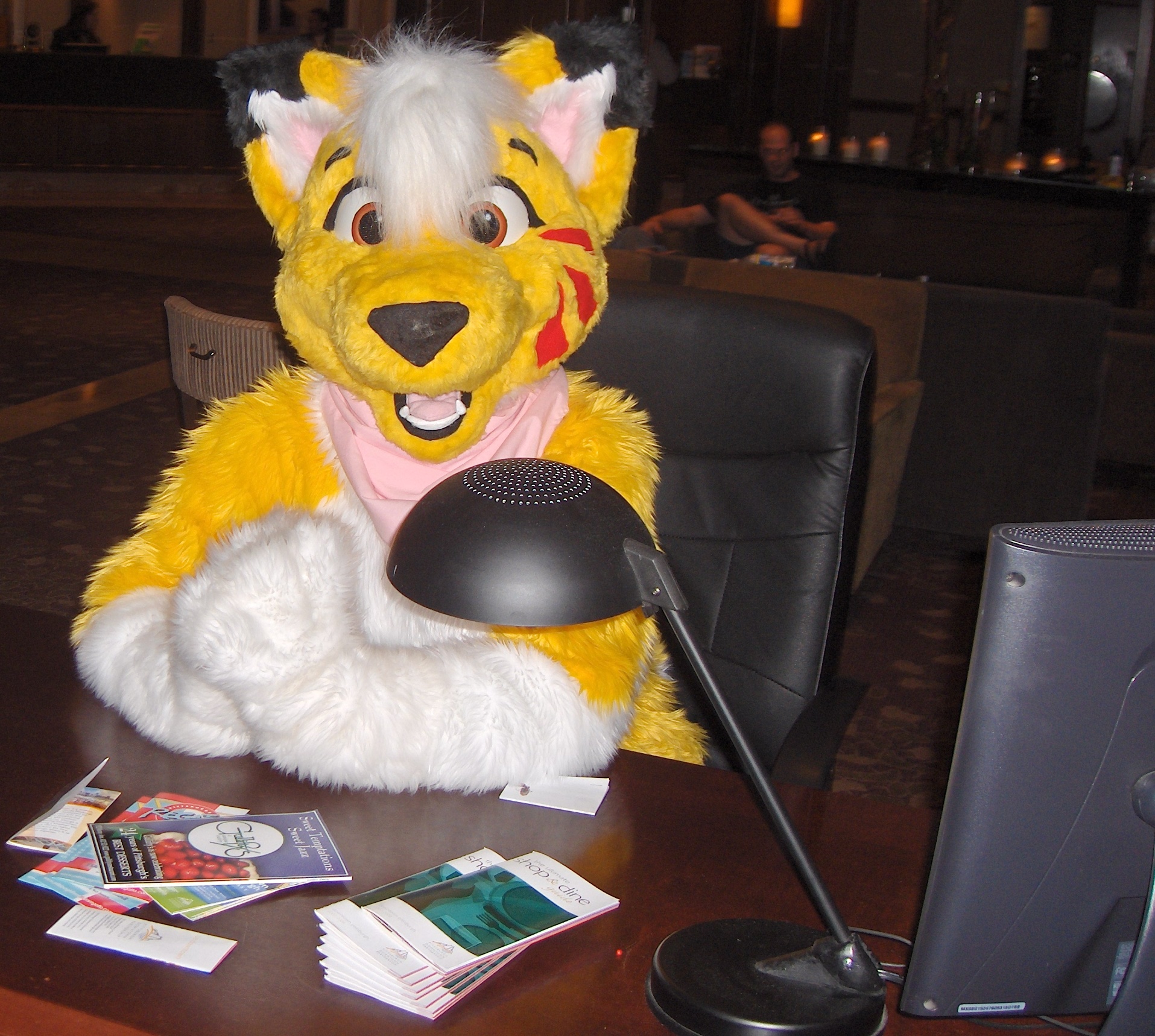
“Lucky Coyote” acting as concierge at Anthrocon 2006, Philadelphia. Photo by GreenReaper.
This trend toward focusing upon original characters of one’s own making or the rendering of others within the fandom rather than the characters of major practice of costuming (or “fursuiting”), a practice which increased with the advent of the first furry parties in Southern California in 1985-1986 (themselves initially resulting from overlap between the APA groups’ gatherings and SoCal’s animation-focused Cartoon/Fantasy Organization). Having its roots in the common SF fandom practice of wearing costumes based upon specific characters from popular franchises, fursuiting mostly diverged from the SF tradition by not only focusing upon original characters of one’s own making but also creating a cottage industry of fursuit manufacturing within the fandom that is, to this day, rivaled in focus by the larger costume industry which creates franchise-based outfits for fans.
Following the advent of the first furry convention, ConFurence, in 1989, the rise in usage of the Internet was reflected in the fandom by the establishment of FurryMUCK in 1990 and The Lion King Fan-Art Archive in 1996, both of which served as persistent routes of furry fandom information and media distribution. The growing number of furry properties on the Internet rapidly replaced the importance of the BBSes (which had all but dissipated from general usage in the world by the mid-1990s), APAs and fanzines, and more conventions and “furmeets” were established every year afterward around the world.
Comparison
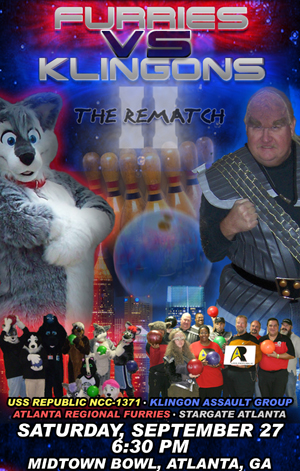
Furries vs. Klingons II. Atlanta Georgia. 2008. Poster by USS Republic NCC-1371.
Due to their shared roots, furry and speculative fiction fandoms share many outstanding qualities.
For instance, a strong identification with alternate reality pervades both fandoms. Masquerades using the characters with whom the wearers most identify are a pillar of the fandom, and have been since the first SF conventions in late 1930s Philadelphia.
The furry fandom, a subset of which is known as the transformation fiction fandom, has received a large number of writers who are or were previously science fiction fans. This has allowed for a cross-pollination of concepts and ideas into the literary aspects of the furry fandom.
Social consciousness or progression has often played a role in the lives of many acolytes of both traditions, evidenced by charitable donations of proceeds from many conventions to initiatives such as ecological/animal welfare groups, human health and social services, etc. Social consciousness often drove authors in the SF tradition to explore the possibilities of human advancement in an industrialized or utopian world order, while many furry fans often entertained the fantasy of physical shapeshifting in both graphical and literary formats of publication.
Congressional events in both fandoms were historically not catered towards by large corporations for most of their early histories, and were initially driven by personally-shared interest in publications by major vendors of fiction or fiction-oriented media at the time. In fact, fandom communities are largely a “labor of love” for their organizers and participants, being inherently driven by fan appropriation and celebration of the impact of relevant media to their own self-perceptions and worldviews.
Contrast
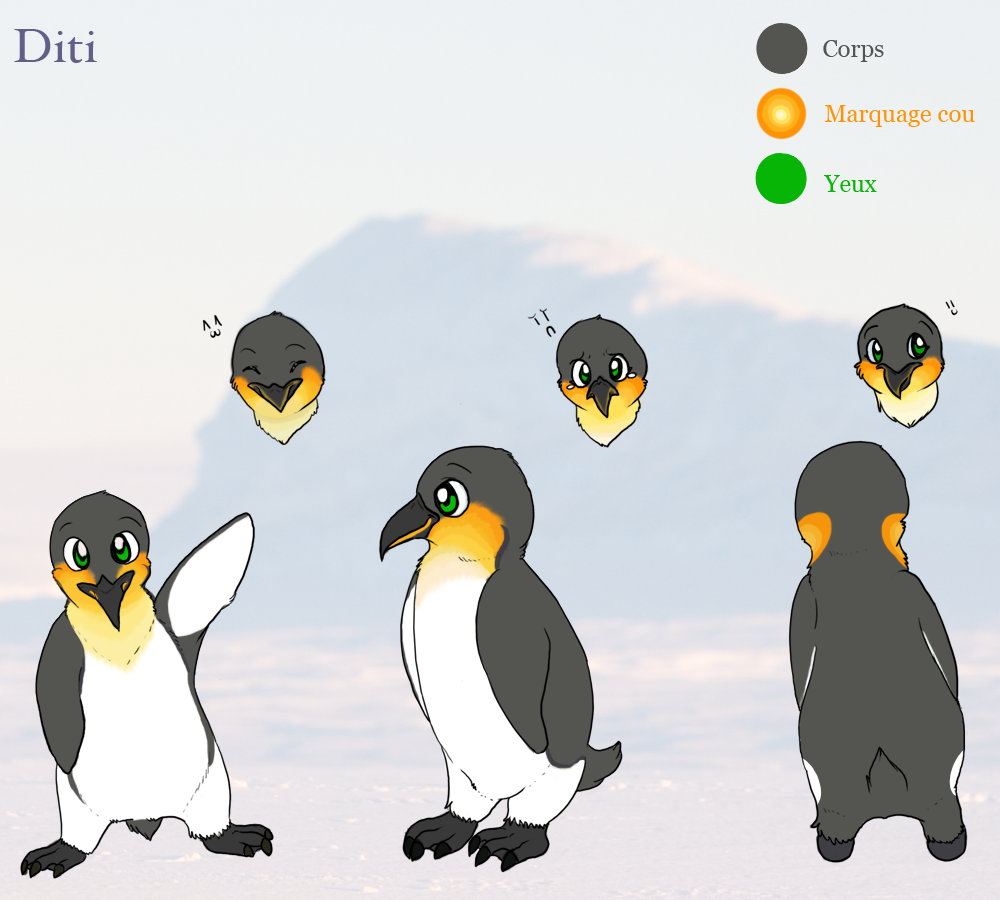
An example of a “fursona reference sheet”, used to artistically describe the personal alter-ego or other character of the furry fan. This reference sheet depicts Demitri “Diti” Torterat‘s penguin fursona as drawn by Luna Tsukario.
Furry fandom is oriented differently than speculative fiction fandom or media fandom:
Unlike the SF fandom, which largely drew from literary sources and historically was driven by genre writers, the furry fandom largely derived from graphic expressions in both still and animated form.
Furry fandom is largely concerned with body phenotypes and graphic depictions thereof, while SF fandom is largely concerned with the settings in which the fiction takes place and the associated concepts which are employed. Media fandom, by contrast to both, is more enamored of character development and relationships.
Furries adopt fursonas, or furry alter-egos, which usually exist outside of franchises (save for rare occasions when the depiction of the fursona is derived in style from another franchise which was not originally marketed as “furry”).
Furry fandom is external to genre restrictions and furry fiction can employ any genre or setting under the sun, including SF.
Furries are more likely to integrate or interpret their fursonas as expressions of their inner selves, or aspects thereof. SF fans are more likely to embrace the character of whose visage they may masquerade for the ideals and role which are most associated with the character in the franchise.
Corporations or large studios are largely a non-presence within the furry fandom:
The SF fandom has largely been focused upon corporately-funded franchises since the 1970s due to the rise in media fan attendance at the largest conventions. In contrast, furries were largely drawn to franchises’ graphic anthropomorphic media before happening upon the Internet’s furry artwork, which is usually not fan derivations of franchise characters.
Corporations have largely remained ignorant of the furry fandom, and artists within the employ of large media companies usually only come to furry conventions at their own expence, usually in retirement (in addition, furries are not a target market or audience in the 2010s by any means for major corporate disseminators of fiction). In contrast, SF fandom draws top-dollar guests such as franchise writers, artists, actors, directors and series creators, and corporations often court fan gatherings for advance teasers.
It is rare to see two or more fursuits of the same character, while it is common for multiple cosplayers to depict the same character or franchise at SF, media and anime conventions.
SF fans have historically achieved greater ascendancy since the 1960s and 1970s, as fans who happened to be writers (Asimov, for example) were hired to write for major franchises or their works were adapted to film, television, etc. Furries have not yet achieved anywhere near that ascendancy within media establishments at this point.
Fandom relations with corporations
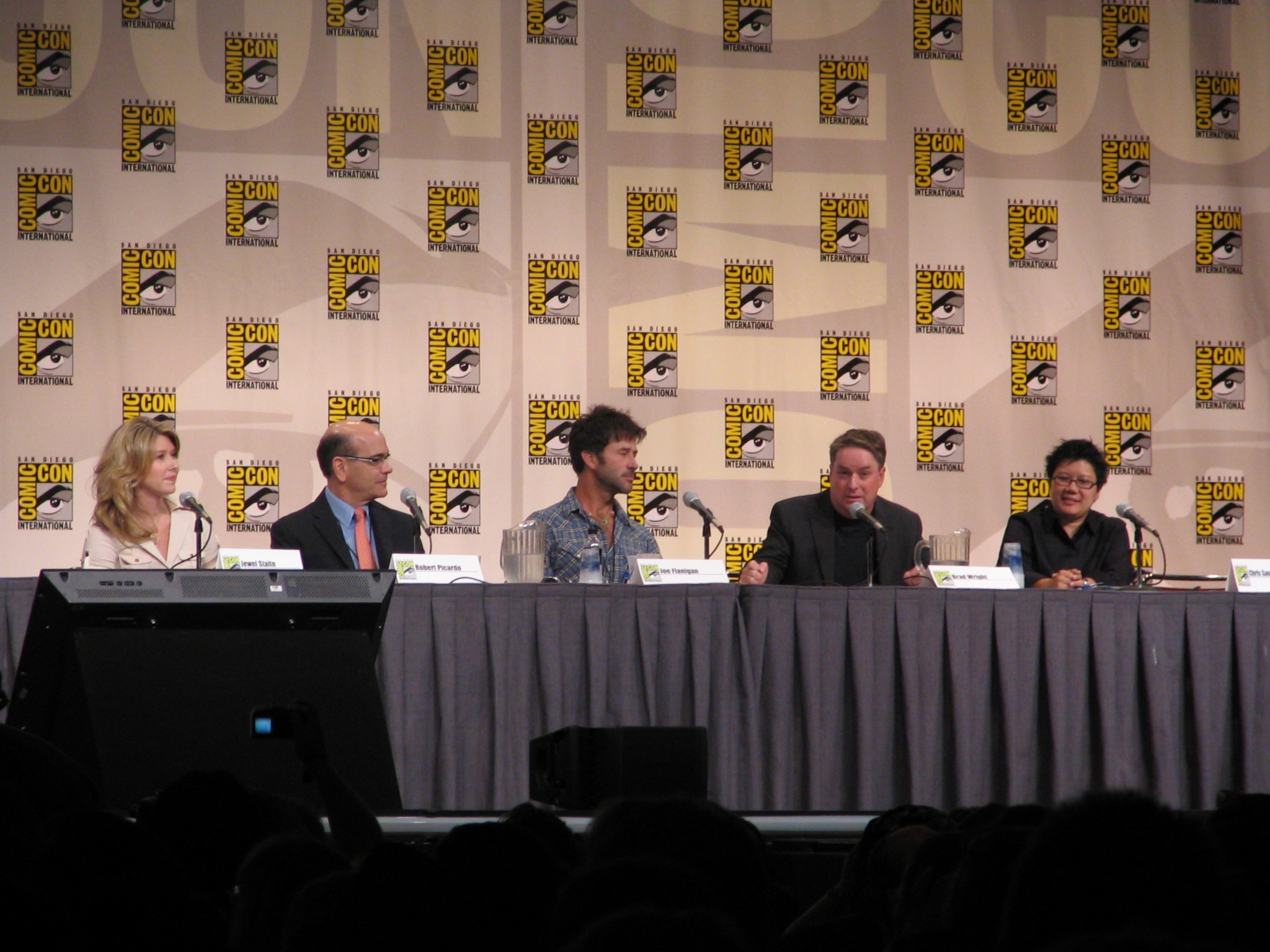
Cast and crew members of Stargate Atlantis at San Diego Comic-Con International 2008 panel discussion. Photo by Heath White.
The relationship between the furry fandom, media franchises and the corporate media outlets which maintain those franchises is awkward and fraught with conflicting understandings. While the furry fandom was initially brought together by graphic artists who were inspired by corporate media franchises of graphical depictions of anthropomorphic characters (and archives of fan works inspired by the franchises remain a so-called “gateway” to the fandom on the Internet), the furry fandom has had a distantly-receptive, one-way relationship with corporate media franchises which has not been reciprocated with similarly-positive feedback.
Any reference by a “non-furry” corporately-owned media outlet to anthropomorphic characters is welcomed and appropriated by the furry fandom’s members, and any reference to the furry fandom in particular is readily documented and reviewed by self-described furries. However, because of the tendency for furries to adopt fursonas, the depiction of fursonas or original characters by various artists tends to outweigh the number of specific homages or appropriations of corporately-owned characters on large galleries such as Fur Affinity.
At the same time, corporations which hold the licenses to the media franchises have responded variably to the furry fandom. Even in 2010, the furry fandom is a new and strange development for many employees of the corporations, and a heavy public stigma which is associated with the fandom due to many past corporate media depictions of furries and furry events (including the 2003 CSI: Crime Science Investigation episode “Fur and Loathing”) may deter corporations from expressly appealing to this niche for the foreseeable future.
In comparison, the media fandom that spilled out of the science fiction fandom after 1969 and inherited most of its customs has gradually cultivated a closer relationship with corporations that sees conventions being broadcast on cable television, endorsed by media franchise owners, cast and crew visiting as panelists and booth operators, etc. Corporations and individual rights holders have varied in their stances on fan derivations of their works in recent years, with many allowing for fan fiction and others taking a somewhat hostile stance against it; those who have warmed to fan fiction adaptations and derivations include some individuals who started their writing careers in the fanfiction scene. This is a far cry from the 1980s, when most copyright owners took hostile, litigious stances against the fanfiction phenomena for the sake of keeping a strong hold on the intellectual property or family-friendliness of their series or franchises.
Conclusion
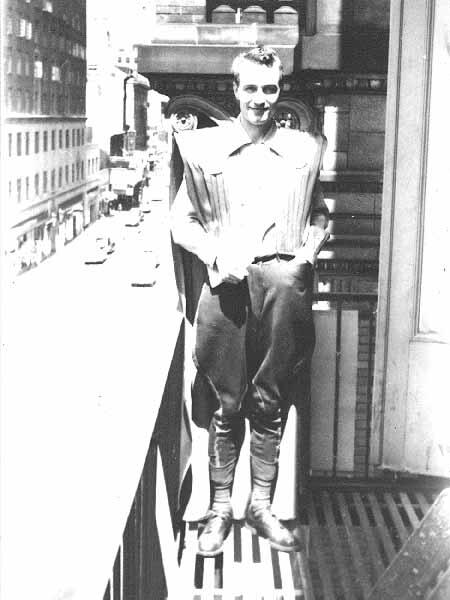
Forrest J. Ackerman in a futuristic costume at Worldcon 1939, perhaps the first costume in fandom history, New York City. Photo c/o Robert Madle/Fanac History Project.
What can certainly be ascertained is that the furry fandom was one of many types of fandom subcultures which developed in the 20th century, one which was influenced by other fandoms and originating from the science fiction fandom. What can also be ascertained is that each fandom – genre-centric, chararacter/relationship-centric, species-centric, origin-centric – is an example of individuals who discovered that there were other people in the world or in their own local proximities who were just as interested in sifting the sensually-pleasing, the intellectually-intensive, the culturally-relevant or other personally-”important” elements from the mass media works of present and past, and celebrating them and their own adaptations.
They are spurred onward by actualities and possibilities which result from such elements and adaptations, and they are far from being immune to corporate co-option or interaction, but they readily exhibit examples of popular or “folk” appropriation of original source material (Jenkins). The canon material is used as a source of “scripting” which details expectations, behaviors and descriptions of real-life situations, with at least a few attempts at establishing new religious movements as outgrowths of fandom communities.
The fandom phenomenon that was first cultivated from the science fiction literary societies of the 1920s and 1930s was transformed by television and its adaptation of text into moving visuals, with media fandom gradually taking precedence in fandom subcultural activities from the 1970s onward. This option by so many to co-opt and derive cultural works from film and television has indelibly redefined the developed world’s perception of popular fiction. It has also influenced the licensing of fictional characters or settings for commercial promotions, as fans will usually be among the first to express vocal disappointment in any corporate deviation from the letter or spirit of the canon material. It is not yet a system of creative checks and balances, but fans of media franchises and the owners of distribution rights over such franchises do often communicate, coalesce or come into open conflict with each other on a frequent basis.
Fandom subcultures will continue to diverge into newer methods of folk interpretation and appropriation of canon for the foreseeable future. The furry fandom, which is young in comparison to the media and literary speculative fiction fandoms, may yet gain economic ascendancy whereby participants in the fandom may be later employed in the larger animation or video game studios for production purposes, or it may develop in an altogether-different manner than the other two fandoms, but it does symbolize a further, somewhat divergent extreme in how those of us who are primarily consumers of fiction media are often motivated to appropriate from past trends or established canon to provide sensory, intellectual or cultural gain.
Jenkins, Henry. “The Poachers and the Stormtroopers: Cultural Convergence in the Digital Age”. Massachusetts Institute of Technology. 27 July 2010. Web. 8 Dec. 2010.
Flynn, John L. “Costume Fandom: All Dressed Up with Some Place to Go!” Towson University. 1986-2001. Web.
Chase, Harry. “Star Trek Cancellation Protest.” Los Angeles Times. 8 Jan. 1968. Web. 8 Dec. 2010.
USS Republic NCC-1371. Web. 8 Dec. 2010.
Burka, Lauren P. “The MUDline.” The MUDdex. 1995. Web. 8 Dec. 2010.
Darlington, Steve. “A History of Role-playing.” Places to Go, People to Be. Web. 8 Dec. 2010.
“The Force Is With…Everyone”. Beliefnet. 2002. Web.
Merlino, Mark. “Re: A few questions for fandom research.” Email to the author. 2 Dec. 2010.