Category Archives: Uncategorized

On the bill to de-certify the Florida Democratic Party

So, there’s a bill in the Florida rubber-stamp legislature, SB 1245, which would decertify any party that previously endorsed slavery. It was filed, obviously, by State Senator and former Florida Republican Party chair Blaise Ingoglia in response to liberal campaigns against Confederate statues. 

In such a situation, what would be the options for liberals who live in such a state which decertifies an entire political party?

  • The judicial route:
    • They could sue on 1st Amendment freedom of speech, freedom of association, and anti-ex-post-facto grounds. 
    • They could sue on the grounds that the law, as currently written, is too nebulous to be enforceable. 
  • They could establish a new political party under another name, as the bill suggests. Plenty of bureaucratic headache if that were to take place. 

The bill is poorly written, IMO. I mean, define this: “if the party’s platform has previously advocated for, or been in support of, slavery or involuntary servitude.”

A more serious (but still ill-fated) attempt would have the following:

  • specify the dates when these platforms were published
  • Be limited to Florida’s jurisdiction
  • Provide the details for how an offending party *corporately* endorsed these platforms (not just individual candidates for office under that party’s brand)

It’s also telling that the bill only extends to “slavery or involuntary servitude”. It does not mention, for example, the violent voter suppression campaign (also known as “Redemption”) to drive Reconstruction-era Republicans from office and cement one-party rule. It does not mention the poll taxes passed by said party, nor the intense apartheid restrictions placed upon the daily lives of Black residents by said party. All of the above would apply to the Democratic Party, of course, but why does slavery alone receive this mention in the bill?

It also begs the question of whether state governments have the power to regulate the names of political parties. California came close to attempting to regulate whether parties can use the name “independent” before Gov. Newsom vetoed said bill in October 2019, arguing that it was unconstitutional. If he had signed the bill, the far-right American Independent Party of California could have sued in federal court on aforementioned 1st Amendment grounds, and would likely have won. Furthermore, as noted by Richard Winger of Ballot Access News, “The bill violates the First Amendment. Communist Party of Indiana v Whitcomb, a unanimous decision from the US Supreme Court in 1974, said states can’t keep parties off the ballot based on the ideas of those parties. So even if the Democratic Party still supported slavery, the bill would be struck down if it passed.”

To play devil’s advocate, there may be at least one back-door way for state governments to regulate or influence party names in a way that avoids constitutional scrutiny regarding speech and viewpoint discrimination. 

  • They could force annual recertification of political parties and repeatedly delay recertification without an official explanation, or even declare a sort of “at-will” decertification of political parties. 
  • They could also publicly distribute a set of officially-unenforceable “best practices” for party names which would pressure political parties to conform. 
  • Republicans could repeatedly jack up the filing fee, petition and party registration threshold by county (or worse) to block new parties from certification

OTOH, if the Federalist Society would rather overturn the Communist Party of Indiana case in order to strangle the First Amendment and support regional one-party rule, Republicans could use this newfound power to add further proscriptions against new political parties, such as “no party shall exist which holds views contrary to state law as written at this date”. They could also expand the definition of “slavery” to include anything that social conservatives hate and demonize, such as welfare and abortion (and they repeatedly “Godwin” themselves with this as it is). 

In a time when social conservatives are dumping their alliance with right-wing libertarians and their sensibilities in the name of power and control, liberal minorities in red states must be prepared for how far their state governments will go to undermine their ability to politically organize. 
Animation at the GLAAD Media Awards

Admittedly, animated works have had a short run in the shortlists of the GLAAD Media Awards, which nominate works of notable relevance to the LGBT community. Milestones:

  • 2018 seems to be the year when GLAAD began to broaden nominations to more age groups and media, creating a category for Kids and Family Programming.
  • 2021 saw the introduction of Outstanding Children’s Programming (for younger children)
  • 2023 is the first with an animated category, albeit for Kids and Family Programming

I wouldn’t be surprised if GLAAD follows the NAACP Image Awards in creating an animated category for Outstanding Film at some point.

2013

Outstanding Film – Wide Release

  • ParaNorman

2017

Outstanding Comedy Series

  • Steven Universe

2018

Outstanding Kids and Family Programming

  • The Loud House
  • Steven Universe
  • Danger & Eggs
  • Doc McStuffins

2019

Outstanding Kids & Family Programming

  • Adventure Time (Cartoon Network)
  • She-Ra (Netflix)
  • Steven Universe (Cartoon Network)

2020

Outstanding Kids and Family Programming

  • The Bravest Knight (Hulu)
  • The Loud House (Nickelodeon)
  • “Mr. Ratburn and the Special Someone” – Arthur (PBS)
  • Rocko’s Modern Life: Static Cling (Netflix)
  • She-Ra and the Princesses of Power (Netflix)
  • Steven Universe: The Movie (Cartoon Network)
  • “A Tale of Two Nellas” – Nella the Princess Knight (Nick Jr.)
  • Twelve Forever (Netflix)

2021

Outstanding Children’s Programming

  • “Challenge of the Senior Junior Woodchucks!” – DuckTales (Disney XD)
  • “Dogbot” – Clifford the Big Red Dog (PBS)
  • “Nancy Plays Dress Up” – Fancy Nancy (Disney Junior)
  • Summer Camp Island (HBO Max)

Outstanding Kids and Family Programming

  • She-Ra and the Princesses of Power (DreamWorks Animation/Netflix)
  • Craig of the Creek (Cartoon Network)
  • Kipo and the Age of Wonderbeasts (Dreamworks Animation/Netflix)
  • The Loud House (Nickelodeon)
  • “Obsidian” – Adventure Time: Distant Lands (HBO Max)
  • The Owl House (Disney Channel)
  • Steven Universe (Cartoon Network)

Special Recognition

  • Out (Pixar/Disney+)

2022

Outstanding Children’s Programming 

  • “Family Day” – Sesame Street (HBO Max)
  • “Berry Bounty Banquet – Part 2” – Strawberry Shortcake: Berry in the Big City (WildBrain Studios/YouTube Kids)
  • City of Ghosts (Netflix)
  • “Gonzo-rella” – Muppet Babies (Disney Junior)
  • “Joie de Jonathan” – Fancy Nancy (Disney Junior)
  • Ridley Jones (Netflix)
  • Rugrats (Paramount+)
  • Summer Camp Island (Cartoon Network/HBO Max)
  • We The People (Netflix)
  • “Whatever Floats Your Float” – Madagascar: A Little Wild (Hulu/Peacock)

Outstanding Film – Wide Release

  • The Mitchells vs. the Machines (Netflix)

Outstanding Documentary

  • Flee

Outstanding Kids and Family Programming

  • Power Rangers Dino Fury (Nickelodeon/Netflix)
  • Amphibia (Disney Channel)
  • Centaurworld (Netflix)
  • The Loud House (Nickelodeon)
  • The Owl House (Disney Channel)

2023

Outstanding Film – Wide Release

  • “Lightyear” (Pixar)
  • “Strange World” (Walt Disney Studios Motion Pictures)

Outstanding Film – Limited Release

  • “Wendell & Wild” (Netflix)

Outstanding Comedy Series

  • “Harley Quinn” (HBO Max)

Outstanding Kids & Family Programming — Animated

  • “Amphibia” (Disney Channel)
  • “Battle Kitty” (Netflix)
  • “Big Nate” (Nickelodeon)
  • “Craig of the Creek” (Cartoon Network)
  • “Dead End: Paranormal Park” (Netflix)
  • “The Dragon Prince” (Netflix)
  • “Jurassic World: Camp Cretaceous” (Netflix)
  • “The Owl House” (Disney Channel)
  • “The Proud Family: Louder and Prouder” (Disney+)
  • Trick or Treat Scooby-Doo! (Cartoon Network)

Outstanding Children’s Program

  • “Adoptasaurus Rex,” “Dino Ranch” (Disney Junior)
  • “Firebuds” (Disney Junior)
  • “The Mint Gala,” “Strawberry Shortcake: Berry in the Big City” (Netflix)
  • “Pinecone & Pony” (Apple TV+)

Works which should have been nominated

SciTech Links I’ve Read Over the Last 3 Months

The “Least” Offensive Ways by Which the Abrahamic Fanatics Carve Out Exceptions on LGBT Rights

Abolishing Marriage Licenses

On August 29, 2019, over four years after the landmark Scotus ruling in Obergefell v. Hodges, Alabama followed through on a lingering threat to abolish marriage licenses. The resulting law is…..interesting, to say the least.

Under the new law, county probate judges are now required to record marriage certificates but are no longer required to issue licenses. Couples are no longer required to apply for a license, and only need to complete and send a marriage certificate to a probate judge, who is required to declare the marriage valid. A ceremony may be held for the wedding, but solemnization is no longer required for a recognized marriage in Alabama.

Coincidentally, this method is similar to how marriage is done in Australia. Over there, marriage licenses do not exist, and are instead carried out in the following manner:

  1. the couple notifies a certified celebrant one month in advance
  2. the couple meets the celebrant in person with at least two witnesses over the age of 18 present
  3. the celebrant recites the required words to solemnize the marriage
  4. the couple signs the certificate in front of the celebrant and witnesses
  5. the celebrant sends the marriage certificate to that state’s Registrar of Births, Deaths and Marriages, who registers the marriage as valid.

The Alabama system seemingly discards the need for a celebrant of any type. It’s as close as Alabama might get to common-law marriage. Unironically, this makes sense, even with the Respect for Marriage Act codifying Loving v. Virginia and Windsor v. United States into law. Now, on the other hand….

The “Utah Compromise”

I still think about how Utah’s SB 296 from 2015 has been hailed since as the “Utah Compromise” on LGBT rights. It was written to protect against discrimination in housing and employment for LGBT people. And now SCOTUS may further gut anti-discrimination laws in order to force this compromise on those states which have more comprehensive civil rights laws in place.

Only Indiana and Arkansas went so far as to pass their bills into law (Georgia and Arizona’s were both vetoed by Republican governors), and both did so without an LGBT nondiscrimination bill being considered by their Republican majorities.

The RFRA moment reached its crescendo in state legislatures in 2015-16 in the run-up to and aftermath of Obergefell v. Hodges, after which the religious right shifted its war-making in the direction of targeting public accommodations for transgender people.

What if this outgoing Congress had passed the Fairness for All Act, which adds the broad religious exemptions to LGBT rights protections sought by the LDS church? The ACLU criticized the bill in 2019 due to its singling-out of sexual orientation and gender identity for religious exemptions, its attempted undermining of then-ongoing court cases, and its undermining of child welfare protections.

I’m trying to find an example of a federal bill which would have advanced broad religious exemptions to all existing civil rights law, something like what Indiana’s SB 101 did. I’ve seen federal bills attempting to expand RFRA to vaccines and vaccine mandates during the height of the pandemic, but not yet something that would expand federal RFRA into a sledgehammer against all other federal civil rights law.

That’s the problem, IMO, with the Fairness for All Act being framed as a federal analogue to Utah SB 296. It specifically targets SOGI for exemptions, like bills filed during the pandemic by Ron Estes or Marco Rubio targeted vaccines, when the GOP could have gone whole-hog and targeted all civil rights law like Indiana SB 101 did. Meanwhile, Utah SB 296 only protected against discrimination in housing and employment, said nothing about SOGI in public accommodations, and was built into Utah’s extremely-broad religious exemptions for state civil rights law (even on race and color).

SCOTUS, these days, seems interested in carving out such exemptions on SOGI. The question is how far are they willing to wreck the Civil Rights Act(s) and Americans with Disabilities Act in the process.

Idea: Federal Recognition for “Traditional Peoples and Communities”

Several communities have campaigned for decades for federal recognition as indigenous tribes. Besides the 571 federally-recognized tribes, 62 others are recognized at the state level across 16 states, while several in the Midwest and Appalachian areas lack any state recognition but have several unrecognized communities which are seek some sort of government recognition. Some of the largest groups locked out from federal recognition as tribes are the Lumbee people of North Carolina, the United Houma Nation of Louisiana, the Echota Cherokee Tribe of Alabama, and the Chinook Indian Nation of Washington.

But then there are other communities which do not consider themselves as Native American but may either have some level of indigeneity to their homelands or are currently organized around distinct economic and cultural activities largely separate from their neighbors in the prevailing culture. This includes the Native Hawaiians, but on a broader level includes the Gullah-Geechee of South Carolina and Georgia, the Romani people, the Melungeons of the Appalachians, the Freedmen communities in Oklahoma, and more.

In Brazil, the federal government since 2007 uses the designation “traditional populations/communities/peoples” to describe a broader number of communities than just federally-recognized indigenous peoples. This term includes the quilombolas, or residents of historic maroon communities in the interior of Brazil, among several others.

Canada’s federal government largely uses the term “indigenous peoples” when describing “First Nations”, “Inuit” and ‘Metis” altogether, but each group is legally distinct from each other.

I argue that the U.S. federal government should create a second tier of federal recognition of peoples through the Department of the Interior, one with a broader definition and looser criteria for federal recognition than those for federally-recognized tribes. My idea is that these communities which fall under this broader umbrella would:

  • include state-recognized tribes, unrecognized tribes, indigenous communities distinct from Native Americans, and ethnic groups which maintain distinct folkways.
  • form public-private partnerships with the federal government in which the federal government plays an advisory and assistive role (similar to the recently-formalized National Heritage Areas)
  • are not entitled to the level of sovereignty accorded to Indian tribes
  • would not be entitled to exclusive land claims
  • may only be designated by an executive order, an Act of Congress, a federal judicial decision, a administrative decision or an application by a state government which recognizes that group under state law

This would go a long way to accommodating several of these communities in this country. They would also bring more tourism opportunities in the areas where they live, as well as allow for more opportunities for ecological and historical preservation.

And at the very least, state governments should lead the way, away from “state-recognized tribes” to “state-recognized traditional peoples and communities”.

Some thoughts on Afro-Brazilian religion, syncretism and feminism

I watch videos of Umbanda ceremonies and read about how Umbanda arose out of a fusion of the black working-class’s practice of Candomble with the 19th century white middle/upper-class practice of spiritualism and spiritism. What has arisen over the last century . It discards the animal sacrifices, ritual Yoruba language (in favor of Portuguese vernacular), alcohol and tobacco use, and sometimes even the colorful necklaces and ritual dress.

What largely brings these Afro-American religions together in Brazil:

  • the resistance to slavery and racism,
  • the use of African-derived music and instruments
  • veneration for African deities such as the Orishas (and sometimes for Indigenous spirits)
  • the terreiros

I’m also interested in how Afro-Brazilian religion approaches LGBT participation and representation. While Candomble is by far better at welcoming LGBT people compared to Abrahamic religions (especially the Evangelical Christianity which has seized so much control over Brazilian politics), and Umbanda can profess to be even more egalitarian on sexual and gender minorities than Candomble (including the performance of same-sex weddings and inclusive initiation rites), research does show a masculine and cisgender bias in the practice of Afro-Brazilian religion which often ticks up depending on the terreiro involved.

Which brings to mind a few things:

  • my own experience going to an Episcopal youth study group one time when relational theology and queer theology were discussed. Very informative, especially as to discussions of egalitarian, ungendered religious language.
  • The debate and conflict within Euro-American nature religions like Wicca and Asatru on the role of gender and sexuality, which has resulted in the creation of even TERF sects such as Dianic Wicca, as well as opposite, egalitarian sects such as the Feri Tradition, Radical Faeries and more

Questions:

  • What would an Afro-Brazilian religion with a relational, queer theology look like?
  • How would the endemic religious language – of “mounting” by orishas, or of fertility, or of gender – change? Or even the language introduced from Kardecist spiritism?
  • It doesn’t seem that sheer inclusion of gay men is enough in a country like Brazil, which still reels from the domestic and political impact of machismo. What of lesbians and transgender people? Will they take a role to the merging of relational and queer theology into an Afro-Brazilian religion?

I could take this further into questions about evolution, about vegetarianism, about political organizing, as well. But I’ll leave it at that.

On Ice Cubes, Mammoth and other Mastodon/Fediverse client apps

Twitter is officially killing third-party apps, including Tweetbot, Twitterific, Aviary and more, with little to no explanation beyond a change in their API terms. The Digg v4-like suicide continues.

Meanwhile, the number of Mastodon apps, including clients, is growing quite a bit. Here’s the list of publicly-available Mastodon apps for several platforms, not to mention some other beta apps like Mammoth and Ivory.

One new app, Ice Cubes, was just approved on the iOS app store on January 23. Blogger John Gruber had previously criticized the hold-up in approval.

What I’ve noticed so far, comparing Ice Cubes to the Mammoth beta and other iOS clients:

  • Ice Cubes may be the first full Mastodon app to have “quote-boosts” as a feature. It uses a workaround combining a screenshot, OP mention and link. Or at least it looks like a screenshot?
  • Like the official Mastodon app, Ice Cubes scales media to span the width of the post, including under the avatar. I’m surprised that this doesn’t seem to be an option on other apps, even those in beta like Mammoth. However, Ice Cubes does not let you scale media to the width of text (while Mammoth does not allow for the size of the image to be adjusted to screen width).
  • Like Mammoth, Ice Cubes also allows one to subscribe to remote instance feeds to show in the Home drop-down. This sets both apps apart from Mastodon official, Tooot, Tootoise and Mercury.
  • Ice Cubes shows a list of most-used post hashtags (at least 9?) under each profile bio (each linking to hashtag searches), alongside a button to open a user’s “About” in a pop-up. That’s new.
  • Opening the “Add/remove from lists” menu opens a pop-up menu for selecting multiple lists. Good, better than Mammoth’s current opening of the menu entirely within the drop-down.
  • Ice Cubes uses the “posts/post and replies/media” tabs in profiles (like Mastodon official). Mammoth places “media” in the top-right drop-down. Tooot places “media” in a sliding menu between the bio and post index, at the end of which you click a button to show more media. Interesting how media on profiles is shown between client apps.
  • Ice Cubes, like most clients, shows the CW button as a small button (and as of 1.1, places the CW drop-down button on the right while placing CW text on the left). Mastodon official shows this button as much larger and centered, with a blurb saying “tap anywhere to reveal” and a small eye icon on the right for closing the CW.
  • Ice Cubes seems to use the iOS file player when opening an uploaded video in a popup, complete with visual playback scroll. Other clients use the regular Safari media player. I can see the point with Ice Cubes’ media playback (with the easy access to the share button).
  • Ice Cubes is missing a means for editing Details and Links in one’s About page.

Those are just a few of the differences what I’ve noticed so far.

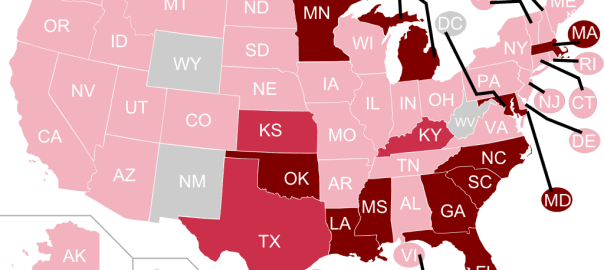
Will these four blue trifectas repeal their sodomy laws in 2023?

Maryland. Massachusetts. Michigan. Minnesota.

All four of these states start with M’s. All four have Democratic trifectas – Democrats controlling their governor’s mansions and both houses of their legislatures. And, as of 2023, all four have bans on gay sex on their books.

I can excuse Michigan and Minnesota (somewhat). Michigan only just gained a Democratic trifecta for the first time since 1983. Minnesota last had a trifecta in 2013-2014, but it was the first time they had such since 1978.

But Massachusetts and Maryland failing to repeal their bans on gay sex despite having two terms of “moderate” Republican governors and long-time Democratic supermajorities in both houses is inexcusable. Maryland had a bill in 2022 which passed almost unanimously in their House of Delegates but died in Senate committee. Massachusetts had a bill in 2022 which was renumbered, and renumbered again, before passing the Senate and then dying in a House committee.

Embarrassing. A waste.

And now a threat thanks to Clarence Thomas’ written attack on Lawrence v. Texas, which has not received any statutory backing federally since 2003 (save for when President Obama signed a repeal of a consensual gay sex ban for the military in the 2014 NDAA).

Meanwhile, trans-hating, gay-hating Alabama managed to repeal their own sodomy law in 2019 (while cleaning up their criminal code). Utah also did the same in the same year. Trans-hating, gay-hating Idaho repealed theirs last March (in response to a lawsuit).

Well, at least Michigan stands the likeliest chance to repeal theirs this year, but only because the larger law which criminalizes gay sex (Act 328 of 1931) also criminalizes abortion, blasphemy, adultery and more.

But the clock is now ticking on all four aforementioned blue trifecta states – Maryland, Massachusetts, Michigan and Minnesota – to repeal these stupid laws.

And, while I’m on it, it’s on Georgia’s Democratic legislators to show the give a shit about LGBT people by filing a bill to repeal O.C.G.A. § 16-6-2. What are you waiting for?

UPDATE: Here are the bills for this year:

  • Maryland HB0131 (SB0054)
  • Massachusetts HD.1777/SD.203
  • Michigan bills HB4006 and SB2 somehow miss the bans on sodomy, fornication, blasphemy, etc?
  • Minnesota HF 91/SF 70 (would repeal abortion restrictions and possibly several sexual offenses)

Other unrelated bills I’m watching from these legislatures:

Bills from legislatures where I’m not expecting much good:

2023 DPG Leadership Election Results + Thoughts

In full (winners in bold):

  • Chair
    • Nikema Williams (I): 206
    • Liz Williams 41
  • 1st Vice Chair (to succeed Ted Terry)
    • Dontaye Carter ?
    • Sheikh Rahman ?
    • Matthew Wilson, round 1: ?, round 2: 143
    • James Woodall, round 1: ?, round 2: 91
  • Vice Chair of Congressional Districts and County Liaison
    • Sarah Todd (I, unopposed)
  • Vice Chair of Constituency Groups (to succeed Bee Nguyen)
    • Brandon Goldberg 69
    • Vincent Olsziewski 165,
    • 2 abstentions
  • Vice Chair of Candidate Recruitment (to succeed Adrienne White)
    • Less Mayer 35,
    • Helen Willis 56,
    • Scout Smith 133
  • Secretary
    • Justin Holsomback (I, unopposed)
  • Treasurer
    • Jason Esteves (I, unopposed)
  • CD 1 Chair:
    • Jay Jones (incumbent)
    • Sabrina Newby
  • CD2 (to succeed Bobby Fuse; resulted in tie, went to runoff by Zoom)
    • Tonza Thomas
    • Willie Davis
  • CD3
    • Charles “Chuck” Enderlin Jr. (i, unopposed)
  • CD4
    • Janel Green (i, unopposed)
  • CD5 (to succeed TJ Copeland)
    • Maria Banjo (unopposed)
  • CD6
    • Melissa Clink (i, unopposed)
  • CD7
    • Cheryl Williams (i, unopposed)
  • CD8
    • Adrian Rivers (i, unopposed)
  • CD9
    • June Krise (i, unopposed)
  • CD10 (to succeed Norman Garrett)
    • Conolus Scott Jr. (unopposed)
  • CD11
    • Sheree Giardino (incumbent)
    • Eduardo “Eddie” Aviles
  • CD12
    • Christopher Johnson (incumbent)
    • Catherine Frederiksen
  • CD13:
    • Joel R. Cope (incumbent)
    • Jasmine Bowles
    • Shelia Edwards
  • CD14
    • David McLaughlin (i, unopposed)

Thoughts

I’m not a fan of this makeup. A sitting member of Congress chairing this party while flying back and forth between D.C. and Atlanta has been a problem for me. Jason Esteves is set to be a sitting member of the General Assembly. I’ve become ideologically opposed to public officials holding officer positions in the party.

I’m pleased with Scout Smith being elected to Candidate Recruitment, as well as Vinny Olsziewski for Constituency Groups.

Scout has done work over the years as Chair of the County Affairs Subcommittee, he’s from Troup County, and he’s talked plenty about what sort of outreach works in rural areas. He’s now in a firm position to lead party policy on candidate recruitment, training, support and communications. His predecessor, Adrienne White (from Gwinnett) leaves this position with a good record: the largest share of General Assembly seats contested by Democrats in two decades happened under her watch, Georgia being the only state in 2020 to see Democrats flip legislative seats and evade the red wall which emerged downballot, Georgia famously flipping both U.S. Senate seats in a rare “double-barrel” runoff, and seeing one of these Senators keep his seat in a runoff. However, the continuing failure to win any statewide executive offices under White will leave Scout with the task of building a bench for 2026 (and potentially earlier, if the method for electing PSC members is changed and delayed elections are held by 2024).

Vinny brings his experience as Chair of the DPG Disability Caucus, which I know best as the group which hosts candidate forums for party positions, to his new role. He has a lot of work to do to bring effectiveness back to this role, including building out the DPG’s relationship with its caucuses, councils and affiliate organizations. Only a few things changed for caucuses and councils since 2019:

  • the DPG’s new bylaws adopted the DNC’s preferred parlance of “council” to describe interest-based in-party groupings as opposed to the identity-based “caucus” (this was definitely pushed for by Nikema)
  • After repeated questions and pleas, Esteves finally designated a policy for caucuses and councils to fundraise, in which ActBlue pages were created for these groups, but such pages would direct donations to the DPG treasury, who would then allocate this money to the groups which received them.

Things I’d like to see from the new Constituency Groups VC:

  • Establishing a protocol for how affiliate organizations establish and maintain their relationships with state and county committees.
  • Establish whether caucuses, councils and affiliate organizations can endorse candidates in primaries
  • What sort of relationship that caucuses and councils should have with county committees.

I look forward to better development of this role.

Matthew Wilson is no longer an elected official (as of this year), so I don’t have a problem with that. It will be his first time in party leadership, and he’s the first openly-LGBT person to serve in the role of 1st Vice Chair (that I know of?). Let’s see how he does.

But now Williams will have to face a few questions:

  • What went wrong with the coordinated campaign?
  • Why do we still have Rebecca DeHart as Executive Director?
  • What went wrong with the Executive Director scouting process?
  • How did we do this poorly for all statewide executive roles?
  • Is it time for Stacey Abrams and a few others to hang it up?
  • Should Abrams’ campaign staff be blacklisted from working for any more large campaigns until they can show some competence?
  • Should we encourage state legislators to not run for state row office in 2026?
  • Should David Scott and Hank Johnson retire?

We need to nip this losing streak in the bud.

Abolitionism, Fair Housing, and Marriage Equality: A Study In Correlation

We in the United States still live with the impact of slavery and abolitionism to this day, even when it comes to LGBT rights:

Charles Boyd's avatarcharlesohalloranboyd

I recently completed a 45-page paper for my first semester as a History PhD student. In this paper, I looked at how abolitionists addressed the issue of residential segregation and what the long term impact of their efforts were in this area after the abolitionists themselves were dead. As part of my analysis, I examined a 1966 vote in the U.S. House of Representatives on whether to remove a fair housing policy from a proposed civil rights bill. I determined that there was a strong correlation between how much of an abolitionist tradition states had in the 1800s and how states’/regions’ Representatives voted on fair housing in the 1960s. For this blog post, I decided to summarize my findings on this and look at two similar correlations related to gay marriage: is there a correlation between how early a state legalized interracial marriage and whether its Senators and Representatives voted…

View original post 1,914 more words