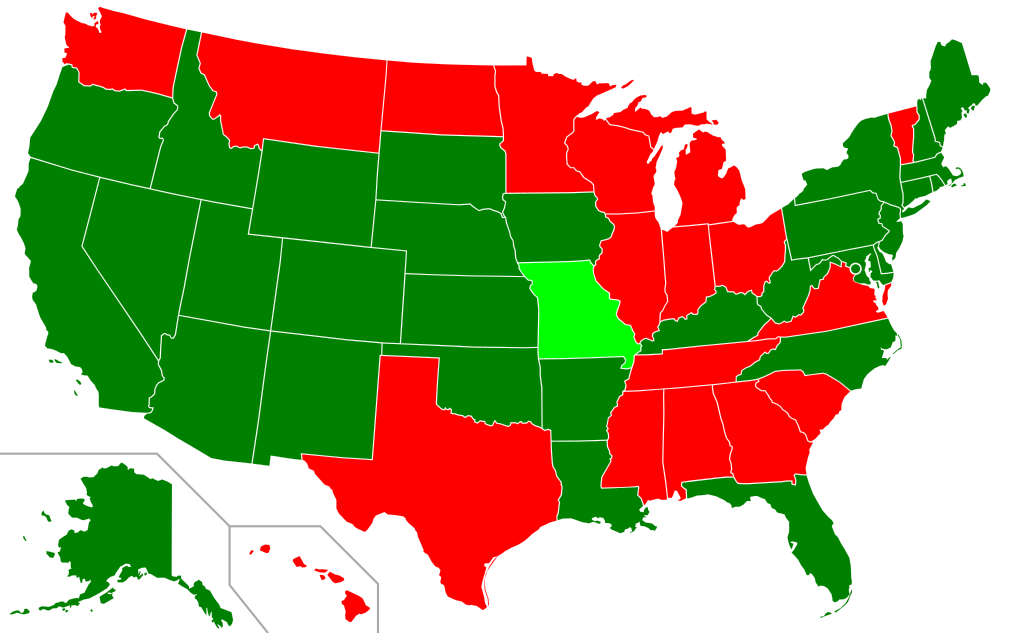
(Note: Missouri’s June 2022 voter ID law (their third attempt at such, set to go into affect in January 2023 pending litigation) requires voters to identify on their voter registration forms with a party or mark themselves as “unaffiliated”).
But I note that most Southern states, save for Arkansas, Florida, Louisiana and North Carolina, have not adopted partisan voter affiliation questions on voter registration forms. The majority of states with partisan voter affiliation (PVA) questions are largely located either west of the Mississippi or in the Northeast.
green: states with partisan voter affiliation questions, light green: set to take effect in 2023; red: states without
Save for Georgia, the other previously-mentioned states with Republican-led movements toward closed primaries are all deeply-red in terms of legislative share. The current one-party rule in these states increasingly resemble the one-party rule under the then-conservative Democratic Party in these same states. As I noted, only Tennessee, North Carolina and Virginia had uninterrupted instances of Republican legislative representation in both houses (much of it paltry) during the days of Jim Crow. But, unlike most other U.S. states outside of the South, most Southern states did not introduce PVA questions during that same era, and instead suppressed Republican and non-white suffrage through other, more notorious means (including the county unit system in Georgia up to 1963 and its state house-based equivalent in Mississippi up until 2021).
Appendix A in this 1985 study on party enrollment and identification shows that, sometime after publication of this study, Alaska (sometime prior to 1995), Arkansas (sometime prior to 2002), Idaho, and Utah all adopted PVA questions on their voter registration forms.
Without addressing the desire or need for closed primaries, the biggest question I have about the use of the PVA question is its intersection with race. Among those Southeastern states with PVA questions:
Arkansas, despite being a slave state prior to emancipation, has a smaller Black population (around 19%) than most other former Confederate states (save only for Texas at around 12%), and is perhaps the “whitest” state in the former Confederacy.
North Carolina, with a 22.5% Black population
Florida at 17.1%
Louisiana at 33.1%
Arkansas is the most inelastic of these four, while the other three see competitive turnovers from time to time in statewide elections. Louisiana may see competitive elections for governorships due to its jungle primary, while North Carolina and Florida see competitive elections due to their plurality elections. As of 2022, Louisiana currently gives the numeric advantage in PVA to Democrats, Florida (a closed primary state) to Republicans, and Arkansas and North Carolina both to independent/unenrolled voters.
What would Georgia’s PVA makeup look like if we had such a question on voter registration applications? Georgia has a 33% Black population (only less of a percentage than Mississippi and Louisiana), and over 80% of Black voters vote for Democrats, while over 70% of white voters regularly vote for Republicans.
And what of those who would mark “unenrolled”/”independent” on their PVA questions? How much would they constitute of Georgia’s population at this time if asked on their VR forms, and how would the unenrolled break down by race/sex/etc?
Finally, this isn’t the first time that Southern states have moved to adopt election-related ideas popular in the Northeast. Literacy tests were also adopted first in the Northeast for voter registration in the 19th century in order to suppress recent immigrants from voting, and were subsequently adopted by Southern governments to suppress African Americans from voting.
Compared to that, however, the main suppressive effect of PVA questions and closed primaries would be the exclusion of unaffiliated voters from determining party nominees. The big question is: who would be the unaffiliated?
This practice needs better documentation, and its wild that I can’t find much research on how partisan voter registration became a thing, or why it has increased among states, or why we seem to be the only country that does this. Why?
States which had continuous legislative opposition presence since statehood: Colorado, Idaho, Illinois, Indiana, Iowa, Kentucky, Maryland, Missouri, Montana, Nevada, New Mexico, North Carolina, North Dakota, Tennessee, Virginia, West Virginia, Wisconsin, Wyoming
States which had periods of no legislative opposition since statehood:
Fun fact: Georgia is one of 10 states to have had unanimous party control in either house of state legislature at least once, and one of 23 states to have had unanimous party control of a state senate at least once. Racist Democrats held all seats in the State House in 1909-1910, and all seats in the State Senate in 1883-1886, 1891-1892, 1905-1910, 1917-1920, 1923-1924, 1929-1930, and 1951-1952.
How many years without a minority caucus:
Alabama Senate: 43 years
Louisiana House: 43 years
Mississippi House: 58 years
Mississippi Senate: 71 years
South Carolina House: 58 years
South Carolina Senate: 69 years
Texas Senate: 37 years
Another political fact: Virginia, North Carolina and Tennessee are the only ex-Confederate states to have had a continuous Republican party presence in both houses of state legislature since the Civil War.
In Virginia, Democrats kept Republicans to as low as 3 House and 1 Senate seat; in North Carolina, 4 House and 1 Senate; and in Tennessee, 5 House and 2 Senate.
Just as with Georgia, the historic base of the Republican Party in these states’ legislatures has been the Appalachian region.
The Black-and-tan faction
Research by academic researchers Jeff Jenkins and Boris Heersink shows how (parts 1 and 2), when Republicans (and by extension African-Americans) were locked out of legislative power throughout vast majority of the Jim Crow South until the 1960s, the largest exercise of political power by Southern Republicans was in distributing federal jobs to local Republican loyalists under Republican presidential administrations. Until the advent of the Franklin Delano Roosevelt administration, the black-and-tan faction of the Southern Republican Party fought a pitched conflict for control of the party, pitting the biracial black-and-tan coalition against the “lily-white” Republicans who favored expelling Black party activists from most leadership positions to increase political viability in the ex-Confederacy.
The black-and-tan coalition was often the largest source of access to employment by the federal government for African-Americans in the South, which cratered first under the pro-segregation policies of Woodrow Wilson, then the kneecapping of black-and-tan political bosses by the Hoover administration, and finally the coup-de-grâce of Roosevelt’s 1932 election, which began a long period of Democratic control of the presidency.
She’s wrong on the facts: Climate change is real, and the devastation it’s causing is not good. But politics requires stories about how things could keep getting better. We do have such a story. Unlike Marjorie Taylor Greene’s story, ours is true. It goes like this: By addressing the climate crisis, we are making the world better. With every policy step we take away from fossil fuels, we are cleaning up the air and water, creating new clean industries in which humans can thrive, making our cities greener, more beautiful, cooler, and full of life. People will live longer lives, evading heat waves and devastating storms. Indeed, our children could well have a future that is more pregnant with exciting possibility than the world we live in now.
A bit of history from the plaintiffs (likely written prior to the appointment of Fitz Johnson by Brian Kemp):
“Commissioners have been chosen by statewide election since 1906. Yet no African American has ever been elected to the Public Service Commission without having first been appointed by the governor. And even then, only one African American has ever served on the Commission.”
Why was the 1998 law passed?
The ruling by Judge Grimberg cites, among others, the 1998 reform of PSC elections from being fully-statewide to having to run statewide from residency districts. This summary from the 1998 session of the Georgia General Assembly cites that year’s HB 95 as that legislation.
The General Assembly passed HB 95 on April 7, 1998, and Governor Zell Miller signed the bill into law on April 23.
As documented here, HB 95 was co-sponsored in the House by speaker Tom Murphy (D), Reps. Terry Coleman (D), Newt Hudson (D), Larry Walker (D, the House Majority Leader), Jimmy Skipper (D, Majority Whip), and LaNett Stanley-Turner (D, Majority Caucus Secretary).
“In its original form, H.B. 95 would have prevented Commissioners Bobby Baker [R] and Dave Baker [R] from seeking re-election. The Senate, in a bipartisan effort authored by Senators Chuck Clay [R] and Charles Walker [D], amended the bill so as not to affect sitting Public Service Commissioners. Split along party lines, the House disagreed with the Senate, but in the last hour of the session accepted the Senate version.” The House version was blatantly partisan. I still question district qualification for a statewide office, but at least this version is fair to all involved,” said Commissioner Dave Baker. The legislation was first introduced in 1996 – just one year after Republicans for the first time became the majority on the PSC.”
So HB 95 seems like legislation which was not fully thought out by its authors, who also could not seek an amendment to the state constitution to establish actual districts and district-exclusive elections (since it takes 2/3 of both chambers to send a proposed amendment to the ballot). This seems like it was meant to protect Democratic incumbents on the commission from eventual defeat and (initially) force two Republican commissioners to run again for their seats, especially if Tom Murphy was involved as a sponsor.
Only in 1998 did Democrats decide to pursue this statutory change to end the fully-statewide election of PSC members, but only through a half-measure which ended up screwing over Democratic candidates for PSC in the 2000s as they hemorrhaged their remaining White rural voting base.
Will this change require a constitutional amendment or a statute law change?
Article IV Section I of the Georgia State Constitution states in full:
Paragraph I. Public Service Commission.(a) There shall be a Public Service Commission for the regulation of utilities which shall consist of five members who shall be elected by the people. The Commissioners in office on June 30, 1983, shall serve until December 31 after the general election at which the successor of each member is elected. Thereafter, all succeeding terms of members shall be for six years. Members shall serve until their successors are elected and qualified. A chairman shall be selected by the members of the commission from its membership. (b) The commission shall be vested with such jurisdiction, powers, and duties as provided by law. (c) The filling of vacancies and manner and time of election of members of the commission shall be as provided by law.
Define “by the people”. Can statute law interpret that “by the people” can apply to “the people of each district”?
The Georgia Public Service Commission shall consist of five members to be elected as provided in this Code section. The members in office on January 1, 2012, and any member appointed or elected to fill a vacancy in such membership prior to the expiration of a term of office shall continue to serve out their respective terms of office. As terms of office expire, new members elected to the commission shall be required to be residents of one of five Public Service Commission Districts as hereafter provided, but each member of the commission shall be elected state wide by the qualified voters of this state who are entitled to vote for members of the General Assembly. Except as otherwise provided in this Code section, the election shall be held under the same rules and regulations as apply to the election of Governor. The Commissioners, who shall give their entire time to the duties of their offices, shall be elected at the general election next preceding the expiration of the terms of office of the respective incumbents. Their terms of office shall be six years and shall expire on December 31.
In order to be elected as a member of the commission from a Public Service Commission District, a person shall have resided in that district for at least 12 months prior to election thereto. A person elected as a member of the commission from a Public Service Commission District by the voters of Georgia shall continue to reside in that district during the person’s term of office, or that office shall thereupon become vacant.
When will the General Assembly work on this change?
Usually, a special session may be called in the lame duck period between election and inauguration, so I wouldn’t be surprised by this. Or this could be handled in the 2023 session.
What changes could be made to PSC elections?
What I can think of:
Single-winner District-exclusive partisan elections (as done in Mississippi, Louisiana, Montana, Nebraska and New Mexico); or
Straight at-large election of all members and abolishing the residency districts (as done in Alabama, Arizona, Illinois, North Dakota, Oklahoma and South Dakota);
Partisan or non-partisan?
Remove PSC from directly-elected to governor-appointed?
Of course, New Mexico (a Democratic-majority government) passed a 2020 referendum which shrinks their Public Regulation Commission from five to three seats and shifts it from elected to gubernatorially-appointed, among other things. The changes take effect on January 1, 2023.
I can at least say that five statewide elections will be taken off the ballot, with voters having only one section reserved for PSC candidates rather than two (if they live in a district which is up for election).
Who won each district in past PSC elections?
Based on data, we do know that Democratic nominees David Burgess (2006), Stephen Oppenheimer (2012), and Lindy Miller (2018) would all have won District 3 under a district-based election method for PSC. However, I couldn’t say that District 2, the next-closest district, would see strong performances by Democratic nominees Mac Barber (2004), Keith Moffett (2010), or a hypothetical Democrat in 2016. Furthermore, the General Assembly’s removal of Gwinnett County from District 2 in 2022 would have foreclosed on a Democrat winning this district under a directly-elected system.
How will this affect independent and third-party candidates?
From my conversation with Colin McKinney, a Libertarian who was on the ballot for PSC District 2 until the election was cancelled, this will not be good for third-party and independent candidates. Libertarians, the only third party on the Georgia general ballot, usually only appear on statewide ballots for office because they are able to solicit enough petition signatures statewide to appear on the ballot in election years. This development means that Libertarians will be harder pressed to find petition signatures in each district.
How will the future PSC map comply with the VRA and other federal law?
The map will have to be drawn by Republicans to barely be compliant with the VRA, whether or not it they decide to comply with current state law mandating that PSC districts must be drawn around whole counties. How much does the 2022 map comply with the VRA’s requirements?
SCOTUS and other bodies controlled by the Federalist Society are hostile to the VRA. What do they gain from this case?
The Federalist Society cult (yes, “cult”) has a knack for using seemingly-innocuous rulings to build up larger assaults on society, and repeatedly doing so until they end up with a Shelby or Dobbs. Remember that this decision is a temporary ruling to force the 11th Circuit to reconsider their stay on Grimberg’s decision. We have no idea when SCOTUS could lift this ruling.
But we do know that the disdain for the VRA among conservatives will spur them to file cases attacking the legitimacy of the VRA. Stay woke and all that.
What will this mean for Georgia Democrats?
I expect that more Democrats (especially outgoing legislators in “safe blue” Metro Atlanta) will consider running for a PSC seat or two. Expect more competitive Democratic primaries for PSC in Metro Atlanta.
Democrats will have a few less statewide seats to compete for on the primary and general election ballot. Maybe that will help them focus on competing for 8 statewide executive seats and U.S. Senate, though.
Like, how do North Carolina Democrats, competing for U.S. Senate and 10 statewide executive seats, have such a better time competing for statewide executive elections than Georgia Democrats?
Possible that service on the PSC could me a springboard for higher office, since the PSC (currently) has larger districts than congressional or legislative districts. However, unlike Louisiana, this has not been the case for past GA PSC members. To date, only one GAPSC member has been subsequently elected governor. Those who retire early from the GAPSC often get jobs in the private sector.
There is still the possibility that the PSC could be moved from elected to appointed. In such a case, I would still see the silver lining of a stronger focus on 1+8 statewides.
Maybe this should be a time to enact stronger ethics and professional safeguards for this office.
What implications could this have for other cases?
There is a VRA case from Mississippi challenging the election of their State Supreme Court. While it’s not statewide, the current system requires that 3 justices each are elected at-large from only three districts (which also concurrently serve as the districts for their three-member Public Service Commission). As a result, only four African-Americans have ever served on the State Supreme Court in its history. With this ruling from Georgia, I wonder how this Mississippi ruling will play out.
Rose could also allow someone to challenge Alabama’s statewide at-large PSC elections. Alabama has seven statewide executive officers not including the three PSC members, but also a large Black population. Let’s see.
A record number of cities and wards enacted partnership registries on a single day (1 April)
Tokyo is set to (finally) establish a prefecture-wide partnership registry on 1 November
Saga and Fukuoka prefectures, both on Kyushu, established a mutual recognition agreement (18 August), the first between prefectures.
Crystal ball notes:
I would not be surprised if mutual recognition between prefectural governments becomes more of a thing in lieu of any national-level recognition
In Taiwan’s spree of local registries from 2015 to 2018 prior to same-sex marriage, at least one agreement was made, this being between Taipei and Kaohsiung city governments.
While Shibuya in Tokyo was the first in Japan to create a partnership registry, the city of Fukuoka was the first to establish a mutual recognition agreement with other cities, and has done so mostly with other cities’ registries on the island of Kyushu.
Most other cities which have established these mutual recognition agreements have mostly done so within the same prefecture.
This agreement between Saga and Fukuoka is likely to do a lot of advancement for the cause of same-sex civil recognition in Japan, cutting some red tape.
Saga and Fukuoka are two of eight prefectures with same-sex partnerships created since 2019, with three others (Tochigi, Shizuoka and Tokyo) joining throughout the autumn. Saga and Fukuoka are also two prefectures with registries which border each other.
Aomori and Akita, which also have registries, also border each other in Northern Honshu, so I wouldn’t be surprised if they also make an agreement soon.
With Tochigi enacting their registry on 1 September, I wouldn’t be surprised at a mutual agreement between Tochigi, Ibaraki and Gunma.
Based on the above, why are Saitama and Kanagawa holding out on prefectural registries?
This is a list of past accolades and nominations for animated works at the NAACP Image Awards. The Image Awards have nominated animated works and/or voice-over actors as far back as 1996, when Denzel Washington won an Image Award for Outstanding Performance in a Youth/Children’s Series or Special in the animated anthology series Happily Ever After: Fairy Tales for Every Child. Dora the Explorer was the first animated to receive an award in its own right.
The first animated film to receive a nomination for an Image Award was The Princess and the Frog, with Anika Noni Rose being the first voice-over actor to receive a nomination for work in a film.
Dora the Explorer received the most nominations for Outstanding Children’s Program, while Doc McStuffins received the most wins in this category. Notably, Disney’s The Proud Family franchise received nominations for in five consecutive years and never won.
Starting in 2015, a category was created for outstanding voice-over performances, with Idris Elba becoming the first to win in this category (and the first to win an award for an animated film). Starting in 2021, however, a larger number of categories were created for animation, with Disney’s Soul becoming the first animated film to win an Image Award (namely the inaugural award for Outstanding Animated Motion Picture), and Disney’s Doc McStuffins winning the inaugural Outstanding Animated Series award.
To note, this does not mean that all of the works being nominated have any African-American characters. Some may have Black voice-overs, or even production crew members.
28th NAACP Image Awards
Outstanding Performance in a Youth/Children’s Series or Special
Denzel Washington – Happily Ever After: Fairy Tales for Every Child (For episode \”Rumpelstiltskin\”)
Whoopi Goldberg – Happily Ever After: Fairy Tales for Every Child (For episode \”Rapunzel\”)
James Earl Jones – Happily Ever After: Fairy Tales for Every Child (For episode \”The Valiant Little Tailor\”)
Sinbad – Happily Ever After: Fairy Tales for Every Child (For episode \”The Frog Prince\”)
Danny Glover – Happily Ever After: Fairy Tales for Every Child (For episode \”The Frog Prince\”)
29th NAACP Image Awards
No animated work nominated.
30th NAACP Image Awards
Denzel Washington – Happily Ever After: Fairy Tales for Every Child (For episode “Mother Goose”)
Avery Brooks – Happily Ever After: Fairy Tales for Every Child (For episode “The Golden Goose”)
Chris Rock – Happily Ever After: Fairy Tales for Every Child (For episode “Pinocchio”)
LeVar Burton – Reading Rainbow
Ronald Daise – Gullah Gullah Island
Natalie Daise – Gullah Gullah Island
31st NAACP Image Awards
No animated work nominated.
32nd NAACP Image Awards
Outstanding Children’s Program
Bill Cosby – Little Bill
Ruby Dee – Little Bill
LeVar Burton – Reading Rainbow
Ossie Davis – Finding Buck McHenry
Alfre Woodard – The Wishing Tree
33rd NAACP Image Awards
Outstanding Children’s Program
Teen Summit
Little Bill
The Proud Family
Reading Rainbow
Sesame Street
34th NAACP Image Awards
Outstanding Performance in a Youth/Children’s Series or Special
LeVar Burton – Reading Rainbow
Tommy Davidson – The Proud Family
Jo Marie Payton – The Proud Family
Kyla Pratt – The Proud Family
Keshia Knight Pulliam – What About Your Friends: Weekend Getaway
35th NAACP Image Awards
Outstanding Performance in a Youth/Children’s Series or Special
Raven-Symoné – That’s So Raven
Cree Summer – All Grown Up!
Tommy Davidson – The Proud Family
Kyla Pratt – The Proud Family
Lynn Whitfield – The Cheetah Girls
36th NAACP Image Awards
Outstanding Performance in a Youth/Children’s Series or Special
Raven-Symoné – That’s So Raven
Tommy Davidson – The Proud Family
Jo Marie Payton – The Proud Family
Kyla Pratt – The Proud Family
LeVar Burton – Reading Rainbow
Outstanding Children’s Program
That’s So Raven
The Proud Family
Reading Rainbow
37th NAACP Image Awards
Outstanding Performance in a Youth/Children’s Series or Special
Raven-Symoné – That’s So Raven
Kevin Clash – Sesame Street
Kyla Pratt – The Proud Family Movie
Tommy Davidson – The Proud Family Movie
Jo Marie Payton – The Proud Family Movie
38th NAACP Image Awards
Outstanding Children’s Program
That’s So Raven
The Backyardigans
Dora the Explorer
Romeo!
High School Musical
Outstanding Performance in a Youth/Children’s Series or Special
Raven-Symoné – That’s So Raven
Corbin Bleu – High School Musical
Kathleen Herles – Dora the Explorer
Kyle Massey – That’s So Raven
Lil Romeo – Romeo!
39th NAACP Image Awards
Outstanding Children’s Program
That’s So Raven
Cory in the House
Dora the Explorer
Go, Diego, Go!
High School Musical 2
Outstanding Performance in a Youth/Children’s Series or Special
Raven-Symoné – That’s So Raven
André 3000 – Class of 3000
Kathleen Herles – Dora the Explorer
Kyle Massey – Cory in the House
Lil’ JJ – Just Jordan
40th NAACP Image Awards
Outstanding Children’s Program
Dora the Explorer
Cory in the House
Go, Diego, Go!
True Jackson, VP
The Cheetah Girls: One World
Outstanding Performance in a Youth/Children’s Series or Special
This is the first time since the 31st NAACP Image Awards (which was absent of any animated works) that no animated work or cast was nominated for Outstanding Children’s Program or Outstanding Performance in a Youth/Children’s Series or Special.
Notably absent from nominations: The Sea Beast (especially actors Marianne Jean-Baptiste and Zaris-Angel Hator), The Owl House (especially actors Sarah-Nicole Robles and Issac Ryan Brown).
Animated Films Which Should Have Been Nominated
Prior to 2021, a slew of animated works could have been nominated for an Outstanding Animated Motion Picture or Outstanding Animated Series Image Award if either existed. My picks:
With the EGOT status (those who have won an Emmy, Grammy, Oscar and Tony award each) now in the news, it is now time to consider the overlap of EGOT winners and nominees with another distinctive award: the Annie Awards, which are perhaps the most public-facing award ceremony for the field of animation. I’m basing this “EGOAT” list off of someone’s edits on the EGOT status article on the English Wikipedia.
Individual persons
The EGOT winners who have also won or been nominated for an Annie are:
Robert Lopez: received his Tony in 2004, his (Daytime) Emmy in 2008, his Grammy Award in 2012, and both his Oscar and Annie in 2013
Alan Menken: received his Oscar in 1989, (Special) Emmy in 1990, Grammy in 1991, Annie in 1995, Tony in 2012, and (Daytime) Emmy in 2020
Scott Rudin: received his (Primetime) Emmy in 1984, Tony in 1994, Oscar in 2007, Grammy in 2012, and an Annie nomination in 2019
all of Rudin’s aforementioned awards and nominations have been for production
EGOT candidates who have received an Annie but have been nominated for one other award are:
Trey Parker: (Primetime) Emmy in 2005, Tony in 2011, Annie and Grammy in 2012, with an Oscar nomination in 2000
Parker has also won a Peabody Award (2005).
Lin-Manuel Miranda: (Primetime) Emmy in 2014, Grammy and Tony in 2016, Annie in 2021, with an Oscar nomination in 2017
Miranda has also won a Pulitzer Prize (2016).
Kristen Anderson-Lopez: Oscar and Annie in 2013, Grammy in 2015, and (Primetime) Emmy in 2021, with a Tony nomination in 2018
Other candidates who have won at least 4/5 awards at least once but have not received a nomination for one other:
All statewide questions on both ballots received a large majority response, with only one question (Republican Question 5) receiving a “No” response.
I wrote Democratic Questions 4 and 8. I’m proud. I only wish a few more of my questions were added. Thanks to Scout Smith for lobbying the DPG for these questions and helping me narrow down my shortlist to 7.
I consider an advisory question to be controversial if majority response is 80% or less. Few questions on the ballot in the history of advisory questions in Georgia primaries have ever fallen under 80% majority response.
Democratic Question 8 (which I authored) had the most controversial reception on the Democratic ballot, despite all counties voting in favor.
Athens-Clarke’s Democrats had the most lopsided response to Democratic Question 8. Baker County had the worst response.
Clarke and Forsyth had extra marijuana legalization questions for some reason.
Democratic Question 8 is the most complete survey on support for marijuana legalization carried out so far. However, this only covers the Democratic side of the ballot.
In 2018, separate Republican questions for medical marijuana and decriminalized recreational access were asked in Harris, Pierce and Ware, with only medical questions being asked in Gordon, Walker and Whitfield.
In 2020, Henry County Republicans asked a question on recreational legalization. This was the first to receive majority support from Republican voters, albeit much slimmer than on past Democratic ballots.
Past Democratic questions on legalization were offered in Cherokee (2014), Whitfield (2014), Glynn (2018), Forsyth (2018 and 2020), and Walton (2020), with a question on medical cannabis being asked in Richmond in 2014 and Catoosa in 2016.
Other Ballot Questions
Democratic Question 1, dealing with student loan debt forgiveness, was probably the second most controversial question on the Democratic ballot.
Democratic Question 4 shows support among the Democratic base for stronger direct democracy than what we currently have.
Republican Question 5, which was written exactly to elicit reactionary conservative disgust/hatred against transgender people, had the most lopsided response on the Republican ballot.
All of the other statewide Republican questions were garbage, and I would have wanted the opportunity to vote no on every single one of them on the same ballot as I voted yes to every single Democratic question. One can dream.
Many county-level questions dealt with local government and infrastructure questions.
Fulton and DeKalb’s Republican ballots both had anti-mask, anti-vaccine questions.
Carroll and Forsyth’s Democratic ballots had questions on diversity, equity and inclusion (DEI) in education, while DeKalb’s Republican ballot had a question on CRT.
Jackson’s Democratic ballot had an anti-Confederate monument question.
Oconee County had the only jointly-shared questions on the primary ballot this cycle, with Republicans going out of their way to spell out in bold “This question was drafted by the Democrat party and is being included on this ballot at the request of the Oconee County Republican Party.” behind both joint questions on their ballot.
Rockdale held a joint question in 2012, as did Pickens in 2018.