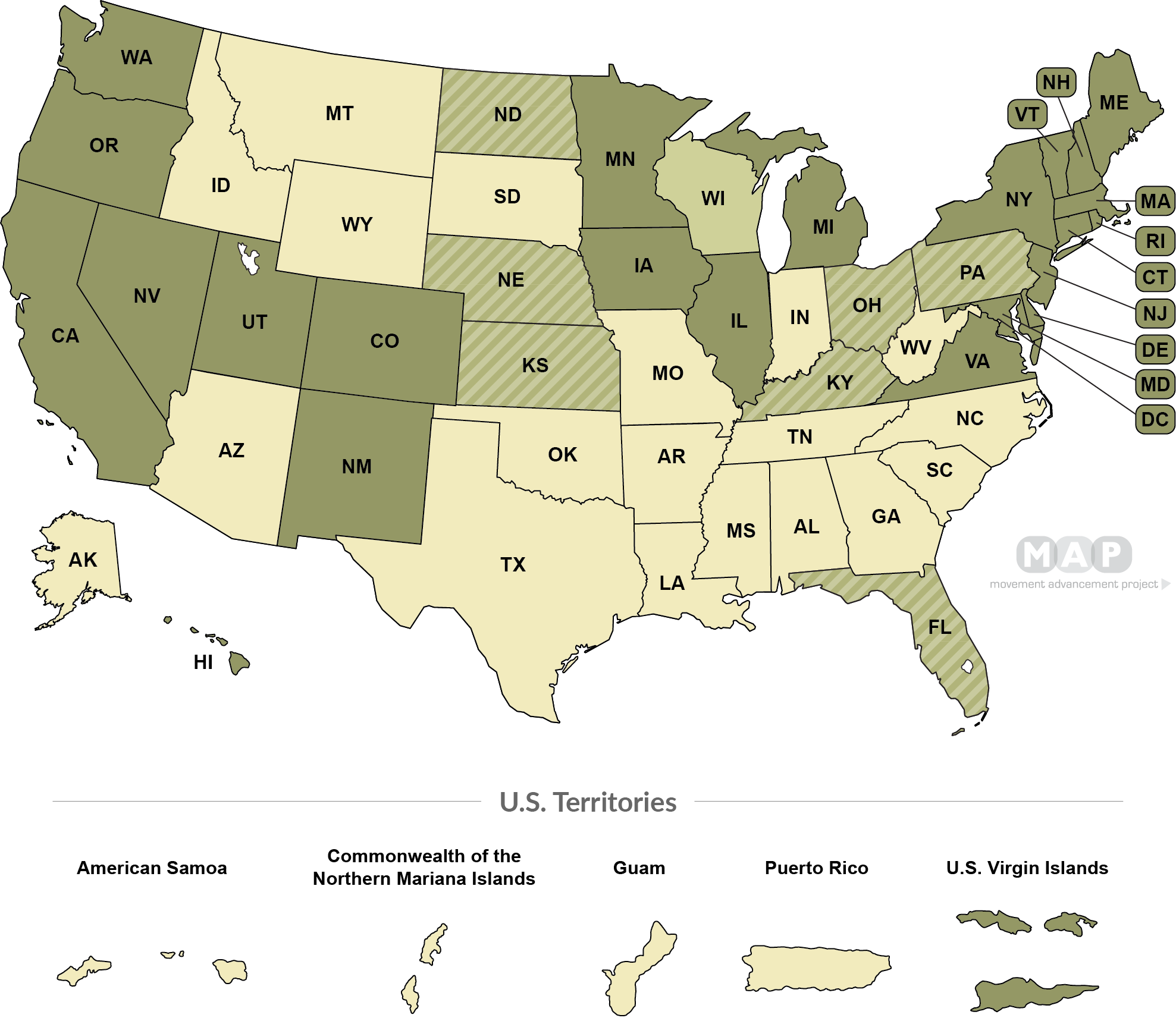
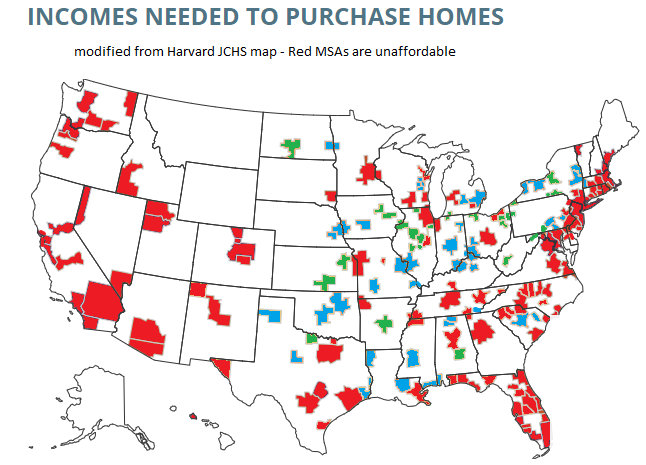
Source: Movement Advancement Project. Darkest colored states have LGBT-inclusive housing protections. Source: Jeremy Horpedahl. Green metropolitan statistical areas are most affordable, blue less so, red are least.
Not too many affordable areas for LGBT people to go for non-discrimination in housing. This is a problem.
This sixth Freedom Stories discussion explores the history of a tri-racial ethnic group prevalent in Central Appalachia and the rural Southeastern United States known as Melungeons. Through performance and discussion with storyteller Lyn Ford, author and community scholar Wayne Winkler, and Anthony Mayle, Assistant Director, Marietta College Office of Diversity and Inclusion, we will examine the unique development of multiple racial identities and challenge the story of Appalachian monoculturalism.
To access resources from this and previous Freedom Stories discussions, including the opening presentation, please visit https://ift.tt/kAV4Kbj.
For more information on this and other ISC projects, please sign up for our newsletter: https://ift.tt/RAhCTiH
Freedom Stories is made possible by funding from the National Endowment for the Humanities and with the support of our friends at the National Association of Black Storytellers – NABS, Green McAdoo Cultural Center, Appalachian African American Cultural Center, Black/White Dialogue, Black in Appalachia, ETSU Leadership and Civic Engagement, Heritage Alliance, Langston Centre, McKinney Center, Northeast Tennessee Tourism, and Historic Jonesborough.
Right in the center of the island nation of Madagascar there’s a strange, almost perfectly circular geological structure. It covers a bigger area than the city of Paris — and at first glance, it looks completely empty. But right in the center of that structure, there’s a single, isolated village: a few dozen houses, some fields of crops, and dirt roads stretching out in every direction.
When we first saw this village on Google Earth, its extreme remoteness fascinated us. Was the village full of people? How did they wind up there? And what did life look like in such a strange geography? To find out, we teamed up with a local team in Madagascar and fell down a rabbit hole of geology and mapping along the way. It’s a story of how continental shifts and volcanic geology came together to form a place for a group of people to call home.
We got to talk with a lot of experts along the way to make this piece. Here are links to some of their work:
Here is some of Michel Jébrak’s research on the Richat structure: https://ift.tt/m6PnJNo
Here is Ndivhuwo Cecilia Mukosi’s original paper on the Ambohiby Complex: https://ift.tt/CPheDdZ
We also spoke with Stian Rice, author of Famine in the Remaking, who helped us understand more about the history of agriculture in Madagascar: https://ift.tt/dmg4spl
Norman Thomas Uphoff at Cornell’s SRI International Network also shared more about agricultural systems and innovation: https://ift.tt/mOl9Ac5
Vox.com is a news website that helps you cut through the noise and understand what’s really driving the events in the headlines. Check out http://www.vox.com.