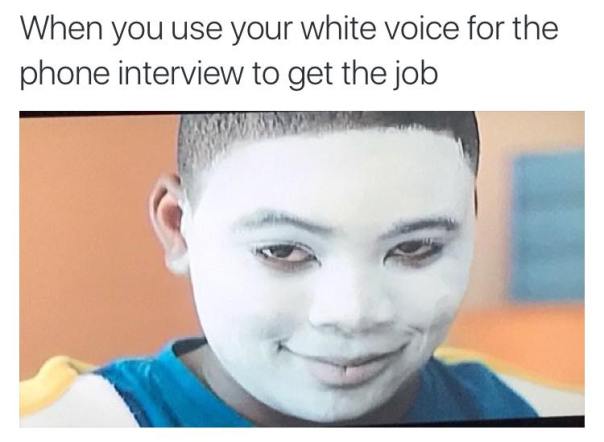
“white voice” vs. “talking black”

14494725_1141994885893375_277181611292078203_n.jpg

Well let’s analyze what is meant by “white voice” vs. “talking black”.

A lot of it has to do with formative regions and the prevailing cultures of a certain period. African-Americans got our accent of English from the White British settlers in the Lowcountry region. We’ve kept that accent and spread it to multiple urban areas outside the South starting with our migrations to the Midwest and the Great Migration. This is why a lot of our linguistic roots in American English are shared with the descendants of British settlers in the Carolinas and Georgia. This spread out further following the invention of the cotton gin, resulting in the forced migration of slaves to as far as Texas by the same descendants of the aforementioned British settlers.

But this spread of population, this region, has always been poor and both socio-economically and racially stratified, and we carried both the accent and the perception of Southern poverty with us to multiple cities. Hence, this Southern American English is more associated with us in more cities than it is with the White Southerners who mostly carry the same and similar linguistic tendencies to this day.

If you’re from the South, you can tell the difference between African-American and White Southern English; in fact, Southern English is the most widespread accent of English in the United States. But if you’re from outside the South, that difference is minimal compared to the difference between African-American and White Western/Minnesotan/New England English.

The Midwestern English that is most associated with Nebraska is the most state- and economically-privileged form of English in the United States. This Nebraska accent, known as “General American”, is what we think of when we speak of “White Voice”. It is also the accent in which television journalists are regularly trained.

I should know, since I can’t speak African-American English to save my life. This accent helps for phone calls.

#NoAccent #MilitaryBrat #NebraskaAccent

Does this make any sense?

“I’m going to vote for Trump! I think he’s a destabilizing force. I’m skeptical of him, too, and who exactly is behind Trump. But given that there’s eternal dissent in the Republican Party, that leads me to believe that whatever he represents might be a destabilizing force. And he’s made a lot of overtures to Russia and China, which in some ways could be thought of as an encouraging thing. I don’t support or endorse any of Trump’s policies. I just think it’ll escalate the problem, which is the best we can hope for. I hope at the very least he’d turn the White House into a reality show. America would tune in, right? And then he could do something nice, like give the money to the National Park Service, because they’re trying to defund it.”

Source: American History XXX – Office Magazine

This is heightening the contradictions. Does he want to heighten the contradictions?

Guns, Germs and Steel

Jared Diamond’s “Guns, Germs and Steel” is a challenging read which does a cursory look at the role that environment and location both have upon human technological development.

But based on the severe critique of the book by other anthropologists, I’m learning to take it with a grain of salt.

The same perceived “environmental determinism” which drives much the book’s narrative can also be tied to the genetic determinism which has been used to justify scientific racism and its many related tragedies.

Instead, it would be better to consider both environmental and social factors.

A people may have been lucky enough to be in a certain place where a certain food crop was plentiful, but they also had to be lucky enough for someone else from somewhere else to show them how to preserve their bodies and food over the winter.

If you’re at the right place at the right time, have the right geography, and encounter the right people under the best terms, your people can go pretty far in the long run.

Those best terms do not include colonialism. Colonialism is one of the worst terms, actually.

#GunsGermsAndSteel #Anthropology

I think Google’s VR headset will flop. The Pixel and the Google Home will succeed, but the Daydream headset doesn’t have much utility. It’s nice looking (cloth is a nice touch), but it’s missing extensibility. It’s doing what Samsung Gear VR’s already doing. It’s not even as functional as, say, Worse, two words are missing from this conversation: “AUGMENTED REALITY.” Where’s the affordable crossover between VR and AR? At most, Daydream looks good only for the hardware specs and the in-world user interface. But there’s no utility beyond wearing it for a few minutes. I’d rather go for Merge VR. At least it will allow you a coverable hole in the headset for your camera.

Black-owned Credit Unions

I’m already over the whole idea of black-owned banks, which duplicate the stratified structure of for-profit banks at the level of ethnic nationalism. Barely interested.

Let’s talk about black-owned credit unions. At least try to make banking more democratic if you want to improve the flow of money within predominantly-black communities.

Here are some examples:

  • Omega Psi Phi Fraternity Federal Credit Union – Lawrenceville, Georgia
  • Phi Beta Sigma Federal Credit Union – Washington, DC
  • FAMU Federal Credit Union – Tallahassee, Florida
  • Credit Union of Atlanta – Atlanta, Georgia
  • Toledo Urban Credit Union – Toledo, Ohio
  • Hill District Credit Union – Pittsburgh, Pennsylvania
  • Urban Upbound Federal Credit Union – New York City
  • St. Louis Community Credit Union – St. Louis, MO

The blog HBCUMoney.com also tracks the state of HBCU credit unions, which are used mostly by employees of HBCUs. https://hbcumoney.com/tag/african-american-credit-unions/

I wonder if there are any books on, or books set in, the African-American community in Boston prior to the Civil War. When slavery was abolished in Massachusetts in 1783 by the Supreme Judicial Court, it took effect immediately rather than the gradual, generational abolition which had been authorized in Pennsylvania and other surrounding states. The Boston African-American community was the largest in the United States to enter the 19th century entirely as legal free people.

Of course Boston is known for being a center of abolitionist sentiment before New York City became the primary metropolitan community of free Africans in North America after 1827. But I’m pretty sure that there is a lot more to the history of the Boston community in the period between 1783 and 1827 beyond the abolition movement. What were the relationships, the cultural expressions, the institutions, the social class structures, the political advancements which developed so early among this early-free community?

One of my fave sci-fi short stories is “Flash Crowd” by Larry Niven. Written in the 1970s, it depicts much of what the world would be like if we had teleportation as a main mode of personal transport. Replace “newstaper” with “blogger” and you’d essentially update this short story by a bit. And smartphones, definitely need those. Meanwhile, we are on the cusp of autonomous, self-driving taxis. These may be the closest thing we have to personal teleportation.

The Racism of Chicago in the White Conservative’s Mind

Something I’ve noticed: certain demographics from outside of Chicago love to describe Chicago’s African-American population and neighborhoods as a Third World country, like it is Hell on Earth.

Apparently, it’s not so “dark”, dysfunctional and evil of a place that most of the European-Americans in Chicago proper flee in droves from the city.

In fact, despite decades of petty gang-gun violence largely concentrated in the African-American population, it’s still the third largest city in the United States.

Maybe most of the African-American population is tucked away in a certain physical memory hole called the South Side, where murders happen and outsiders cynically tsk-tsk the surviving residents (or burnish their 2nd Amendment grievances with the bloody cloth of Black gun violence, or rage against the “niggers” and “race pimps” sullying the good name of yet another nice city) before moving on with their day?

Maybe deindustrialization happened, making life harder and encouraging many who had their highest skills in manual labor to turn to drugs, which entailed a turn to the violence which follows?

Maybe the culture of honor in the White South was adopted by us early in our belated freedom, and was brought by us to places like Chicago during the Great Migration when we should have left it in Jim Crow Land?

Nah, none of that could possibly be true! Chicago is just our sideshow, our American Mordor! Let’s always talk about Chicago’s Black people as if they are all crazy, evil and feral, and then pin that on President Obama like we’ve done since 2007.

Lineage-based Fraternal Societies

Reading about Essie Mae Washington-Williams, the mixed-race oldest daughter of Strom Thurmond who he never publicly recognized in his 100-year life. I noticed that she tried unsuccessfully to join the United Daughters of the Confederacy through her father’s descent from Confederate soldiers, but emphasized the need for African-Americans to join more lineage-based fraternal societies in order to forge closer ties to the earlier United States. Dr. Henry Louis Gates, Jr. has also joined the Sons of the American Revolution by way of a free man of color who fought for Continental forces in the Revolutionary War.

This led me to the list of lineage-based fraternal societies in the United States, most of which are either based on participation in war, settlement of a state or region at a particular time, ethnicity, service in some military branch.

Most of these tend to be of the accidental, circumstantial type that would involve some catechism of honor to esteem the “honorable ancestors”, the sort of unchangeable accident of history involving some distant soldier guy (or nurse woman) who, if you were not reminded of it or cognizant of research, you would totally forget or ignore. Similar to this practice is the war or period reenactment culture (like RenFaire and Civil War reenactment).

The only African-American-oriented genealogical [NOT lineage] society which I can find right now is the AAHGS-Afro-American Historical and Genealogical Society, Inc. and their state chapters, which exist to “share resources and methodology for pursuing historical and genealogical research” and “to trace the historical ties that bind us one to another, mold the present, and shape the future.”

So it’s not exactly “Sons/Daughters of [whatever]”.

It seems to predominantly be a Euro-American thing. It’s hard for us to squeeze into most of these organizations.