Tag Archives: africa

Why are there so few submarine cables between Africa and South America?

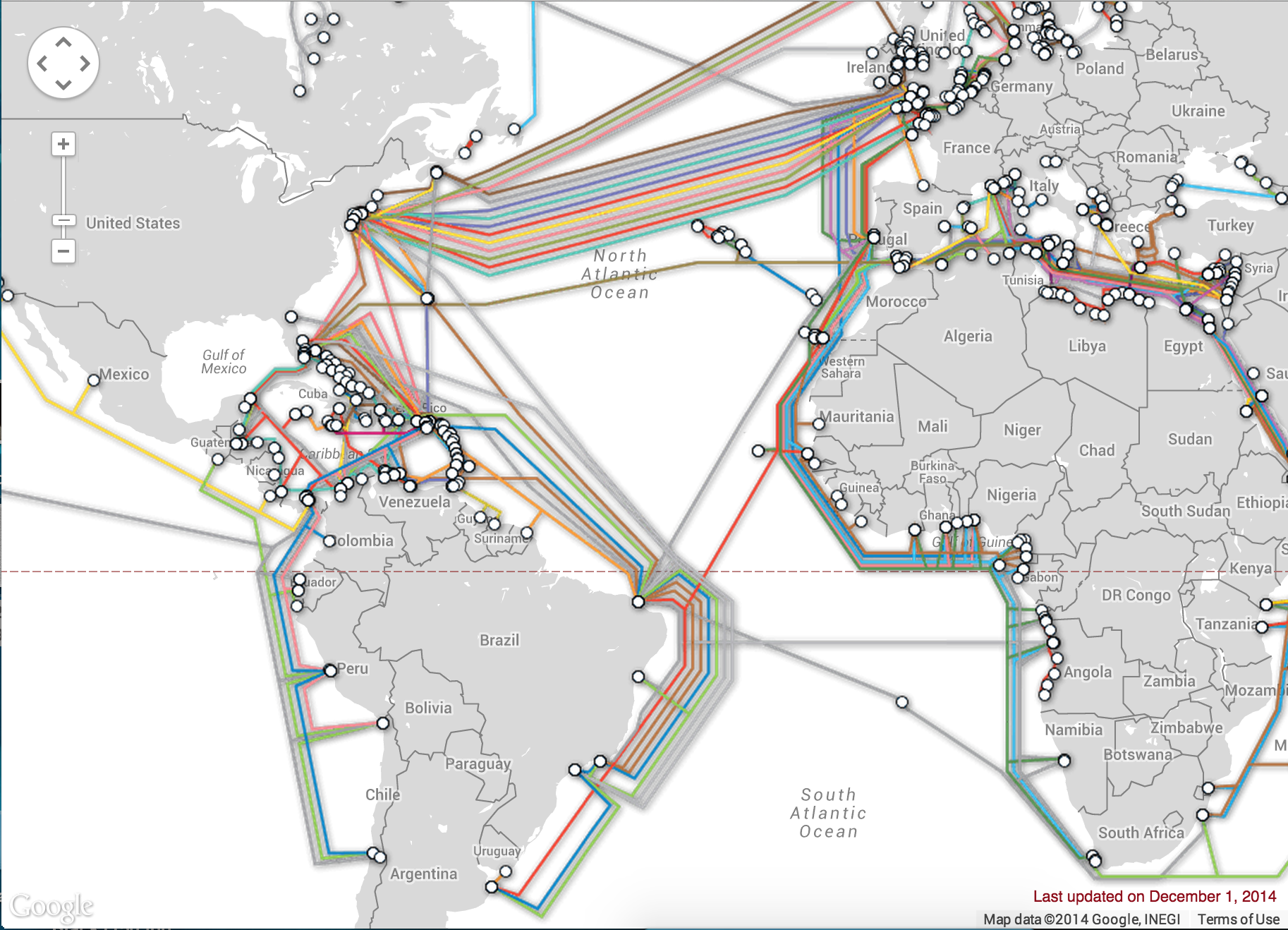
Map of transatlantic submarine cable lines as of 2014, courtesy of SubmarineCableMap.com.

I think looking at the map on the right shows how stratified the layout of communication technology is for the Atlantic Ocean region. So much up top and spilling vertically down (on both sides), but so little between the bottom.

Why are there so few submarine cables between Africa and South America? Between Nigeria/South Africa/Angola and Brazil/Argentina/Venezuela?

Surely there would be lots of historical links to share between the two continents, such as post-colonial, post-slavery histories? Or especially the large portion of slaves from West Africa heading to the Portuguese colony of Brazil? Or the histories of exploitation of labor and natural resources? Or musical and artistic commonalities?

I mean, Brazil literally faces several African countries along the same set of latitudinal lines (more so than a good portion of North America faces Europe), but yet there are maybe one or two submarine cable lines between these countries.

Why is that? Is it neglect? Is it money? Is it racial anxiety (which would be weird gives how many Europe-to-Africa lines there are)? Is it linguistics?

And what would be gained if this were changed with the building of new lines between the two regions?

I think that more equitable trade, cultural ties, freedom of expression, and all institutions which depend upon these developments would only gain in strength and viability – while shrinking only in cost barriers and administrative burdens. It would also reduce the cost of communication between other regions which go through these regions (especially South Asia, which has several cables running to East Africa).

So I’m glad to read that there are two lines currently being built between the two regions: SACS (South Atlantic Cable System) between Fortaleza/Fernando de Noronha (Brazil) and Sangano (Angola) in 2016, and SAEx (South Atlantic Express) between Fortaleza and Windhoek (Namibia)/Mtunzini/Yzerfontein (South Africa)/St. Helena in 2017.

These lines will be the first to connect the two continents directly. I hope that they will help bridge the gap between these two superactors in the Global South.

SADC and thoughts of a Bantu Republic

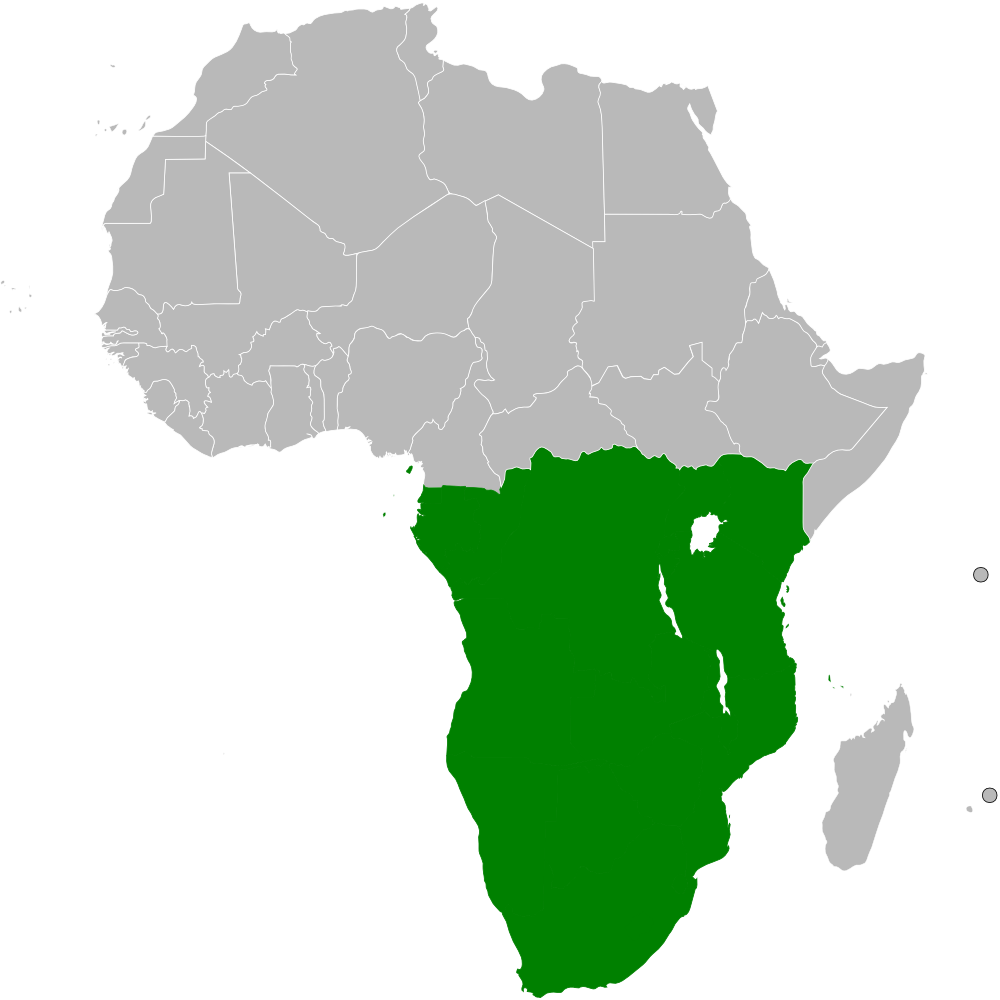
The Southern African Development Community looks like the perfect root for an African superstate.

Linguistically, the states of SADC (and most of the states of Central Africa and the Great Lakes region) are largely populated by speakers of Bantu languages, including KiSwahili, isiZulu, chiShona and kiKongo. This common linguistic heritage, spread out over such a vast geography and its natural resources, could reasonably lend itself to a state which governs over a third of the continent.

BantuRepNoBordersPolitically, a Bantu superstate would be the most visible representative of the African continent to the international community. It would also reduce the visibility of internal ethnic rivalries and any specific exploitable natural resource (such as oil, minerals, etc.).

Finally, it would be the best way for an African state to ably exit all of the many post-colonial federations such as the Commonwealth and La Francophonie, while using the government and diplomatic apparatus to highlight and export a more uniform amalgam of Bantu culture and language to the world, especially to the African diaspora in the Americas.

Let’s call it the Bantu Republic, or Azania.

The last 13 years of David Kato’s life

While the world only began to find out about David Kato within the last three years of his life, much of what is traceable about him resides chronologically within the last 13 years of his life, from his return to Uganda in 1998 at the age of 34 to his murder in January at the age of 46.

Before 1998, he spent an indeterminate number of years as a teacher in South Africa. At the time of his return, Nelson Mandela was just about to complete his only term as the first black president of the country and turn the gavel over to his Deputy president Thabo Mbeki, and Uganda was just sending its troops into the Democratic Republic of Congo to back a rebel group in the deadliest conflict in Africa since World War II. Since 1994, the South African government was putting forth a series of measures decriminalizing many aspects of LGBT life in the country, including a 1998 measure for prohibition of labor discrimination based on sexual orientation.

Kato was cited by a few reports as having participated in anti-apartheid activities before it was dismantled, but the details are extremely murky because of a lack of available date placements for his participation in South African anti-apartheid activities.

So fining some more specific details on Kato’s life pre-1998 would help.

In reply to this post about the Wikimedia Foundation moving to shut down several African-language wikis, since their commenting system is very broken at the moment. I’m a bit tired ATM, so my comment may seem very “all-over-the-place” and incoherent.

“You didn’t mention that, in several countries in Africa (especially those which are former British colonies), English (or some other Indo-European language that isn’t spoken natively by the population) is the default language of media (including Internet), education, government, and business, while languages such as Yoruba and isiZulu which are spoken at home but rarely taught outside with text-centricity don’t enjoy the same recognition. The only Niger-Congo language which may come close to such a status is KiSwahili, particularly because it was promoted in “British East Africa” by the British and by the subsequent national governments post-independence; as a result, it is an official language in Tanzania, Kenya, Uganda, and the bordering Democratic Republic of the Congo (by order of state recognition).

Hausa may be as big as KiSwahili in the number of native and secondary speakers in the Sahelian region, but in none of the countries where it is spoken (save for Nigeria, where it is promoted exclusively in some of the northern states) is it promoted by the national government or similarly-overarching institutional forms:

  • Niger
  • Nigeria (only the state governments)
  • Benin
  • Burkina Faso
  • Cameroon
  • Ghana
  • Sudan
  • Togo

Yoruba, like Igbo, may also have such a large presence on their own wikis because of 1) Nigeria’s population and 2) the fact that such languages are promoted by the local and state governments. They don’t have the wikipresence of KiSwahili (currently the largest African-language wiki besides, possibly, the Afrikaans wiki) because the languages are not promoted by more than one government.

In South Africa, isiZulu and isiXhosa are the two largest-spoken Niger-Congo languages with official status, and they are promoted to a certain extent on SABC-owned media outlets. Outside of that, very little promotion of such languages exists (even Afrikaans is waning as an influence), and the de-facto language of education in the country is English; isiZulu may only have greater media recognition than isiXhosa because 1) it possesses more native and secondary speakers in KwaZulu Natal and Gauteng and 2) the music industry, particularly Kwaito, which is particularly embracive of Zulu lyrics.

It depends more, IMO, upon the prior promotion of the languages rather than the sort of model used for the distribution of information. Most sub-Saharan African national governments and their local first-tier subdivisions haven’t pushed or encouraged their local population’s home languages or lingua franca to a similar degree as have countries like Nigeria, Tanzania, or the Democratic Republic of the Congo. There is a lack of social or financial incentive to promote their own home languages or lingua franca at the expense of the main languages which unite them with the former colonial power, be it the UK (Commonwealth of Nations), France (la Francophonie), Portugal (Community of Portuguese Language Countries), etc.

This may also explain why English also emanates from India (a former British dominion) as the primary source of written Internet language for Indians, even when communicating with each other on that same medium; this comes at the expense of Hindi (the other official language of the federation and the most locally-spoken language of a majority of the population), Bengali, Malayalam, Marathi, Punjabi, etc. Such local languages have their own amply-supplied wikis under the Wikimedia banner for those who understand the text, but most blogs written by Indian people are in English, and not Hindi or other local languages.

And that you make an indirect nod to China, I suppose (“So get ready for the time in which non Euro-Americans will discuss on THEIR media whether keeping en.wiki on-line makes sense or not.”), brings to mind the fact that written Chinese is the only standard that keeps “Chinese languages” like Mandarin and Cantonese even remotely mutually intelligible with each other.

Oh…nevermind, there’s actually more than one “Chinese” Wikipedia, and none of them are anywhere near being moved to the Incubator, but only the Vernacular, “official” one is the largest…at slightly less than 200,000 articles (about as much as the Romanian and Czech Wikipedias):

Again, I believe that a successful non-English Wikipedia depends upon the promotion of literacy in the language at home and abroad; it also depends upon the ease of access to the Internet. Most of the African, Indian and Asian language wikis suffer from the lack thereof in the places where they are most spoken.

Should we blame this on the nature of the technology that we’re using here in the West and exporting to the other countries, that it is not geared to the populations’ cultures?

No. Why should we blame the technology that came from the West for a deficiency that lies almost squarely within the Third World’s court? The technology that we have exported over the Internet has failed to make inroads into the regions of sub-Saharan Africa, India, China, etc., while it has made strong inroads into such countries as Japan and Singapore, only because the Internet and prerequisite communication mediums have failed to make inroads to a multitude of countries while penetrating the very heart of a few.

We who create and edit wikis just can’t apologize for things which are out of our hands. I can only say that the resources of the West has failed to work out better means of communication for the Third World’s populations, where several countries’ governments and cultures already place severe restrictions on such “elitist” “Enlightenment” features as “freedom of speech”, “assembly”, “belief”, etc.

I do agree with you on the mobile thing. Wikis and mobile devices currently don’t mix well, at least because wikis are a set of documents and most documents aren’t designed to be viewed and accessed for mobile, pocket-sized displays.”

The Green movement and sub-Saharan Africa

OK, I don’t know how to put this down correctly, so this post will look a bit bleh.

===

I don’t think that the Green movement will get that much foothold in Africa, at least not in the near future.

Right now, the dominant political parties in the countries’ parliaments and executive mansions espouse (at least on paper) some common threads: Pan-Africanism, religious conservatism, nationalism, and populism.

Also, most of these countries’s demographies, because of the history of cross-continental dialogue between Africa and Europe, tend to be averse to any political ideology or social cause of a supposed Western origin: anarchism, environmentalism, civil rights for LGBT citizens, etc.

The only case of an African “Green party” that is enjoying any publicity is the Mazangiri Green Party of Kenya, led by Nobel Peace Prize winner Wangari Maathai, who is an ally of the current (disputed) president Mwai Kibaki.

Heck, even the Green political movement in South Africa has taken a turn for the worse in the post-apartheid era. From the Wikipedia suggestion, most Greens in South Africa are currently allied with either the ANC or the DA, primarily because of how the most outstanding  (token) environmental excesses of the apartheid regimes, including nuclear weapons and power, were cleaned up or scaled down by the Mandela government.

Perhaps the most outstanding issue, however, in South Africa and most of sub-Saharan Africa, is the rise of AIDS/HIV, something that no national Green party has similarly incorporated to the very top of their political agenda (except for this; see if YOU can find the reference to AIDS/HIV in all that text). While Africa is scared as hell about this epidemic and its effects on their populations, livelihoods, and media images, most Green parties are more concerned with the prevention of nuclear power, whaling, or other matters which are of less populistic appeal to the electorates.

I would like to see that change, as I will either vote for a Libertarian or Green in November, but the lack of Green participation in national and local government in Africa is worrying to me.

The Anti-empire

Originally posted here.

“What would happen now? The great imperial system had been completed, Black unity had been achieved among numerous language groups on one of the widest scales in history, from Zambia down to South Africa. cities of stone dotted the land, the Zimbabwe cities north and south were the deathless symbols of a people’s greatness….

….The Emperor Matope also left the country with a great organized religion with a powerful and formally organized priesthood, something unusual in Africa outside of ancient Egypt, Ethiopia, and Abyssinia….

But would there be unity now that the last of the two great personalities around whom unity revolved had silently stolen away in the shadows of the Great Zimbabwe, gone forever? The question arises whenever a great leader passes; political psychology and mass psychology are crucially combined….

There were unifying factors which Matope left behind in his great empire. one was that same organized religion led by a highly advanced and literate priesthood…. The other important factor that should have made unity imperative was the greater prosperity that would flow from economic interdependence and close commercial relations between the constituent states and provinces. The great system of roads and highways, instead of being recaptured by the bush and forests after serving their initial military purpose, could have been converted into permanent national highways, crisscrossing the Empire, and thus serving as the indispensable communication links for administration, trade, travels by the people and, in short, unification. Other factors that should have been a solid foundation for black unity were the similarity of their social institutions and the absolute sameness of their constitutional system.

Yet, with Matope’s death the Empire began to break up. Why? Notwithstanding all the forces mentioned above that should have made for unity and stability, the actual fact is that the traditional African political system was fundamentally and structurally anti-empire. The very circumstances of the endless process of segmentation, of forever splintering off to form little independent mini-states, developed a built-in disunity, reinforced by the attending growth of different languages. But self-gevernment or chiefdom was a way of life, not a theory. Chiefs and Elders, as we have seen, were leaders, advisors and representatives of the people, and not their rulers. The same operating principle prevailed when a group of states united to form a kingdom and kingdoms united to form an empire, but with a disturbing difference: Centralization tended to erode local authority, transferring chiefs from the control of their people to the control of the central government. In the case of conquered territories this change was abrupt and painful. And it was one of the principal resons for later rebellions and the break-up of kingdoms and empires. Therefore, let us say it again, to say that Arabs and Europeans were solely or even mainly responsible for the destruction of all great African states would be glossing over or attempting to ignore the principal internal factor: disunity. What the whites did, Asians and Europeans, was to appraise this continent-wide disunity and “cash in” on it to the fullest extent possible. They did not have to divide and conquer even, for the Blacks were already divided, just as though they were waiting for the foreign conquerors to come.”

Chancellor Williams, The Destruction of Black Civilization: “Great Issues of a Race from 4500 B.C. to 2000 A.D., Third World Press, 1987

—————————————————————————

From what I’ve noticed so far, such a situation can be related to today’s Africa and how it is constituted.

Considering that sub-Saharan Africa’s traditional political outlook has always been “every chiefdom for himself”, I wonder if that’s one of the major reasons for why human rights are not regarded by most regimes down there. I mean, first off, these countries were former European colonies who were then given their “independence”, but did you ever notice that, except for Eritrea, Namibia and Sudan, there has never been a country in Africa that gained independence from a neighboring African nation?

Eastern Nigeria, a.k.a. Biafra, is an oil-rich area, with so much petroleum-based potential that the region, by itself, should have the same standard of living as Singapore. However, when this area, which is predominately Igbo, decided to secede from Nigeria in reaction to the pogroms against other Igbos who were living in other cities throughout Nigeria by members of the Hausa ethnicity, which resides mostly in northern Nigeria, which is known for being a stronghold of Muslim fundamentalists who have installed sharia law in most of the northern states’ governments, they were, after three years (1967-1970), forced back into the Nigerian fold, at the cost of well over a million lives, and billions of US dollars in property damage.

Also, when copper-rich Katanga province decided to secede from the recently-made-“independent” DRC within the first 5 years of independence (1960-65), that region also was forced back into line by both Congolese and UN troops, after one of the absolute worst examples of general UN incompetency in Third World conflicts.

When Eritrea made a bid for independence in the 1960’s, it took them over 30 long, torturous, bloody years before that bid was granted by the government in Addis Ababa (in 1993). When Namibia made a similar bid for independence from apartheid-era South Africa, not only did it take decades for that bid to finally be recognized (in 1990), but that bid was also tied inextricably with the civil war in neighboring Angola, a civil war that involved the intrigues of the Cold War in the strangest manners (the USSR sending aid to the Angolans and, by turn, the SWAPO independence fighters in Namibia; Cuba sending its own troops to help fight UNITA and the South African Army in the Angolan hinterland; South Africa helping UNITA in Angola while fighting SWAPO in Namibia; and it goes on).

Sudan and its southern rebels have finally signed a peace deal with each other, ending, hopefully and thankfully, 21 years of conflict. The South had sought secession from Sudan because of the domineering ways of the autocrats in Khartoum, and the long-sought-after deal has made a particular provision that may give ultimate credence to the bid (The South has the right to secede from Sudan if conditions do not improve within the next 6 years between the government and the region).

So, why is it that it takes the loss of human life to keep these nations together? Why is it that these nations, on a general scale, have not exercised a deep respect for human rights (despite the constant berations by the heads of state of these nations upon the West for colonization and slavery), and have violated such rights NUMEROUS times in order to keep their national institutions or personalities intact from infracture by the masses? And why is it that secessionist movements have never been allowed to develop in sub-Saharan Africa, even though the act of secession would actually be better for that region?

Is it because of the transplanted European mentality that empires are meant to last as long as they can be preserved (combined with “the end justifies the means”)? Is it because the regions where secession is beginning to be seen as a good idea are economically viable (even potential-wise), and thus would be enough to fight for, on the central government’s part?

And if that is the case, then are such mentalities as the aforementioned the kinds of things that the traditional African political outlook was actually AIMING TO AVOID?

I mean, if the chiefs were tending toward so-called “balkanization”, then consider that it wasn’t necessarily for the sake of the chief, but rather for the people themselves (and then I begin to see the light). If a nation has to preserve its institutions or borders or personalities with the sacrifice of human life, rights, or property, then such things are erroneous and worthless. National unity is bullshit if ordinary citizens who seek for some form of self-determination are jailed, tortured, or murdered. National unity is hogwash if private interests are put up at the forefront of priority rather than public need. Empires are not worth the preservation if humanity and human need is actively spurned by the government.

So basically, the African people are basically anti-empire, quite the oppposite of their European counterparts. To the traditional approach, unity is needed in time of common distress, interest, or cause, but otherwise, tiny sovereignties in Africa would actually do better by themselves, if allowed to go their own ways. So, really, the European approach toward things like politics isn’t necessarily the greatest thing after all.

And the more that such is realized, the better off that Africa will be with itself and, hopefully, the world.