Tag Archives: african-american

Building on the #WEBDuBois quote Edric just posted:

Reading DuBois’ critique of both parties in 1956, one has to understand what the parties represented in that period. The Democrats were still a very racist political party which appealed to the White working class. The Republicans, by comparison, were mostly indistinguishable from the Democrats except in their Lincolnian heritage and their more concrete adherence to free-market ideals. Republicans in the South were struggling to arise as an appreciable political force, becoming plastered in its declining years as the “Negro Party”.

Fast-forward to today. The Republicans are dominant in the South and are a very racist, white-identity-obsessed party. The Democrats in the South are struggling to arise as an appreciable political force, and are now becoming consigned to “Negro Party”, permanent-minority status. Outside of the South, the parties are more apart than ever before, except on many of the matters which DuBois touches on in this letter. Some things have never changed, and some things have changed party affiliation.

Frank Ocean’s highly anticipated Blonde is only the most recent offering in a remarkable string of theologically complex R&B and rap music. In a year that saw Kendrick Lamar’s Untitled Unmastered, Chance the Rapper’s Coloring Book and Beyoncé’s Lemonade, Blonde (initially titled Boys Don’t Cry) only further emphasizes how gospel themes are being increasingly used as a mode of resistance.

Since its release at the end of summer, the album’s message has continued to spread far and wide, making its latest round in the news cycle this week when Kanye West threatened to mount a boycott against the Grammys if Blonde wasn’t nominated.

Ocean has in the past expressed his belief in a redemptive God (“We All Try”) alongside his disbelief in the value of organized religion (“Bad Religion”). In this sophomore work, he further evolves his spiritual identity in the context of racial justice and queer masculinity. The tone is plaintive but also resilient, fitting into an ethos seen from other black artists this year.

Source: Racial Justice and Queer Masculinity: The Gospel of Frank Ocean | Religion Dispatches

When Republicans Stopped Wanting Our Vote

From a comment I posted to John Jackson’s thread last October 15, copypasted and edited here from my other profile because it bears repeating in public:

“If the GOP were the more effective alternative for African-American voters to the racist Southern Democrats in the post-WWII South, why did people like Fannie Lou Hamer attempt to integrate the Mississippi Democrats (who were atop an effective one-party state since Reconstruction) and not the recently-reestablished Mississippi GOP (re-born 1956)? Why did her MFDP become the focus of attention in the 1964 Democratic Convention when they sought a seat at the Mississippi delegation table, when the free-market GOP championing Barry Goldwater was available that year?

In relation to what [some guy] said earlier, where were all this “free stuff” that Democrats were handing out for the 90+ years that Democrats had one-party rule throughout the South, and were Southern White people being given this free stuff that Black people were clearly prohibited from accessing? Southern White people, with high rates of regional illiteracy and racial privilege, “pulled the lever” for Democratic governors for over 4 generations, and never pulled that lever for a GOP governor, so what changed?

That’s what I’m curious about. What changed in the South that Democrats went from being “my (racist) grandpapy’s party” to being the party of “free stuff”, from a racist kleptocratic party in the South to the “socialist party” in opposition for the next century? Was it FDR’s New Deal? Truman’s integration of the military? Johnson’s ban on bigoted poll taxes, or his promotion of the Great Society? I don’t think that it is the viability or non-viability of the GOP’s free-market policy or its anathema to “free stuff” that is the issue. Otherwise, many would have been more attracted to the GOP as a party on a Booker T. Washington/Marcus Garvey/Malcolm X “do for self” black-nationalist pro-business basis.

But that didn’t happen, and so you didn’t have traditional Black Republicans get into federal office after Senator Edward Brooke of Massachusetts, who was the last gasp of the type of Black GOPer who was promoted aggressively by the Radical Republicans to Southern statewide office in Reconstruction. Now it’s all “bootstrap”, “anti-big-gov” and militarist types like J.C. Watts, Mia Love, Allen West and Tim Scott since the civil-rights movement era. What happened, and why can’t the GOP relate to the Black Nationalist “do for self” trend in the same way that the Democrats have been able to relate (somewhat) to the Black social-democratic tendency?”

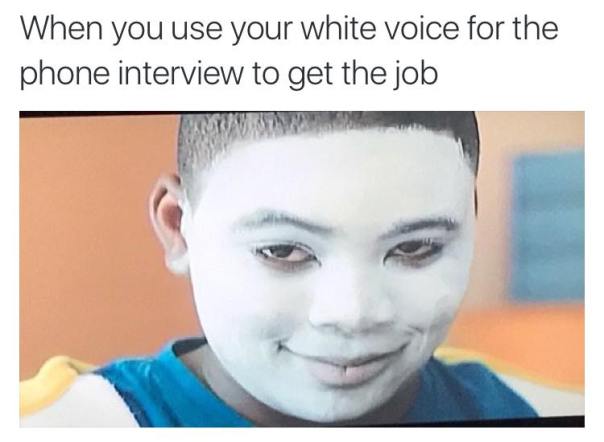
“white voice” vs. “talking black”

14494725_1141994885893375_277181611292078203_n.jpg

Well let’s analyze what is meant by “white voice” vs. “talking black”.

A lot of it has to do with formative regions and the prevailing cultures of a certain period. African-Americans got our accent of English from the White British settlers in the Lowcountry region. We’ve kept that accent and spread it to multiple urban areas outside the South starting with our migrations to the Midwest and the Great Migration. This is why a lot of our linguistic roots in American English are shared with the descendants of British settlers in the Carolinas and Georgia. This spread out further following the invention of the cotton gin, resulting in the forced migration of slaves to as far as Texas by the same descendants of the aforementioned British settlers.

But this spread of population, this region, has always been poor and both socio-economically and racially stratified, and we carried both the accent and the perception of Southern poverty with us to multiple cities. Hence, this Southern American English is more associated with us in more cities than it is with the White Southerners who mostly carry the same and similar linguistic tendencies to this day.

If you’re from the South, you can tell the difference between African-American and White Southern English; in fact, Southern English is the most widespread accent of English in the United States. But if you’re from outside the South, that difference is minimal compared to the difference between African-American and White Western/Minnesotan/New England English.

The Midwestern English that is most associated with Nebraska is the most state- and economically-privileged form of English in the United States. This Nebraska accent, known as “General American”, is what we think of when we speak of “White Voice”. It is also the accent in which television journalists are regularly trained.

I should know, since I can’t speak African-American English to save my life. This accent helps for phone calls.

#NoAccent #MilitaryBrat #NebraskaAccent

Black-owned Credit Unions

I’m already over the whole idea of black-owned banks, which duplicate the stratified structure of for-profit banks at the level of ethnic nationalism. Barely interested.

Let’s talk about black-owned credit unions. At least try to make banking more democratic if you want to improve the flow of money within predominantly-black communities.

Here are some examples:

  • Omega Psi Phi Fraternity Federal Credit Union – Lawrenceville, Georgia
  • Phi Beta Sigma Federal Credit Union – Washington, DC
  • FAMU Federal Credit Union – Tallahassee, Florida
  • Credit Union of Atlanta – Atlanta, Georgia
  • Toledo Urban Credit Union – Toledo, Ohio
  • Hill District Credit Union – Pittsburgh, Pennsylvania
  • Urban Upbound Federal Credit Union – New York City
  • St. Louis Community Credit Union – St. Louis, MO

The blog HBCUMoney.com also tracks the state of HBCU credit unions, which are used mostly by employees of HBCUs. https://hbcumoney.com/tag/african-american-credit-unions/

I wonder if there are any books on, or books set in, the African-American community in Boston prior to the Civil War. When slavery was abolished in Massachusetts in 1783 by the Supreme Judicial Court, it took effect immediately rather than the gradual, generational abolition which had been authorized in Pennsylvania and other surrounding states. The Boston African-American community was the largest in the United States to enter the 19th century entirely as legal free people.

Of course Boston is known for being a center of abolitionist sentiment before New York City became the primary metropolitan community of free Africans in North America after 1827. But I’m pretty sure that there is a lot more to the history of the Boston community in the period between 1783 and 1827 beyond the abolition movement. What were the relationships, the cultural expressions, the institutions, the social class structures, the political advancements which developed so early among this early-free community?

Lack of Self-Respect Among Black Republicans

He told the New Times that he had hopes of helping the Trump campaign avoid the mistakes that Gov. Mitt Romney (R-MA) made in his failed presidential run in 2012. Romney, said Jackson, waited until too late in his campaign to start outreach to nonwhite voters.

“I have been saying repeatedly that you cannot go into black community in the 9th hour of a campaign and ask them to vote for a GOP candidate,” he said. “The party has done a piss poor job of courting the black vote over 50 years. So you have to have more vested interest in time and in your financial effort for the whole campaign, not just in the last 100 days.”

Source: Head of Trump’s black outreach in Florida says ‘piss poor’ campaign doesn’t care about blacks – Raw Story

Thinking about it, I can understand an immigrant from Haiti like Rep. Mia Love of Utah becoming a GOP politician. Because she is an immigrant, she gains from the “pull yourself up by your own bootstraps because we’re a nation of immigrants who sought a better life here” doctrine. I don’t find it strange that she follows through on that, first as mayor of Saratoga Springs, Utah and later as a House rep from Utah. She doesn’t even need the Congressional Black Caucus because she rhetorically hates its very existence, despite joining it after joining Congress in 2015 (oops).

But what do African-Americans of antebellum slave descent gain from joining the GOP at this moment of political history? The prevailing consensus in the GOP is that our history is an inconvenience to be glossed over (even glamorized) and not “focused upon”; that our contributions are to be honored but not the trauma which produced those contributions; that our current plight, only 2 adult generations out from the end of Jim Crow, is a result of our “personal lifestyle choices” and not of systemic origin; that we should ditch the Mexicans in order to make more room for (everyone else but) us in the low-skill, high-labor jobs of agriculture, mining, manufacturing and even service industries (which may or may even not be “real jobs worthy of a living minimum wage”); that we should ditch LGBT people and Planned Parenthood clinics in order to make our divorce rate drop, men return to their wives, children have more children, and women stop being so liberated as to make informed choices for their bodies; and other insults to our intelligence.

None of that is appealing to me. None of this makes sense. Maybe if I got into a car accident, got a bad case of amnesia, adopted a new name and identity as a Nigerian immigrant from Lagos, integrated myself into the Nigerian American community like Rachel Dolezal did with African-Americans in Spokane, became religious, set up a business and then decided to go into politics as a moderate Republican Congressperson from Atlanta, this message would be a bit more appealing for me to campaign on and live by. A bit.

Then I would be lauded by those who don’t know any better as another rare Black politician who “never slaved on the Democratic plantation” and joined the party of Lincoln “bcuz freedom.” And Fox News, Breitbart and the National Review would love me for every word I publicly utter.

But that ain’t happening in this timeline of reality. I’d have to shut part of my brain off to join the present GOP even if I were a descendant of antebellum slaves who was anti-immigrant, anti-choice, anti-LGBT, anti-welfare or at least just pro-free-market. I’d have to shut off part of my brain to vote for the real estate developer or anyone who endorses him. And most Black Republican descended from antebellum slaves, except for Rep. Mia Love, don’t even sound original to me in their adoption of GOP talking points, especially when those talking points emanate from some angle of gratuitous anti-Blackness and class bigotry. Maybe they’re honest, but not original or nuanced.

We’re looking for empowerment for our families’ and neighbors’ lives that we didn’t have when “things were simpler” and “Black businesses were better” under Jim Crow. The GOP’s austerity and anti-civil rights policies simply don’t provide empowerment for most African-Americans, and they seem to be harming the Euro-American community across the country, too (see Kansas under Brownback, Indiana under Pence, Wisconsin under Walker, Michigan under Snyder and North Carolina under McCrory). The latter may get tired of it soon enough, if they can jump off the nativist train first.

MLK’s description of the 1964 Republican campaign of Barry Goldwater applies just as much to this year and the subsequent landslide that is about to happen against the GOP nominee.

Again.
 

Black America Measured as the Next U.S. State

I remember reading this article from The Atlantic from a while back which thoroughly measured the economy and infrastructure of Black America as its own nation-state.

However, I don’t know if anyone has ever thought about if Black America were its own state within the Union – a majority-minority state demographically dominated but never self-governed at the state level by people of African descent.

But what if it were? What would be the prevailing politics of this state?

Let’s call it the 52nd state in the Union – the State of New Afrika. The 51st would be Puerto Rico.

In the State of New Afrika, how would Black Democrats govern and represent their districts? How would Black Republicans?

What would be the state of law enforcement in New Afrika? How much control would the majority-Black state government have over its majority-Black cities?

State governments have perhaps more control over the function of cities and their residents than the federal government does. The provision of funding for public schools, for law enforcement, for prisons (public or private), for water resources, for roads, for recreation, for environmental protections and so on. No city in the United States except for the District of Columbia (subject to Congress) has such a broad control over their infrastructure. The federal government is also hobbled in its ability to reach cities because of state government control.

So if Black America lopsidedly dwells in metropolitan areas, but these metropolitan areas’ statuses are ultimately determined at the state level where the majority of leaders are not of the same economic, ethnocultural or regional background, what does that say about how much control we actually have over our local communities and our welfare?


For Those Who Still Don’t Have a Choice

Thinking about The Movement for Black Lives’ Vision for Black Lives manifesto and its inclusion of a pro-Dreamer/anti-Deportation plank.

One can argue this:

The ancestors of most slave-descended African-Americans did not choose to come here willingly. Legally, neither did Dreamers who were brought here as children.

I understand that Dreamers can more readily identify their country of ancestry. But their entire memory has been cultivated here in this country.

I understand that Dreamers have more of an opportunity to go back to their country of origin. But forcefully deporting someone who did not choose to come to this country is gratuitously cutting someone off from their de facto adoptive country.

The 14th Amendment was crafted to apply citizenship to people who didn’t end up here “the right way”, the most privileged way. It established birthright citizenship, which has now become a feature of naturalization for most countries in the Americas.

Some would want to eliminate or curtail birthright citizenship. I think it should be expanded to automatically naturalizing those who arrived in the U.S. as minors and have spent at least 5-10 years of their lives here.

That is the humane thing to do. #Vision4BlackLives