Tag Archives: brazil

Idea: Federal Recognition for “Traditional Peoples and Communities”

Several communities have campaigned for decades for federal recognition as indigenous tribes. Besides the 571 federally-recognized tribes, 62 others are recognized at the state level across 16 states, while several in the Midwest and Appalachian areas lack any state recognition but have several unrecognized communities which are seek some sort of government recognition. Some of the largest groups locked out from federal recognition as tribes are the Lumbee people of North Carolina, the United Houma Nation of Louisiana, the Echota Cherokee Tribe of Alabama, and the Chinook Indian Nation of Washington.

But then there are other communities which do not consider themselves as Native American but may either have some level of indigeneity to their homelands or are currently organized around distinct economic and cultural activities largely separate from their neighbors in the prevailing culture. This includes the Native Hawaiians, but on a broader level includes the Gullah-Geechee of South Carolina and Georgia, the Romani people, the Melungeons of the Appalachians, the Freedmen communities in Oklahoma, and more.

In Brazil, the federal government since 2007 uses the designation “traditional populations/communities/peoples” to describe a broader number of communities than just federally-recognized indigenous peoples. This term includes the quilombolas, or residents of historic maroon communities in the interior of Brazil, among several others.

Canada’s federal government largely uses the term “indigenous peoples” when describing “First Nations”, “Inuit” and ‘Metis” altogether, but each group is legally distinct from each other.

I argue that the U.S. federal government should create a second tier of federal recognition of peoples through the Department of the Interior, one with a broader definition and looser criteria for federal recognition than those for federally-recognized tribes. My idea is that these communities which fall under this broader umbrella would:

  • include state-recognized tribes, unrecognized tribes, indigenous communities distinct from Native Americans, and ethnic groups which maintain distinct folkways.
  • form public-private partnerships with the federal government in which the federal government plays an advisory and assistive role (similar to the recently-formalized National Heritage Areas)
  • are not entitled to the level of sovereignty accorded to Indian tribes
  • would not be entitled to exclusive land claims
  • may only be designated by an executive order, an Act of Congress, a federal judicial decision, a administrative decision or an application by a state government which recognizes that group under state law

This would go a long way to accommodating several of these communities in this country. They would also bring more tourism opportunities in the areas where they live, as well as allow for more opportunities for ecological and historical preservation.

And at the very least, state governments should lead the way, away from “state-recognized tribes” to “state-recognized traditional peoples and communities”.

Some thoughts on Afro-Brazilian religion, syncretism and feminism

I watch videos of Umbanda ceremonies and read about how Umbanda arose out of a fusion of the black working-class’s practice of Candomble with the 19th century white middle/upper-class practice of spiritualism and spiritism. What has arisen over the last century . It discards the animal sacrifices, ritual Yoruba language (in favor of Portuguese vernacular), alcohol and tobacco use, and sometimes even the colorful necklaces and ritual dress.

What largely brings these Afro-American religions together in Brazil:

  • the resistance to slavery and racism,
  • the use of African-derived music and instruments
  • veneration for African deities such as the Orishas (and sometimes for Indigenous spirits)
  • the terreiros

I’m also interested in how Afro-Brazilian religion approaches LGBT participation and representation. While Candomble is by far better at welcoming LGBT people compared to Abrahamic religions (especially the Evangelical Christianity which has seized so much control over Brazilian politics), and Umbanda can profess to be even more egalitarian on sexual and gender minorities than Candomble (including the performance of same-sex weddings and inclusive initiation rites), research does show a masculine and cisgender bias in the practice of Afro-Brazilian religion which often ticks up depending on the terreiro involved.

Which brings to mind a few things:

  • my own experience going to an Episcopal youth study group one time when relational theology and queer theology were discussed. Very informative, especially as to discussions of egalitarian, ungendered religious language.
  • The debate and conflict within Euro-American nature religions like Wicca and Asatru on the role of gender and sexuality, which has resulted in the creation of even TERF sects such as Dianic Wicca, as well as opposite, egalitarian sects such as the Feri Tradition, Radical Faeries and more

Questions:

  • What would an Afro-Brazilian religion with a relational, queer theology look like?
  • How would the endemic religious language – of “mounting” by orishas, or of fertility, or of gender – change? Or even the language introduced from Kardecist spiritism?
  • It doesn’t seem that sheer inclusion of gay men is enough in a country like Brazil, which still reels from the domestic and political impact of machismo. What of lesbians and transgender people? Will they take a role to the merging of relational and queer theology into an Afro-Brazilian religion?

I could take this further into questions about evolution, about vegetarianism, about political organizing, as well. But I’ll leave it at that.

Military Budget/Size and the Likelyhood of a Coup on U.S. Soil

Brazil, with the 5th largest country in area size and the 5th largest population, has the 14th largest military and 11th largest military budget. Practicing conscription, this military has not been in conflict with its neighbors since 1870, nor has it been in conflict with any other country since 1945. It has had four coups d’etat and accompanying military dictatorships, the last of which ended in 1985.

United States, with the 4th largest area and the 3rd largest population, has the second largest military and the largest military budget. A volunteer military since the 1970s, this military has been in conflict with or in other countries for 224 of it’s 241 years of independence, including up to the present. It has never had a coup.

North Korea, with the 97th largest area and the 48th largest population, has the 4th largest military and is rumored to spend up to a third of its total income on defense expenses. A conscript military, this country has been in a formal, tightly-held state of war with South Korea since 1950. It has long been ruled by its military through the Kim family.

Comparing between these countries, I’m wondering what sort of role these militaries play in relation to their national populations. Are disproportionately-large militaries and larger military budgets a way to mollify and pacify the public? Are military adventures a way to distract us, as the Argentine military tried to do by invading the Falkland Islands (much to their failure at British hands) while Argentina was under a brutal military dictatorship?

If a military has no conflict abroad or natives to pacify, does that military become restless and more likely to lash out at its civilian government through a coup?

What if we in the U.S. pulled back all of our overseas military installations and detachments, ended the international War on Terror and Drugs, scaled down our military budget from its massive $597B to something like India’s $56B, move more active duty folks to reserve duty, recycled our excess of F-16s and other wasted weaponry, closed some of our excess of domestic bases?

If we did all of that and shifted all of that expenditure to other areas, that might benefit more of our working class, although we’d still have to weather the blowback from the craters we’ve made internationally.

But I fear that our military leaders, if reduced in power, scope and range of conflict, will turn against our civilian government. I fear that a reduced, internationally-neutral military will initiate a coup d’etat in the name of correcting the course of civilian government.

This happens way too much in other countries which have not seen conflict between sovereign countries for an extended time.

And this is ironic for me to say since I live on a military base, lol!


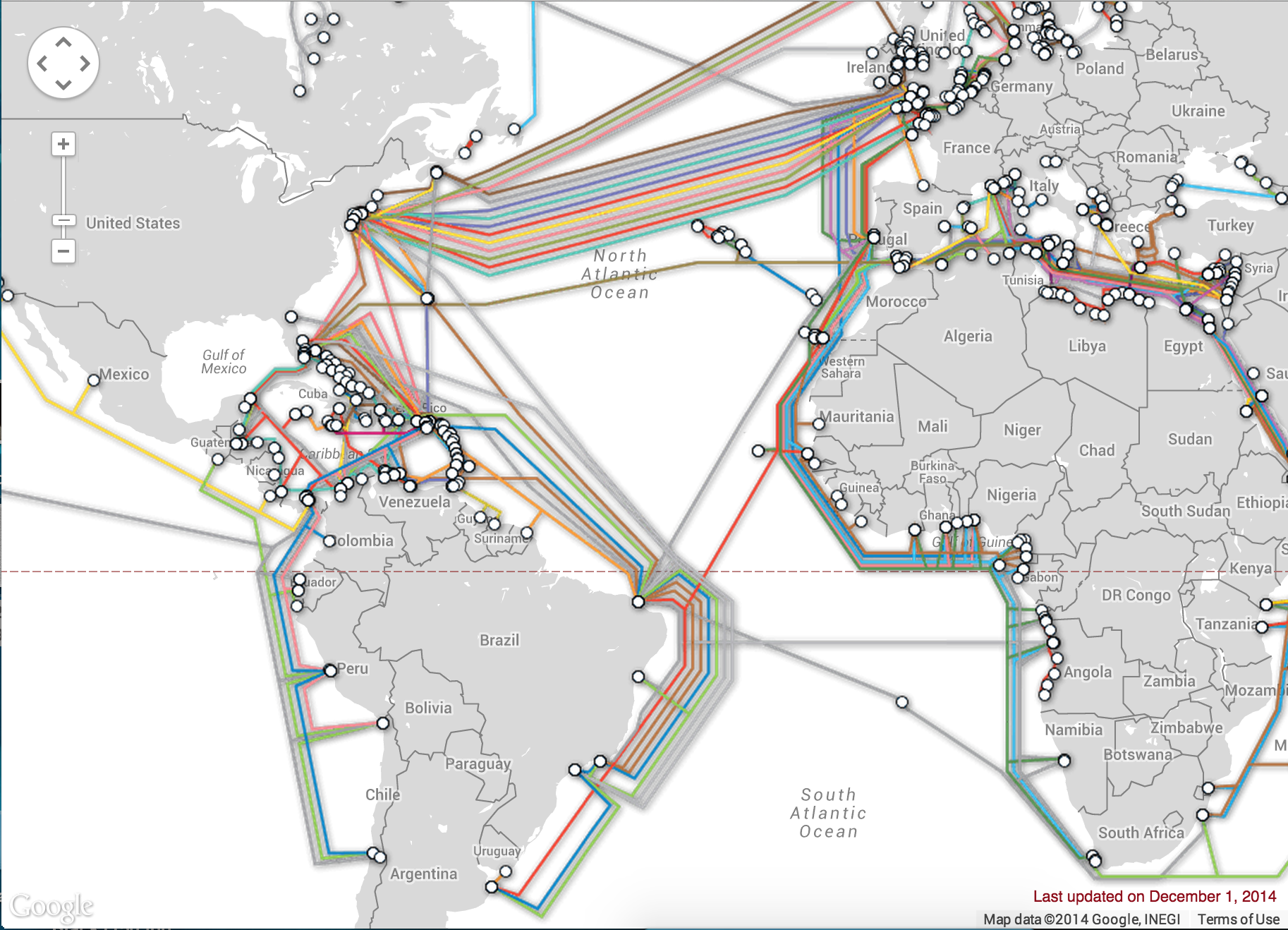
Why are there so few submarine cables between Africa and South America?

Map of transatlantic submarine cable lines as of 2014, courtesy of SubmarineCableMap.com.

I think looking at the map on the right shows how stratified the layout of communication technology is for the Atlantic Ocean region. So much up top and spilling vertically down (on both sides), but so little between the bottom.

Why are there so few submarine cables between Africa and South America? Between Nigeria/South Africa/Angola and Brazil/Argentina/Venezuela?

Surely there would be lots of historical links to share between the two continents, such as post-colonial, post-slavery histories? Or especially the large portion of slaves from West Africa heading to the Portuguese colony of Brazil? Or the histories of exploitation of labor and natural resources? Or musical and artistic commonalities?

I mean, Brazil literally faces several African countries along the same set of latitudinal lines (more so than a good portion of North America faces Europe), but yet there are maybe one or two submarine cable lines between these countries.

Why is that? Is it neglect? Is it money? Is it racial anxiety (which would be weird gives how many Europe-to-Africa lines there are)? Is it linguistics?

And what would be gained if this were changed with the building of new lines between the two regions?

I think that more equitable trade, cultural ties, freedom of expression, and all institutions which depend upon these developments would only gain in strength and viability – while shrinking only in cost barriers and administrative burdens. It would also reduce the cost of communication between other regions which go through these regions (especially South Asia, which has several cables running to East Africa).

So I’m glad to read that there are two lines currently being built between the two regions: SACS (South Atlantic Cable System) between Fortaleza/Fernando de Noronha (Brazil) and Sangano (Angola) in 2016, and SAEx (South Atlantic Express) between Fortaleza and Windhoek (Namibia)/Mtunzini/Yzerfontein (South Africa)/St. Helena in 2017.

These lines will be the first to connect the two continents directly. I hope that they will help bridge the gap between these two superactors in the Global South.