Tag Archives: california

California and Other Blue States Should Declare a Congressional Redistricting Emergency

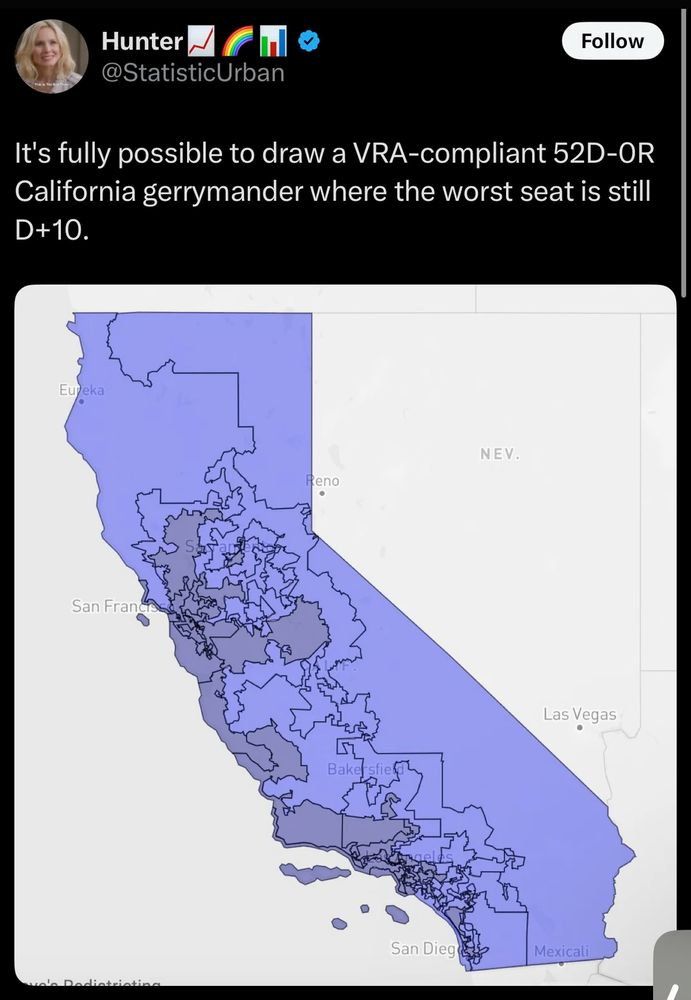
From Hunter @StatisticUrban: “It’s fully possible to draw a VRA-compliant 52D-0R California gerrymander where the worst seat is still D+10.”

In 2008, California voters established the California Citizens’ Redistricting Commission to redraw state legislative districts, and in 2010, extended its powers to redraw congressional districts.

Within portions of the California Democratic Party in 2025, the latter power to redraw congressional districts is widely perceived as an act of unilateral disarmament when it comes to the empowered Republican legislative majorities in Florida, Texas and North Carolina. And now that both Trump’s White House and the Texas Republican Party want to eliminate as many as five more Democratic-held metropolitan seats in Congress, the idea of Newsom calling a special legislative session to refer an amendment to the voters to restore partisan gerrymandering powers to the legislature is being trafficked to news outlets.

In my opinion, California should keep their citizens’ redistricting commission, but should amend their constitution to provide for a “congressional redistricting emergency” period for legislative redistricting of congressional districts until the majority of congressional districts nationwide (217 out of 435 seats), or more broadly, every state assigned three or more congressional districts through reapportionment after each census, are covered by state constitutions which provide for citizens’ redistricting commissions.

Based in part off of the 2016 Interstate Compact for Fair Representation Act (SB 0322), which was proposed by then-Illinois State Senator (now Illinois Attorney General) Kwame Raoul, and passed the State Senate before dying in committee in the State House, here’s how I would amend the California State Constitution Article XXI Section 1 to carve out this exception:

“(b) In the year following the year in which the national census is taken under the direction of Congress at the beginning of each decade and in which at least one state with three or more congressional districts at the time of redistricting has not enacted the terms of Article XXI in substantially the same form in their own state constitution as applies to the constitutional districts of their state, the Legislature shall retain the right to amend a map of congressional boundary lines as proposed by the Citizens’ Redistricting Commission and to approve said amendments by majority vote of both houses and approval by the Governor. The Legislature shall retain the right to amend said boundary lines in an intervening year if any state enacts a similarly-timed adjustment of congressional boundary lines which fails to espouse the terms of Article XXI. Such compliance with this subsection shall be determined by the Secretary of State, who shall declare a state of congressional redistricting emergency to terminate upon determination of such compliance.”

This way:

  • only a small portion of Article XXI would be amended to carve out the time-dependent congressional exception, since we’re wanting more states to adopt Article XXI in substantially the same form for their state government.
  • Furthermore, it would encourage more Democratic-led states to keep their congressional gerrymandering powder dry for when it is needed for when interstate and anti-presidential conflicts arise.
  • it would allow the Legislature to respond to mid-decade redistricting by another state if necessary.
  • Finally, it would empower the Secretary of State to determine if any state has failed to adopt the terms of Article XXI in their state constitution to trigger legislative intervention.

This power should not be held by the legislature in perpetuity. This should be an emergency power that is used to stabilize Congress in a time of interstate conflict. It would be a departure from unilateral disarmament, instead treating interstate relations as a theater in which to seek diplomacy, mutual defense and good government.

But I can see such a move irking those who have pushed for decades in the trenches to unilaterally enact citizen redistricting by ballot initiative or legislation. I also acknowledge that Republican-led states like Arizona and Montana would be within their right to adopt similar exceptions to nonpartisan redistricting for congressional gerrymandering. Yes, this could become a “race to the bottom” as put by State Assemblymember Alex Lee.

In the Anglophone hell that is our first-past-the-post, single-winner elections for legislative branches nationwide, unilateral disarmament is no virtue, and keeping your gerrymandering powder dry to force concessions from other states is no vice.

I encourage readers to read this Penn State Law Review paper by Zachary J Krislov as well as this University of Chicago Law Review paper by Samuel P. LeRoy for great breakdowns on these “interstate compact” trigger laws on redistricting, the histories of such proposals and their potential efficacy.

Arreguin’s SB 9 and its possibilities

SB 9, authored by freshman state senator Jesse Arreguin, was the first major pro-housing bill passed by the California State Senate this session. It now goes to the Assembly.

[BILL ALERT] SB 9 (2025), which clarifies and strengthens HCD's enforcement authority over local ADU ordinances, has passed the Senate floor by a vote of 27-4! Congrats to author @jessearreguin.bsky.social on this win. Learn more about this bill: cayimby.org/legislation/…

California YIMBY (@cayimby.bsky.social) 2025-05-28T18:11:14.308Z

SB 9 was originally written to “remove the requirement of property occupancy and amend parking standards” for ADUs, but was amended in committee to simply allow the California Department of Housing and Community Development (HCD) to 1) void any noncompliant local ADU ordinance 2) substitute with state ADU law until local govt passes remedial fixes.

Also noting that, under AB 72 (2017), the HCD is allowed to decertify a local government’s noncompliant housing element (after locals’ nonresponse to repeated notices), which results in “builder’s remedy” kicking in until a complaint housing element is approved. This is the most direct enforcement action possible for HCD under current law.

SB 9 (Arreguin) would give some more teeth to HCD’s reactive enforcement powers beyond simply informing the AG of violations to trigger litigation. Theoretically, it would also function as another “builder’s remedy” for developers seeking to build more housing in the interim. (Would have been nice to keep the original text as well, but whatevs.)

Thinking that if SB 9 (Arreguin) becomes law for ADU ordinances, this could also become a template for future bills allowing HCD to temporarily void other implementing ordinances (as allowed by the HOME Act, SB 10, SB 6, AB 2011, etc.) and trigger builder’s remedy.

I’m getting the sense that Arreguin’s bill received better treatment in the Senate than Scott Wiener’s SB 79 (or Buffy Wicks’ AB 609, which just passed the Assembly this week) will likely receive because legislators are more receptive in this term to codifying stronger enforcement of existing state law rather than expanding allowed types of housing, exempting them from certain barriers, or investing more money into “affordable” housing.

Given that HCD will likely be placed by Newsom’s budget under a new California Housing and Homelessness Agency (CHHA), Arreguin’s SB 9 (if passed) will strengthen the state’s hand (and that of housing developers) against intransigent counties and cities in the years to come.

Idea: Remote state residency

As more people move out of (or are displaced from) California, maybe the state government should consider a type of state residency which can be exercised from other states.

Idea: a remote state residency.

  • Would allow for the following to apply as remote residents of the state without physical, permanent domicile in the state:
    • Non-residents
    • former residents
    • prospective transplants from other states
    • those born in the state of California 
    • Non-residents who apply for any state volunteer program
    • Non-residents who apply to study remotely or in-person at any California public college or university
  • Would allow for participation in in certain, but not all, activities and services accessible to active California residents
    • Would issue remote residency cards to successful applicants
    • Easier process for applying to CSU, UC and CCC colleges for remote study
    • Easier, discounted process for applying online to California-based public libraries for digital assets
    • Easier process for applying to California Virtual Academies (or state-operated online K-12 public school)
    • Invitations to voluntary programs
      • California State Guard (CSG)
        • Maritime Component
        • Army Component
        • Air Component
      • Programs of the Chief State Officer
        • College Corps
        • California Climate Action Corps
        • Youth Jobs Corps
        • AmeriCorps California
        • Disaster Volunteer Management
        • Alumni Network
    • Automatic application to remote residency for non-residents who volunteer for the above
    • Easier remote company formation, banking, payment processing, and taxation
    • Zoom marriages certified and officiated by California county clerks
  • Must be renewed every five years
  • Why:
    • Many people are driven out of California by the housing crisis
    • Many are hoping to leave other current states of residency due to policy
    • No state services are afforded to those who study online in CSU, UC or CCC systems
    • No state services are afforded to those who work remotely for California-based businesses and organizations
    • Remote work and service is an increasing reality, as is the growing interconnectedness of communications
    • The e-residency programs in Estonia and Lithuania offer a forward-looking attempt to extend the concept of citizenship to those who wish to do business in either country
    • This remote residency program would empower many more people to empower California, and would be an investment in our own future as a state

ADOS and Caste discrimination

Progress is being made on SB 403, a California bill to prohibit caste discrimination, despite the protests and opposition of upper-caste people of South Asian descent. However, I’d argue that African Americans who are descendants of U.S. enslaved people should find a stake in this legislation.

There is an argument to be made for African Americans who are descendants of antebellum slaves to claim a stance against caste discrimination. The slave status had a unique impact upon the immediate generations of those enslaved as well as their descendants, even to the present. Those who are descended from antebellum slaves cannot claim descent from willful immigrants who switched their prior nationalities to embrace that of the U.S. citizen. They also cannot claim to be indigenous, aboriginal or autochthonous in their historical ties to the land claimed by the United States. Instead, their ties to this nation are rooted exclusively in the enslavement of their ancestors on this land. 

Race, including biases and prejudices along such lines, cannot and does not explain this status and its implications upon this community. The ADOS movement correctly claims that “lineage” from the enslaved entitles this community to specific legal consideration distinct from more recent immigrants of African, Afro-Caribbean or Afro-South American origin. 

But the word lineage, arguably, does not exactly entail the historic socio-economic, political, environmental, ethical and institutional treatment of those who are of said lineage. Isabel Wilkerson’s thesis of the distinct position of the American descendant of slaves within an hierarchy of submission and exclusion as a “caste” position goes further to encompass this status position. 

It is therefore of interest to those who seek continued structural transformation to eliminate and undermine this system, to allow for more race-neutral avenues to enable total socio-economic mobility for African-Americans, to embrace the legal prohibition of discrimination against perceived lower castes of society in the United States. 

It would be in the interests of advocates for racial justice to also tackle discrimination on the basis of caste against the descendants of freedmen. By treating descendants of freedmen as a socio-economic caste parallel to an ethnic group, legal discussion of race can become divorced somewhat from the specific conditions visited upon these descendants as opposed to others who faced lesser acts of institutional discrimination. 

Legalize Marijuana and Abolish Cash Bail for Nonviolent Offenders

I read once that we’re living in the “justice reform era”. Marijuana legalization seems to be the landmark product of this era.

However, the news coming from post-legalization states is that, for its suspension of much of a local theatre of the long War on Drugs, the poor of color are not the biggest beneficiaries of this regime change.

What we do know, so far, is that white people, Latinos and homeowners are the biggest beneficiaries of marijuana legalization at the state level, especially in California. Black people who use weed while within or near their residence run a higher risk of offending the terms of their lease with their possession of weed, especially those who live in federally-funded housing.

So how do we mitigate the impact of “smoking weed while black”? One way is to abolish cash bail for those accused of nonviolent offenses, like using marijuana.

Imagine marijuana-legal California abolishing cash bail. Being the biggest state that would do so, those who are arrested for nonviolently offending the remaining state-level marijuana laws (among other laws) can be released quickly from jail on their own cognizance so that they don’t lose their jobs, homes, cars, or other life needs. Poor people of color, including those who use legal amounts of marijuana, would be major beneficiaries of abolishing cash bail and related pre-trial expenses.

Ending this financially-oppressive practice for all accused nonviolent offenders can make California a more economically-fair place to both live and use weed for poor people of color.

Maybe this can be encapsulated as a “pro-forgiveness” agenda, in which those who, by indirect way of an authority figure’s perception of a person’s unchangeable background or features, receive more disproportionate punishment for crimes or offenses which are committed at the same rate by all suspect classes can receive effective amnesty and expunging of their records.

With legal weed (in California as of this year), restrictions on civil asset forfeiture (already passed in California in 2016), the shifting of many felonies to misdemeanors (already passed) and cash bail abolition for nonviolent offenders (yet to be passed), we will see greater economic mobility for the poor of color.

I can’t wait to see both marijuana and cash bail reform happen in the same state.

LGBT, Minority Rights Focus of Several Bills Signed in Last Legislative Session | Diversity | Agenda | KCET

California has really progressed on LGBT rights this past session. Cheers to Gov. Brown and the California Legislature Dems in Sacramento!

Now if only the regular police patrol were not armed, and gun control applied to both the government and the public. Hopefully someone can take up that idea next session.

Link: LGBT, Minority Rights Focus of Several Bills Signed in Last Legislative Session | Diversity | Agenda | KCET.

If California fails…

What is to be done? Sure, Obama has won, but since Florida and Arizona have already passed same-sex marriage bans and California seems like it will pass a similar ban/de-recognition, what is to happen now?

Apparently, even though California has one of the highest concentrations of same-sex-identified residents and couples in the world, the state’s general populace has apparently shown that it cannot be trusted to weigh same-sex relationships along same or similar criteria as "traditional", heterosexual relationships.

But now, after California has rejected the recognition of same-sex marriage (and, by extension, the many long-term same-sex relationships in the state), it is time for the LGBT rights organizations to reassess the security of the place of the LGBT demographic in U.S. society, even in such a place as California, and to rethink just how welcome they are within the de-facto democratic process in these states.

Outside of the marriage issue, for example, the movement towards the establishment of the first LGBT-centric high school in the state of Illinois was brought to a halt a few weeks ago by Chicago’s mayor Daley, who "fears" the effects of "segregation" of LGBT students from non-LGBT students. Only two other such schools have already been established in the U.S., one in New York City (which has faced opposition from conservatives) and one in Milwaukee.

The issue of same-sex relationships in prisons has not been resolved at all; neither have LGBT adoption, LGBT migration and asylum provisions, nor standards of municipal provisions for gay/LGBT villages, nor any special assessment of the needs of the LGBT elderly. Even organized self-defense of LGBT individuals, relationships, gatherings or communities has not been considered save by a few LGBT gun rights organizations like the Pink Pistols. Even the homeless and under-poverty-line LGBT demographic (including the LGBT youth) has not been fully considered, nor has empowerment of the LGBT identity in all areas.

But now let’s look at the issue of the seemingly few-and-far-between LGBT population in rural areas, where the movement for "traditional" marriage may draw its highest support and where the stereotypically. Is this demographic as spread out and unconcentrated as we may assume, or is it possible to encourage a better entrenchment of the LGBT population in rural areas?

What can be defined as LGBT values within a rural context in Middle America? How different is the rural LGBT experience compared to the urban LGBT experience, and how should LGBT organizations in these areas be focused and organized towards their empowerment in these areas? And can a full reachout to the LGBT population, closeted and non-closeted, in non-urban areas, including Califiornia, help to redefine how the public views the LGBT demographic?

I think that the answer to all of the above questions is an emphatic "Yes." Rural, Middle American visibility matters in any political situation. Establishing a stronger presence in such areas could potentially push the LGBT rights agenda’s advocacy to new heights of respectability in the political arena.

I think it is time that PFLAG, the HRC, GLAAD and other LGBT-centric organizations begin to assess their rural efforts and outreach if they hope to reverse the tide of same-sex marriage bans that have been passed by most state’s electorates within the last decade. But the only question that remains on such an effort is "How?"