Tag Archives: Donald Trump

California and Other Blue States Should Declare a Congressional Redistricting Emergency

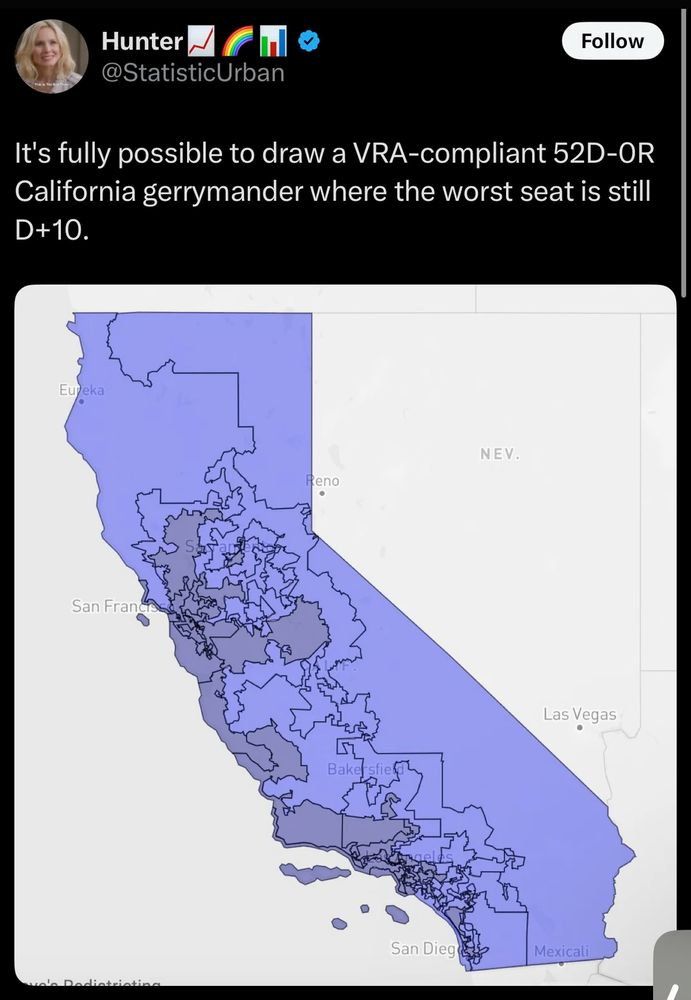
From Hunter @StatisticUrban: “It’s fully possible to draw a VRA-compliant 52D-0R California gerrymander where the worst seat is still D+10.”

In 2008, California voters established the California Citizens’ Redistricting Commission to redraw state legislative districts, and in 2010, extended its powers to redraw congressional districts.

Within portions of the California Democratic Party in 2025, the latter power to redraw congressional districts is widely perceived as an act of unilateral disarmament when it comes to the empowered Republican legislative majorities in Florida, Texas and North Carolina. And now that both Trump’s White House and the Texas Republican Party want to eliminate as many as five more Democratic-held metropolitan seats in Congress, the idea of Newsom calling a special legislative session to refer an amendment to the voters to restore partisan gerrymandering powers to the legislature is being trafficked to news outlets.

In my opinion, California should keep their citizens’ redistricting commission, but should amend their constitution to provide for a “congressional redistricting emergency” period for legislative redistricting of congressional districts until the majority of congressional districts nationwide (217 out of 435 seats), or more broadly, every state assigned three or more congressional districts through reapportionment after each census, are covered by state constitutions which provide for citizens’ redistricting commissions.

Based in part off of the 2016 Interstate Compact for Fair Representation Act (SB 0322), which was proposed by then-Illinois State Senator (now Illinois Attorney General) Kwame Raoul, and passed the State Senate before dying in committee in the State House, here’s how I would amend the California State Constitution Article XXI Section 1 to carve out this exception:

“(b) In the year following the year in which the national census is taken under the direction of Congress at the beginning of each decade and in which at least one state with three or more congressional districts at the time of redistricting has not enacted the terms of Article XXI in substantially the same form in their own state constitution as applies to the constitutional districts of their state, the Legislature shall retain the right to amend a map of congressional boundary lines as proposed by the Citizens’ Redistricting Commission and to approve said amendments by majority vote of both houses and approval by the Governor. The Legislature shall retain the right to amend said boundary lines in an intervening year if any state enacts a similarly-timed adjustment of congressional boundary lines which fails to espouse the terms of Article XXI. Such compliance with this subsection shall be determined by the Secretary of State, who shall declare a state of congressional redistricting emergency to terminate upon determination of such compliance.”

This way:

  • only a small portion of Article XXI would be amended to carve out the time-dependent congressional exception, since we’re wanting more states to adopt Article XXI in substantially the same form for their state government.
  • Furthermore, it would encourage more Democratic-led states to keep their congressional gerrymandering powder dry for when it is needed for when interstate and anti-presidential conflicts arise.
  • it would allow the Legislature to respond to mid-decade redistricting by another state if necessary.
  • Finally, it would empower the Secretary of State to determine if any state has failed to adopt the terms of Article XXI in their state constitution to trigger legislative intervention.

This power should not be held by the legislature in perpetuity. This should be an emergency power that is used to stabilize Congress in a time of interstate conflict. It would be a departure from unilateral disarmament, instead treating interstate relations as a theater in which to seek diplomacy, mutual defense and good government.

But I can see such a move irking those who have pushed for decades in the trenches to unilaterally enact citizen redistricting by ballot initiative or legislation. I also acknowledge that Republican-led states like Arizona and Montana would be within their right to adopt similar exceptions to nonpartisan redistricting for congressional gerrymandering. Yes, this could become a “race to the bottom” as put by State Assemblymember Alex Lee.

In the Anglophone hell that is our first-past-the-post, single-winner elections for legislative branches nationwide, unilateral disarmament is no virtue, and keeping your gerrymandering powder dry to force concessions from other states is no vice.

I encourage readers to read this Penn State Law Review paper by Zachary J Krislov as well as this University of Chicago Law Review paper by Samuel P. LeRoy for great breakdowns on these “interstate compact” trigger laws on redistricting, the histories of such proposals and their potential efficacy.
Civic Sedevacantism: A United States Government-in-Exile

Reading Josh Marshall’s recent post positing a theory of “civic sede vacantism“, which posits that American liberals/progressives need to narratively and linguistically treat the current regime – both in the executive and the judicial branches – is operating so much outside of the constitution that it cannot be expected to curtail or regulate its own abuse of power, and that it is up to libprogs to use state power to curtail federal power and restore constitutional government.

I find the idea interesting in how it comes around to effectively calling for progressive federalism in deed, but doing so from the position of reacting to a “fallen” political order which ought to be rejected in its legitimacy, curtailed from its uses of power, and corrected into a better relationship with its power.

You can find this sort of legitimism/sedevacantism in a number of cases:

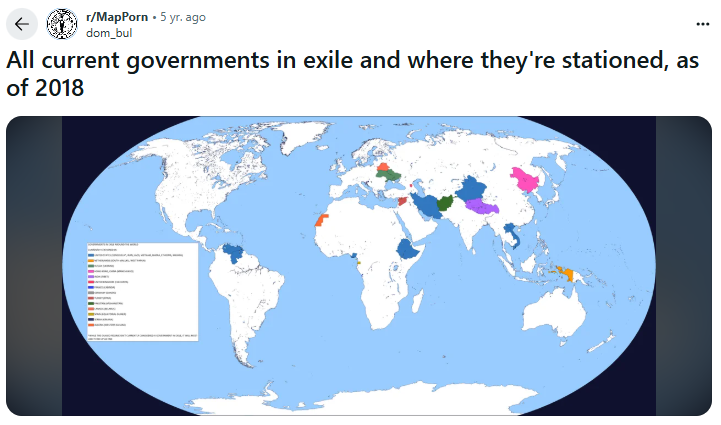
  • Anyone who has ever maintained a government-in-exile after fleeing a country (i.e., the Second Spanish Republic government in exile from 1939 to 1977) or have maintained claims to a former monarchy;
  • Catholic sedevacantism, in which some Catholics reject the legitimacy of any pope since Pius XII due to the holding of the Second Vatican Council, and may instead elect antipopes with rival claims to the Roman papacy;
  • Irish republican legitimism, which posits that the pre-partition all-island Irish Republic declared in 1919 is still in existence and rejects both the 1921 Anglo-Irish Treaty and the existence of the modern Republic of Ireland;
  • Sovereign citizens who believe that the Fourteenth Amendment to the United States Constitution converted “sovereign citizens” into “federal citizens” by their agreement to a contract to accept benefits from the federal government, and that the United States stopped being a legitimate country afterward, instead becoming a “corporation” (the SovCit who originated this, of course, was a white supremacist);
  • Sovereign citizens in Europe (Russia, where some believe that the USSR continues; the Reichsburger movement in Austria and Germany; some in the Czech Republic who believe that the dissolution of Czechoslovakia was illegal, etc)

This can easily go down the road of conspiracy theory mongering, but I can respect the cognitive dedication to an alternate, rival status quo.

But if we’re departing from the status quo narrative, why start with Trump 2? Why even start with George W. Bush’s 2000 “election”?

Equal Rights Amendment

In fact, let’s date it to the moment when Congress erroneously inserted a ratification deadline to the Equal Rights Amendment.

Was it Congress’s authority to impose a statutory deadline on ratification? It’s debatable. Who’s idea was it to add a deadline? These questions have been brought up repeatedly in court.

One can argue that Congress abrogated its legitimacy as a branch of government by interfering with the ratification of a constitutional amendment after its legitimate proposal.

POTUS (Nixon and Carter) and SCOTUS also signed off on this deadline, so they get the chop too.

It’s also how this imposition of an illegitimate deadline, not only for the ERA (1979, then 1982) but also for the DC Voting Rights Amendment (1985), resulted in no further amendments being proposed by Congress after 1978 to this day.

This was supremely violative of the amendment process. It arbitrarily suppressed the relationship of the states with the constitution. It was the moment when the broader Second Reconstruction era ended as a constitutional movement and began to slowly recede, especially after William Rehnquist became Chief Justice in 1986 and John Roberts in 2005.

This abdication of legislative responsibility led to SCOTUS intervening for the right to abortion in Roe v. Wade (1973-2022) and subsequent progressive readings of 14th Amendment jurisprudence, all of which are now vulnerable to retirement. All of that should have been Congress’s responsibility to propose, and for the states to ratify at their pleasure.

So if the White House is constitutionally vacant, so is Congress and SCOTUS, all since 1972.

Civic, constitutional sedevacantism (legitimism?) should apply to all three branches and their actions since 1972, regardless of party or impact. I think that’s a good rupture point.

But what would this mean in practice?

A Progressive, Provisional Congress-in-exile

I’d argue that a sedevacantist position would take the following stances:

  • The Equal Rights Amendment was fully ratified by Virginia on January 15, 2020, and is therefore of legal effect nationwide.
  • The entire federal government since 1972, including all federal government elections and terms of Congress, all nine presidents (from Ford to Trump), all SCOTUS terms, and every statute, executive proclamation and federal judicial ruling, is illegitimate.
  • Yes, even the good laws and decisions, like Roe v Wade, Lawrence v Texas, Obergefell v Hodges, Bostock v. Clayton.
  • The D.C. Voting Rights Amendment, proposed by an illegitimate Congress, was also improperly abrogated by a seven-year deadline.
  • The pragmatic approach would be to engage with the illegitimate federal government, but with a political imagination as to blotting out the legitimacy of every action taken by the federal government against the Second Reconstruction agenda.
  • The more idealistic-but-isolative approach would be to establish a United States government-in-exile:
    • complete with all three branches of government
    • electing a Provisional president and provisional Congress
    • appointing a provisional Supreme Court
    • loyal to the Constitution as amended by January 15, 2020
    • recognizing the D.C. Voting Rights Amendment as still open to ratification by the states, and the statutory deadline of 1985 as invalid
    • open to proposing further amendments by two-thirds of the Provisional Congress
    • selectively supportive of certain statutes passed since 1972
    • diverging from the illegitimate federal government in foreign policy.

And how far could we go with the government-in-exile concept?

(Sidenote: What about state governments? I’d argue that the end of the First Reconstruction era in the South happened through illegitimate means at the state level, such as the forced resignation of Rufus Bullock, the liberal Republican governor of Georgia from 1868 to 1871, when he fled the state under threat from the Klan, which was followed by the significant, forced decline of equality under the law in Georgia. Or how Reconstruction was ended through bloodshed by the Klan. But that is for another post.)

Statutes under a government-in-exile would include most of what was unsuccessfully brought to the 111th and 117th Congresses (the two most recent Democratic trifectas):

  • For the People Act
  • Equality Act
  • American Dream and Promise Act
  • Paycheck Fairness Act
  • Washington D.C. Admission Act
  • Federal Death Penalty Abolition Act
  • Sabika Sheikh Firearm Licensing and Registration Act
  • Raise the Wage Act
  • Family and Medical Insurance Leave (FAMILY) Act
  • Trumka Protecting the Right to Organize Act
  • FAIR Act
  • U.S. Citizenship Act (including the NO-BAN Act)
  • Workplace Violence Prevention for Health Care and Social Service Workers Act
  • George Floyd Justice in Policing Act
  • Puerto Rico Admission Act
  • Farm Workforce Modernization Act
  • Eliminating a Quantifiably Unjust Application of the Law (EQUAL) Act
  • Assault Weapons Ban Act
  • Ensuring Lasting Smiles Act
  • SAFE Banking Act
  • CROWN Act
  • Recovering America’s Wildlife Act
  • Marijuana Opportunity Reinvestment and Expungement (MORE) Act
  • Augmenting Compatibility and Competition by Enabling Service Switching (ACCESS) Act
  • Local Journalism Sustainability Act
  • Averting Loss of Life and Injury by Expediting SIVs (ALLIES) Act
  • American Innovation and Choice Online (AICO) Act
  • Women’s Health Protection Act
  • Democracy Is Strengthened by Casting Light on Spending in Elections (DISCLOSE) Act
  • Fair Representation Act

But then I’d argue that even the most recent Democratic trifecta was playing it safe with the legislation it introduced. A Congress-in-exile would introduce bills to reform the federal government itself by statute, such as:

Finally, this Congress-in-exile can vote to approve by two-thirds for multiple, much-delayed proposals to amend the Constitution, sending them to the active state legislatures.

Conclusion

This is ultimately about changing the narrative about the federal government, away from a do-nothing entity encumbered by an ineffective Constitution, to one in which Congress fills in the gaps.

If it takes having to establish an alternative to this illegitimate status quo regime from abroad, so be it. If this is what it takes to repair the relationship between the United States and the world, so be it.

The deep wound inflicted by a wayward Congress against the Constitution since 1972 through a ratification deadline clause has to be resolved, even if by a Congress in exile.

Progressive Federalism: Bifurcate All the Things

The 10-5 en banc decision by the U.S. 5th Circuit Court of Appeals, which blocks laws in Mississippi and Texas allowing for ballots to be counted if they are postmarked by Election Day, will likely be appealed by SCOTUS, which may very well allow for the ruling to stand nationwide for federal elections. This, alongside congressional action supporting the SAVE Act which would double-block noncitizens from voting in all federal elections, shows where things are headed under Trump-Musk.

Under the shadow of this regime, perhaps the most expensive part of progressive federalism will be the bifurcation between state and federal functions, even if for progressive ends.

But in terms of vital elections, postal mail and the census, blue states will need to separate as much of their operations from those of the federal government in order to legally and functionally protect themselves and their citizens from federal overreach, reject federal funding, and maintain their sovereignty.

Bifurcation is a major, inevitable part of progressive federalism, no matter how high the price tag. It will allow blue states to innovate in favor of their residents, even in times such as these.

Bifurcated voter rolls and state elections

Separate voter rolls for state-local and federal elections would protect blue state elections from federal overreach:

  • In addition, it would protect permanent residents who wish to vote in select local elections.
  • Protect LGBTQ voters
  • Allow for holding (preferably consolidated) state and local elections on a separate date from the federal election

Like Obamacare, this is a Heritage Foundation idea which can be repurposed for progressive ends. Arizona, since 2014, has been the pioneer in pursuing this idea, as voters who are unable to provide hard documentary evidence of citizenship are only able to register as “federal-only” voters under Arizona law until they are able to provide such evidence.

The progressive response would be to switch it somewhat: “federal-only” ballot (general or special) for those who can provide such evidence of citizenship, “state-only” ballot (on another date) for those who can’t.

To reiterate, this will also help blue states who want to hold general elections on a date separate from the federal election, possibly in an odd year. I would like to see state, local and lower elections held together on Sundays or Saturdays.

And any worry that this would overburden election works should be eased by making the state legislature (1) unicameral (2) termed to four years and (possibly 3) staggered.

Separate state census

The United State Census Bureau cannot be the only survey agency in town anymore. As it is coming close to adding a citizenship question and has repeatedly failed to institute requested reforms such as identifying incarcerated prisoners to help end prison gerrymandering, it is perhaps time to bring back state censuses. This would also be beneficial for LGBTQ residents who have not been correctly identified in past censuses.

Separate state postal service

  • An example of “local post
  • Complete with separate postage stamps, letter boxes and mail trucks
  • Protection from the Comstock Act and other federal censorships (i.e., on obscenity)
  • Postal banking (which was previously a feature of the USPS from 1911 to 1966)
  • Vital for carrying state-level mail ballots
  • Potential state census assistance

State communications commission

The FCC has been beset by conservative opposition for decades when it comes to regulatory capacity, especially when it comes to issues such as net neutrality. Now that conservatives have control over the FCC, blue states (like California) have the opportunity to stake out more regulatory power over communications within their borders, even within constitutional boundaries. The time for state communications commissions is upon us.

Interstate election security compacts

The Electronic Registration Information Center (ERIC) is a good example of a nonprofit foundation acting as a de facto interstate compact commission in its assistance to state governments, namely in maintaining voter rolls.

Now Arizona Secretary of State Adrian Fontes is making such a move regarding protection of elections from foreign interference:

After the Cybersecurity and Infrastructure Security Agency (CISA) cut funding to its election security programs, Arizona Secretary of State Adrian Fontes (D) is taking matters into his own hands and forming an alternative program to fill CISA’s void for state and local election offices.

According to a memo obtained by Democracy Docket, Fontes’ office wants to form a new organization called VOTE-ISAC, “an independent organization committed to safeguarding elections and restoring international confidence in the integrity of our democratic processes.” The idea for the program is to fill the void left by CISA’s crucial Elections Infrastructure Information Sharing and Analysis Center (EI-ISAC). 

A spokesperson for Fontes’ office told Democracy Docket that he started work on this plan well before CISA cut its EI-ISAC program and has already been in touch with different states and stakeholders to get on board with the proposal. 

We need more of this, in the absence of federal support. In addition:

  • Interstate replacements for the FEC regarding campaign finance
  • Interstate Replacement for the EAC for election standards,
  • Interstate redistricting clearinghouse which eases disputes between states regarding redistricting at all levels.

Protect voters’ rights to free and fair elections

And of course, it is a good time to pass legislation like:

  • State Voting Rights Act
  • Independent Redistricting amendment
  • Universal vote-by-mail
  • Right to free and fair elections amendment
  • Multi-winner proportional representation for state and local elections
  • Campaign financing regulations for ballot initiatives

State DARPA and defense intelligence

The firings of professionals, including TGNC individuals, from military and civilian service in the federal government have opened a door for expanding state defense force capabilities.

A research and development (R&D) office under a state defense force can help to hire some of these trained professionals back into the realm of military science, research, development and innovation without federal interference. 

This proposal would establish a minimal operation which, if allowed, can expand further based upon the wishes of the legislature and the needs of the SDF command structure. 

In addition, it would allow for the hiring of those who wish to continue pursuing trained, intelligence-related work, particularly in the field of geospatial intelligence. 

Finally, it would fit into the larger purpose of redirecting all feasible resources in the larger state military department (which usually runs both the National and State Guards under a state adjutant general) to within and under the state defense force specifically, as the state can no longer expect the Department of Defense of the United States to abide by shared values. 

And more

interstate equivalents to CDC, Department of Education, HHS, NPS, HUD, etc.

An End to American Exceptionalism

So….

That happened.

I hope this is an end to American exceptionalism. I hope it’s an end to the idea that we could never have a(n auto)coup attempt against the U.S. government take place, that we’re not built like that.

Numerous people around the world can tell first-hand about how things went when a coup or coup attempt took place, when the constitutional order was seized and abrogated, when the reset button was pressed, when the machine was unplugged because someone felt it was acting too buggy.

This is the first time that someone tried to abrogate the constitutional order of the United States, and it unfortunately was the fascist side which made this attempt. And it is pretty damn symbolic that only 24 hours earlier, Georgia voters played by the same damn rules which had been decried for giving Biden the win in November and gave a giant L to two Republican Senators. Yet, such an event as happened on Tuesday was not on the front pages of the struggling newspaper industry on Wednesday.

And now we see how buggy and limited in functionality the constitutional order is when it comes to responding to such an incident as what happened Wednesday, as well as our current chronic inability to fix the limitations of the 25th Amendment. We’re likely not going to see it invoked before January 20th.

But yet, we’re forced to live with the garbage structure of the 1787 Constitution, because we’re scared of how people who decided to flex their perceived privilege and assault police inside the Capitol building and are now in various levels of dispersion from scrutiny are more than willing to kill people and avoid consequences in the attempt to seize power.

I fear impunity. They may get away with it, Congress may do nothing, and we’ll be effectively living under a different set of rules than what applies to Trump and his shitty supporters, even after he leaves office.

And we also won’t be exceptional in that regard. After all, despite her family’s crimes in office (including her husband, “our man in Manila” who we effectively rescued from the consequences of his actions), Imelda Marcos was allowed to come back and serve in the Philippine Congress twice.

(Fun fact: Mom was living in Clark AFB, and still remembers the curfew enforced on the base the night that the Marcos family fled Malacañang Palace 83 km north to Clark AFB, where they spent two days and then flew to Guam, then to Hawaii. I was born in California almost a year after the People Power Revolution.)