In Georgia (for example), if we insist on holding elections for most statewide executive offices, these offices should be made nonpartisan:
Secretary of State
Attorney General
State Superintendent of Schools
Labor Commissioner
Agriculture Commissioner
Insurance and Fire Commissioner
Public Service Commissioner
I would like to see the above change appended to SB 14, which would make district attorney and solicitor general elections nonpartisan. Hell, add it to sheriff elections as well.
None of these should be subject to the partisan primary filter or party labels.
I somehow ended up reading a blog post from a “New Right” “intellectual” blog about the difference between Patronage vs. Constituent Parties, and why the Republican Party is more prone and capable to punish those supporters who do not sufficiently support the party (or specifically the party leader). I will purposefully not link to it, but I found the argument interesting.
In the American political system, the only party structure best suited to sufficiently punish campaign workers and consultants who are blamed for losing an election by casting them into the outer darkness of unemployment is one which swears loyalty to the party leader, not one which embraces its constituent groups and allows for their challenging of party leadership.
The Democrats, in their decades-long post-New Deal incarnation as a coalition of constituencies, do not get to punish or exile their lesser-performing or confrontational apparatchiks, no matter how tiresome they may be. The Republicans, as a vanguard of the old stock Americans and those who seek alliance with such, do.
The desire of Berniecrats to punish Manchin, Sinema and their enablers in the last Dem trifecta reflected a preference for a party structure which doesn’t exist, and is not allowed to exist, in the Democratic coalition.
Not even the DSA, with its own coalition of constituencies which sought to capture the left of the Democratic coalition, could pull off a party machine which punishes those who fail the platform and campaign.
For the left-of-center to discipline or punish its own would require a significant abandonment of diversity, coalition-building and consensus, in favor of patronage, hierarchy and corporate leadership, in which open dissent or failure results in loss of access to party leadership.
tl;dr: Pick your poison. Internal democracy does not make for a strong party machine.
The wedge argument that the ADOS/FBA/AfAm nativist movements hinges upon is that African Americans who were enslaved on American plantations are uniquely disadvantaged compared to even other Americans (Afrodescendant or otherwise) who immigrated voluntarily.
Unfortunately, the ADOS/FBA/AfAm nativist movements parlay this wedge into helplessness and futility toward the WASP American power structure, as well as a wide-ranging angst and contempt against almost everyone else in the world.
For liberals and progressives, what is the utility of this wedge which separates descendants of the antebellum enslaved in the United States from descendants of those enslaved elsewhere?
How do those who do not share in the mythology of the voluntary immigration experience – particularly of the depiction of immigration as a formative, affirmative rite of passage and ethnogenesis – deal with this wedge in a healthier way than ADOS’ nativism? Or, alternatively, being a Black expat?
I fear that progressives and liberals do not yet have an answer to this wedge, no way to resolve the contradiction of a big tent bringing together descendants of slaves, immigrants, aborigines and settlers.
Enough of the big tent broke ranks to vote against that solidarity and sacrifice some immigrants’ dreams, livelihoods and potentially lives in the name of security and certainty.
We need a better arrangement to bridge this wedge, a liberalism which can respect and celebrate immigrant experiences while respecting that it’s not a formative experience for some ethnicities and may be less pleasant to experience in reverse from the most powerful country on earth.
We need a liberalism which can promote immigration as a benefit for those who did not experience immigration, even for those who are descendants of forced migration and enslavement like myself.
Racedep (race depolarization) happened this election, to the benefit of anti-immigrant, anti-urban conservatives like Donald Trump. Promoting an alternative integrative social contract will be a major task of the post-Obama Democratic coalition.
I very much favor how the Labour Parties in the UK and Australia nominate candidates for public office compared to the way that American parties nominate theirs, even though they have a parliamentary system compared to our presidential.
The primary and the caucus, which has been in increasing use by both major parties in the United States since the early 20th century but especially after the 1960s, are both paranoid, time-consuming, irresponsible, expensive garbage in comparison.
The primaries and caucuses have placed us in such a position that we are bowing down to:
the millionaire and billionaire donors and barons who fund primary candidates’ campaigns and think tanks;
the Republican, anti-democratic state governments who control the primaries;
pollsters and TV talking heads who have a vested interest in the dramatic rot and instability of the republic for their ratings and ego.
Things should not be this over-engineered. We should not feel this helpless and listless. Democracy should not involve sacrificing any political party’s freedom of association for the sake of financial expediency and outsourcing of responsibility to people with conflicting and divergent interests.
We should not use primaries and caucuses, both of which necessitate the demand for more money and advertising unleashed by the Citizens United decision.
But this century-long snowballing disaster has come to dominate our political thinking, at the expense of democracy in the republic.
Getting Biden to withdraw will not begin to fix the fundamental rot caused by the primary as an extension of the general election.
Reforming our elections toward various flavors of nonpartisan blanket primary will not solve this rot, either. In fact, it may further it, I’m sorry to say.
We are not a multiparty system because the primary and caucus, combined, is treated as an extension of the first-past-the-post general election, as a public utility to be regulated by state governments, even if they are ran by rival parties.
And now, fascism and feudalism govern so many states – and maybe soon the White House again – because our two-party system does not allow for building a cordon sanitaire, a clean rope, against anti-democratic forces.
Europe’s parliamentary systems understand this. Latin America’s presidential but proportional systems (except for Argentina, I guess) are made starkly aware of this, even as those presidential systems lead to rival parties in control of either branch of government and coming to frequent blows against each other. Their citizens often know which parties to block from power.
They also, mostly, understand to let parties be parties, and to not outsource the responsibility of nominating candidates or authoring legislation for legislative or presidential office to the state or to think tanks.
But to Americans, such thinking is foreign. Parties have long been weakened and demonized as an institution at all levels of government by the paranoid majority for generations.
We have become ideologically polarized, but have not allowed ourselves to split parties, represent those who support us, and not appeal to anti-democratic constituencies.
Why didn’t we? Why haven’t we?
And are we too late?
How much longer do we this rot fester before we start treating parties as parties, respecting their role in society, and let them flourish on their own power?
Hopefully this election will lead to that reckoning, one which we thoroughly deserve.
Or, alternatively, we will experience further, misguided destruction of the republic.
Qualifying for the May 21 Democratic primary and nonpartisan election ended last Friday at noon.
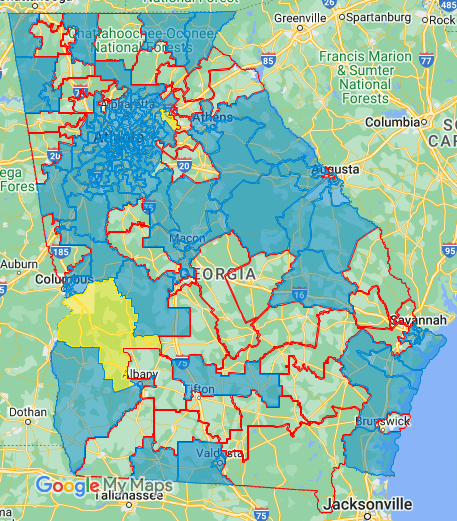
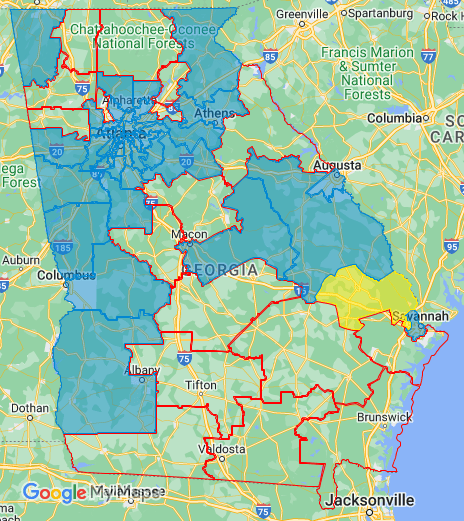
House seats being competed for by Democrats in November 2024. Districts in yellow are Biden-voting or slightly-Trump-favoring districts according to 2020 data. Senate seats being competed for by Democrats in November 2024.
Statewide:
John Barrow is running for Andrew Pinson’s seat on the Supreme Court. This is the first likely-substantial contest against an incumbent justice in years. This “nonpartisan” election is on May 21.
There will be a “nonpartisan” contest for an open seat on the State Court of Appeals. Attorney Jeff Davis will face off against Cobb County Magistrate Judge Tabitha Ponder. This “nonpartisan” election is on May 21.
The Public Service Commission elections have been cancelled again, and the current commissioners will remain on the ballot for the next two years. It’s likely that we will be voting on all five commissioners in 2026.
We are now running for 38 seats (2/3rds) in the Senate and 135 seats (3/4) in the House. To compare, since 1992, we’ve ran for at least 75% of the House in 1992, 1994, 1996 and 2020.
We are running for District Attorney positions in 14 circuits. There will be Republican challengers in three circuits: Atlanta, Chattahoochee and Eastern.
Democrats are running for all 14 congressional districts. There will be Republican challengers in all but GA13.
At the end of qualifying, we left HD104, a Biden district in Gwinnett County, HD151, a slightly-Trump voting district in Southwest GA, and SD4, a Biden district near Savannah, on the table.
And now for local elections around Columbus:
We will have a Democrat, Carl Sprayberry, for HD139 (open).
We will have a Democrat, Ellen Wright, for SD29.
Debbie Buckner in HD137 will have a primary challenge from Carlton Mahone Jr and a Republican challenger.
Teddy Reese in HD140 will have a Democratic challenger in Alyssa Nia Williams.
There will be a Democratic primary for the open seat in deep-red GA03. Val Almonord, who was the Democratic nominee in 2020 and 2022, will have a challenge
There will be a Republican challenger for GA02.
We now have a Democrat running for District Attorney in Chattahoochee Circuit: criminal defense attorney Anthony L. Johnson. He has no primary opposition, and will be on the ballot in November against Republican and acting DA Don Kelly. We are also challenging a Republican for DA in Eastern Circuit as well.
Our incumbent Sheriff Greg Countryman is running for re-election as a Democrat. He will be opposed in November by Republican Mark LaJoye.
Our incumbent state court solicitor Suzanne Goddard, who previously held office as a Democrat, is running for re-election as a Republican. We have a Democratic challenger in Shevon Sutcliffe Thomas.
Buddy Bryan is running for re-election as Coroner as a Democrat. He will be opposed in the May primary by Royal Anderson. No Republican is running in November.
Lula Lunsford Huff is not running for re-election as Tax Commissioner. David Britt is running as a Democrat for the position and is unopposed in May and November.
We will likely not have a challenger to Gary Allen for Council District 6. A potential candidate fell through. I am sad about this as well since I live here.
Toyia Tucker will have a challenge in Council District 4. This “nonpartisan” election is on May 21.
There will be a four-way race for Council At-Large 10. This “nonpartisan” election is on May 21.
There will be a contest for Board of Education District 7, with Lakeitha Ashe challenging incumbent Pat Frey. This “nonpartisan” election is on May 21.
Incumbents unopposed in May and November: Danielle Forte (D) for Superior Court Clerk, Reginald Thompson (D) for Clerk of Municipal Court, Marc D’Antonio (D) for Judge of Probate Court.
No contests for HD138 (Vance Smith (R)), HD141 (Carolyn Hugley (D)), City Council Districts 2, 6 or 8, Board of Education District 1, 3, 5, or At-Large 9, nor State Court Judge (Temesgen).
In addition, there may be some party primary advisory ballot questions.
Retirements:
Both Senate Minority Leader Gloria Butler (SD55) and House Minority Leader James Beverly (HD142) are not running for re-election to either house.
Other Senate Democratic retirements: Valencia Seay (SD34) and Horacena Tate (SD38).
Other House Democratic retirements: Doug Stoner (HD42), Roger Bruce (HD61), Mandisha Thomas (HD65), Pedro Marin (HD96), Gregg Kennard (HD107), Gloria Frazier (HD126), Patty Bentley (HD150).
Zoom will have additional features for their VisionOS version: usage of visionOS personas based on face scans, pinning faces of meeting participants with transparent backgrounds in the real-world environment, and 3D object file-sharing.
Japan’s Wakayama Prefecture to become the 21st to create a same-sex partnership registry on 1 February (news in Japanese). More prefectures to create similar registries throughout the year, but no news as to more mutual recognition agreements between prefectures as of yet. Keep track on Wikipedia.
Strong Towns on how Sacramento City Council ended single-family zoning in city limits by increasing the Floor Area Ratio and switching to a form-based zoning code. This is on top of laws passed by the state to override city laws to abolish parking minimums within a 1/2 mile of transit and allowing for homeowners to split their home lots into ADUs.
NYC Marathon refuses to give nonbinary prize money to winner. Rule: “a runner eligible for prize money in the nonbinary group had to be a member of the NYRR for at least six months, and compete in several club-sponsored events. The same rule applies to professional and invited athletes.” Winner: “They added this stipulation to this division following the registration period. It was not there last year.”
Somber news:
Sonar detection found an object which may be Amelia Earhart’s plane somewhere near Howard Island in the Pacific. It took years and millions of dollars, and will take even more to lead an expedition to confirm.
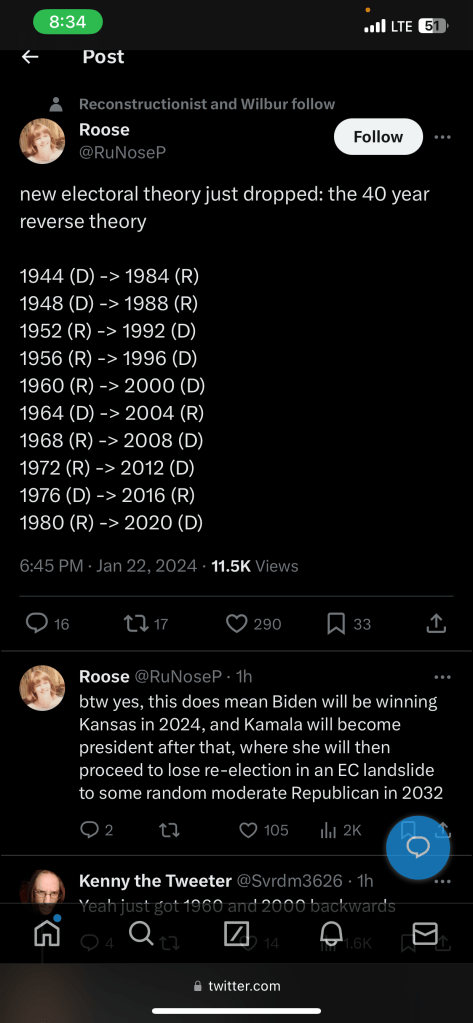
“btw yes, this does mean Biden will be winning Kansas in 2024, and Kamala will become president after that, where she will then proceed to lose re-election in an EC landslide to some random moderate Republican in 2032”
As noted by someone, this gets 1960 and 2008 backward in terms of party. Also, it’s missing “1940 (D) -> 1980 (R)”, although it likely wouldn’t work for 1936 (D) -> 1976 (D).
but still. This is very interesting to think about. This could mean that Dems have eight more years in the White House.
But a bigger question: does that mean that Democrats are headed to winning full control of Congress in a 2034 Democratic Revolution? And does that mean that Democrats will win back the majority of state legislative seats by the 2040s?
One of my long-term goals is to start a 501(c)3 nonpartisan organization to educate the public in support of direct democracy (if no one else does it first).
I understand that the Ballot Initiative Strategy Center (BISC) does an amazing job in supporting the use of the ballot initiative from a progressive standpoint. However, their Defend Direct Democracy campaign page, IMO, doesn’t exactly address how their organization defends the use of direct democracy from legislative and bureaucratic attacks. And they don’t seem to have a resource for model legislation or how to advocate for adding direct democracy to more state laws, including state constitutions.
If there is one thing that more states need – especially states with part-time legislatures, especially Southern states, especially states which lack nonpartisan redistricting – it is direct democracy. But no one is trying to push these states to adopt direct democracy into their state laws, and BISC seems to only play defense for the right to the ballot initiative.
I wouldn’t want this hypothetical organization to duplicate any of BISC’s work, only to do the following:
educate the public on the nonpartisan necessity for the ballot initiative system
build a political and social culture for ballot initiative systems in states which lack such systems
train election administrators on how to implement ballot initiative systems in their election regimes
train and support advocates on expert talking points supporting the ballot initiative system
It is sad that the ballot initiative system only was adopted in some states through the Progressive era of the 1890s-1910s and then largely fell off afterward (save for brief victories in Florida and Mississippi). But just like how once-nearly-abandoned election systems like ranked-choice voting have made a comeback through the likes of FairVote advocating to the public, I want to duplicate the success of the ranked-choice voting movement for the ballot initiative system.
So here’s me sending this idea “out to the universe”: a 501(c)3 nonpartisan organization supporting the right to the ballot initiative system in more states.
Out of the former Confederate states in the period between 1870 and 1901, only South Carolina sent at least two or more members to the U.S. House.
Georgia, Alabama, Louisiana, Mississippi, Florida, North Carolina and Virginia all sent one member at a time.
Texas and Tennessee never sent any members in the (post-)Reconstruction era
and Arkansas has never sent any African Americans to Congress to the present day
Now, Alabama will likely send two Black members to the U.S. House for the first time. And Louisiana is within spitting distance of doing the same for the second time in their history; the first time such a thing happened was in 1993, when William Jefferson (D-LA02 and Cleo Fields (D-LA04) went to the 103rd Congress.
The big question which sticks out for me is whether the Alabama Democratic Party will be prepared for this moment.
They certainly weren’t when Doug Jones won the once-in-a-blue-moon Senate special election in December 2017. In fact, the Alabama Democratic Party, the statewide Black Democratic club ran by Joe Reed, actively fought Jones for influence over the party’s bylaws and structure. The fight continues to this day, years after Jones lost his Senate seat to some bigoted football coach. And it seems like the DNC will have to pry some control of the ADP from the Conference. The Conference also tried to intervene twice in the Allen v. Milligan case to advocate for a more Black-majority 2nd and 7th district (to no avail), which went against the strategy of the plaintiffs as well as Rep. Terri Sewell in favor of two opportunity districts.
Now, however, with Sewell likely to win again in the 7th, the question remains as to the impact of whoever wins the 2nd congressional district. It’s most likely that the winner may be Black, or that whoever wins will have the support of the Black voting-age population in the 2nd district. But will the winner have more of a role in the Alabama Democratic Party? Will the campaign to defend both the 7th and the new 2nd district arouse the party out its current shape?
The same can be asked about Louisiana’s Democratic Party. It is heading to another era in the statewide wilderness with the terming-out of Governor John Bel Edwards and the likely election of a Republican governor. The party has been beaten down badly in other political aspects due to a massive decline in white rural support. Besides retaining Foster Campbell on the PSC in 2026 (he had his closest election in 2020), the other favorable political aspects above the state legislature have been:
the election of Davante Lewis to the PSC in 2022
the possible creation of a second opportunity congressional district around Baton Rouge for 2024
This is why I look forward to the impact of Allen v. Milligan on Southern elections. All of these issues can be challenged in federal court:
the potential second opportunity district in Louisiana
the reform of Mississippi’s State Supreme Court districts
Alabama’s Public Service Commission election method
Georgia’s Public Service Commission election method and maps
It would make sense for a decision in Rose v Raffensperger to come before Thanksgiving, which quickly precedes the start of the special legislative session on November 29. As stated in Saporta Report, this decision will be cited for decades. It will have an impact on voting rights, redistricting and other types of litigation, not only in the 11th Circuit but elsewhere.
But I go back to the VRA litigation saga from 2011-2016 against at-large FPTP elections in jurisdictions like Fayette County, GA, or to the 100+ court cases since 1982 in Georgia alone which replaced at-large districts with single-winner district elections for city councils, school boards, county commissions and legislative districts.
I would be very surprised if the 11th Circuit sided with Georgia on the PSC’s at-large election method. But the clock is ticking on the 11th Circuit to make a decision:
the special session on congressional and legislative districts starts on 29 November;
then a regular session to start in January 2024 for 40 days, which is a chance to change statute law regarding PSC elections;
then a general election to be held in November in which at least another PSC seat (District 5, held by Republican Tricia Pridemore) will be on the ballot (and maybe the two held by Echols and Johnson?), as well as a chance for voters to change Article IV Section 1 of the state constitution regarding the PSC.
On the flip side, the 11th Circuit could rule the case unjusticiable and remove itself from the case. Or they could rule for the plaintiffs but then the state could simply move the PSC to an appointed body instead (like most states). Who knows.