- Virginia: Dems hold Senate, flip House of Delegates
- Don Scott is likely speaker-designate, would be first African-American speaker in Virginia’s 400+ years of legislative history
- Danica Roem wins Senate seat, becomes second transgender state senator in U.S. history, was already first transgender state legislator
- Dems will likely refer constitutional amendments to 2026 ballot, depending on if they hold the House of Delegates majority in 2025. They have lots of options:
- abortion rights (!)
- marriage equality (!)
- voting rights for ex-prisoners (!)
- environmental justice/right to healthy environment
- remove the 30-day limit on legislative sessions
- allow governor to run for consecutive second term
- move state elections to even-numbered years
- prohibit slavery in the state constitution
- have lieutenant governor elected on joint ticket with governor
- Kentucky: Andy Beshear wins re-election as governor:
- Beshear is only the third incumbent governor in Kentucky history to win a second consecutive term, seventh to win re-election overall
- Beshear is the sole Democrat to survive this election statewide. No telling what will happen with the next Democratic nominee for governor in 2027.
- Ohio: Issue 1 (abortion rights) and Issue 2 (marijuana) pass, legalizing both.
- Republican leaders are seething and vowing to attempt repeal of Issue 1
- Pennsylvania: Judge Dan McCaffrey wins seat on PA Supreme Court, keeping the Democratic majority 5-2.
- Democrats flip several county commissions, including some like Dauphin which haven’t been held by Democrats in 100+ years.
- Mississippi: Brandon Presley (D) came close but did not win the governorship.
- Minnesota and Michigan: Ranked-choice voting had a very good night at the polls in several cities.
Tag Archives: elections
Proposals: Delegates to Congress from Native American Tribes and from Americans Abroad
I have two ideas for better representation in Congress:
- an at-large delegate to Congress for Native American tribes (aka the Native American Delegate Act)
- an at-large delegate to Congress for Americans Abroad (aka the Americans Abroad Delegate Act)
A Delegate for Native American Tribes
For several years, the Cherokee Nation and the United Keetowah Band of Cherokee Indians have both pursued the goal of sending a delegate to the U.S. House. The Treaty of Hopewell (1785) and Treaty of New Echota (1835), signed between the Cherokee and the United States, promised a delegate for the Cherokee to Congress, but it was never acted upon until Cherokee Nation President Chuck Hoskins appointed activist Kimberly Teehee as a delegate in 2019. Despite this appointment, Teehee has not yet been seated in any session of Congress.
Similarly, the Choctaw Nation, who received a promise for a delegate in the Treaty of Dancing Rabbit Creek (1830), has never pursued sending a delegate, although the nation did send an ambassador to represent them before the general U.S. government throughout the 19th century. The Lenape Delaware Nation also signed a Treaty of Fort Pitt (1778) with the U.S. government, which encouraged them to form a state that would have representation in Congress, but never pursued either idea.
The issue here is that if the Cherokee (which are split between three tribes) and Choctaw deserve representation, that still leaves over 570 tribes which did not receive such a promise and do not have representation in Congress.
Their political concerns may be better represented by an at-large delegate who is popularly elected by enrolled voters from all the federally-recognized tribes in U.S. territory.
This idea, which may either provide for at-large or perhaps at least two districts on either side of the United States, more equitably support the representation of Native Americans in the federal level of government beyond the bounds of the Bureau of Indian Affairs.
The idea also passes the smell test of the 14th Amendment, as this would be limited only to enrollees of sovereign nations within the United States, including the 1 million who reside on reservations.
A Delegate for Americans Abroad
More countries in the 21st century, including France, Italy, Tunisia and more, have created electoral districts or reserved seats in their national parliaments to allow citizens who live abroad to vote for their own member/representative. This is often a recognition of the diasporas of citizens who keep their nationality and citizenship even as they live abroad for a long duration of time.
As of 2016, there were at least 4.8 million U.S. citizens who live abroad, including Armed Forces personnel, diplomats, businesspeople, expats, their families, and even accidental Americans who were born on U.S. soil to temporary workers or tourists but who have been raised for most of their lives in another country.
Suffrage for U.S. citizens has greatly increased since 1986, when the Uniformed and Overseas Citizens Absentee Voting Act (UOCAVA) was passed. But what overseas U.S. voters are allowed to vote on varies between their state of formal residence, with some only allowing them to vote in federal elections, or some states barring their overseas residents from voting in any election if they have never resided in their formal state of residence.
Furthermore, expecting all overseas Americans to know about the candidates who are running for office on home soil is a tall order.
At the very least, those Americans who reside abroad should have more competent federal representation in Congress from U.S.-citizen candidates who may also reside closer to or on the same continent as themselves and share similar concerns as other U.S. expats.
Similar to France, this arrangement could create more than one district, but that may get into the weeds of reapportionment and how to draw lines to ensure equal population in order to comply with law, at least unless this delegation is exempted from the equal population requirement.
Finally, creating an overseas constituency for one’s parliament is an example of projecting soft power to a country’s diaspora which goes beyond just mere diplomacy, business networking or cultural promotion:
- It creates a “legislator-diplomat” who liaises and and advocates for policy between the home country and its citizens in other countries, albeit more in the legislative branch more than in the executive.
- If a foreign ministry executes the policies developed in the legislative branch which impact overseas citizens, it stands to reason that overseas citizens ought to have a direct say in the legislative branch.
- Even when the policies from the legislative branch don’t directly affect foreign policy, overseas citizens also have an interest in domestic policies of a country to which they may return at some point for as long as they keep their citizenship.
The Belated Entry of Partisan Voter Affiliation Questions into the South?
There is a legislative effort in Tennessee, Alabama, Georgia, Missouri , South Carolina and even Texas to close partisan primaries for elected office and require partisan voter affiliation questions on registration forms, and several individuals are sounding alarm bells about it.
(Note: Missouri’s June 2022 voter ID law (their third attempt at such, set to go into affect in January 2023 pending litigation) requires voters to identify on their voter registration forms with a party or mark themselves as “unaffiliated”).
But I note that most Southern states, save for Arkansas, Florida, Louisiana and North Carolina, have not adopted partisan voter affiliation questions on voter registration forms. The majority of states with partisan voter affiliation (PVA) questions are largely located either west of the Mississippi or in the Northeast.
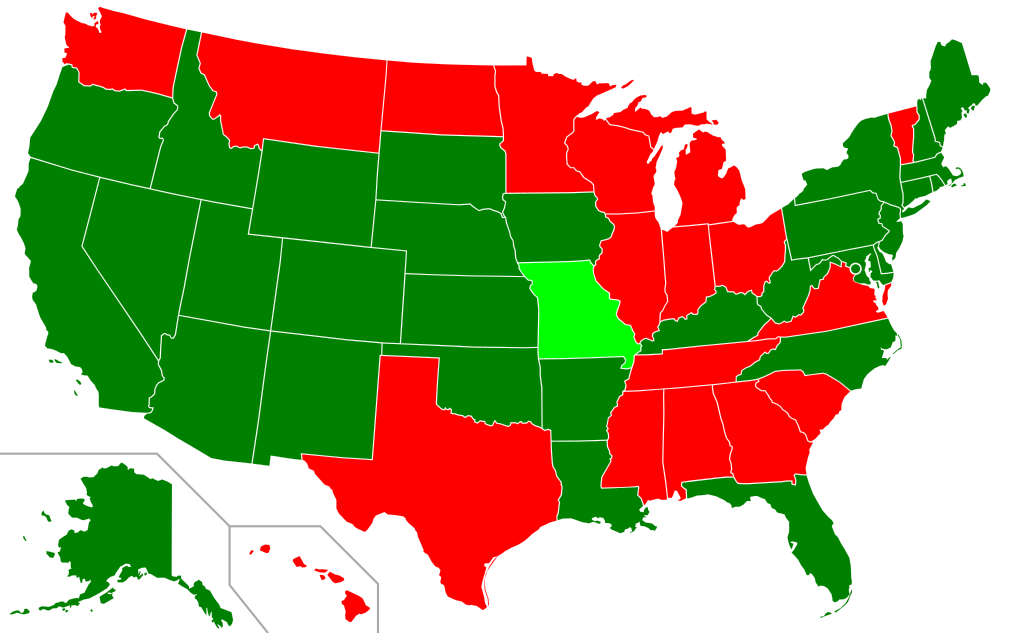
Save for Georgia, the other previously-mentioned states with Republican-led movements toward closed primaries are all deeply-red in terms of legislative share. The current one-party rule in these states increasingly resemble the one-party rule under the then-conservative Democratic Party in these same states. As I noted, only Tennessee, North Carolina and Virginia had uninterrupted instances of Republican legislative representation in both houses (much of it paltry) during the days of Jim Crow. But, unlike most other U.S. states outside of the South, most Southern states did not introduce PVA questions during that same era, and instead suppressed Republican and non-white suffrage through other, more notorious means (including the county unit system in Georgia up to 1963 and its state house-based equivalent in Mississippi up until 2021).
Appendix A in this 1985 study on party enrollment and identification shows that, sometime after publication of this study, Alaska (sometime prior to 1995), Arkansas (sometime prior to 2002), Idaho, and Utah all adopted PVA questions on their voter registration forms.
Without addressing the desire or need for closed primaries, the biggest question I have about the use of the PVA question is its intersection with race. Among those Southeastern states with PVA questions:
- Arkansas, despite being a slave state prior to emancipation, has a smaller Black population (around 19%) than most other former Confederate states (save only for Texas at around 12%), and is perhaps the “whitest” state in the former Confederacy.
- North Carolina, with a 22.5% Black population
- Florida at 17.1%
- Louisiana at 33.1%
Arkansas is the most inelastic of these four, while the other three see competitive turnovers from time to time in statewide elections. Louisiana may see competitive elections for governorships due to its jungle primary, while North Carolina and Florida see competitive elections due to their plurality elections. As of 2022, Louisiana currently gives the numeric advantage in PVA to Democrats, Florida (a closed primary state) to Republicans, and Arkansas and North Carolina both to independent/unenrolled voters.
What would Georgia’s PVA makeup look like if we had such a question on voter registration applications? Georgia has a 33% Black population (only less of a percentage than Mississippi and Louisiana), and over 80% of Black voters vote for Democrats, while over 70% of white voters regularly vote for Republicans.
And what of those who would mark “unenrolled”/”independent” on their PVA questions? How much would they constitute of Georgia’s population at this time if asked on their VR forms, and how would the unenrolled break down by race/sex/etc?
Finally, this isn’t the first time that Southern states have moved to adopt election-related ideas popular in the Northeast. Literacy tests were also adopted first in the Northeast for voter registration in the 19th century in order to suppress recent immigrants from voting, and were subsequently adopted by Southern governments to suppress African Americans from voting.
Compared to that, however, the main suppressive effect of PVA questions and closed primaries would be the exclusion of unaffiliated voters from determining party nominees. The big question is: who would be the unaffiliated?
Another note: this article from the American Political Science Review published in 1922 states that the number of states who switched to PVA questions on voter registration forms rose from 11 in 1908 to 26 by 1920.
This practice needs better documentation, and its wild that I can’t find much research on how partisan voter registration became a thing, or why it has increased among states, or why we seem to be the only country that does this. Why?
SCOTUS Intervenes on Side of Black Voters (For Now), Cancels 2022 GAPSC Elections
I wishcasted a bit about VRA implications for GAPSC back in January.
A bit of history from the plaintiffs (likely written prior to the appointment of Fitz Johnson by Brian Kemp):
“Commissioners have been chosen by statewide election since 1906. Yet no African American has ever been elected to the Public Service Commission without having first been appointed by the governor. And even then, only one African American has ever served on the Commission.”
Why was the 1998 law passed?
The ruling by Judge Grimberg cites, among others, the 1998 reform of PSC elections from being fully-statewide to having to run statewide from residency districts. This summary from the 1998 session of the Georgia General Assembly cites that year’s HB 95 as that legislation.
The General Assembly passed HB 95 on April 7, 1998, and Governor Zell Miller signed the bill into law on April 23.
As documented here, HB 95 was co-sponsored in the House by speaker Tom Murphy (D), Reps. Terry Coleman (D), Newt Hudson (D), Larry Walker (D, the House Majority Leader), Jimmy Skipper (D, Majority Whip), and LaNett Stanley-Turner (D, Majority Caucus Secretary).
From what we know, Republicans occupied 23 seats in the state senate, 76 in the state house in that iteration.
As the PSC put it in a press release from the time:
“In its original form, H.B. 95 would have prevented Commissioners Bobby Baker [R] and Dave Baker [R] from seeking re-election. The Senate, in a bipartisan effort authored by Senators Chuck Clay [R] and Charles Walker [D], amended the bill so as not to affect sitting Public Service Commissioners. Split along party lines, the House disagreed with the Senate, but in the last hour of the session accepted the Senate version.” The House version was blatantly partisan. I still question district qualification for a statewide office, but at least this version is fair to all involved,” said Commissioner Dave Baker. The legislation was first introduced in 1996 – just one year after Republicans for the first time became the majority on the PSC.”
So HB 95 seems like legislation which was not fully thought out by its authors, who also could not seek an amendment to the state constitution to establish actual districts and district-exclusive elections (since it takes 2/3 of both chambers to send a proposed amendment to the ballot). This seems like it was meant to protect Democratic incumbents on the commission from eventual defeat and (initially) force two Republican commissioners to run again for their seats, especially if Tom Murphy was involved as a sponsor.
Only in 1998 did Democrats decide to pursue this statutory change to end the fully-statewide election of PSC members, but only through a half-measure which ended up screwing over Democratic candidates for PSC in the 2000s as they hemorrhaged their remaining White rural voting base.
Will this change require a constitutional amendment or a statute law change?
Article IV Section I of the Georgia State Constitution states in full:
Paragraph I. Public Service Commission.(a) There shall be a Public Service Commission for the regulation of utilities which shall consist of five members who shall be elected by the people. The Commissioners in office on June 30, 1983, shall serve until December 31 after the general election at which the successor of each member is elected. Thereafter, all succeeding terms of members shall be for six years. Members shall serve until their successors are elected and qualified. A chairman shall be selected by the members of the
commission from its membership.
(b) The commission shall be vested with such jurisdiction, powers, and duties as provided by law.
(c) The filling of vacancies and manner and time of election of members of the commission shall be as provided by law.
Define “by the people”. Can statute law interpret that “by the people” can apply to “the people of each district”?
Here’s the statute text from O.C.G.A. 46-2-1(a):
- The Georgia Public Service Commission shall consist of five members to be elected as provided in this Code section. The members in office on January 1, 2012, and any member appointed or elected to fill a vacancy in such membership prior to the expiration of a term of office shall continue to serve out their respective terms of office. As terms of office expire, new members elected to the commission shall be required to be residents of one of five Public Service Commission Districts as hereafter provided, but each member of the commission shall be elected state wide by the qualified voters of this state who are entitled to vote for members of the General Assembly. Except as otherwise provided in this Code section, the election shall be held under the same rules and regulations as apply to the election of Governor. The Commissioners, who shall give their entire time to the duties of their offices, shall be elected at the general election next preceding the expiration of the terms of office of the respective incumbents. Their terms of office shall be six years and shall expire on December 31.
- In order to be elected as a member of the commission from a Public Service Commission District, a person shall have resided in that district for at least 12 months prior to election thereto. A person elected as a member of the commission from a Public Service Commission District by the voters of Georgia shall continue to reside in that district during the person’s term of office, or that office shall thereupon become vacant.
When will the General Assembly work on this change?
Usually, a special session may be called in the lame duck period between election and inauguration, so I wouldn’t be surprised by this. Or this could be handled in the 2023 session.
What changes could be made to PSC elections?
What I can think of:
- Single-winner District-exclusive partisan elections (as done in Mississippi, Louisiana, Montana, Nebraska and New Mexico); or
- Straight at-large election of all members and abolishing the residency districts (as done in Alabama, Arizona, Illinois, North Dakota, Oklahoma and South Dakota);
- Partisan or non-partisan?
- Remove PSC from directly-elected to governor-appointed?

Of course, New Mexico (a Democratic-majority government) passed a 2020 referendum which shrinks their Public Regulation Commission from five to three seats and shifts it from elected to gubernatorially-appointed, among other things. The changes take effect on January 1, 2023.
I can at least say that five statewide elections will be taken off the ballot, with voters having only one section reserved for PSC candidates rather than two (if they live in a district which is up for election).
Who won each district in past PSC elections?
Based on data, we do know that Democratic nominees David Burgess (2006), Stephen Oppenheimer (2012), and Lindy Miller (2018) would all have won District 3 under a district-based election method for PSC. However, I couldn’t say that District 2, the next-closest district, would see strong performances by Democratic nominees Mac Barber (2004), Keith Moffett (2010), or a hypothetical Democrat in 2016. Furthermore, the General Assembly’s removal of Gwinnett County from District 2 in 2022 would have foreclosed on a Democrat winning this district under a directly-elected system.
How will this affect independent and third-party candidates?
From my conversation with Colin McKinney, a Libertarian who was on the ballot for PSC District 2 until the election was cancelled, this will not be good for third-party and independent candidates. Libertarians, the only third party on the Georgia general ballot, usually only appear on statewide ballots for office because they are able to solicit enough petition signatures statewide to appear on the ballot in election years. This development means that Libertarians will be harder pressed to find petition signatures in each district.
How will the future PSC map comply with the VRA and other federal law?
The map will have to be drawn by Republicans to barely be compliant with the VRA, whether or not it they decide to comply with current state law mandating that PSC districts must be drawn around whole counties. How much does the 2022 map comply with the VRA’s requirements?
SCOTUS and other bodies controlled by the Federalist Society are hostile to the VRA. What do they gain from this case?
The Federalist Society cult (yes, “cult”) has a knack for using seemingly-innocuous rulings to build up larger assaults on society, and repeatedly doing so until they end up with a Shelby or Dobbs. Remember that this decision is a temporary ruling to force the 11th Circuit to reconsider their stay on Grimberg’s decision. We have no idea when SCOTUS could lift this ruling.
But we do know that the disdain for the VRA among conservatives will spur them to file cases attacking the legitimacy of the VRA. Stay woke and all that.
What will this mean for Georgia Democrats?
- I expect that more Democrats (especially outgoing legislators in “safe blue” Metro Atlanta) will consider running for a PSC seat or two. Expect more competitive Democratic primaries for PSC in Metro Atlanta.
- Democrats will have a few less statewide seats to compete for on the primary and general election ballot. Maybe that will help them focus on competing for 8 statewide executive seats and U.S. Senate, though.
- Like, how do North Carolina Democrats, competing for U.S. Senate and 10 statewide executive seats, have such a better time competing for statewide executive elections than Georgia Democrats?
- Possible that service on the PSC could me a springboard for higher office, since the PSC (currently) has larger districts than congressional or legislative districts. However, unlike Louisiana, this has not been the case for past GA PSC members. To date, only one GAPSC member has been subsequently elected governor. Those who retire early from the GAPSC often get jobs in the private sector.
- There is still the possibility that the PSC could be moved from elected to appointed. In such a case, I would still see the silver lining of a stronger focus on 1+8 statewides.
- Maybe this should be a time to enact stronger ethics and professional safeguards for this office.
What implications could this have for other cases?
There is a VRA case from Mississippi challenging the election of their State Supreme Court. While it’s not statewide, the current system requires that 3 justices each are elected at-large from only three districts (which also concurrently serve as the districts for their three-member Public Service Commission). As a result, only four African-Americans have ever served on the State Supreme Court in its history. With this ruling from Georgia, I wonder how this Mississippi ruling will play out.
Rose could also allow someone to challenge Alabama’s statewide at-large PSC elections. Alabama has seven statewide executive officers not including the three PSC members, but also a large Black population. Let’s see.
Why Georgia Needs a Free Elections Amendment
I’m writing this in light of the North Carolina Supreme Court again using that state’s free elections clause to strike down GOP gerrymanders of congressional and legislative maps just a few hours ago.
Someday, I hope that Georgia adopts the free elections clause into our state constitution, something like this draft I wrote up.
Around 30-31 states have this “free elections” provision in their state constitutions, usually within their respective bills of rights. They are most often written in the following way: “All elections shall be free and equal, and no power, civil or military, shall at any time interfere to prevent the free exercise of the right of suffrage”:
- http://www.ncsl.org/research/redistricting/free-equal-election-clauses-in-state-constitutions.aspx
- https://www.commoncause.org/wp-content/uploads/2019/09/FreeEqualOnePager-9.4.19.pdf

This is not the same as the right to vote, which is usually detailed in a separate portion of a state constitution’s bill of rights (which we already have) as a declaration of who has the right and freedom to register and cast ballots. The right to free and equal elections, on the other hand, usually applies to the right to an election which is conducted without forced compulsion or constraints against voters, candidates or election officials in their participation in elections. In the past, this was more often applied against allegations of bribery, ballot tampering and other unlawful attempts to curtail the choices of voters.
In three of these states (Pennsylvania, Virginia and North Carolina), courts have determined that partisan gerrymandering is a violation of their respective states’ right to free elections (among other state constitutional violations, such as freedom of speech and equal protection), resulting in more proportionate maps being drawn by either their respective legislatures or by court-appointed cartographers.
It’s a shame that Georgia, which has the youngest constitution of the 50 states, does not have a free elections clause which helps to protect our right to free and fair elections. It is not detailed in Article I, Section I (Bill of Rights), nor in Article II, Section I (Method of Voting, Right to Register and Vote), the latter of which at least affirmatively details the right to vote.
The Trumpists who have wailed about how the 2020 election was not fair to them do not have a provision in the state constitution which backs up their claim. Furthermore, the United States Constitution neither positively details the right to vote nor details any right to free elections, and the U.S. Supreme Court in Rucho v. Common Cause has ruled out any future intervention by the federal judiciary in cases regarding partisan gerrymandering, mandating that only state courts could possibly decide such cases.
Meanwhile, the 1868 South Carolina Constitutional Convention, which was arguably predominantly-Black in membership, managed to introduce a free elections clause to the South Carolina State Constitution, where it remains to this day. The crafters of our past state constitutions (namely the 1867-1868 convention) seemed to have missed this, badly.
This is why I hope that Georgia can catch up to these other states in adding this provision to our state constitution, so that we have fairly-drawn district lines and better state constitutional guardrails against voter suppression.
General Assembly Passes Pro-Republican Gerrymanders for Legislature and Congress, Columbus and West Georgia Set for Status Quo
Despite party-line opposition from Democrats, the Republican majority in the General Assembly passed all three of their proposed maps for U.S. House, State Senate and State House with very little dissenters. Notable controversies:
- the de-facto ousting of Lucy McBath from GA-06 (she has since announced a primary challenge in GA-07, currently held by Carolyn Bordeaux who has also announced her own re-election bid)
- the cracking of Cobb County into four congressional districts, with a largely-Democratic area in West Cobb being placed into Marjorie Taylor Green’s GA-14 (to her objection)
- the packing of Democratic voters in Gwinnett et al into GA-07
- the postponing of a Republican attempt to shoehorn electoral reforms for Gwinnett’s County Commission and Board of Education into the next session, for which outgoing Lt. Governor Greg Duncan has helped organize a bid to make all county boards of education nonpartisan
- The redrawing of Democratic State Senator Michelle Au’s Gwinnett-based SD48 into a Republican-leaning district, which is notable because Au is Georgia’s first and only Asian American woman state senator
- The splitting of Coweta County into five State House districts, combining a northern portion with Democratic districts extending into South Fulton County.
State House

In Columbus, the current legislative partisan makeup of the county will likely be retained, with Reps. Carolyn Hugley’s HD136 (now renamed HD141) and the retiring Calvin Smyre’s HD134 (renamed HD140).
Rep. Hugley’s district will undergo one key change: the entirety of Gentian/Elizabeth Bradley Turner precinct will move into her district from Richard Smith’s HD134 (renamed HD139), including the main campus of Columbus State University. Under the outgoing map, this precinct was split between the two districts.
Rep. Debbie Buckner’s HD136 will undergo the biggest map change: her district, currently stretching from east Columbus-Muscogee into eastern Harris, southern Meriwether, and all of Talbot, will now consist of eastern Columbus-Muscogee, all of Talbot County, a smaller portion of Meriwether County (cutting out Greenville, Gay and Woodbury), and southeastern Troup County stretching into African-American majority parts of southern LaGrange, completely excluding Harris County. This results in an odd hook shape for the district.
Under this rewrite, Harris County loses a House district while Troup County gains a district. Buckner’s former portion of Harris (Waverly Hall precinct) goes to Richard Smith’s district. Vance Smith’s HD133 (renamed to HD138) as well as David Jenkins’ HD132 (renamed to HD136) both lose chunks of southern Troup to Buckner’s district.
State Senate

Sen. Ed Harbison’s SD15 has undergone minor changes, with the Salvation Army precinct (formerly Blackmon precinct), Gentian/Elizabeth Bradley Turner precinct (formerly Gentian/Reese precinct) and Epworth precinct all being shifted to SD15 from Randy Robertson’s SD29.
Congress

With those maps passed, the General Assembly Republicans introduced on Wednesday Nov 18 a congressional map which, besides notably nuking Lucy McBath’s re-election chances in GA06 and making the GA07 much more Democratic, also shifts Sanford Bishop’s GA02 into a more interesting position: moving a bit more of northern Columbus-Muscogee into GA02 from Drew Ferguson’s GA03, but also shifting Warner Robins, northern Houston County and Thomas County into GA02 from Austin Scott’s GA08. While the addition of Thomas County would shift the African-American share of the population to under 50% and increase the Republican presence in the district, the addition of the strongly-blue precincts of Warner Robins would likely help keep Bishop in office and the district blue.
As far as Columbus is concerned, the new GA02 would pick up Moon/Morningside precinct as well as most of Cornerstone precinct north of J.R. Allen Freeway, while splitting a northern bit of the Columbus Tech precinct into GA03, cutting through the streets of the Crescent Ride neighborhood.
Aftermath
The entire process of redistricting by Republicans in the General Assembly was centered around protecting incumbents through anti-competitive measures such as packing and cracking while taking out a few Democratic casualties. New York Magazine notes that the Republicans’ treatment of voters in GA-06, among other plans, may invite a new round of litigation under the Voting Rights Act to combat instances of racial gerrymandering, although any of the challenges under the VRA face a high threshold to succeed in federal court, with nearly 2/3s of 11th circuit district judges being appointed by the last three Republican presidents (the largest share being appointed by Trump).
On the “bright side” for Democrats, this year’s redistricting process was not as brutal as in the 2011 cycle, which further sunk Democrats to such a historic nadir from 2013 to 2017 that Republicans enjoyed a supermajority of 38 seats in the State Senate, was one seat shy of a 120-seat supermajority in the State House, and held 10 congressional seats. Under the General Assembly-approved map for next year, Republicans are clearly favored for 9 seats in Congress, 33 Senate seats (with Au’s SD48 being the most competitive) and 85-97 House seats. Even though historic levels of public scrutiny and partisan intrigue were ignored by the legislative majority, they could not ignore the massive growth in population by over a million new Georgians, largely moving to the Atlanta region.
Meanwhile, redistricting for Columbus City Council and Muscogee County School District may continue into next year, as will other local redistricting processes across the state, due to the delays of the 2020 Census by the COVID-19 pandemic. This will either 1) push primaries and nonpartisan local elections later by a month or 2) force local elections across the state to be held under the current map and delay implementation of the new maps into the 2023 and 2024 elections.
Comment Now on Redistricting

The clock is ticking for making your voice heard in how you are represented at the Gold Dome and U.S. Capitol.
The Georgia General Assembly has a public form for submitting comment online regarding redistricting, which for most Georgia residents may be the only means by which they can shape an otherwise tightly-controlled process.
To date, only three comments have been submitted from Columbus-Muscogee:
A. Russell of Muscogee County:
we would like all of Muscogee to be in one district. it would be my idea for Muscogee, Harris, and Meriweather to all 3 move to the 2dd Congressional District. thank you for this meeting.
A. Corley of Muscogee County:
I have bodycam footage of the kidnapping that was concealed during the TPR. I have SAAG Kent Lawrence and Mathias Skrowneak signatures on orders that they prepared for the Judges to sign. Kidnapping is a felony and placing my daughter up for an unlawful adoption is human trafficking. I have everything properly documented and authenticated with certification and seal. I also have audio recordings. Gov. Kemp was forwarded everything from Senators Johnny Isakson and Kelly Loeffler’s office as, federal government had to give the the State opportunity to investigate before they could. Gov. Kemp can do something as, he appointed the Commissioners for DHS. Gov. Kemp can do something as, he is head of the State of Georgia and is the executive level. Gov. Kemp had the authority and responsibility to enforce the laws made by the General Assembly. The executive branch which Gov. Kemp is under is defined as: Executive Georgia’s main executive official and head of state is the governor.
H. Underwood of Muscogee County (yours truly):
Good evening committee members, my name is Harry Underwood. I’m a resident of Columbus, a resident of Georgia since 1993 and a board member of Better Ballot Georgia, which advocates for instant-runoff voting, also known as ranked-choice voting. I’d like to take this opportunity to tell you how shameful and tiring I find this practice of redistricting by elected legislators, and how we Georgians ought to know better that this political system – of winner-take-all elections, of partisan redistricting by legislators, of restrictive ballot access laws – perpetuate a baked-in culture of constant two-way factional disrespect, drowning out the needs of our state’s residents. Other than these United States, no other political system on earth has quite the amount of unilateral temerity shared among so many elected legislators to bake in incumbent advantages for their own (and their friends’ own) benefit over the next ten years. The people of this state – no matter what party we may support – should feel upset that our elected legislators won’t let themselves compete on competitive grounds nor let themselves be judged by their ideas and goals for legislation across whole communities, not partitioned neighborhoods who are traded between districts because of their partisan lean. We have done this for over 200+ years, with one party having done this for most of this time, and another party which gained power in the early 2000s now doing the same thing. It is time to say “enough”. The people of this state should demand a better political system than that being exhibited through this committee. Georgia should adopt independent, nonpartisan redistricting by a jury of citizens representative of our state’s demographics. Georgia should adopt multi-winner districts and proportional elections systems including ranked-choice voting. Georgia should let those who want less compromise on their political principles register their own political parties with less cost and overhead than is currently, irrationally demanded under state law, so that we could have even more competitive elections. Georgia should adopt rules which count our state’s prisoners, who are currently barred from the voting franchise, as residents of their last voluntary residence rather than of their current prison, so that prison-hosting districts are not artificially inflated in their numbers during the redistricting process. And finally, Georgia should join 30 other states, including our neighbors in South Carolina, North Carolina and Tennessee, in adopting a state constitutional amendment requiring all elections in this state to be free, fair and open without civil or military interference. These five reforms could make for more elections which are reflective of our communities and demographic changes without legislators feeling the need to create maps which bake in their own advantages over the course of at least the next five successive legislative elections. These reforms could make for elections in which candidates feel more of a need to seek consideration from all voters, not merely those who “look” like they would vote for a certain party. And these reforms could set the guardrails for how our demographics are represented in our General Assembly without pitting our legislators against their constituents. I ask the members of this committee to consider the adoption of nonpartisan redistricting, instant-runoff voting, fairer ballot access laws, a ban on prison gerrymandering, and a free elections amendment to our state constitution. Thank you.
By comparison:
- 89 from Fulton
- 72 from DeKalb
- 46 from Athens-Clarke
- 25 from Cobb
- 25 from Forsyth
- 18 from Macon-Bibb
- 17 from Gwinnett
- 11 from Rockdale
- 10 from Augusta-Richmond
- 9 from Cherokee
- 9 from Glynn
- 8 from Chatham
- 6 from Dougherty
- 6 from Whitfield
- 5 from Camden
- 5 from Fayette
- 5 from Hall
- 5 from Henry
- 4 from Baldwin
- 4 from Bartow
- 4 from Clayton
- 4 from Columbia
- 4 from Oconee
- 3 from Barrow
- 3 from Floyd
- 3 from Houston
- 3 from Jackson
- 3 from Madison
- 3 from Newton
- 3 from Tift
- 2 from Decatur
- 2 from Pickens
- 2 from McIntosh
- 2 from Morgan
- 2 from Towns
- 2 from Walker
- 2 from Ware
- 1 from Bryan
- 1 from Bulloch
- 1 from Burke
- 1 from Carroll
- 1 from Chattooga
- 1 from Coweta
- 1 from Crisp
- 1 from Dade
- 1 from Douglas
- 1 from Effingham
- 1 from Gilmer
- 1 from Harris
- 1 from Johnson
- 1 from Jones
- 1 from Monroe
- 1 from Montgomery
- 1 from Toombs
- 1 from Walker
- 1 from Walton
- 1 from Washington
- 1 from White
In the meantime, a special session of the General Assembly has been called by Governor Kemp for November 3 to redraw congressional and legislative districts for the next ten years. Partisan gerrymandering is likely, with no constitutional guardrails in place at the state level and the process being controlled by Republican legislators.
In addition, it will be the first redistricting process since the U.S. Supreme Court gutted the Voting Rights Act’s preclearance provisions, meaning that state legislatures do not have to submit their maps to the U.S. Justice Department for review for any racial bias prior to implementation. Finally, it is possible that bills will be filed to ban local governments from issuing mask or vaccine mandates, a bete noire of Republicans nationwide.
Nickie Tillery wins special election for School Board District 2
Nickie Tillery has won the special election in Muscogee County School Board District 2, defeating John “Bart” Steed 67.4% to 32.6%. Tillery will fill the remaining term of the late Mike Edmondson, who died on February 10, 2021 at the age of 66 from a brief fight with cancer.
This was Steed’s second attempt at the seat, last running in 2014 and ending up in third place behind John F. Thomas and then-incumbent John Wells, with Thomas ending up defeating Wells in a runoff. Steed owns and operates Kar Tunes Car Stereo and Lube Plus.
The seat will be on the ballot in circa June 2022.
Winning the Senate is More Important than Anything
I have voted for Joe Biden and Kamala Harris, and for Democrats down the ballot.
But when I did so, my enthusiasm was not focused on the top of the ticket. I’m learning to not fall in love with the top of the ticket, or to hold high expectations for what the president will do upon taking office.
Instead, I have high expectation from a Democratic majority Senate and House, and for President Biden to cooperate with this majority.
Nancy Pelosi, as Speaker, has set up some extremely high expectations in this 116th Congress for what the congressional agenda will be under the next Democratic trifecta. All of those bills that were passed by the Democratic House and blocked by the Republican Senate need to be passed again with a Democratic trifecta. And the Senate, under Schumer or whoever, absolutely needs to ditch the filibuster to make all of this happen.
Then I need this trifecta to try passing at least one (1) progressive constitutional amendment. There’s one that’s been waiting for over 40 years to become the 28th.
All I want from our 46th president is to sign all of those bills, take the credit and step out of the way. Don’t obstruct, don’t try to get in the way of the House.
That’s the only way I can get some sleep. The joke may be that we’re voting for “Sleepy Joe” so we can get some sleep, but I’m not resting (much) until the backlog of bills on McConnell’s desk is cleared into law in the 117th. I’m not resting until substantial federal COVID relief is passed. Not until a new VRA is passed, not until DC statehood is passed, not until the For the People Act, Equality Act, George Floyd Act, HR 40, Paycheck Fairness Act, SAFE Banking Act, Climate Action Now Act, and every other act passed by the 116th House gets sent to Joe Biden’s desk in the 117th. I look forward to the MORE Act, the Ending Qualified Immunity Act, and other bills which didn’t get consideration by this Congress moving forward in the next.
That’s what I’m voting for, no matter what happens at/with the increasingly-deligitimized SCOTUS, no matter the rage of right-wing governors, attorneys-general and secretaries of state.
I’m glad that Biden will be going into office without the high expectations which were accorded to Obama from his election, and without the high drama which dogged Clinton throughout her campaign. He will be boring, and maybe opaque, and that’s good. Hopefully, he won’t have too many Executive Orders to issue.
The main focus must be paid to the Democratic Congress, and to whether they will fulfill their promises to the people.
The regional discrepancy in early vote turnout for 2020, and other observations
Looking at the Elect Project’s map of early voting turnout up to this point, I spent a week wondering why the turnout in the Midwest and Pennsylvania (especially Pennsylvania) was so low compared to most of the “Sun Belt” states.
Apparently, I learned that this is the first year in which most of the Midwest, Pennsylvania and New York was introduced to both early voting and no-excuse absentee voting, but no-excuse absentee was introduced as the only means of early voting in several Midwestern states. Gerrymandered Republican state legislatures had incredible misgivings about no-excuse absentee throughout this election cycle.
That partly explains why pre-Election Day turnout in the Midwest, New York and Pennsylvania is lower than Georgia, Florida, North Carolina (All three of which use both absentee and and either paper ballots or machines for in-person for 3 weeks), Texas (which largely used paper or machines for 3 weeks of early in-person voting while shunning expansion of absentee voting to those with no excuse), and most states west of the Mississippi.
(At least Michigan prepared a bit better with the passage of Proposal 3 in the Blue Wave of 2018, which legalized no-excuse absentee voting among other reforms via ballot initiative as a constitutional amendment, which has meant that Republicans have found other means of nipping at absentee voting in Michigan such as cutting counting time to Election Day).
The Midwest needed no-excuse absentee in the first place. Michigan was more prepared for COVID forcing a greater reliance on absentee voting, but not the other Midwestern states. The early voting turnout in the Midwest was leaps and bounds ahead of their 2016 early voting turnout, which is to be praised. BUT this sudden and exclusive switch to no-excuse absentee voting was a mistake, IMO, at least when looking at states which did both in-person paper/machine voting and absentee voting and almost eclipsed their 2016 totals (like Georgia and Florida). This amounted to a trial-by-fire for election administrations who were more accustomed to voters turning out on Election Day in person. Absentee voting (and especially early voting) absolutely should be kept and expanded in the Midwest, but maybe they should be kept as an option for at least a few more elections before going total absentee like Colorado and four other states. Or maybe this method of reserving early voting for absentee ballots will improve in future cycles.
Thanks to this early turnout for absentee ballots in the Midwest, GOTV for Dems is going to be a heavier lift in the Midwest/PA/NY for Election Day (but a lot easier for Dems compared to 2016), while GOTV for Dems in the Sun Belt has the easier(?) but more complicated necessity to be more precise with who to pull to the polls, especially Black and Brown voters in Florida. The worries over Black and Brown turnout are easy fodder for the usual “Dems in disarray” headlines, even as Biden has led an otherwise stellar campaign.
And the growing consensus among the prognosticators and election mappers I read on Twitter is that North Carolina’s early count of absentee ballots (currently 97% counted) will likely point to the Electoral College winner on what is erroneously called “Election Night”.
