Tag Archives: elections

On Ice Cube

All of the 13 points from Ice Cube’s “Contract with Black America” rely on legislation, all of this is the responsibility of Congress, few of these will withstand scrutiny as mere executive orders, and few (if any) of these will pass a 60-vote majority in the Republican Senate.

Furthermore, as we’ve seen throughout the last 3 years, Trump does not control the Republican Senate (he may have been key to a few election wins for them, but he’s currently being kept at arms’ length). Trump’s “Platinum Plan” will not get 60 votes, and the Republican Senators are damn sure not repealing the filibuster.

Similarly, Biden will not control the Democratic Senate, and his only job will be to pass or veto whatever is sent to him by a Democratic Congress.

So Ice Cube can collaborate with Trump’s advisors to perfect the “Platinum Plan” all he wants. Doesn’t mean it’s going to Trump’s desk, or the CWBA to Biden’s, unless the filibuster goes away next year.

And Biden’s campaign was right to answer that this will have to wait until after the election. It’s Schumer who will have to answer that anyway, not Biden. Don’t write a check that you can’t cash from the White House.

Abolish Legislative Districts

In which I explain why I’m radicalized on legislative districts:

We talk about the need for nonpartisan redistricting of state legislatures and the U.S. House, and Republicans see it as a way by which they slightly loosen their intense grip on power in many states. We talk about greater competitiveness in elections as a virtue to pursue.

But nonpartisan redistricting is a band-aid on the egregiousness of first-past-the-post methods of voting, including two-round FPTP elections, whether for single- or multi-winner at-large elections. Nonpartisan redistricting of single-winner FPTP elections has to be incredibly precise to accomplish the goals of minority representation and partisan competitiveness.

Even with the proposed Fair Representation Act, which combines nonpartisan redistricting with ranked-choice voting and multi-winner elections, the job of nonpartisan redistricting is made somewhat easier with fewer, larger super-districts, but the premise of even having districts becomes questionable beyond a mere demand for geographical representation.

Why should geographical representation matter for legislative elections anymore? The long-running argument is that geographical representation through districts helps the legislature pay attention to legislators’ particular corners of the polity. But the laws which these legislators write have reverberations – direct or not – upon the entire polity.

I’d argue that we should simply bypass the need for districts altogether, and have all legislators elected statewide and at-large through party-list proportional representation, in which voters vote for their preferred party, and parties become members of the legislature by how much of a percentage of the vote they receive.

Such a method removes geographical jockeying for legislative power from the table, and places the focus squarely upon legislating for the entire polity. No more redistricting, no more fear of partisan competitiveness, no more zero-sum single-winner two-round legislative elections, no more pitting rural and urban areas against each other through structural capture of elections.

Most Latin American nations have made party-list PR work as presidential republics, and have mostly switched to party-list PR since 1908. Few have switched back to majoritarian legislative elections, even with brutal, bloody interruptions to constitutional orders by military coups. It works well, and most of these countries who retain party-list PR don’t have this “eternal” question of carving up geography and property as a tool to gain and retain partisan dominance, nowhere near how bad we have it.

This is what I mean by evolving past the need for legislative (and congressional) districts, beyond redistricting, beyond single winners, beyond electoral colleges of any type, and beyond first-past-the-post elections. Throw it all out.

The Fair Representation Act’s combo of RCV+multimember districts+nonpartisan redistricting is just a compromise.
Thoughts on Biden/Harris

The only one that fit the profile of a typical VP candidate is Harris. She’s relatively fresh to DC politics but has had some DC experience, and has little to no background that could excite the GOP beyond “something something Willie Brown”.

It was never going to be Warren, for one, thanks to the Native American issue (and I say this as someone who supported Warren for President). Rice was problematic because of the “Benghazi” fiction, and because foreign policy experience is an allergen to xenophobic conservatives. Abrams has no federal experience and sat out of two potential runs for Senate. Whitmer literally just got elected Governor. Bass has those Cuba and Scientology comments, making her a liability in Florida. Demings was even more of a cop and had a very exploitable background as a police chief, a potential lightning rod for the left and the anti-urban right.

The safest choice besides Harris was Duckworth. She’s even more boring, Midwestern and cuddlier to veterans. By the time that Duckworth was ruled out, I figured that Harris had it.

The Berniecrats may hate Harris, or hate the #KHive on Twitter (and the feeling is certainly mutual from the KHive). Harris was not the most progressive prosecutor in California. But Twitter is not real life, progressive prosecutors are still carving their way into the punitive prosecutorial establishment against political biases as we speak, and the Trump campaign will be tasked to come up with an attack line against Harris that could actually stick and not slide off like it’s been sliding off of Biden. The polls are still more favorable to a Biden win, at least for now, less than 90 days to the election.

And progressives who are situated to the left of this ticket still have room for being change agents, especially those who have won primaries this year.

So I’m not actually disappointed by this ticket. It’s not exciting, but this is not as much of an excitement election as it is an anti-incumbent election. I made peace with it a long time ago, and I’m thinking of the longer term. If this ticket wins along with a Senate majority (despite all the headwinds of voter suppression), we can stop the judicial bleeding at the federal level. But we need the Senate filibuster to be dropped so that the bleeding can reverse.

The die has been cast. We need to win it all.

Georgia Primary Advisory Questions and Results

Working on a list of ballot questions which were placed on county primary ballots on June 9. I’m looking for the other questions placed on the ballot in 10 remaining counties.

There were 19 counties which had county-level party primary advisory questions on June 9, out which 7 had Democratic entries.

Forsyth by far had the most Democratic advisory questions with 11 questions. Cobb came in second with 6 questions, followed by Oconee and Walton which had 5 each, Dawson with 4, Glynn with 3 and Upson with 2. Clayton and Harris also had the most Republican questions with 8 each; Hart with 7; Barrow, Columbia and Rabun with 5; Forsyth and Glynn with 4; Brantley, Gordon, Henry and Jackson with 3; Union with 2; and Lincoln with 1.

Republicans had at least 6 counties where “2nd Amendment sanctuary county” questions were placed on the primary ballot. A few counties had Republican ballots replete with anti-immigrant language, including anti-sanctuary city, pro-border wall, anti-immigrant-student, anti-driver’s-license-for-immigrants, and so on.

Democrats had their own red-meat questions, ranging from climate change, pre-k education, Medicaid expansion, election reform and immigration reform.

A notable question was one asking Henry County Republicans on whether to legalize marijuana, which was supported at 51%. At least two counties asked Republicans on whether to legalize casino/horse/sports gambling, neither of which were affirmed.

Another notable exception was in Forsyth County, where one party question ended up on both primary ballots: “Should the County invest in beautification projects such as median landscaping, mast arms for stop lights, and upgraded signage similar to John’s Creek, Alpharetta, Roswell and Sugar Hill?” It was supported on both ballots.

A few may have legislative impact at the county level, with Cobb’s Democratic question 11 asking for a county non-discrimination ordinance (in lieu of Georgia’s lack of a civil rights law) being supported 97.41%.

After Mark Jones’ Victory, the Bigger Work Ahead

This is part of why I did whatever I did with Mark’s campaign.

This year, we blew the judicial and DA elections, badly. 4 Supreme Court justices, 6 Court of Appeals judges, 138 Superior Court judges across 49 circuits, all nonpartisan.

Out of those 138 Superior Court seats, only 14 received challengers, across 9 circuits.

Out of the 35 District Attorney races up for election, 6 will have major party candidates go up against each other in November (in Alcovy, Augusta, Dublin, Eastern, Gwinnett and Houston). Dems decided 7 DA races by default in the primary, and the GOP decided 22 other races by default. All DA races are partisan.

So the next chance we get to make an impact on these judicial and DA elections should be seriously capitalized upon.

In 2022, 1 Supreme Court Justice, 2 Court of Appeals judges, 74 Superior Court judges in 36 circuits, 44 State Court judges in 30 counties, 17 chief magistrate judges, and district attorneys in 10 circuits will be up for election. Most of these hardly ever get challengers, and that needs to be changed.

We can’t say that we are pro-CJ reform but not get involved in pro-reform electoral bids for judicial and prosecutorial seats.

So I’m writing forum questions to ask judgeship candidates for 2022.

ENDORSEMENT: Mark Jones for District Attorney

Full disclosure: I state the following in my own personal capacity.

This mail ballot was the first time in my life I have ever voted on paper, and I voted for Mark Jones for District Attorney.

However that I may have felt about his unorthodox campaign style for DA was obliterated by the developments of the last month. After seeing his dedication to his campaign and to those who he hopes to have as his constituents, as well as the attacks made against him by the law enforcement establishment in this region, I could not be more proud of voting for him.

I also could not be more proud of supporting his move into this campaign from the get-go. He reached out to me in late February after I made a post about the need for more primary contests in the upcoming qualifying week, and asked if there was room for him to run against Julia Slater for DA. He hesitated for a few weeks, and then I reached back to him and said that he – a lawyer, a resident of the circuit, a reform-minded person – is more than qualified to run as a Democrat, and that I wanted a good, clean primary contest to draw attention to this position and it’s role in corrections reform. The following week, he did not hesitate to jump in, drive to Atlanta to qualify, and loan himself money to buy signs and digital billboards, all before buying a website domain. He has been campaigning non-stop ever since, and being charged and staying for two nights at Muscogee County Jail has not stopped him one bit. Two of his supporters being arrested, charged and jailed has not stopped him fighting to get them released and their charges dropped.

I am angry at the behavior of the law enforcement establishment in this region against Mark, his supporters and BlackLivesMatter protesters in Columbus. I am angry that the jail is filled to such capacity as it is. I am angry that the police here are no better than the other police departments who should be defunded. I am angry at civil asset forfeiture, cannabis criminalization, cash bail and other stupidities committed by the laws and law enforcement establishment of this city and this state. Damn this authoritarian system, and damn this state and this city for perpetuating it.

Out of all of the votes I filled out on paper, I may have cast my first vote for Mark Jones for District Attorney.

Fair and Equal Michigan Finds a Way to E-Sign Ballot Petitions

I’ll be watching Fair and Equal Michigan’s electronic signature campaign for putting an LGBT anti-discrimination bill on the November ballot. Numerous other organizations have tried gathering signatures by mail or electronically, but many state governments which allow for petitions to put questions on general election ballots specifically mandate (like in Arizona’s constitution for example) that the circulator must witness voters signing the petition in person, and even what sort of ink to use. Courts in Ohio, Montana and Arizona have all ruled against ballot campaigns asking for electronic signatures for such issues as Redistricting reform, Cannabis decriminalization and voting rights expansion, all within the last month.

The Michigan campaign is doing an end run around this requirement by allowing Michigan voters to:

  1. use two-factor authentication
  2. submit their driver’s license or State ID number
  3. use DocuSign to sign twice, once as a signer and once as a petition circulator
  4. Have their identity checked against voter rolls by the campaign

Furthermore, the campaign cites that this is covered under both Michigan’s Uniform Electronic Transactions Act (UETA) as well as Executive Order 2020-41, both of which provide that e-signatures for legal documents shall have legal effect and shall not be denied enforceability. If they pull this off and can get the prerequisite number of signatures before May 27, this may be the first statewide ballot question in US history to ever be put on a general election ballot using electronic signatures. This could open a new chapter in direct democracy in the United States.

Stacey Abrams is Right to Stay Away from the Senate Race

Pundits on Twitter are still pissed that Stacey Abrams abstained from a Senate run.

It’s not her fault that all our candidates for Senate suck at fundraising, or that idiot Democrat donors from out of state are burning their money on the twin pyres of McGrath (KY) and Harrison (SC).

Her eyes have been set on the governorship and nothing else. If she ran for Senate (or even House) in 2020, she would be trashed as an also-ran chasing any office like Beto was.

I also don’t think she should be a VP pick. What would be the benefit? She would be distracted from her political plans, and whoever wins the nomination would be attacked for picking a state legislator without federal experience.

The candidates who qualified for Perdue’s Senate last week just need to step their game up and/or clear the field ASAP. It’s getting a bit late in the day, and state’s out west and in NC are deciding their Senate nominees real soon. Similarly, these Dems running for Loeffler’s seat in the jungle primary need to get their shit together to avoid a lockout from a likely runoff.

Also, as an aside, I don’t care much for Maya Dillard Smith because she’s transphobic AF. Accomplished, but not on my shortlist.

Post-Reconstruction White Republicans in the South

Fannin, Pickens, Gilmer and Towns counties in Appalachian Georgia are Deep-red counties which I can respect. They’ve consistently voted for Republicans since the 1870s, and their ancestors, like East Tennesseeans, were more sympathetic to the Union. Fannin, in particular, was the ONLY county in the entire Deep South and West South Central states to not vote for FDR, only voting for Democrats William Jennings Bryan (1900) and Jimmy Carter (1976) since 1868.

Similarly, East Tennessee – the most mountainous and least plantation-friendly region of the state – contained the most solidly-Republican congressional districts – CD-01 and CD-02 – in the ex-Confederate South. They have always elected Republican representatives – and never elected a Democrat – to Congress since 1870. They also had a history of seeking separation from Tennessee over the issue of Confederate secession.

They are literally the only counties whose white people can say “I’m a Republican because my great-great-great-great grandpapa voted Republican, none of them were slaveowners, the Confederate bastards killed my 3rd cousin x-times removed for desertion or draft resistance, and we resisted their children’s kleptocratic Dixiecrat rule by holding the only Republican primaries in the whole state”.

They were likely racist, too (of course!), but perhaps not to the extent that the Dixiecrats in plantation-land were. Maybe they didn’t feel so much of an impulse that poor white people should vote with the rich white people for the same party to preserve the Deep South’s pecking order.

So they were OG Southern Republicans – Appalachian folk who resisted outside governance and monied aristocrats alike – who voted that way loooooong before the Second Reconstruction made the Democratic brand less popular among the Dixiecrats’ descendants and made it hip to vote GOP.

My Hot Take: Split Georgia in Half

I’m going to be heartless like a liberal Ann Coulter (or more like Michael Tomasky?) in this post, so prepare to yikes:

I’m not going to blame black voters for this, be they rural or urban.

I’m going to blame white rural voters in Georgia, especially in rural South Georgia. They will never change their vote, not even for a conservative white “good-ole-boy” Democrat has-been who “won’t bite” like John Barrow.

I’m tired of this state. Split Georgia in half. Pull a “3 Californias” on it.

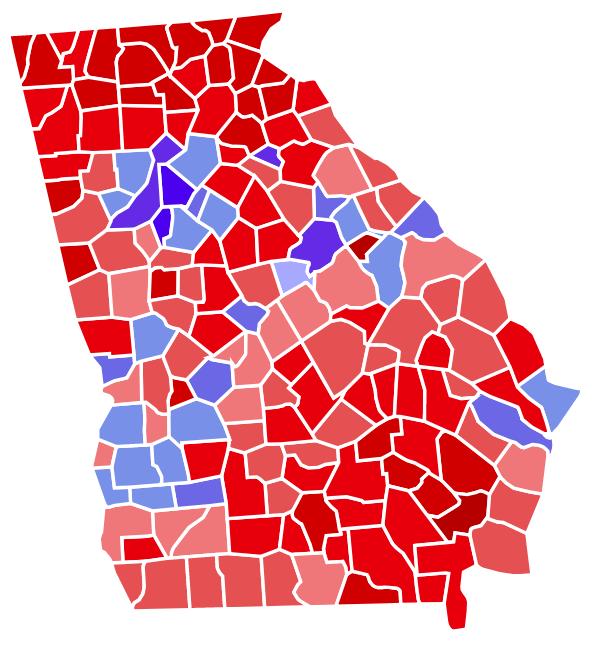
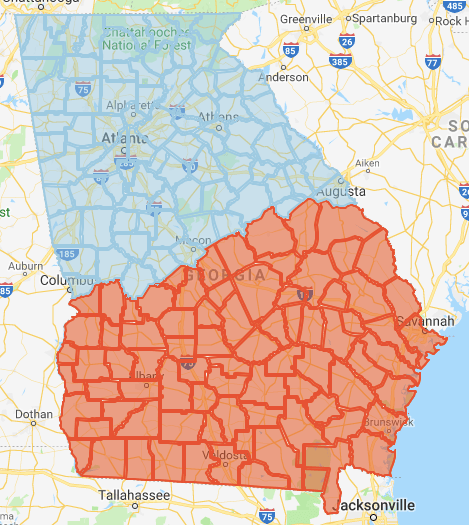
South Georgia is still outvoting Metro Atlanta statewide, no matter who we will put out there in 2020 or 2022 for Senate or any executive position. Stacey Abrams, if she runs for U.S. Senate, won’t replace David Perdue with this map.

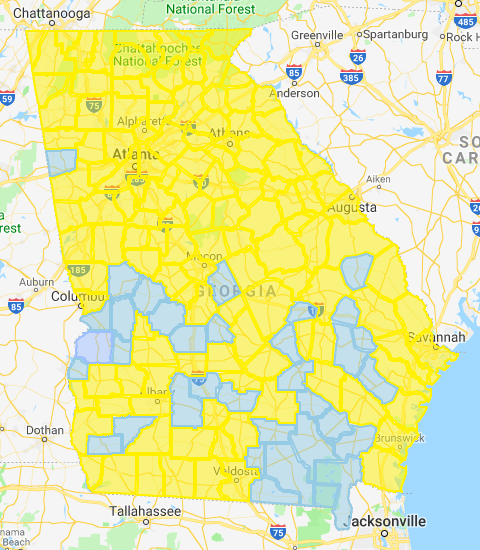
Meanwhile, this is the map of active and inactive Democratic county committees, and a map of how Georgia voted in the gubernatorial.

(Where are the county committees for Talbot, Stewart, Macon? They voted in the majority for Stacey Abrams, but there are no Democratic committees there.)

As far as looking at counties is concerned, I still don’t see the benefit of the “organize-organize-organize” strategy. People are voting the way they’re voting whether or not we are organizationally present. How many more votes can we squeeze out of Democratic voters that don’t fall victim to the next scummy Secretary of State Brad Raffensperger? South Georgians aren’t stupid and are voting for their culture and their beliefs, just like they always have (even when they prevented black people from voting). They’re voting so deeply red for a reason, making the rest of the state look like a joke, and that can’t be ignored or glossed over by assuming that they are stupid.

Republicans are adept at picking their voters (and justifying it, too!), just like their conservative Democratic parents were. I’m open to doing the same thing. Let’s pick our residents. Let’s cut off South Georgia, south of Augusta-Macon-Columbus, into its own state so that they won’t rule the rest of us with their messed-up choices anymore.

I want to win something at least one goddamn election. I want my values to at least be marginally represented in the governor’s mansion at least once every 100 years. We are too large, we have too many counties, and we are still paying the price for the Union not breaking up some Confederate states.

South Georgia ruled the rest of Georgia during the years of the County-Unit System, during the height of Jim Crow apartheid. Brian Kemp ignored urban and suburban Georgia and pulled the votes of rural white South Georgia. Almost all of his mandate comes from South Georgia. I want to bid them adieu so that we can go our own separate ways, so that my political values are more competitive in statewide elections. #2Georgias #BreakItUp