Tag Archives: essays

Organized Feasts for the Eyes and Mind: An evaluation of historical fandoms and fan consumption of multimedia

Organized Feasts for the Eyes and Mind:

An evaluation of historical fandoms and fan consumption of multimedia

 
By Harry Underwood
HUMN-3460
Honors Final Project
December 8, 2010

Introduction

The Fursuit Parade at Anthrocon 2009 in Pittsburgh, PA. Photo by Karl "Xydexx Squeakypony" Jorgensen.
The Fursuit Parade at Anthrocon 2009 in Pittsburgh, PA. Photo by Karl “Xydexx Squeakypony” Jorgensen.

The furry fandom is a modern phenomenon with long historic roots and sources of reference. Having been consolidated by 1989 with the launch of the first furry convention, it originated from the speculative fiction fandom subculture that had exponentially grown in geographic representation since 1969. However, instead of a focus upon literary inspirations or cross-media adaptations thereof, the furry fandom has been primarily driven by recognition of a long-running cultural appeal for graphical representations of the anthropomorphic, semi-animal beings that populated a wide variety of artistic depictions from the earliest artistic works created by Homo sapiens.

A Doctor Who fan in a Fourth Doctor costume, at the Gallifrey One 2006 convention in Los Angeles. Photo by Josiah Rowe.

Differences and similarities in origin, focus and treatment have influenced the characteristics of both fandom subcultures, and re-evaluation or appropriation of past and present corporately-distributed cultural works by fandom subcultures in general have been widely discussed and debated among scholars and experts as pertaining to legal, political and economic ramifications. They have also been perceived by various scholars as being part of modern-day “folk” subcultures by way of adapting and deriving cultural works to non-canonical real-life situations or experiences.  Since the 1970s, media fandoms have largely constituted a large minority, if not a majority, of the speculative fiction fandom demographic, and have come to play an increasingly-important role in the interaction between fandom and corporate distribution outlet. 

 
            Three examples of the developing nature of fandom subculture and influence are found in the furryspeculative (science fiction, horror fiction, fantasy fiction, etc., also known as “SF”) and media fandoms. All three symbolize specific but gradual stages in the 20th century development of modern fandom, ranging from the 1930s to the present day. All fandoms were created to assemble those who found the works of their favorite genres to be both truly attractive and genuinely misunderstood by those who simply didn’t “get” the appeal of the work, and they ended up becoming hotbeds of cultural appropriation and derivation for the majority of their history, often becoming the basis for fans to later become artisans in their own right. However, they each focused on specific features, characteristics or contexts of media works which were specific to each fandom’s main concern, and magnified such features to life-sized, life-relevant proportions, changing the Western world’s sense of popular fiction for the foreseeable future.

SF and Media fandom

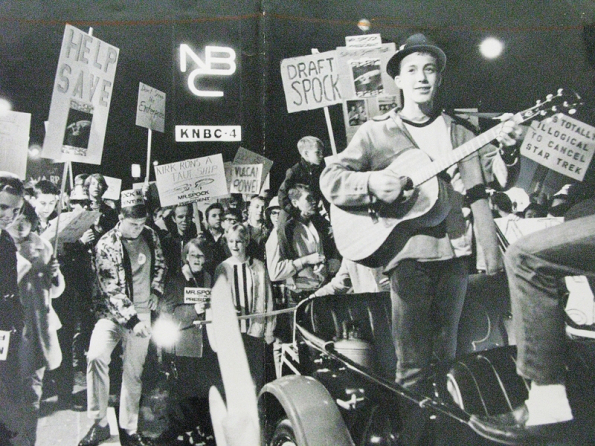
Star Trek anti-cancellation protest in front of KNBC 4 Los Angeles in 1968. Photo by Harry Chase, Los Angeles Times.
Star Trek anti-cancellation protest in front of KNBC 4 Los Angeles in 1968. Photo by Harry Chase, Los Angeles Times, used under fair use.

1969 was the year when Star Trek was finally cancelled after three seasons of low ratings on NBC. But it was also the year that dedicated science fiction fans had realized the importance of their viewership in the era of television, due to the fan campaign which kept the series on the air for one more season. Thus, the Star Trek fan groups around the US began to help in organizing various science fiction conventions, with a growth in “Trekkie” attendees and various personnel from the series being in high demand at these conventions. This was the start of an unprecedented period in fandom history, with fans deriving from a larger number of media outlets and franchises than ever before. This trend would continue into the 1980s, buoyed by the impact of 1977’s Star Wars.Throughout the history of SF fandom, the seeming “lifeblood” of the culture has been the literary publication industries, as writers for science fiction or superhero works were the usual guests and vendors at the few SF conventions which existed between 1936-1969, and many future writers, such as Isaac Asimov, often got their start as fandom organizers. Costumes based upon franchise characters (film, comic book/novel/short story, TV) were worn by regular attendees at such conventions from the first SF conventions in the 1930s onward (Flynn).

The growth of science fiction conventions from 1969 onward, however, is most likely due to the growth of another meta-fandom: the media fandom. As Star Trek’s cancellation had served as a catalyst for fascinated viewers in the United States and elsewhere to court the cast and crew of the series in anticipation of news on upcoming releases and events in the Star Trek canon, the science fiction fandom was infused with far larger numbers of convention attendees than in the last 40 years of science fiction history. Cast and crew of television serials were invited to a geographically- and demographically-growing circuit of conventions, and convention goers dressed up in television and film character costumes to celebrate the appeal of the series. This signified a growing split in focus between the fans of the older literarily-oriented concept-driven science fiction (which had predominately constituted the bulk of the fandom until the 1970s) and fans of visual character-driven science fiction. This spilled over into the establishment of the first franchise-specific media fandom conventions in the 1970s for fans of Star Trek, Doctor Who, The Man from U.N.C.L.E., and other franchises.
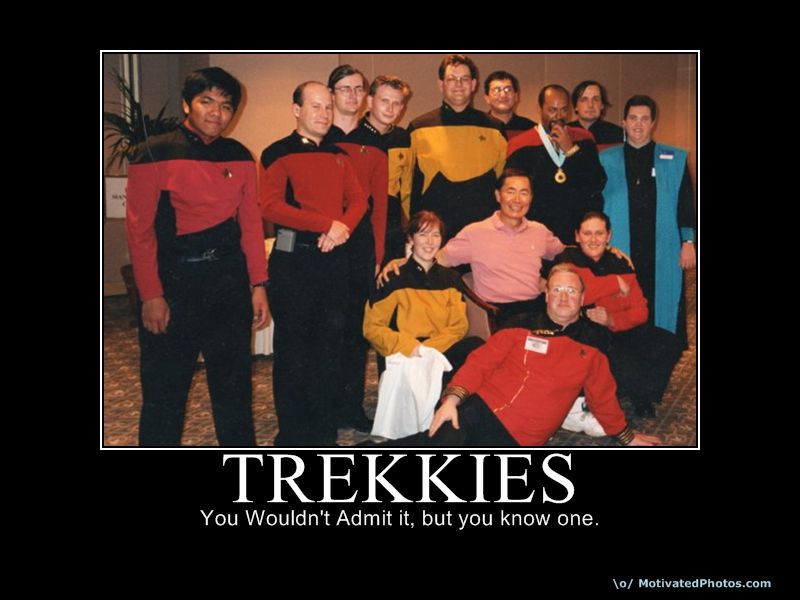
 

George Takei, who played Hikaru Sulu in Star Trek: The Original Series, with fans in full costume.

This also signified the beginning of the corporate interaction to fandom conventions, whereby the distributors of franchises interfaced with the fandoms through the cast and crew who manned franchise booths and panels for autographs and memorabilia. However, as shown with the litigation exercises of George Lucas concerning both fan tribute and commercial appropriation from the watershed Star Wars film series, corporations began to fire the first salvos in the war on infringement of intellectual property, one which notably involved fans who wrote non-canon depictions of Star Wars characters, often in pornographic situations (this phenomenon was not new, as the first fan-fictitious work in fandom history was published in 1967 in the fanzine Spockanalia, and the first homoerotic fanfic to depict the two leading characters of Star Trek in a close relationship was published in 1974, leading to what became known as “Kirk/Spock”). This campaign was further magnified by the rise in popularity of home recording cartridges after 1977, which enabled budding videographers to film their own fan tributes to the franchise for convention exhibition.

The 1980s saw further hints toward diversification that would be entrenched in the 1990s. Roleplaying became a serious pursuit – he RP and video game fan communities partly drew from already-existing wargaming conventions as well as SF – , Japanese animation was increasingly shown to be a highly-developed industry showcasing a wide range of topic and emotion that was sorely lacking in the West, and funny animals, those characters of semi-animal semi-human constitution who were exhibited in animated works throughout the entire history of animation, were extended to become more serious and diverse in emotion and topic than ever previously. All three emerged from the general speculative fiction fandom community with their own conventions and their own fandom subcultures.

Furry fandom
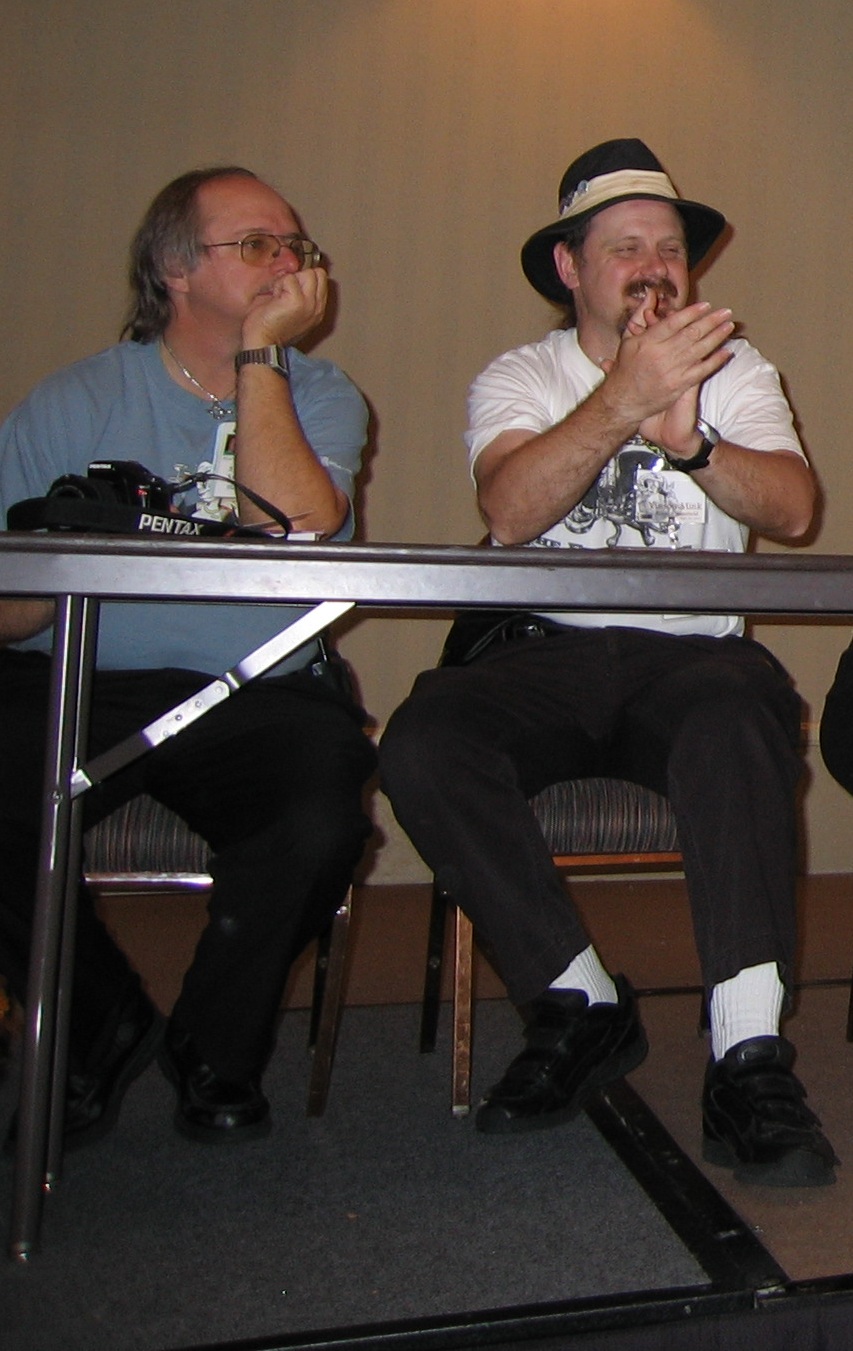
Mark Merlino and Rod O'Riley, co-founders of ConFurence. Photo by RainRat.
Mark Merlino and Rod O’Riley, co-founders of ConFurence. Photo by RainRat.

The funny animal fandom, in its transition into the furry fandom, showed several distinctive features. Prior to the introduction of funny animals into serious works of speculative fiction, funny animals were primarily used as a stock trope in various, usually humorous works of fiction for television, film and printed works.

Through the usage of original anthropomorphic characters in serious works of speculative fiction and romance fiction, the humorous or light-hearted stereotype of anthropomorphic characters in fiction was forced to share room with topically and emotionally diverse subject matter. However, at the same time, this newer revision of the anthropomorphic character was not welcomed or expressly promulgated by most multimedia vendors in their own lagging offerings of anthropomorphic characters in film, television and comic books. Thus, the primary couriers of the serious anthropomorphic characters were independent, often amateur graphic artists and writers who self-published or placed their works in the fledgling amateur press associations (APAs) and fanzines of the late 1970s and 1980s (Merlino); unlike the general SF fandom, the products of this movement were far from SF’s major franchise characters (save for rare occasions, when Teenage Mutant Ninja Turtles, originally independently-published, became one of the rare serious anthropomorphic titles to become self-sustaining for its artists), and artists within what became the furry fandom generally drew their own or others’ original characters.
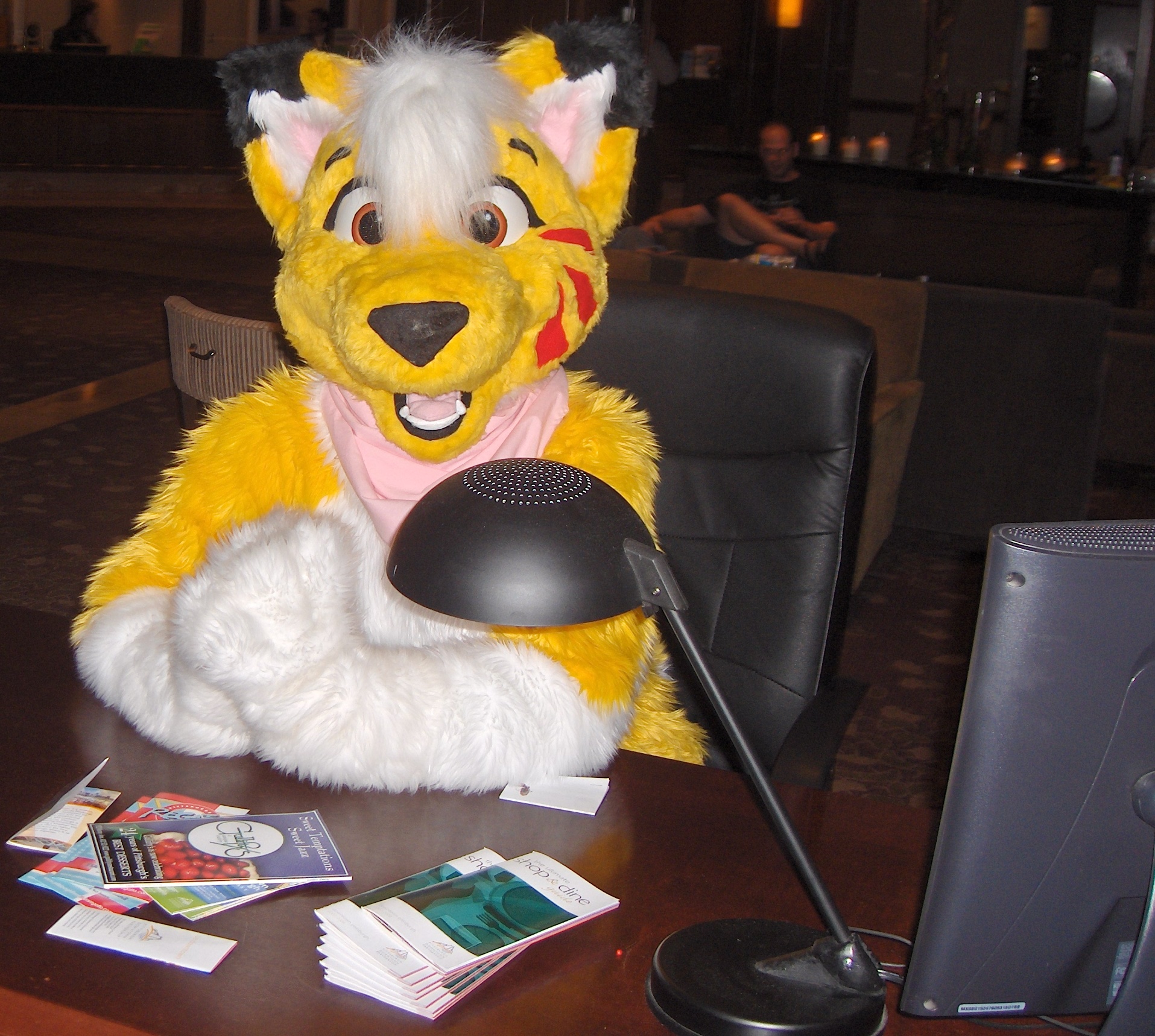
Lucky Coyote acting as concierge at Anthrocon 2006, Philadelphia. Photo by GreenReaper.
“Lucky Coyote” acting as concierge at Anthrocon 2006, Philadelphia. Photo by GreenReaper.

This trend toward focusing upon original characters of one’s own making or the rendering of others within the fandom rather than the characters of major practice of costuming (or “fursuiting”), a practice which increased with the advent of the first furry parties in Southern California in 1985-1986 (themselves initially resulting from overlap between the APA groups’ gatherings and SoCal’s animation-focused Cartoon/Fantasy Organization). Having its roots in the common SF fandom practice of wearing costumes based upon specific characters from popular franchises, fursuiting mostly diverged from the SF tradition by not only focusing upon original characters of one’s own making but also creating a cottage industry of fursuit manufacturing within the fandom that is, to this day, rivaled in focus by the larger costume industry which creates franchise-based outfits for fans.

Following the advent of the first furry convention, ConFurence, in 1989, the rise in usage of the Internet was reflected in the fandom by the establishment of FurryMUCK in 1990 and The Lion King Fan-Art Archive in 1996, both of which served as persistent routes of furry fandom information and media distribution. The growing number of furry properties on the Internet rapidly replaced the importance of the BBSes (which had all but dissipated from general usage in the world by the mid-1990s), APAs and fanzines, and more conventions and “furmeets” were established every year afterward around the world.

Comparison
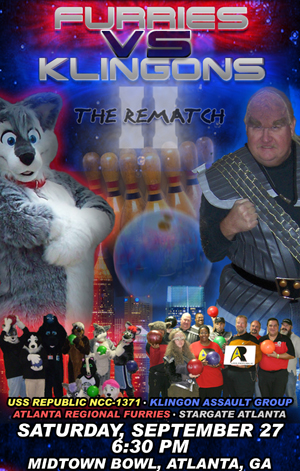
 

Furries vs. Klingons II. Atlanta Georgia. 2008. Poster by USS Republic NCC-1371.

Due to their shared roots, furry and speculative fiction fandoms share many outstanding qualities. 

            For instance, a strong identification with alternate reality pervades both fandoms. Masquerades using the characters with whom the wearers most identify are a pillar of the fandom, and have been since the first SF conventions in late 1930s Philadelphia. 

            The furry fandom, a subset of which is known as the transformation fiction fandom, has received a large number of writers who are or were previously science fiction fans. This has allowed for a cross-pollination of concepts and ideas into the literary aspects of the furry fandom.
            Social consciousness or progression has often played a role in the lives of many acolytes of both traditions, evidenced by charitable donations of proceeds from many conventions to initiatives such as ecological/animal welfare groups, human health and social services, etc. Social consciousness often drove authors in the SF tradition to explore the possibilities of human advancement in an industrialized or utopian world order, while many furry fans often entertained the fantasy of physical shapeshifting in both graphical and literary formats of publication.

Congressional events in both fandoms were historically not catered towards by large corporations for most of their early histories, and were initially driven by personally-shared interest in publications by major vendors of fiction or fiction-oriented media at the time. In fact, fandom communities are largely a “labor of love” for their organizers and participants, being inherently driven by fan appropriation and celebration of the impact of relevant media to their own self-perceptions and worldviews.

Contrast
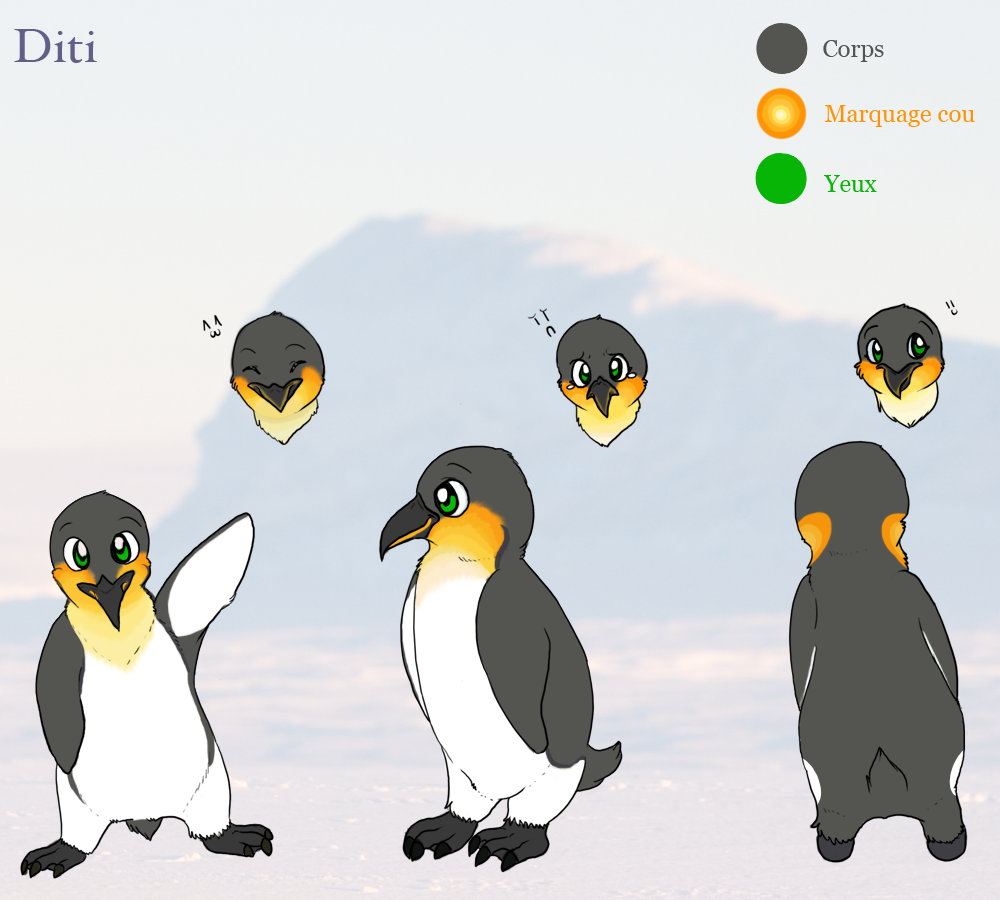
An example of a "fursona reference sheet", used to artistically describe the personal alter-ego or other character of the furry fan. This reference sheet depicts Demitri "Diti" Torterat's penguin fursona as drawn by Luna Tsukario.
An example of a “fursona reference sheet”, used to artistically describe the personal alter-ego or other character of the furry fan. This reference sheet depicts Demitri “Diti” Torterat‘s penguin fursona as drawn by Luna Tsukario.

Furry fandom is oriented differently than speculative fiction fandom or media fandom:

  • Unlike the SF fandom, which largely drew from literary sources and historically was driven by genre writers, the furry fandom largely derived from graphic expressions in both still and animated form.
  • Furry fandom is largely concerned with body phenotypes and graphic depictions thereof, while SF fandom is largely concerned with the settings in which the fiction takes place and the associated concepts which are employed. Media fandom, by contrast to both, is more enamored of character development and relationships.
  • Furries adopt fursonas, or furry alter-egos, which usually exist outside of franchises (save for rare occasions when the depiction of the fursona is derived in style from another franchise which was not originally marketed as “furry”).
  • Furry fandom is external to genre restrictions and furry fiction can employ any genre or setting under the sun, including SF.
  • Furries are more likely to integrate or interpret their fursonas as expressions of their inner selves, or aspects thereof. SF fans are more likely to embrace the character of whose visage they may masquerade for the ideals and role which are most associated with the character in the franchise.

Corporations or large studios are largely a non-presence within the furry fandom:

  • The SF fandom has largely been focused upon corporately-funded franchises since the 1970s due to the rise in media fan attendance at the largest conventions. In contrast, furries were largely drawn to franchises’ graphic anthropomorphic media before happening upon the Internet’s furry artwork, which is usually not fan derivations of franchise characters.
  • Corporations have largely remained ignorant of the furry fandom, and artists within the employ of large media companies usually only come to furry conventions at their own expence, usually in retirement (in addition, furries are not a target market or audience in the 2010s by any means for major corporate disseminators of fiction). In contrast, SF fandom draws top-dollar guests such as franchise writers, artists, actors, directors and series creators, and corporations often court fan gatherings for advance teasers.
  • It is rare to see two or more fursuits of the same character, while it is common for multiple cosplayers to depict the same character or franchise at SF, media and anime conventions.
  • SF fans have historically achieved greater ascendancy since the 1960s and 1970s, as fans who happened to be writers (Asimov, for example) were hired to write for major franchises or their works were adapted to film, television, etc. Furries have not yet achieved anywhere near that ascendancy within media establishments at this point.

Fandom relations with corporations
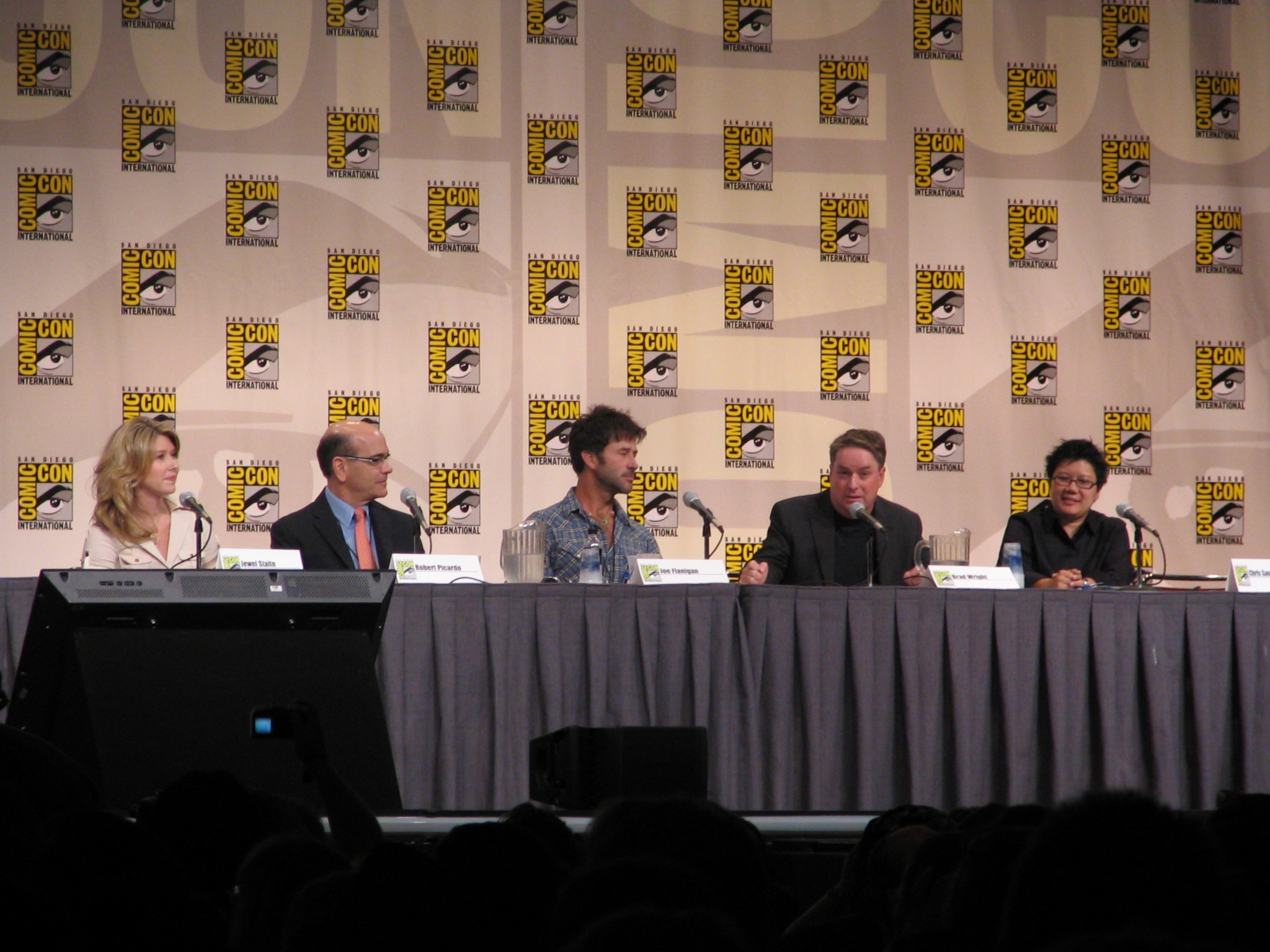
 

Cast and crew members of Stargate Atlantis at San Diego Comic-Con International 2008 panel discussion. Photo by Heath White.

The relationship between the furry fandom, media franchises and the corporate media outlets which maintain those franchises is awkward and fraught with conflicting understandings. While the furry fandom was initially brought together by graphic artists who were inspired by corporate media franchises of graphical depictions of anthropomorphic characters (and archives of fan works inspired by the franchises remain a so-called “gateway” to the fandom on the Internet), the furry fandom has had a distantly-receptive, one-way relationship with corporate media franchises which has not been reciprocated with similarly-positive feedback.

Any reference by a “non-furry” corporately-owned media outlet to anthropomorphic characters is welcomed and appropriated by the furry fandom’s members, and any reference to the furry fandom in particular is readily documented and reviewed by self-described furries. However, because of the tendency for furries to adopt fursonas, the depiction of fursonas or original characters by various artists tends to outweigh the number of specific homages or appropriations of corporately-owned characters on large galleries such as Fur Affinity.

At the same time, corporations which hold the licenses to the media franchises have responded variably to the furry fandom. Even in 2010, the furry fandom is a new and strange development for many employees of the corporations, and a heavy public stigma which is associated with the fandom due to many past corporate media depictions of furries and furry events (including the 2003 CSI: Crime Science Investigation episode “Fur and Loathing”) may deter corporations from expressly appealing to this niche for the foreseeable future.

In comparison, the media fandom that spilled out of the science fiction fandom after 1969 and inherited most of its customs has gradually cultivated a closer relationship with corporations that sees conventions being broadcast on cable television, endorsed by media franchise owners, cast and crew visiting as panelists and booth operators, etc. Corporations and individual rights holders have varied in their stances on fan derivations of their works in recent years, with many allowing for fan fiction and others taking a somewhat hostile stance against it; those who have warmed to fan fiction adaptations and derivations include some individuals who started their writing careers in the fanfiction scene. This is a far cry from the 1980s, when most copyright owners took hostile, litigious stances against the fanfiction phenomena for the sake of keeping a strong hold on the intellectual property or family-friendliness of their series or franchises.

Conclusion
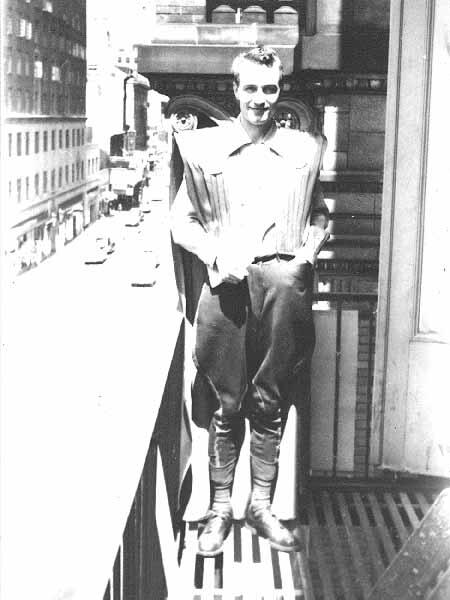
 

Forrest J. Ackerman in a futuristic costume at Worldcon 1939, perhaps the first costume in fandom history, New York City. Photo c/o Robert Madle/Fanac History Project.

What can certainly be ascertained is that the furry fandom was one of many types of fandom subcultures which developed in the 20th century, one which was influenced by other fandoms and originating from the science fiction fandom. What can also be ascertained is that each fandom – genre-centric, chararacter/relationship-centric, species-centric, origin-centric – is an example of individuals who discovered that there were other people in the world or in their own local proximities who were just as interested in sifting the sensually-pleasing, the intellectually-intensive, the culturally-relevant or other personally-”important” elements from the mass media works of present and past, and celebrating them and their own adaptations.

They are spurred onward by actualities and possibilities which result from such elements and adaptations, and they are far from being immune to corporate co-option or interaction, but they readily exhibit examples of popular or “folk” appropriation of original source material (Jenkins). The canon material is used as a source of “scripting” which details expectations, behaviors and descriptions of real-life situations, with at least a few attempts at establishing new religious movements as outgrowths of fandom communities.

The fandom phenomenon that was first cultivated from the science fiction literary societies of the 1920s and 1930s was transformed by television and its adaptation of text into moving visuals, with media fandom gradually taking precedence in fandom subcultural activities from the 1970s onward. This option by so many to co-opt and derive cultural works from film and television has indelibly redefined the developed world’s perception of popular fiction. It has also influenced the licensing of fictional characters or settings for commercial promotions, as fans will usually be among the first to express vocal disappointment in any corporate deviation from the letter or spirit of the canon material. It is not yet a system of creative checks and balances, but fans of media franchises and the owners of distribution rights over such franchises do often communicate, coalesce or come into open conflict with each other on a frequent basis.

Fandom subcultures will continue to diverge into newer methods of folk interpretation and appropriation of canon for the foreseeable future. The furry fandom, which is young in comparison to the media and literary speculative fiction fandoms, may yet gain economic ascendancy whereby participants in the fandom may be later employed in the larger animation or video game studios for production purposes, or it may develop in an altogether-different manner than the other two fandoms, but it does symbolize a further, somewhat divergent extreme in how those of us who are primarily consumers of fiction media are often motivated to appropriate from past trends or established canon to provide sensory, intellectual or cultural gain.

Works cited

Patten, Fred. “A Chronology of Furry Fandom.” Yarf! 1996. Web. 8 Dec. 2010.


Jenkins, Henry. “The Poachers and the Stormtroopers: Cultural Convergence in the Digital Age”. Massachusetts Institute of Technology. 27 July 2010. Web. 8 Dec. 2010.


Flynn, John L. “Costume Fandom: All Dressed Up with Some Place to Go!” Towson University. 1986-2001. Web.


Chase, Harry. “Star Trek Cancellation Protest.” Los Angeles Times. 8 Jan. 1968. Web. 8 Dec. 2010.


USS Republic NCC-1371. Web. 8 Dec. 2010.


Burka, Lauren P. “The MUDline.” The MUDdex. 1995. Web. 8 Dec. 2010.


Darlington, Steve. “A History of Role-playing.” Places to Go, People to Be. Web. 8 Dec. 2010.


“The Force Is With…Everyone”. Beliefnet. 2002. Web.


Merlino, Mark. “Re: A few questions for fandom research.” Email to the author. 2 Dec. 2010.

The Traumatic Subliminal Intersection of Dissociation and Shamanism in Ghost Hound

Harry Underwood

Monica Young-Zook

HUMN 2111H

10/15/2011

The Traumatic Subliminal Intersection of Dissociation and Shamanism in Ghost Hound

Mind-body dissociation, as an “altered state of consciousness”, has figured largely in the history of religion as a means by which societies and cultures could ascertain vital messages from inhabitants of mythological cosmologies. Many works of speculative fiction have made use of dissociation as an allegory for the exploration of subliminal aspects of characters’ personalities, but have also vividly depicted such explorations with intentional sensory distortions. The 22-episode animated series Ghost Hound is an exemplary modern exploitation of this core plot element: the correlation between disconnection from normal senses and exposure to the subsensory. The series makes use of this to explore a familiar trope in horror and mystery fiction: communication and interaction with the realm of the dead. Ghost Hound offers a view into the modern intersection between the religious, scientific and artistic views of dissociation as a window into the sublime.

The prior experiences of the three central male characters of the series set the stage for the discovery of the sublime by the viewer. Taro, a 16-year-old middle school student, suffers from trauma caused by the kidnapping of himself and his sister 11 years prior, and the death of his sister during the incident. Makoto, a distant relative of Taro, suffers from witnessing the suicide of his father and abandonment by his mother, as well as the overbearing influence of his grandmother, who operates a local “new religious movement”. Masayuki, a recent transplant from Tokyo, is haunted by both the memory of a classmate’s suicide due to bullying as well as his parents’ emotional withdrawal from each other.

The three students’ own unique hauntings by unfortunate incidents from the past are manifested psychologically. Taro’s almost-daily occurrences of lucid dreams take him through replays of his kidnapping, including the moment of his sister’s death on the bed opposite him with their hands tied behind their backs. However, after exposing themselves to the location of Taro’s sister’s death, the trio discover the ability to consciously experience out-of-body travels. This soon leads them, their families, their classmates and other characters as diverse as Taro’s school counselor and workers at a mysterious laboratory in the mountains into the experience of both psychological and supernatural forces at work in the town of Suiten.

The terror of facing past trauma constitutes a core feature of the plotline, and the trio make use of soul travelling in order to more capably face the manifestations of their traumas. They also soon realize that the daughter of the local Shinto priest unwillingly experiences her own interactions with travelling spirits, which manifest themselves by taking brief possession of her body.


Historical Religious Elements in the Subliminality of Ghost Hound

Religion serves as a significant and vital theater of the sublime and subsensory in Ghost Hound. Drawing strongly upon Japanese cosmological mythology, the series provides a rich, historical backdrop whereby the viewer can understand the cultural context of what the children observe in both the Hidden Realm and real world.

A sublime feature of the plot is the wonder and terror at the geography of the “Hidden Realm” in which the spirits of all species reside, and particularly how it overlays the geography of the land within and around Suiten. The world of the dead which the three encounter in their disembodied sojourns is a vast, highly-distorted realm which is inhabited by countless species of creatures, many existent, extinct or mythological. The forest, particularly that part separating the shrine from the lake, initially holds a lot of terrible elements which frighten Taro, as he frequently sees the tall, looming, exaggerated visage of his long-dead kidnapper striding ominously through the forest. This is because the forest itself symbolically demarcates the real world inhabited by the living from the distorted and sensually-intense Hidden Realm.

The shamanistic roles of the characters derive from historic perceptions of dissociation as a means of communication with deities and spirits. In addition to her duties as a miko (female joint shrine assistant and shaman), the lead character Miyako also encounters recurring instances of spirit possession, whereby disembodied spirits possess and communicate through her. She is the only character with the ability to see disembodied souls, including those of the three lead characters when they are in the midst of an out-of-body experience (O.B.E.). These unbidden gifts of mediumship harken to the historical shamanistic roots of the miko position. The historical miko, who could either be attached or non-attached to any particular shrine, was usually one who possessed the innate trait of communication and interaction with the spirit world. This ability made the miko a role of high importance for local cults of kami (spirits), as the words of a miko under the thrall of a trance could be interpreted as either communications from beyond the grave of a loved one (Feldman 14), prophecies of great political and economic weight or as means by which patients could be healed of ailments (Lee 291).

Likewise, the three male lead characters’ pursuit of this endeavor is fundamentally shamanistic in its intentions and actions. While Miyako herself may be the more “professional” shaman of the lead characters, the three male lead characters are engaging in interactions with the denizens of the Hidden Realm – the spirit world – in order to ascertain answers of paramount interest to not only their own individual desires to bring their mental states under a more capable governance, but to also bring closure to the minds of their disrupted families. This harkens to Lee’s recounting of shamanistic social networks in ancient non-Western societies, whereby those who were adept at dream communication with the afterlife often found and helped each other cultivate their abilities for future applications for the masses (Lee 293).

Yet, at the same time, the trait of communication and interaction with spirits causes problems for Miyako in her daily life. As a born medium, she always finds one foot planted in the realm of ancient, disembodied souls who can take possession of her body at a moment’s notice. The public knowledge of her occupation in the local area allows her to be both the benificiary of parishioners’ gifts as well as the scorn of neighbors. This causes her to doubt her ability to relate to the people around her, and also compels her to constantly reassure herself of her own sense of self.

As a result, the enthusiasm for interaction with the Hidden Realm among the lead characters varies widely. This is exemplified by the fact that the three lead male characters – Taro, Masayuki and Makoto – are eagerly exploring and seeking for answers within the Hidden Realm, while Miyako – a significant figure throughout the series – is seeking for normalcy and acceptance away from the denizens of the Hidden Realm. Makoto, however, is personally conflicted because of his emphatic rejection of the role of heir apparent to his grandmother, herself a spirit medium.  


Scientific Psychology’s Significance in the Sublime

Psychological references, particularly those referring to dissociation, figure heavily in the series’ depiction of the sublime world inside the mind. Dell et al. describe dissociation as the “partial or complete disruption of the normal integration of a person’s psychological functioning”, of
ten in “ways that the person cannot easily explain (Dell et al.).” Ghost Hound, as a series, takes stock from the centuries-long appraisals of mental hallucinations from both religious and psychological points of view. In particular, it explores and contrasts such in their historical religious role as means of communication with the deceased and their current role in psychology as theaters for personal (or, if possible, shared) confrontation with traumatic incidences.

The three central characters of the series each have their own psychological reasons for connection with the departed. Taro, whose sister died in front of him during a double-kidnapping attempt 11 years prior, makes use of his almost-daily lucid dreams in order to attempt a reconnection with the soul of his sister. Makoto, a truant whose father killed himself a short time after Mizuka’s death, looks for answers and reconnection with the father who he barely remembers. Masayuki, a transplant from Tokyo, seeks to overcome the stress caused by the bullying-related suicide of a classmate.

The key dissociation away from the body occurs through an encounter with the site of a traumatic experience. It is through exposure (namely a crude attempt at “Exposure therapy”) to the exact place of Taro’s sister’s death that the three are able to achieve the ability to travel out of, and into, their own bodies at will. This allows them to make several journeys through both the present reality around the town of Suiten as well as into various areas of the “Hidden Realm” of deceased and mythological heritage. Other altered states of consciousness come more naturally to the three characters following the initial OBE, in keeping with Blackmore’s hypothesis concerning altered state experients (Alvarado et al. 298).

This exploration of both roles of mental hallucinations, and the reliance upon the measurement of powerfully-manifested emotional reactions to such hallucination, sheds light onto the sublime aspect of mental hallucination as a means of interaction with creatures of the past, including the spirits of the dead. Hallucinations are marked by their vivid pronouncements to the receiver, but are simultaneously noted by their reliance upon some degree of sensory obscurity. Because of the combination of their vivid and obscure elements, hallucinations such as lucid dreams and spirit possession provoke raw, emotional and irrational responses from the receiver.

The utility of certain physical objects to the characters when experiencing their respective OBEs is also of dissociative importance. Taro often sleeps in the room of his sister Mizuka, focusing upon her backpack hanging from the chair as he nods off. Makoto often goes soul travelling while his physical arms clutch his electric guitar, his favorite pastime and means of sensory escape from the gloom of the Ogami shrine complex. Masayuki often nods off into an OBE while wearing his gyroscopic video game headset. All three objects hold sensory importance to the characters, providing individual means of sensory dissociation and removal from the physical body, and perhaps a root by which they can reenter their bodies. Such objects as utilized in real-world meditation are described by Lutz et al. as tools in “Focused Attention” meditation (Lutz et al. 6), a practice that is well-known to societies with large Buddhist populations such as Japan. The objects, when applied in the context most appropriate to the meditator, allow for the users to ignite the sensation of dissociation in the user.

Finally, the concept of the Hidden Realm is also dynamically reapplied to a more naturalistic, disenchanted reappraisal of the invisible, externalized repository of memories. It is somewhat secularized by Hirata, Taro’s psychiatrist, in the form of Thought Field Therapy (TFT), a form of therapy which attempts to treat phobias (Callahan et al. 123) by means of interaction with a hypothetical “invisible field” external to the brain which contains long-term memories (Sheldrake 32; “Affordance/TFT”). This concept may also explain why Taro is able to visit the eternal Kameiwa Hospital, which resides on a floating island within a “forest”of flashing neural synapses which he supposes as the inside of his own brain. This pairing of the religious concept of the “Hidden Realm” with the secular hypothesis of the external “though field” allows for the series to carefully reposition the concept of the human mind as both a window into the self as well as a window into the abodes of the permanently-disembodied selves.


Artistic Depictions of the Sublime

The sublime value of dissociation in the series is manifested through visual and auditory distortions. Distortions and unrealistic increase whenever the viewer is brought within any distance of mental or religious significance, resulting in artistic cues for the viewer to immediately decipher as an experience within the mind or in the mind’s travels. These cues of distortion give the viewer a strong sense of the intensity and subliminality, the heightened sense of heavy emotional drama, which may likely be felt by the character at that exact moment.

The Hidden Realm, for example, is characterized by heavy, predominant visual elements. It is depicted as a transparent overlay over the reality of the living, one which is as ghostly and flexible as its inhabitants. Heavy colors predominate in certain environments during key scenes in the series. When Taro travels to the Kameiwa hospital and talks with a patient, only to find that he is visiting an area of the Hidden Realm in which the souls of the hospital’s oldened patients reside for eternity, the predominant color of the area is various shades of brown (“For the Snark”). When travelling through the swirling eddies of the Hidden Realm, the predominant color is blue; this color is also the predominant shade which the souls of OBE experients assume when in the out-of-body state.

As a further explanation of places in the series which hold sublime importance and relevance to the realm of the spirits, a contrast of sublime elements can also be made between the mountain shrine belonging to Miyako’s father and the larger shrine owned by the Ogami sect. The mountain shrine, while old, is comparatively bright, earthy and rich in its predominant brown shade; the only time where any prolonged focus takes place in a dark part of the shrine is in Miyako’s bedroom at night, as her psychological condition visibly worries her awake. The Ogami shrine, on the other hand, is so dark and suppressed in its exterior and interior atmosphere that the only sources of interior lighting come from candles. The only room lit by window light is the room in which Makoto’s father killed himself. As he, at age 5, was the first to discover the body of his father, Makoto finds it most difficult, yet most necessary, to enter this room in order to seek the answers that are kept hidden in the dark by those with whom he lives.

The sound effects used in the series also strongly evoke the intense and sublime. From the perspective of his recurring nightmares, Taro’s perception of sound within his dreams, particularly those recounting images from his kidnapping, is highly distorted and often jarring to the ears of the viewer. Williams interprets this experience of sound as Taro “sealing his aural memories in a womb-like enclosure” (Williams). Similar sound effects also feature in the mental episodes of Makoto and Masayuki when recounting their own personal traumas.

The choice of instrumentation for the soundtrack, again, reflects the and are applied at key moments of mental or religious sensation. Most of the instruments used for the background music are traditional Japanese instruments associated with Shinto observances at shrines like the Komagusu and Ogami shrines. Makoto’s electric guitar, on which he occasionally practices in certain episodes of the serie
s, is a channeling of his otherwise-cold and rough emotion through his fingers.


Conclusion

The entire plotline of Ghost Hound is imbued with a strong essence of the sublime, as best filtered through a modern Japanese cultural filter. The psychological, artistic and supernatural are easily blended, while the effects of such blendings upon all of the characters is made evident through their varying reactions and coping mechanisms. The applications of dissociation and the resulting distortive effects of such dissociation deliver to the viewer of the series a strong sense of the highly-personal.

The intersection of mind-body dissociation and, as shown in Ghost Hound, allow for the modern generation to explore ancient, yet modern, constellations of the sublime and emotion-inspiring. The series, in itself, is not a horror-oriented work, nor is it totally geared toward the solicitation of suspense, thrill or awe, yet it manages to combine portions of such plot elements into a procedural call to the viewer to reappraise the characters’ experiences as intimate, sensually distorted and intense in its relevance to the plotline. Such a combination, when best performed, is difficult to find in the larger corpus of speculative fiction, but it is also rewarding to the viewer in its rich, subsensory narrative.

From the meditation to the lucid dreaming to the out-of-body experience to many other types of dissociation depicted, the most general constant visible in these techniques, their applications and the intersections of dissociation and distortion  is the adventure toward both resolution with death and the reaffirmation of living. In this complex adventure, which takes the characters and viewers through the most sensually-intense corners of the mind (both inside and out), Ghost Hound accomplishes such goals, and its presentation of the sublime leaves the viewer desirous for more of what it offers.


Works cited

Alvarado, Carlos, Nancy Zingrone and Kathy Dalton. “Out-of-Body Experiences: Alterations of Consciousness and the Five-Factor Model of Personality”. Imagination, Cognition and Personality, 1998-99. Vol. 18(4) pp. 297-317. Print. 9 Dec 2011.

“Affordance/TFT . Thought Field Therapy”. Ghost Hound. Nakamura, Ryūtarō, dir. Shirow, Masamune, wri. WOWOW. Tokyo. 20 Dec 2007. Television.

Callahan, R.J. and Callahan, J. (2000). Stop the Nightmares of Trauma. Chapel Hill: Professional Press. p. 143. Print.

Dell, P. F., & O’Neil, J. A.. Preface. In P. F. Dell & J. A. O’Neil (Eds.), Dissociation and the dissociative disorders: DSM-V and beyond (pp. xix-xxi). New York: Routledge. 2009 Print.

Feldman, Ross Christopher. “Enchanting Modernity: Religion and the Supernatural in Contemporary Japanese Culture.” The University of Texas at Austin. 2011. pp 14, 29-32.

“For the Snark Was a Boojum, You See”. Ghost Hound. Nakamura, Ryūtarō, dir. Shirow, Masamune, wri. WOWOW. Tokyo. 31 Jan 2008. Television.

Lee, Raymond L.M. “Forgotten Fantasies? Modernity, Reenchantment and Dream Consciousness.” Dreaming, Vol 20(4), Dec 2010, 288-304. Print.

Lutz, Antoine, Heleen A. Slagter, John D. Dunne and Richard J. Davidson. “Attention regulation and monitoring in meditation.” Trends in Cognitive Science. 2008 April; 12(4): 163–169. Print.

Sheldrake, Rupert. The Sense of Being Stared At: And Other Unexplained Powers of the Human Mind. Random House Digital, Inc. 2004. p. 32. Print.

Williams, Alex. “Ghost Hound: Sounds from the womb, visuals made from nightmares.” Undated. <http://alex-williams.net&gt;. PDF file.

Never Turn Your Back on Family: An Analysis of Relationships in Summer Wars

Harry Underwood
Film Analysis
COMM 3010
4/13/2013

Never Turn Your Back on Family: An Analysis of Relationships in Summer Wars

Theories about communication are crafted in order to almost-accurately predict the communicative behavior of individuals in a number of settings and intentions. Within the realm of both old, large families as well as new, young ones, the utility of discerning communication commonalities among participants in these relationships is indispensable. Summer Wars, a 2009 animated film directed by Mamoru Hosoda, is exemplary of a number of theories and principles on communications which have been explored over the history of communications as a subject of academic investigation. Ranging from the interpersonal and nonverbal to the massive and computer-mediated, the film uses the protagonist as a vehicle for exploration of communication as a life- and world-changing agent in human experience.

The Relationship Interaction Stages Model, which offers a suitable rubric for the development of characters’ relationships within the film, shows various stages of interpersonal behavior which reflect the severity of sentiments harbored by the participants of the relationship toward other participants. The model ranges in its stages from “coming together” – the stages of initiation, experimenting, intensifying, integrating and bonding – to “coming apart” – differentiation, circumscribing, stagnation, avoiding, and terminating. It is through this model that the behaviors of a number of key characters in Summer Wars – namely Kenji, Natsuki, Wabisuke, Sakae and Kazuma – can be assessed as fluctuations in relationship status within a large family in the flux of institutional change.

Coming Apart

The differentiating stage is one in which differences between individuals or groups is emphasized by the participants, with resent often being a major sentiment exhibited by the parties. This stage is reached on a group basis by the male members of the Jinnouchi clan following the matriarch Sakae’s death, as they pursue a plan to take Love Machine down while the female members of the family concern themselves with preparations for the funeral. On an interpersonal level, Kenji and Natsuki also experience this stage with each other, with Natsuki angrily running from him after seeing her uncle Wabisuke remove himself from the clan and leave the house. To her, Kenji seems too much of an outsider to understand her feelings.

Circumscribing is a stage marked by the focus of individuals on their own personal matters, actively distancing themselves from each other. This, collectively, is developed by the men and women of the family, with the men, including Kenji, attempting to work on a plan to take on the virus, and the women focusing on the funerary arrangements for Sakae. Members of the two groups complain about each other’s seemingly-misplaced priorities, showing their greater desperation and concern for the matters at their respective hands.

The stagnation stage is marked by a lack of change in relational intensity, boredom, and short answers to questions from relationship participants. Wabisuke, a “love child” of Sakae’s husband who is first shown as a late, ill-welcomed arrival to the reunion, attempts to strike up a conversation with family members, only for most of the adult members of the clan to show their anger at his presence due to past misdeeds. He remains, for a period, on the periphery of family functions with a sense of tedium, with the adult members remaining leery and dismissive of his presence. His lack of change in relationship status vis-à-vis the family reflects the intolerant sentiment blocking the two parties from any progression.

The avoiding stage is one in which mostly physical isolation from other family members occurs with only minimal communication. It is in this stage which we find characters like Kazuma, who isolates himself from the clan while playing in the virtual world Oz as his character King Kazma. He hardly communicates or interacts with other family members or their activities, only involving himself with the family when needed, asked or drawn by a sudden impulse of self-interest.

The termination stage, in which absolutely no contact of a physical or communicative nature is maintained between parties, is reached by Wabisuke, as he had already spent ten years of his life in the United States and had only come back to Japan for the sake of his adoptive grandmother Sakae, who he calls “you old hag” in a semi-joking tone of voice. This termination is renewed after he finds himself at the point of an antique spear wielded by Sakae in anger for his creation and selling of the virus to the U.S. military; he flees in a rage from the estate and remains in isolation from the clan until the one person who has admiration for him, Natsuki, calls him home with the news of Sakae’s death.

Coming Together

The initiating stage, in which individuals first interact with each other, is illustrated from the beginning of the film. Natsuki and Kenji enter this stage when Natsuki, the “prettiest girl in school,” enlists him to join her on her train trip to her family reunion. The two ask questions of each other along the way about their interests and hobbies, such as Kenji’s prowess in mathematics and the size of Natsuki’s family; this stage transforms into something too radical for Kenji’s tastes as Natsuki surprisingly introduces him to Sakae as her fiancée.

The intensifying stage involves probes into, and disclose, each other’s personal morals and values. Sakae participates in this stage when, after he is introduced as Natsuki’s “beau,” she sternly questions Kenji on his ability to protect Natsuki from any harm or danger, receiving a reluctant answer in the affirmative before smiling with assurance. Before he is (temporarily) hauled away for his alleged unleashing of a virus, Kenji shows more of himself to Sakae by disclosing to her his own comparative lack of a family life compared to that enjoyed by the Jinnouchi clan, ending with an expression of appreciation to her and to the clan. Finally, after explosively driving off Wabisuke from her estate, Sakae invites Kenji to play a (final) card game called “hanafuda,” disclosing Natsuki’s shortcomings and wagering (successfully) that, if she wins, he will “promise to take care of Natsuki.” With these trades of inquiry and information, Kenji and Sakae establish a rapport as individuals sharing commonalities in values and interests.

The integration stage, in which the lives of individuals begin to merge and individuals begin to see themselves as participants in a larger collective, is reached by most of the key characters in the film in their own individual ways. Wabisuke’s isolation is ended when Natsuki calls his phone with the news of Sakae’s death, to which he reacts by desperately rushing back to the clan house to pay his respects to his grandmother. This sudden turn of emotion is reciprocated by the family to Wabisuke on Sakae’s written wishes for them to welcome him back. Kazuma also experiences this stage as he begins to emerge from his isolation and become more involved in the family’s struggle to stop the artificially-intelligent Love Machine virus, using his King Kazma character to fight the avatar incarnation of the virus. Natsuki herself is emotionally reintegrated into the clan by being enlisted to play a life-or-death card game of Hanafuda with the Love Machine, waging the Oz avatars of her family members in order to gain hundreds of millions of stolen accounts from Love Machine.

The integration stage is also reached on a monogamous level between Natsuki and Kenji at various points in the film. In the immediate aftermath of Sakae’s death, a distraught Natsuki begs Kenji to hold her hand, to which the reluctant main protagonist eventually complies as she weeps. It is this contact which marks the duo’s first attempt at intimate self-disclosure, with Natsuki, in a time of depression, showing her interest in physical and emotional solidarity from someone who is as interested in playing a positive role in her world. However, given their comparative lack of private self-disclosure to each other throughout most of the story, this moment in their relationship is also indicative of the experimental relationship, as they are now slightly more comfortable and connected with each others’ close presence.

Finally, the stage of bonding is reached by Kenji and Natsuki as they attempt to kiss each other in public for the first time after the clan’s victory over the Love Machine virus. This stage is marked by a public declaration of love, an act which shows the progression of a relationship to a moment of comfort and internal acceptance of one’s status as a participant and partner which would be hardly deprecated in quality if it were to be shown to the view of other parties. At the same time, due to their comparative lack of time spent within each other’s close proximity, this moment of self-disclosure and intimacy can also be associated with the experimenting stage. At this particular moment in time, the two are now more comfortable and willing to embrace the connections forged between each other, although the two continue to carry this budding relationship at a steady pace.

Conclusion

In conclusion, Summer Wars demonstrates to the viewer how the relationship interaction stage model operates within a large family in a moment of violent change. Sakae’s written will and testament advises her surviving family, including Wabisuke, to show resilience in their relationships: “Never turn your back on family, even when they hurt you. Never let life get the better of you.” This statement speaks volumes to the viewer about the film’s message of collective resilience in the face of crisis. The statement can just as well apply to the relationship between two individuals like Natsuki and Kenji, who are separated from each other at various times, but find themselves increasingly drawn to each other in their most-helpless moments. Just as Wabisuke possesses a close, but fluctuating relationship with Sakae and her family, Natsuki and Kenji develop their relationship in stages of interaction with each other and with their clan.