Tag Archives: georgia

Elections for Most Statewide Executives Should Be Nonpartisan

In Georgia (for example), if we insist on holding elections for most statewide executive offices, these offices should be made nonpartisan:

  • Secretary of State
  • Attorney General
  • State Superintendent of Schools
  • Labor Commissioner
  • Agriculture Commissioner
  • Insurance and Fire Commissioner
  • Public Service Commissioner

I would like to see the above change appended to SB 14, which would make district attorney and solicitor general elections nonpartisan. Hell, add it to sheriff elections as well.

None of these should be subject to the partisan primary filter or party labels.

GA GOP Senate and House Maps Released, with Democratic Responses

Over the course of November 26-30, the GOP and Democratic caucuses in the Georgia Legislature have released their legislative map proposals.

Senate

  • Senate has 56 total seats, majority is 29.
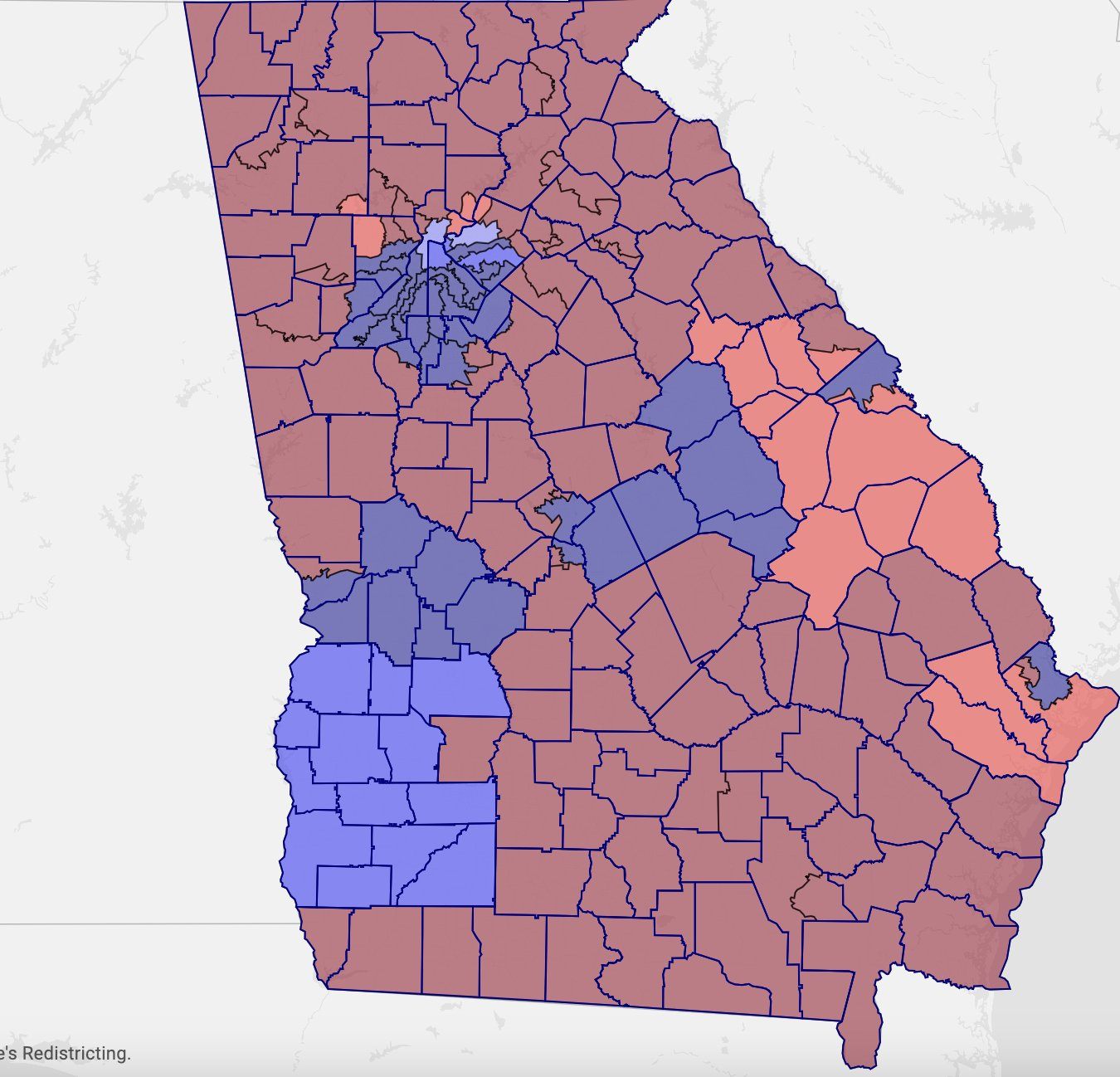
  • The GOP’s proposed Senate map keeps the party composition at 33R-23D by packing two majority-black districts and eliminating two majority-white Democratic districts.
  • The Democratic response would shift the party composition to 31R-25D by adding two majority-Black districts in the southern Atlanta suburbs.
  • The Democrats are challenging the GOP Senate map as not fulfilling the court order. Won’t be surprised if it goes back to court.
  • Looking at the glass half-full, the current Senate party composition is the closest its ever been since Republicans gained the Senate majority in 2003-2004 for the first time since Reconstruction. They held it at 30R-26D, then increased it to a historic 39R-17D by 2016 before Democrats began bouncing back from 2017 onward.
  • More analysis by Niles Francis.

House

  • House has 180 total seats, majority is 91.
  • The GOP’s proposed House map brings the party composition of the House in 2025 to 99R-81D, down from the current composition of 102R-78D.
  • The Democratic response would modestly bring the party composition to 96R-84D by creating four majority-Black and one plurality-Black districts while double-bunking or flipping some Republican seats in the process.
  • Not as much Democratic outcry about the GOP House map as there is against their Senate map. However, there is disagreement from expert testimony on whether the House map passes the VRA smell test.
  • The last time the GOP was under 100 members in the House was the 148th General Assembly in 2005-2006, when the GOP held the House for the first time since Reconstruction. It was 99R-80D-1 independent. From there, Republicans ascended to a high of 119R-60D-1 independent 2013-2016 before Democrats bounced back from 2017 onward.
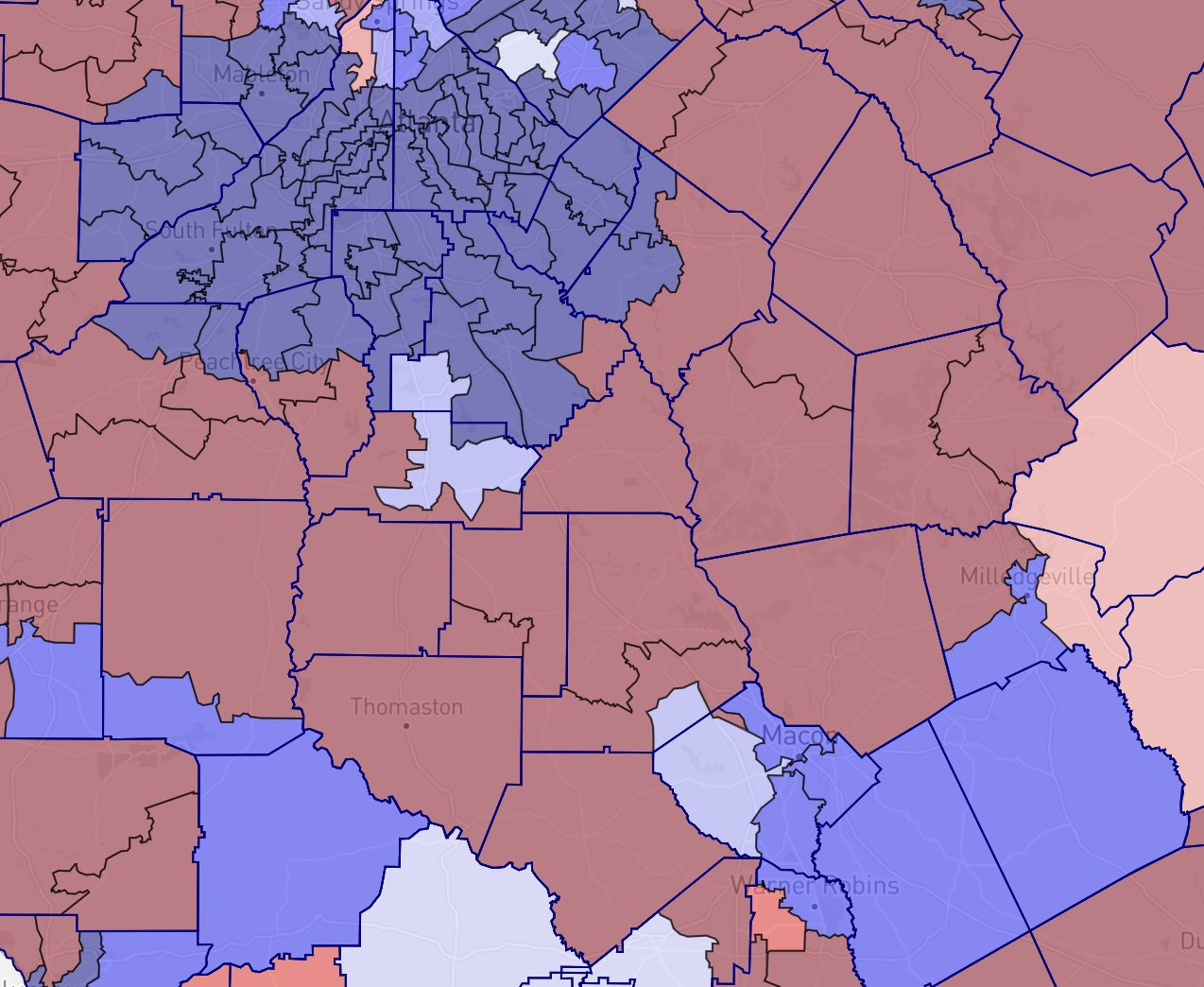
  • Under both House maps, Houston County finally gets Democratic House representation, with the map stretching HD143 (currently held by House leader James Beverly) to represent Warner Robins and northern Houston County while splitting central Macon into three blue districts stretching into surrounding counties.
    • Larry Walker was the last Democrat to represent a portion of Houston County in the House, way back in the 147th General Assembly (2003-2004).
  • Nothing in Greater Columbus was touched (obviously).
  • The map definitely strengthens the Black Belt’s African American representation a bit.
  • This map, and the Democratic response, reflects how the state’s popular vote has shifted to the left in the last several elections.
  • More analysis by Niles Francis.

Notes

  • Even on gerrymandering grounds, I wonder why the GOP wants to keep the current margins for Senate while conceding 3 seats in the House. I’d have expected at least one concession in the Senate for a 32R-24D map.
  • I wouldn’t be surprised if, in the congressional map phase, the GOP goes the route of packing more Black voters into Lucy McBath’s GA07 rather than redraw the west Atlanta suburbs between the 3rd, 6th, 11th, 13th and 14th districts. The Dems are hoping to keep the 7th intact.

Democrats are hoping for something like this (courtesy Stephen Wolf @PoliticsWolf):

Are Alabama’s Democrats Ready? Are the South’s Democrats Ready?

I think about the following:

  • Out of the former Confederate states in the period between 1870 and 1901, only South Carolina sent at least two or more members to the U.S. House.
  • Georgia, Alabama, Louisiana, Mississippi, Florida, North Carolina and Virginia all sent one member at a time.
  • Texas and Tennessee never sent any members in the (post-)Reconstruction era
  • and Arkansas has never sent any African Americans to Congress to the present day

Now, Alabama will likely send two Black members to the U.S. House for the first time. And Louisiana is within spitting distance of doing the same for the second time in their history; the first time such a thing happened was in 1993, when William Jefferson (D-LA02 and Cleo Fields (D-LA04) went to the 103rd Congress.

The big question which sticks out for me is whether the Alabama Democratic Party will be prepared for this moment.

They certainly weren’t when Doug Jones won the once-in-a-blue-moon Senate special election in December 2017. In fact, the Alabama Democratic Party, the statewide Black Democratic club ran by Joe Reed, actively fought Jones for influence over the party’s bylaws and structure. The fight continues to this day, years after Jones lost his Senate seat to some bigoted football coach. And it seems like the DNC will have to pry some control of the ADP from the Conference. The Conference also tried to intervene twice in the Allen v. Milligan case to advocate for a more Black-majority 2nd and 7th district (to no avail), which went against the strategy of the plaintiffs as well as Rep. Terri Sewell in favor of two opportunity districts.

Now, however, with Sewell likely to win again in the 7th, the question remains as to the impact of whoever wins the 2nd congressional district. It’s most likely that the winner may be Black, or that whoever wins will have the support of the Black voting-age population in the 2nd district. But will the winner have more of a role in the Alabama Democratic Party? Will the campaign to defend both the 7th and the new 2nd district arouse the party out its current shape?

The same can be asked about Louisiana’s Democratic Party. It is heading to another era in the statewide wilderness with the terming-out of Governor John Bel Edwards and the likely election of a Republican governor. The party has been beaten down badly in other political aspects due to a massive decline in white rural support. Besides retaining Foster Campbell on the PSC in 2026 (he had his closest election in 2020), the other favorable political aspects above the state legislature have been:

  • the election of Davante Lewis to the PSC in 2022
  • the possible creation of a second opportunity congressional district around Baton Rouge for 2024

This is why I look forward to the impact of Allen v. Milligan on Southern elections. All of these issues can be challenged in federal court:

  • the potential second opportunity district in Louisiana
  • the reform of Mississippi’s State Supreme Court districts
  • Alabama’s Public Service Commission election method
  • Georgia’s Public Service Commission election method and maps
  • Texas’s Supreme Court election method
  • Texas’ State Board of Education maps
  • Texas’s Railroad Commission election method
  • Louisiana’s Supreme Court election method

Special Session Called for Redrawing Congressional and Legislative Maps

So federal district Judge Steve Jones ruled that Georgia’s current legislative and congressional maps – namely one seat for US House, two seats for state senate and five seats for house – violate Section 2 of the Voting Rights Act. The ruling is 516 pages long, and calls for the legislature to draw new maps by December 8 or else a special master will be appointed.

Also the ruling states these following demands:

  • Redrawn congressional majority-minority district must be in west of Atlanta, including parts of Cobb and Douglas counties
  • Two redrawn state senate majority-minority districts must be in south of Atlanta
  • two House seats south of Atlanta, one west of Atlanta, and two around Macon

And now Gov Kemp (aka Lurch), on the same day, has called a legislative session for redrawing both maps, set for November 29.

Much of the commentary focuses on how the Republican majority may simply do a sleight of hand and redraw Lucy McBath’s district to be majority-Black instead of redrawing a district west of Atlanta. If so, it’s back to court.

I’m also interested in the state house map ordered by the judge, which would likely create a majority-Black district in Warner Robins/northern Houston County for the first time. House Districts 142, 143, 145, 147 and 149, all ordered to be redrawn, cover Crawford, Wilkinson, Twiggs, Bleckley, central and southern Macon-Bibb, northern half of Peach, northern and central Houston and northern and central Dodge counties.

courtesy Stephen Fowler of GPB News

As someone who was raised in Warner Robins, I’ve wanted to see Warner Robins get an urban state house district for years. But then again, I’ve waited for someone to bring a VRA complaint over the fact that Houston County elects all members of its county commission at-large using FPTP.

More on SCOTUS redistricting rulings

  • Alabama’s legislature will approve a new congressional map with a second VRA district by July 21. The plaintiffs’ remedial map, which goes for a least-change approach, might be adopted, but several submissions have been sent.
  • SCOTUS rejecting Louisiana’s appeal defending their congressional maps is only a partial victory for fairer maps. The case was sent back to the 5th Circuit to decide whether to continue hearing Louisiana’s appeal or to send it back to the Middle District of Louisiana which already ruled against the map. We shall see, but either Louisiana or the 5th Circuit can draw this one out.
  • The denial of cert to Ohio’s case defending their shit maps is not a victory for fair maps at all. Unless Ohio defeats Issue 1, most other attempts at redistricting reform in that state are f**ked.
  • Still nothing regarding Rose v. Raffensperger from the 11th Circuit, beyond both plaintiffs and the state sparring in dueling letters to the court asserting Milligan and Gingles‘ applicability to the case immediately following the Milligan decision.
  • I tried redrawing a map with a second majority-Black district for Louisiana’s PSC. I don’t think it worked.

2022 Georgia Primary Ballot Advisory Questions: A Postscript

  • Full list of questions
  • All statewide questions on both ballots received a large majority response, with only one question (Republican Question 5) receiving a “No” response.
  • I wrote Democratic Questions 4 and 8. I’m proud. I only wish a few more of my questions were added. Thanks to Scout Smith for lobbying the DPG for these questions and helping me narrow down my shortlist to 7.
  • I consider an advisory question to be controversial if majority response is 80% or less. Few questions on the ballot in the history of advisory questions in Georgia primaries have ever fallen under 80% majority response.
  • I’m getting ready for 2024.

Democratic Question 8

  • Coverage of Democratic Question 8: Marijuana Moment, Ganjapreneur, Cannabis Business Times
  • Democratic Question 8 (which I authored) had the most controversial reception on the Democratic ballot, despite all counties voting in favor.
  • Athens-Clarke’s Democrats had the most lopsided response to Democratic Question 8. Baker County had the worst response.
  • Clarke and Forsyth had extra marijuana legalization questions for some reason.
  • Democratic Question 8 is the most complete survey on support for marijuana legalization carried out so far. However, this only covers the Democratic side of the ballot.
    • In 2018, separate Republican questions for medical marijuana and decriminalized recreational access were asked in Harris, Pierce and Ware, with only medical questions being asked in Gordon, Walker and Whitfield. 
    • In 2020, Henry County Republicans asked a question on recreational legalization. This was the first to receive majority support from Republican voters, albeit much slimmer than on past Democratic ballots.
    • Past Democratic questions on legalization were offered in Cherokee (2014), Whitfield (2014), Glynn (2018), Forsyth (2018 and 2020), and Walton (2020), with a question on medical cannabis being asked in Richmond in 2014 and Catoosa in 2016.

Other Ballot Questions

  • Democratic Question 1, dealing with student loan debt forgiveness, was probably the second most controversial question on the Democratic ballot.
  • Democratic Question 4 shows support among the Democratic base for stronger direct democracy than what we currently have.
  • Republican Question 5, which was written exactly to elicit reactionary conservative disgust/hatred against transgender people, had the most lopsided response on the Republican ballot.
  • All of the other statewide Republican questions were garbage, and I would have wanted the opportunity to vote no on every single one of them on the same ballot as I voted yes to every single Democratic question. One can dream.
  • Many county-level questions dealt with local government and infrastructure questions.
  • Fulton and DeKalb’s Republican ballots both had anti-mask, anti-vaccine questions.
  • Carroll and Forsyth’s Democratic ballots had questions on diversity, equity and inclusion (DEI) in education, while DeKalb’s Republican ballot had a question on CRT.
  • Jackson’s Democratic ballot had an anti-Confederate monument question.
  • Oconee County had the only jointly-shared questions on the primary ballot this cycle, with Republicans going out of their way to spell out in bold “This question was drafted by the Democrat party and is being included on this ballot at the request of the Oconee County Republican Party.” behind both joint questions on their ballot.
    • Rockdale held a joint question in 2012, as did Pickens in 2018.

Why Georgia Needs a Free Elections Amendment

I’m writing this in light of the North Carolina Supreme Court again using that state’s free elections clause to strike down GOP gerrymanders of congressional and legislative maps just a few hours ago.

Someday, I hope that Georgia adopts the free elections clause into our state constitution, something like this draft I wrote up.

Around 30-31 states have this “free elections” provision in their state constitutions, usually within their respective bills of rights. They are most often written in the following way: “All elections shall be free and equal, and no power, civil or military, shall at any time interfere to prevent the free exercise of the right of suffrage”:

This is not the same as the right to vote, which is usually detailed in a separate portion of a state constitution’s bill of rights (which we already have) as a declaration of who has the right and freedom to register and cast ballots. The right to free and equal elections, on the other hand, usually applies to the right to an election which is conducted without forced compulsion or constraints against voters, candidates or election officials in their participation in elections. In the past, this was more often applied against allegations of bribery, ballot tampering and other unlawful attempts to curtail the choices of voters.

In three of these states (Pennsylvania, Virginia and North Carolina), courts have determined that partisan gerrymandering is a violation of their respective states’ right to free elections (among other state constitutional violations, such as freedom of speech and equal protection), resulting in more proportionate maps being drawn by either their respective legislatures or by court-appointed cartographers.

It’s a shame that Georgia, which has the youngest constitution of the 50 states, does not have a free elections clause which helps to protect our right to free and fair elections. It is not detailed in Article I, Section I (Bill of Rights), nor in Article II, Section I (Method of Voting, Right to Register and Vote), the latter of which at least affirmatively details the right to vote.

The Trumpists who have wailed about how the 2020 election was not fair to them do not have a provision in the state constitution which backs up their claim. Furthermore, the United States Constitution neither positively details the right to vote nor details any right to free elections, and the U.S. Supreme Court in Rucho v. Common Cause has ruled out any future intervention by the federal judiciary in cases regarding partisan gerrymandering, mandating that only state courts could possibly decide such cases.

Meanwhile, the 1868 South Carolina Constitutional Convention, which was arguably predominantly-Black in membership, managed to introduce a free elections clause to the South Carolina State Constitution, where it remains to this day. The crafters of our past state constitutions (namely the 1867-1868 convention) seemed to have missed this, badly.

This is why I hope that Georgia can catch up to these other states in adding this provision to our state constitution, so that we have fairly-drawn district lines and better state constitutional guardrails against voter suppression.

Recent Notable Voting Rights Act-related Actions in Federal Court

Two federal VRA cases of note:

  1. Georgia Public Service Commission election case, arguing that the at-large election method in the state constitution for the Public Service Commission violates the Voting Rights Act. Federal judge just ruled (1/24) against the state’s motion for a summary judgment, in favor of plaintiffs’ request for partial summary judgment. Georgia law holds that candidates for PSC run statewide but must live in their home districts.
  2. Alabama congressional map struck down (1/24) by federal court (surprisingly consisting of two Trump and 1 Reagan/Clinton appointees) due to packing Black-majority areas into one district, ruling that Alabama could create two Black-majority districts (ruling in PDF). Huge implications for in-process Louisiana congressional map as well (maybe even South Carolina?). Alabama AG announced an appeal to SCOTUS on the ruling.

VRA Implications for Alabama, etc

It is already well-documented that Republicans and their judicial sycophants like John Roberts despise the Voting Rights Act when it comes to its pre-Shelby federal intervention powers, i.e., U.S. DOJ preclearance of legislative and congressional maps. What is less well-known is how Republicans see the VRA’s insistence on majority-minority representation in redistricting as a tool for packing and cracking districts to minimize Democratic-preference representation and protect Republican incumbents.

I’m not prepared to say what implications could arise if SCOTUS reverses the Northern District of Alabama ruling.

VRA Implications for Georgia PSC

On the PSC issue, if the court rules for the plaintiffs (and the decision survives SCOTUS), Georgia would join Mississippi, Louisiana, Montana, Nebraska and New Mexico in holding elections for PSC from voters of individual districts rather than statewide. Alabama, Arizona, Illinois, North Dakota, Oklahoma and South Dakota all hold statewide elections, but seats do not represent districts. All other PSCs in other states are appointed, usually by the governor.

A victory for the plaintiff would likely recommend that Georgia changes either Article IV, Section I of the state constitution and/or O.C.G.A. 46-2-1(a) to clarify how PSC members are elected, either removing any mention of the five PSC districts or removing any mention of statewide election for PSC members. It would also mean the return of Democratic Party representation to the PSC for the first time since 2006, when David Burgess was defeated in his re-election bid. Notably, out of those PSCs which are currently elected by district, only Montana lacks any Democrats among their membership (since 2012).

What may become an issue is if the districts of the PSC, currently based around counties, are subsequently redrawn further for Republicans’ base benefit, even though the current map would likely go 4R-1D anyway (which would be an improvement).

Or is there a further opportunity to redraw this map for VRA compliance? But then would the basis exclusively around multiple counties rather than around equal population get in the way?

District 2 is easily the most competitive district on this map, having voted 51% Trump-46% Biden. The current District 2 is also a minority opportunity district which is 51% minority (30.25% Black, 11.94% Hispanic), anchored between Athens, Macon, Warner Robins and the eastern Metro Atlanta counties.

Richmond County being moved from District 4 to District 2 would make District 2 knife’s-edge, easily flippable for either party depending on the year.

District 5 is not as competitive, having voted 54% Trump-43% Biden, but moving Muscogee County from out of District 1 would make District 5 a little bit more competitive, shifting to 53% Trump-44% Biden.

State supreme courts

Somewhat related: I did research on state supreme courts and how they are elected. Only Illinois, Kentucky, Mississippi and Louisiana hold district elections for state supreme court justices; all others, including Georgia, are either elected statewide or appointed/nominated by the governor. Recent actions by Republicans regarding elections of state supreme courts: November ballot question in Montana to elect justices by district rather than statewide, and a new law in Ohio to hold partisan elections for justices.

The idea of having justices represent districts may conflict with the fact that state supreme courts usually take cases from, and deliver interpretations of the law which impact, all areas of their states. This is in contrast to legislatures and commission bodies like PSCs, which enact new policies.

Abrams Announces 2nd Bid for Georgia Governor, 1st to Enter the Democratic Primary

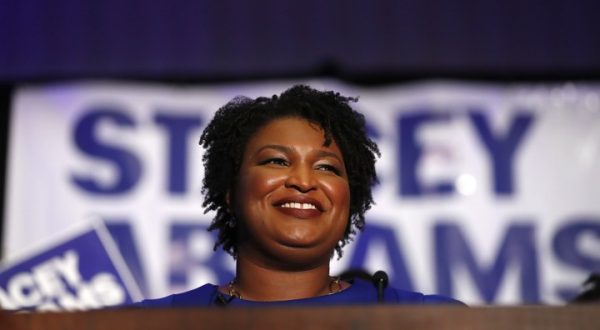
Stacey Abrams

Ending years of speculation, Fair Fight CEO and former state House Minority Leader Stacey Abrams announced her 2022 bid for governor, an announcement timed on the day after the 2021 municipal runoffs. She is widely expected in the press to be the leading candidate in the May 24 2022 Democratic gubernatorial primary.

Despite her renown and the possibility that she could have no primary competition, Abrams will face an uphill battle against the eventual Republican nominee, whether it is incumbent Brian Kemp, former U.S. Senator David Perdue, or the conservative former Democratic state legislator-turned-Republican candidate Vernon Jones. The Abrams campaign currently expects an uncontested primary for governor, preferring that more of the primary infighting occurs on the Republican side in the coming months.

Abrams also faces an uphill battle against stagnant national poll numbers for President Joe Biden and downballot Democrats. History shows an emerging Democratic Party in Georgia which only began in recent years to rebuild itself in a new image.

16 Years in the Wilderness, Then a Path Forward

The last time that Democrats in Georgia ran for governor and state row offices under a Democratic president’s first midterm was in 2010, which resulted in a poor showing, with Republican former congressmember Nathan Deal defeating the Democratic former one-term governor Roy Barnes by 10 percentage points, and the downballot Democrats performing worse in their popular vote share. The 2014 gubernatorial election also saw a poor showing by Democrats, with Nathan Deal defeating Democratic state senator Jason Carter by 8 points.

On the other hand, 2006, which was a Democratic downballot wave year nationally, also saw Georgia Democrats massively underperforming the national environment from the governor downward, with Republican incumbent Sonny Perdue dealing a 19-point defeat to Democratic Lieutenant Governor Mark Taylor, the worst result for a Democratic gubernatorial nominee in Georgia history. The Democratic popular vote percentages for U.S. House, Georgia Senate and Georgia House all exceeded Taylor’s.

In general, the 2000-2016 period was a doldrum period for Democrats, only experiencing an infusion of energy beginning in 2017 with Trump-era special elections ending the Republican supermajority in the State Senate and a spirited push by then-candidate Jon Ossoff for Georgia’s 6th congressional district. At the same time, the vote share difference between the parties has declined in each successive gubernatorial contest since 2006, from that year’s 57.9 – 38.2 difference between Perdue and Taylor to 2018’s 50.2 – 48.8 difference between Kemp and Abrams.

Abrams in 2018 was the first Democratic nominee for Georgia governor who had neither any ties with the pre-21st century political establishment within the party nor any electoral experience prior to 2000. Barnes was a state senator from 1975-1991, state representative from 1993-1999 and governor from 1999-2003; Taylor served as state senator from 1987-1999 and Lieutenant Governor 1999-2007; and Carter is the grandson of former U.S. president Jimmy Carter, and shared the 2014 ballot with Michelle Nunn, who ran for U.S. Senate and is the daughter of former U.S. senator Sam Nunn (who served in the Georgia House from 1969-1973 and the U.S. Senate from 1973–1997).

Even the other state row offices have seen improvements. The last Senate-Governor year in a Democratic president’s first midterm (2010) saw Michael Thurmond bottom out with 39% of the vote for U.S. Senate, followed closely by Georganna Sinkfield for Secretary of State with 39.4%. The last Georgia state row office election in a Senate-Governor year (2014) saw Democrats’ worst-performing statewide candidates – Christopher Irvin for Agriculture Commissioner and Liz Johnson for Insurance and Safety Fire Commissioner – each gaining 41.7% of the vote. In contrast, the 2018 election saw Fred Swann improve on the state row office floor with 46.92% for Agriculture Commissioner.

The Political Environment in Georgia

The task before Georgia Democrats is to maintain the Trump-era momentum in the Biden era, overperform against national polls, and accomplish the difficult task of putting a Democrat in the governor’s mansion, but the national environment sometimes offers mixed surprises. 2010, while a disaster for downballot Democrats across most of the country, did see Democrats pick up governorships in five states, while Republicans took governorships in eleven other states. Similarly, in 2021, Democrats lost the Virginia governorship, but retained the governorship of New Jersey in that state’s first Democratic re-election win in 40 years, a mixed early national result for Democrats downballot heading into 2022.

And the current state-level environment offers early positive signs for Georgia Democrats, with self-identified Democrats flipping 48 municipal seats in 25 counties in 2021, including a close historic win for the Warner Robins mayorship, while Republicans flipped 6.

2022 will also be the first time since 2014 that both offices of governor and U.S. senator will be on the ballot in Georgia. The Democratic nominee for governor will likely campaign at the top of the Democrats’ Georgia ticket alongside the Democratic Senate nominee, widely expected to be the incumbent Raphael Warnock, who is running for a full six-year term in office. Warnock and his fellow senator Jon Ossoff both forced Republican then-incumbents Perdue and Kelly Loeffler into runoffs and pulled off wins in January 2021.

A slew of Democratic candidates have announced bids for all executive row offices to the press throughout the year, with likely competitive primaries for Lieutenant Governor, Attorney General, Secretary of State, and the Commissioners of Agriculture, Insurance and Labor. Surprisingly, only one Democrat, Cobb County Public Schools Board member Dr. Jaha Howard, has announced for State Superintendent of Schools, an office for which there is usually a competitive Democratic primary.

A History of Georgia’s Party Primary Ballot questions

I’m writing this post to document the history of the limited access to direct democracy in the U.S. state of Georgia, and especially about the potential small-d democratic opportunities which can be used to advise city, county and state legislators. For reference, here is a Google Drive folder of all the party advisory questions placed on the ballot in Georgia at state and county levels since 2000 (ongoing at the moment).

History of direct democracy in Georgia

Georgia mostly missed the boat, or rather, the tide of the initiative & referendum movement which took more westward states by storm in the late 19th-early 20th century. From 1911-1913, the General Assembly moved to extend initiative, referendum and recall rights to the residents of four cities, including Atlanta. The first ballot measures for legislatively-referred constitutional amendments took place in 1924. The first amendments to be rejected at the ballot were five out of 13 proposed amendments on the November 4, 1930 ballot. The most recent proposed amendments to fail at the ballot was Amendment 1 on the November 8, 2016 ballot, which would have established the so-called “Opportunity School District” as a statewide at-large school district over public schools deemed “chronically failing”.

In addition, county and city governments can place questions on the ballot for all voters, and can choose a date. Counties can place a question on the ballot (whether in the nonpartisan section of a primary ballot, or on the general election ballot) by one of the following means:

  • county commissioners voting to place the question on the ballot
  • citizens gathering a required number of petition signatures to amend (or veto changes to) local ordinances, resolutions, and regulations.

Either option requires a majority of the city or county’s delegation in the General Assembly to file a bill in support of the referendum, and for the General Assembly to approve the bill.

In addition, there is a third way to put a question on the ballot, one which is advisory in most ways but can have an indirect, motivating impact on legislation.

Party Advisory Questions on Primary Ballots

Around April 1997, a law allowing for parties to place advisory questions on the primary ballot was passed by the General Assembly, making Georgia only one of three states to allow parties’ chairs to place questions on primary ballots (alongside Texas and South Carolina). In 2000, the Richmond County Republican Party became the first recorded county party to use this law to place a question on the primary ballot, doing so with 6 questions that year. The practice increased across many counties over the next five primaries, and in 2012 questions were placed for the first time on statewide primary ballots, with both the Democratic Party of Georgia placing 4 questions and the Georgia Republican Party placing 5.

On a few occasions in a few counties, both parties have placed the same question on the ballot, including Rockdale in 2012 and Pickens in 2018, both of which were related to the form of government to be taken by the county government. To date, no statewide primary ballot has had both parties place the question on the same ballot.

Due to the way that such polls are written, they’re usually fluffy questions which do not deviate from the party’s already-established platform. The few times that a question is fielded from outside of party orthodoxy is usually intended to gin up primary voter opposition to the question.

Marijuana/Cannabis on the Georgia Ballot

Only a few good-faith questions which deviate from party orthodoxy have been fielded by county parties, such as Henry County Republicans’ 2020 Question 4, asking Republican voters whether marijuana should be legalized and taxed to the same extent as alcohol. Republican voters approved this question 9,849 to 9,415 (51.13%-48.87%). However, in 2018, two similar questions (one asking whether medical marijuana should be legalized, and another asking the same for recreational marijuana) provided a more complicated picture among Republican voters in multiple, largely-rural counties, with 6 counties’ Republican primaries registering lopsided support for medical marijuana but the same voters in 3 of those counties registering lopsided opposition to recreational marijuana (those being the only counties which polled Republicans on recreational marijuana that year).

By comparison, marijuana has been on at least one county’s Democratic ballot every year since 2014, all winning lopsidedly at the polls:

  • Cherokee and Whitfield Dems on recreational, Richmond Dems on medical (2014)
  • Catoosa Dems on medical marijuana (2016)
  • Forsyth and Glynn Dems on recreational (2018)
  • Forsyth and Walton Dems for recreational (2020)

How to capitalize on advisory questions

I think that party advisory questions, while incredibly flawed in only being placed by party leaders on separate primary ballots, offer an opportunity for massive polling of the primary-voting public on issues, not only for well-established party platforms but also for newer ideas which have yet to be incorporated into party platforms. In addition, polling of the primary-voting public through advisory questions can offer glimpses into regional divides, nuances and knowledge about newer ideas.

For example, Cobb4Transit’s post on the results of two 2020 Democratic advisory questions in Cobb County – Question 7 on a one-center sales tax for transit funding, and Question 8 on MARTA expansion into Cobb – provides an in-depth look at the nuances of support for these positions on the Democratic side in Cobb County.

A 2020 Republican statewide question (Republican Question 2), which called for establishing closed party primaries to determine primary winners, failed by 1-2%. The data shows that the idea has support among Republicans in northern and coastal Georgia, with the greatest opposition coming from western, middle and southern Georgia Republicans. A similar question was asked to South Carolina Republicans in the 2018 and 2020 primaries, receiving 92.30% and 86.47% respectively.

I expect marijuana legalization to be on the Democratic statewide party primary ballot in 2022. It may be the biggest question that the Democratic Party of Georgia hasn’t yet asked on the statewide ballot, after a near decade of asking primary voters their position on already-settled party positions such as Medicaid expansion, expanding HOPE access and gun control.

Similarly, for LGBT civil rights activists, Whitfield’s 2014 Democratic Question 6 and Cobb’s 2020 Democratic Question 11, both of which asked voters whether their county should pass a non-discrimination law covering sexual orientation and gender identity (Cobb’s listed more categories), received resounding endorsements, winning 75.58% in Whitfield and 97.41% in Cobb. This is another question that the DPG State Chair should be encouraged to ask to Democrats statewide, in regards to the proposed Georgia Civil Rights Act.

But finally, more county commissions should be encouraged to follow Wisconsin’s example in placing advisory questions on the November general election ballot.