Tag Archives: georgia general assembly

Georgia Democrats Qualify for a Variety of Seats in a Presidential Year

Qualifying for the May 21 Democratic primary and nonpartisan election ended last Friday at noon.
Statewide:

  • John Barrow is running for Andrew Pinson’s seat on the Supreme Court. This is the first likely-substantial contest against an incumbent justice in years. This “nonpartisan” election is on May 21.
  • There will be a “nonpartisan” contest for an open seat on the State Court of Appeals. Attorney Jeff Davis will face off against Cobb County Magistrate Judge Tabitha Ponder. This “nonpartisan” election is on May 21.
  • The Public Service Commission elections have been cancelled again, and the current commissioners will remain on the ballot for the next two years. It’s likely that we will be voting on all five commissioners in 2026.
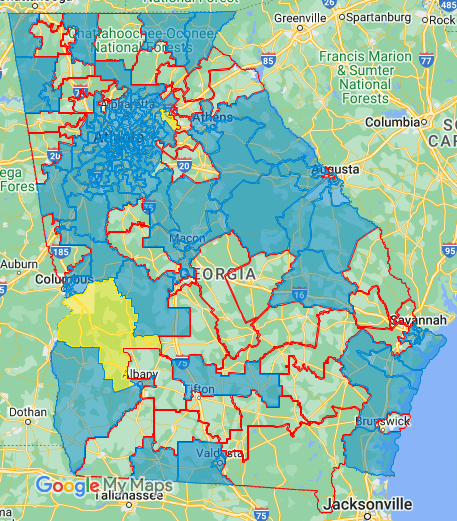
  • We are now running for 38 seats (2/3rds) in the Senate and 135 seats (3/4) in the House. To compare, since 1992, we’ve ran for at least 75% of the House in 1992, 1994, 1996 and 2020. 
  • We are running for District Attorney positions in 14 circuits. There will be Republican challengers in three circuits: Atlanta, Chattahoochee and Eastern.
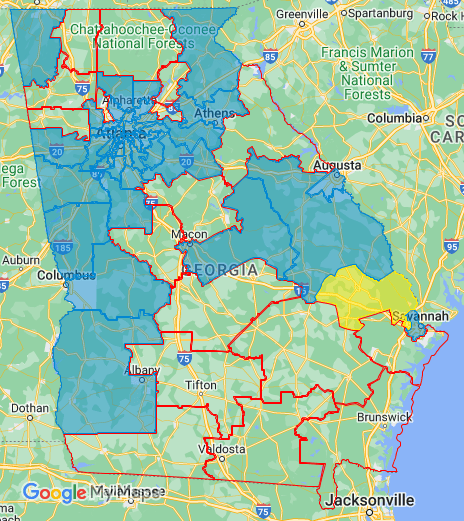
  • Democrats are running for all 14 congressional districts. There will be Republican challengers in all but GA13.
  • At the end of qualifying, we left HD104, a Biden district in Gwinnett County, HD151, a slightly-Trump voting district in Southwest GA, and SD4, a Biden district near Savannah, on the table. 

And now for local elections around Columbus:

  • We will have a Democrat, Carl Sprayberry, for HD139 (open).
  • We will have a Democrat, Ellen Wright, for SD29. 
  • Debbie Buckner in HD137 will have a primary challenge from Carlton Mahone Jr and a Republican challenger. 
  • Teddy Reese in HD140 will have a Democratic challenger in Alyssa Nia Williams. 
  • There will be a Democratic primary for the open seat in deep-red GA03. Val Almonord, who was the Democratic nominee in 2020 and 2022, will have a challenge
  • There will be a Republican challenger for GA02. 
  • We now have a Democrat running for District Attorney in Chattahoochee Circuit: criminal defense attorney Anthony L. Johnson. He has no primary opposition, and will be on the ballot in November against Republican and acting DA Don Kelly. We are also challenging a Republican for DA in Eastern Circuit as well. 
  • Our incumbent Sheriff Greg Countryman is running for re-election as a Democrat. He will be opposed in November by Republican Mark LaJoye.
  • Our incumbent state court solicitor Suzanne Goddard, who previously held office as a Democrat, is running for re-election as a Republican. We have a Democratic challenger in Shevon Sutcliffe Thomas. 
  • Buddy Bryan is running for re-election as Coroner as a Democrat. He will be opposed in the May primary by Royal Anderson. No Republican is running in November. 
  • Lula Lunsford Huff is not running for re-election as Tax Commissioner. David Britt is running as a Democrat for the position and is unopposed in May and November. 
  • We will likely not have a challenger to Gary Allen for Council District 6. A potential candidate fell through. I am sad about this as well since I live here.
  • Toyia Tucker will have a challenge in Council District 4. This “nonpartisan” election is on May 21.
  • There will be a four-way race for Council At-Large 10. This “nonpartisan” election is on May 21.
  • There will be a contest for Board of Education District 7, with Lakeitha Ashe challenging incumbent Pat Frey. This “nonpartisan” election is on May 21.
  • Incumbents unopposed in May and November: Danielle Forte (D) for Superior Court Clerk, Reginald Thompson (D) for Clerk of Municipal Court, Marc D’Antonio (D) for Judge of Probate Court. 
  • No contests for HD138 (Vance Smith (R)), HD141 (Carolyn Hugley (D)), City Council Districts 2, 6 or 8, Board of Education District 1, 3, 5, or At-Large 9, nor State Court Judge (Temesgen). 
  • In addition, there may be some party primary advisory ballot questions. 

Retirements:

  • Both Senate Minority Leader Gloria Butler (SD55) and House Minority Leader James Beverly (HD142) are not running for re-election to either house.
  • Other Senate Democratic retirements: Valencia Seay (SD34) and Horacena Tate (SD38).
  • Other House Democratic retirements: Doug Stoner (HD42), Roger Bruce (HD61), Mandisha Thomas (HD65), Pedro Marin (HD96), Gregg Kennard (HD107), Gloria Frazier (HD126), Patty Bentley (HD150).
GA GOP Senate and House Maps Released, with Democratic Responses

Over the course of November 26-30, the GOP and Democratic caucuses in the Georgia Legislature have released their legislative map proposals.

Senate

  • Senate has 56 total seats, majority is 29.
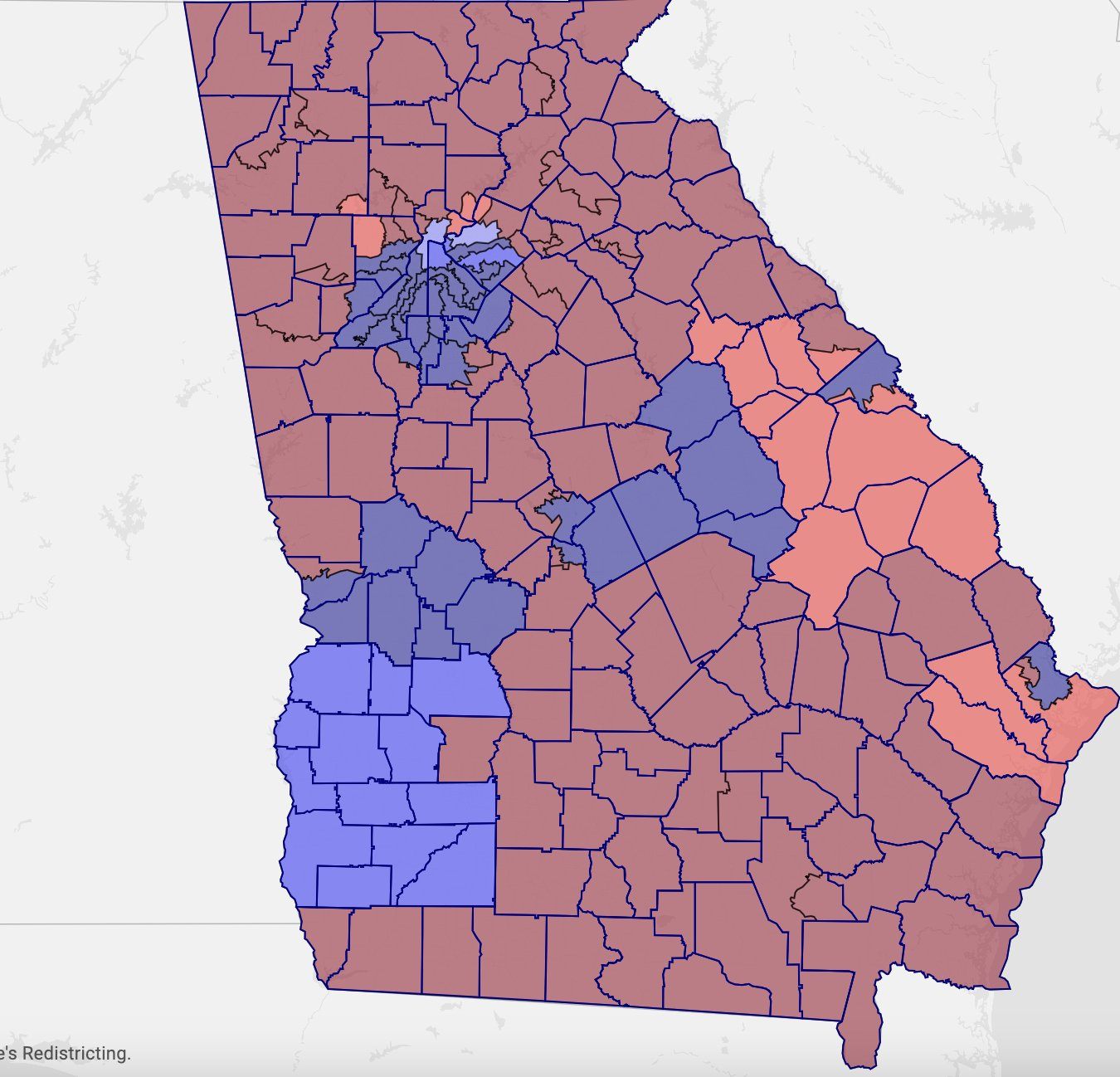
  • The GOP’s proposed Senate map keeps the party composition at 33R-23D by packing two majority-black districts and eliminating two majority-white Democratic districts.
  • The Democratic response would shift the party composition to 31R-25D by adding two majority-Black districts in the southern Atlanta suburbs.
  • The Democrats are challenging the GOP Senate map as not fulfilling the court order. Won’t be surprised if it goes back to court.
  • Looking at the glass half-full, the current Senate party composition is the closest its ever been since Republicans gained the Senate majority in 2003-2004 for the first time since Reconstruction. They held it at 30R-26D, then increased it to a historic 39R-17D by 2016 before Democrats began bouncing back from 2017 onward.
  • More analysis by Niles Francis.

House

  • House has 180 total seats, majority is 91.
  • The GOP’s proposed House map brings the party composition of the House in 2025 to 99R-81D, down from the current composition of 102R-78D.
  • The Democratic response would modestly bring the party composition to 96R-84D by creating four majority-Black and one plurality-Black districts while double-bunking or flipping some Republican seats in the process.
  • Not as much Democratic outcry about the GOP House map as there is against their Senate map. However, there is disagreement from expert testimony on whether the House map passes the VRA smell test.
  • The last time the GOP was under 100 members in the House was the 148th General Assembly in 2005-2006, when the GOP held the House for the first time since Reconstruction. It was 99R-80D-1 independent. From there, Republicans ascended to a high of 119R-60D-1 independent 2013-2016 before Democrats bounced back from 2017 onward.
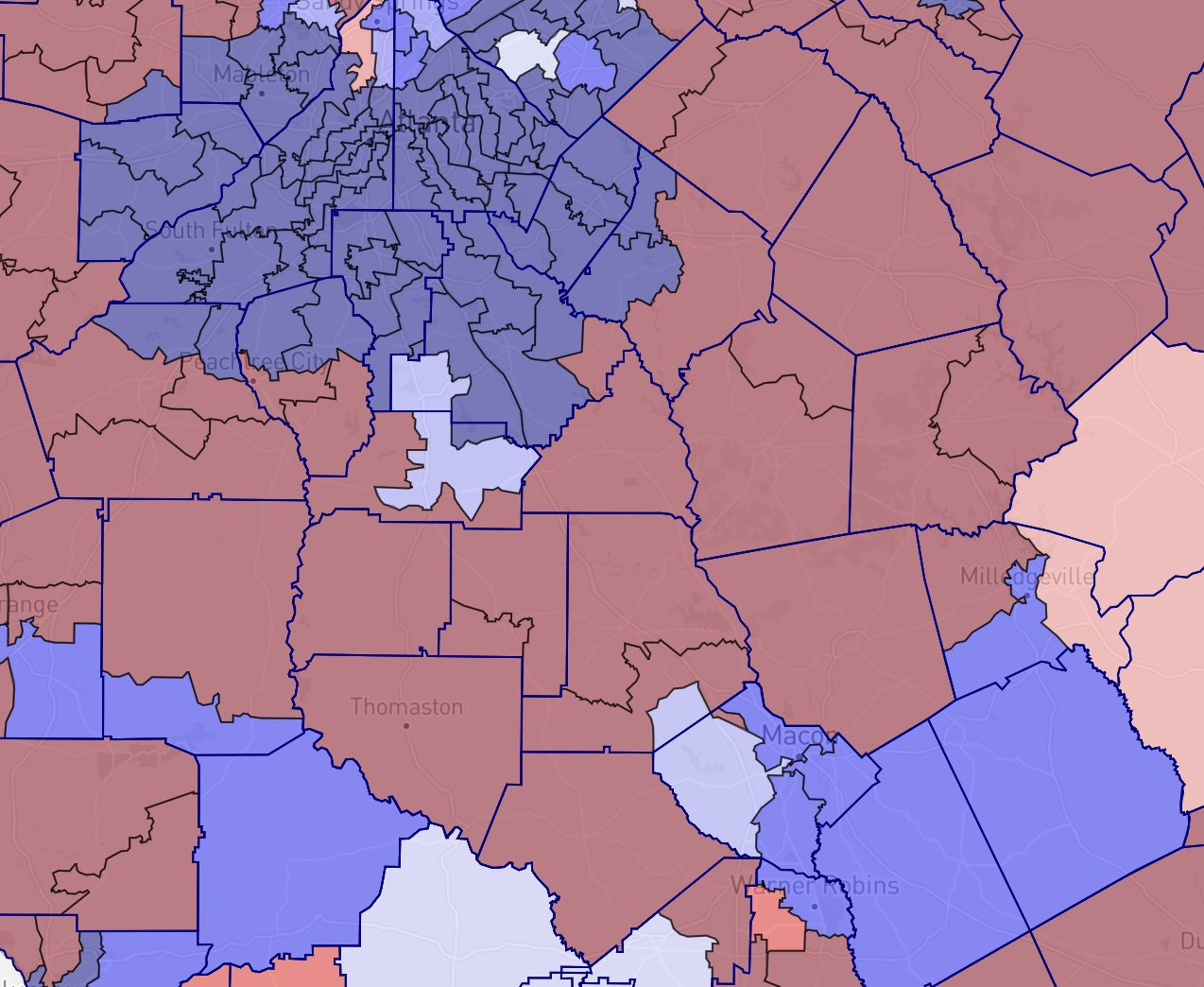
  • Under both House maps, Houston County finally gets Democratic House representation, with the map stretching HD143 (currently held by House leader James Beverly) to represent Warner Robins and northern Houston County while splitting central Macon into three blue districts stretching into surrounding counties.
    • Larry Walker was the last Democrat to represent a portion of Houston County in the House, way back in the 147th General Assembly (2003-2004).
  • Nothing in Greater Columbus was touched (obviously).
  • The map definitely strengthens the Black Belt’s African American representation a bit.
  • This map, and the Democratic response, reflects how the state’s popular vote has shifted to the left in the last several elections.
  • More analysis by Niles Francis.

Notes

  • Even on gerrymandering grounds, I wonder why the GOP wants to keep the current margins for Senate while conceding 3 seats in the House. I’d have expected at least one concession in the Senate for a 32R-24D map.
  • I wouldn’t be surprised if, in the congressional map phase, the GOP goes the route of packing more Black voters into Lucy McBath’s GA07 rather than redraw the west Atlanta suburbs between the 3rd, 6th, 11th, 13th and 14th districts. The Dems are hoping to keep the 7th intact.

Democrats are hoping for something like this (courtesy Stephen Wolf @PoliticsWolf):

Special Session Called for Redrawing Congressional and Legislative Maps

So federal district Judge Steve Jones ruled that Georgia’s current legislative and congressional maps – namely one seat for US House, two seats for state senate and five seats for house – violate Section 2 of the Voting Rights Act. The ruling is 516 pages long, and calls for the legislature to draw new maps by December 8 or else a special master will be appointed.

Also the ruling states these following demands:

  • Redrawn congressional majority-minority district must be in west of Atlanta, including parts of Cobb and Douglas counties
  • Two redrawn state senate majority-minority districts must be in south of Atlanta
  • two House seats south of Atlanta, one west of Atlanta, and two around Macon

And now Gov Kemp (aka Lurch), on the same day, has called a legislative session for redrawing both maps, set for November 29.

Much of the commentary focuses on how the Republican majority may simply do a sleight of hand and redraw Lucy McBath’s district to be majority-Black instead of redrawing a district west of Atlanta. If so, it’s back to court.

I’m also interested in the state house map ordered by the judge, which would likely create a majority-Black district in Warner Robins/northern Houston County for the first time. House Districts 142, 143, 145, 147 and 149, all ordered to be redrawn, cover Crawford, Wilkinson, Twiggs, Bleckley, central and southern Macon-Bibb, northern half of Peach, northern and central Houston and northern and central Dodge counties.

courtesy Stephen Fowler of GPB News

As someone who was raised in Warner Robins, I’ve wanted to see Warner Robins get an urban state house district for years. But then again, I’ve waited for someone to bring a VRA complaint over the fact that Houston County elects all members of its county commission at-large using FPTP.

Comment Now on Redistricting

Gerrymandering diagram

The clock is ticking for making your voice heard in how you are represented at the Gold Dome and U.S. Capitol.

The Georgia General Assembly has a public form for submitting comment online regarding redistricting, which for most Georgia residents may be the only means by which they can shape an otherwise tightly-controlled process.

To date, only three comments have been submitted from Columbus-Muscogee:

A. Russell of Muscogee County:

we would like all of Muscogee to be in one district. it would be my idea for Muscogee, Harris, and Meriweather to all 3 move to the 2dd Congressional District. thank you for this meeting.

A. Corley of Muscogee County:

I have bodycam footage of the kidnapping that was concealed during the TPR. I have SAAG Kent Lawrence and Mathias Skrowneak signatures on orders that they prepared for the Judges to sign. Kidnapping is a felony and placing my daughter up for an unlawful adoption is human trafficking. I have everything properly documented and authenticated with certification and seal. I also have audio recordings. Gov. Kemp was forwarded everything from Senators Johnny Isakson and Kelly Loeffler’s office as, federal government had to give the the State opportunity to investigate before they could. Gov. Kemp can do something as, he appointed the Commissioners for DHS. Gov. Kemp can do something as, he is head of the State of Georgia and is the executive level. Gov. Kemp had the authority and responsibility to enforce the laws made by the General Assembly. The executive branch which Gov. Kemp is under is defined as: Executive Georgia’s main executive official and head of state is the governor.

H. Underwood of Muscogee County (yours truly):

Good evening committee members, my name is Harry Underwood. I’m a resident of Columbus, a resident of Georgia since 1993 and a board member of Better Ballot Georgia, which advocates for instant-runoff voting, also known as ranked-choice voting. I’d like to take this opportunity to tell you how shameful and tiring I find this practice of redistricting by elected legislators, and how we Georgians ought to know better that this political system – of winner-take-all elections, of partisan redistricting by legislators, of restrictive ballot access laws – perpetuate a baked-in culture of constant two-way factional disrespect, drowning out the needs of our state’s residents. Other than these United States, no other political system on earth has quite the amount of unilateral temerity shared among so many elected legislators to bake in incumbent advantages for their own (and their friends’ own) benefit over the next ten years. The people of this state – no matter what party we may support – should feel upset that our elected legislators won’t let themselves compete on competitive grounds nor let themselves be judged by their ideas and goals for legislation across whole communities, not partitioned neighborhoods who are traded between districts because of their partisan lean. We have done this for over 200+ years, with one party having done this for most of this time, and another party which gained power in the early 2000s now doing the same thing. It is time to say “enough”. The people of this state should demand a better political system than that being exhibited through this committee. Georgia should adopt independent, nonpartisan redistricting by a jury of citizens representative of our state’s demographics. Georgia should adopt multi-winner districts and proportional elections systems including ranked-choice voting. Georgia should let those who want less compromise on their political principles register their own political parties with less cost and overhead than is currently, irrationally demanded under state law, so that we could have even more competitive elections. Georgia should adopt rules which count our state’s prisoners, who are currently barred from the voting franchise, as residents of their last voluntary residence rather than of their current prison, so that prison-hosting districts are not artificially inflated in their numbers during the redistricting process. And finally, Georgia should join 30 other states, including our neighbors in South Carolina, North Carolina and Tennessee, in adopting a state constitutional amendment requiring all elections in this state to be free, fair and open without civil or military interference. These five reforms could make for more elections which are reflective of our communities and demographic changes without legislators feeling the need to create maps which bake in their own advantages over the course of at least the next five successive legislative elections. These reforms could make for elections in which candidates feel more of a need to seek consideration from all voters, not merely those who “look” like they would vote for a certain party. And these reforms could set the guardrails for how our demographics are represented in our General Assembly without pitting our legislators against their constituents. I ask the members of this committee to consider the adoption of nonpartisan redistricting, instant-runoff voting, fairer ballot access laws, a ban on prison gerrymandering, and a free elections amendment to our state constitution. Thank you.

By comparison:

  • 89 from Fulton
  • 72 from DeKalb
  • 46 from Athens-Clarke
  • 25 from Cobb
  • 25 from Forsyth
  • 18 from Macon-Bibb
  • 17 from Gwinnett
  • 11 from Rockdale
  • 10 from Augusta-Richmond
  • 9 from Cherokee
  • 9 from Glynn
  • 8 from Chatham
  • 6 from Dougherty
  • 6 from Whitfield
  • 5 from Camden
  • 5 from Fayette
  • 5 from Hall
  • 5 from Henry
  • 4 from Baldwin
  • 4 from Bartow
  • 4 from Clayton
  • 4 from Columbia
  • 4 from Oconee
  • 3 from Barrow
  • 3 from Floyd
  • 3 from Houston
  • 3 from Jackson
  • 3 from Madison
  • 3 from Newton
  • 3 from Tift
  • 2 from Decatur
  • 2 from Pickens
  • 2 from McIntosh
  • 2 from Morgan
  • 2 from Towns
  • 2 from Walker
  • 2 from Ware
  • 1 from Bryan
  • 1 from Bulloch
  • 1 from Burke
  • 1 from Carroll
  • 1 from Chattooga
  • 1 from Coweta
  • 1 from Crisp
  • 1 from Dade
  • 1 from Douglas
  • 1 from Effingham
  • 1 from Gilmer
  • 1 from Harris
  • 1 from Johnson
  • 1 from Jones
  • 1 from Monroe
  • 1 from Montgomery
  • 1 from Toombs
  • 1 from Walker
  • 1 from Walton
  • 1 from Washington
  • 1 from White

In the meantime, a special session of the General Assembly has been called by Governor Kemp for November 3 to redraw congressional and legislative districts for the next ten years. Partisan gerrymandering is likely, with no constitutional guardrails in place at the state level and the process being controlled by Republican legislators.

In addition, it will be the first redistricting process since the U.S. Supreme Court gutted the Voting Rights Act’s preclearance provisions, meaning that state legislatures do not have to submit their maps to the U.S. Justice Department for review for any racial bias prior to implementation. Finally, it is possible that bills will be filed to ban local governments from issuing mask or vaccine mandates, a bete noire of Republicans nationwide.