Vice Chair of Congressional Districts and County Liaison
Sarah Todd (I, unopposed)
Vice Chair of Constituency Groups (to succeed Bee Nguyen)
Brandon Goldberg 69
Vincent Olsziewski 165,
2 abstentions
Vice Chair of Candidate Recruitment (to succeed Adrienne White)
Less Mayer 35,
Helen Willis 56,
Scout Smith 133
Secretary
Justin Holsomback (I, unopposed)
Treasurer
Jason Esteves (I, unopposed)
CD 1 Chair:
Jay Jones (incumbent)
Sabrina Newby
CD2 (to succeed Bobby Fuse; resulted in tie, went to runoff by Zoom)
Tonza Thomas
Willie Davis
CD3
Charles “Chuck” Enderlin Jr. (i, unopposed)
CD4
Janel Green (i, unopposed)
CD5 (to succeed TJ Copeland)
Maria Banjo (unopposed)
CD6
Melissa Clink (i, unopposed)
CD7
Cheryl Williams (i, unopposed)
CD8
Adrian Rivers (i, unopposed)
CD9
June Krise (i, unopposed)
CD10 (to succeed Norman Garrett)
Conolus Scott Jr. (unopposed)
CD11
Sheree Giardino (incumbent)
Eduardo “Eddie” Aviles
CD12
Christopher Johnson (incumbent)
Catherine Frederiksen
CD13:
Joel R. Cope (incumbent)
Jasmine Bowles
Shelia Edwards
CD14
David McLaughlin (i, unopposed)
Thoughts
I’m not a fan of this makeup. A sitting member of Congress chairing this party while flying back and forth between D.C. and Atlanta has been a problem for me. Jason Esteves is set to be a sitting member of the General Assembly. I’ve become ideologically opposed to public officials holding officer positions in the party.
I’m pleased with Scout Smith being elected to Candidate Recruitment, as well as Vinny Olsziewski for Constituency Groups.
Scout has done work over the years as Chair of the County Affairs Subcommittee, he’s from Troup County, and he’s talked plenty about what sort of outreach works in rural areas. He’s now in a firm position to lead party policy on candidate recruitment, training, support and communications. His predecessor, Adrienne White (from Gwinnett) leaves this position with a good record: the largest share of General Assembly seats contested by Democrats in two decades happened under her watch, Georgia being the only state in 2020 to see Democrats flip legislative seats and evade the red wall which emerged downballot, Georgia famously flipping both U.S. Senate seats in a rare “double-barrel” runoff, and seeing one of these Senators keep his seat in a runoff. However, the continuing failure to win any statewide executive offices under White will leave Scout with the task of building a bench for 2026 (and potentially earlier, if the method for electing PSC members is changed and delayed elections are held by 2024).
Vinny brings his experience as Chair of the DPG Disability Caucus, which I know best as the group which hosts candidate forums for party positions, to his new role. He has a lot of work to do to bring effectiveness back to this role, including building out the DPG’s relationship with its caucuses, councils and affiliate organizations. Only a few things changed for caucuses and councils since 2019:
the DPG’s new bylaws adopted the DNC’s preferred parlance of “council” to describe interest-based in-party groupings as opposed to the identity-based “caucus” (this was definitely pushed for by Nikema)
After repeated questions and pleas, Esteves finally designated a policy for caucuses and councils to fundraise, in which ActBlue pages were created for these groups, but such pages would direct donations to the DPG treasury, who would then allocate this money to the groups which received them.
Things I’d like to see from the new Constituency Groups VC:
Establishing a protocol for how affiliate organizations establish and maintain their relationships with state and county committees.
Establish whether caucuses, councils and affiliate organizations can endorse candidates in primaries
What sort of relationship that caucuses and councils should have with county committees.
I look forward to better development of this role.
Matthew Wilson is no longer an elected official (as of this year), so I don’t have a problem with that. It will be his first time in party leadership, and he’s the first openly-LGBT person to serve in the role of 1st Vice Chair (that I know of?). Let’s see how he does.
But now Williams will have to face a few questions:
What went wrong with the coordinated campaign?
Why do we still have Rebecca DeHart as Executive Director?
What went wrong with the Executive Director scouting process?
How did we do this poorly for all statewide executive roles?
Is it time for Stacey Abrams and a few others to hang it up?
Should Abrams’ campaign staff be blacklisted from working for any more large campaigns until they can show some competence?
Should we encourage state legislators to not run for state row office in 2026?
A bit of history from the plaintiffs (likely written prior to the appointment of Fitz Johnson by Brian Kemp):
“Commissioners have been chosen by statewide election since 1906. Yet no African American has ever been elected to the Public Service Commission without having first been appointed by the governor. And even then, only one African American has ever served on the Commission.”
Why was the 1998 law passed?
The ruling by Judge Grimberg cites, among others, the 1998 reform of PSC elections from being fully-statewide to having to run statewide from residency districts. This summary from the 1998 session of the Georgia General Assembly cites that year’s HB 95 as that legislation.
The General Assembly passed HB 95 on April 7, 1998, and Governor Zell Miller signed the bill into law on April 23.
As documented here, HB 95 was co-sponsored in the House by speaker Tom Murphy (D), Reps. Terry Coleman (D), Newt Hudson (D), Larry Walker (D, the House Majority Leader), Jimmy Skipper (D, Majority Whip), and LaNett Stanley-Turner (D, Majority Caucus Secretary).
“In its original form, H.B. 95 would have prevented Commissioners Bobby Baker [R] and Dave Baker [R] from seeking re-election. The Senate, in a bipartisan effort authored by Senators Chuck Clay [R] and Charles Walker [D], amended the bill so as not to affect sitting Public Service Commissioners. Split along party lines, the House disagreed with the Senate, but in the last hour of the session accepted the Senate version.” The House version was blatantly partisan. I still question district qualification for a statewide office, but at least this version is fair to all involved,” said Commissioner Dave Baker. The legislation was first introduced in 1996 – just one year after Republicans for the first time became the majority on the PSC.”
So HB 95 seems like legislation which was not fully thought out by its authors, who also could not seek an amendment to the state constitution to establish actual districts and district-exclusive elections (since it takes 2/3 of both chambers to send a proposed amendment to the ballot). This seems like it was meant to protect Democratic incumbents on the commission from eventual defeat and (initially) force two Republican commissioners to run again for their seats, especially if Tom Murphy was involved as a sponsor.
Only in 1998 did Democrats decide to pursue this statutory change to end the fully-statewide election of PSC members, but only through a half-measure which ended up screwing over Democratic candidates for PSC in the 2000s as they hemorrhaged their remaining White rural voting base.
Will this change require a constitutional amendment or a statute law change?
Article IV Section I of the Georgia State Constitution states in full:
Paragraph I. Public Service Commission.(a) There shall be a Public Service Commission for the regulation of utilities which shall consist of five members who shall be elected by the people. The Commissioners in office on June 30, 1983, shall serve until December 31 after the general election at which the successor of each member is elected. Thereafter, all succeeding terms of members shall be for six years. Members shall serve until their successors are elected and qualified. A chairman shall be selected by the members of the commission from its membership. (b) The commission shall be vested with such jurisdiction, powers, and duties as provided by law. (c) The filling of vacancies and manner and time of election of members of the commission shall be as provided by law.
Define “by the people”. Can statute law interpret that “by the people” can apply to “the people of each district”?
The Georgia Public Service Commission shall consist of five members to be elected as provided in this Code section. The members in office on January 1, 2012, and any member appointed or elected to fill a vacancy in such membership prior to the expiration of a term of office shall continue to serve out their respective terms of office. As terms of office expire, new members elected to the commission shall be required to be residents of one of five Public Service Commission Districts as hereafter provided, but each member of the commission shall be elected state wide by the qualified voters of this state who are entitled to vote for members of the General Assembly. Except as otherwise provided in this Code section, the election shall be held under the same rules and regulations as apply to the election of Governor. The Commissioners, who shall give their entire time to the duties of their offices, shall be elected at the general election next preceding the expiration of the terms of office of the respective incumbents. Their terms of office shall be six years and shall expire on December 31.
In order to be elected as a member of the commission from a Public Service Commission District, a person shall have resided in that district for at least 12 months prior to election thereto. A person elected as a member of the commission from a Public Service Commission District by the voters of Georgia shall continue to reside in that district during the person’s term of office, or that office shall thereupon become vacant.
When will the General Assembly work on this change?
Usually, a special session may be called in the lame duck period between election and inauguration, so I wouldn’t be surprised by this. Or this could be handled in the 2023 session.
What changes could be made to PSC elections?
What I can think of:
Single-winner District-exclusive partisan elections (as done in Mississippi, Louisiana, Montana, Nebraska and New Mexico); or
Straight at-large election of all members and abolishing the residency districts (as done in Alabama, Arizona, Illinois, North Dakota, Oklahoma and South Dakota);
Partisan or non-partisan?
Remove PSC from directly-elected to governor-appointed?
Of course, New Mexico (a Democratic-majority government) passed a 2020 referendum which shrinks their Public Regulation Commission from five to three seats and shifts it from elected to gubernatorially-appointed, among other things. The changes take effect on January 1, 2023.
I can at least say that five statewide elections will be taken off the ballot, with voters having only one section reserved for PSC candidates rather than two (if they live in a district which is up for election).
Who won each district in past PSC elections?
Based on data, we do know that Democratic nominees David Burgess (2006), Stephen Oppenheimer (2012), and Lindy Miller (2018) would all have won District 3 under a district-based election method for PSC. However, I couldn’t say that District 2, the next-closest district, would see strong performances by Democratic nominees Mac Barber (2004), Keith Moffett (2010), or a hypothetical Democrat in 2016. Furthermore, the General Assembly’s removal of Gwinnett County from District 2 in 2022 would have foreclosed on a Democrat winning this district under a directly-elected system.
How will this affect independent and third-party candidates?
From my conversation with Colin McKinney, a Libertarian who was on the ballot for PSC District 2 until the election was cancelled, this will not be good for third-party and independent candidates. Libertarians, the only third party on the Georgia general ballot, usually only appear on statewide ballots for office because they are able to solicit enough petition signatures statewide to appear on the ballot in election years. This development means that Libertarians will be harder pressed to find petition signatures in each district.
How will the future PSC map comply with the VRA and other federal law?
The map will have to be drawn by Republicans to barely be compliant with the VRA, whether or not it they decide to comply with current state law mandating that PSC districts must be drawn around whole counties. How much does the 2022 map comply with the VRA’s requirements?
SCOTUS and other bodies controlled by the Federalist Society are hostile to the VRA. What do they gain from this case?
The Federalist Society cult (yes, “cult”) has a knack for using seemingly-innocuous rulings to build up larger assaults on society, and repeatedly doing so until they end up with a Shelby or Dobbs. Remember that this decision is a temporary ruling to force the 11th Circuit to reconsider their stay on Grimberg’s decision. We have no idea when SCOTUS could lift this ruling.
But we do know that the disdain for the VRA among conservatives will spur them to file cases attacking the legitimacy of the VRA. Stay woke and all that.
What will this mean for Georgia Democrats?
I expect that more Democrats (especially outgoing legislators in “safe blue” Metro Atlanta) will consider running for a PSC seat or two. Expect more competitive Democratic primaries for PSC in Metro Atlanta.
Democrats will have a few less statewide seats to compete for on the primary and general election ballot. Maybe that will help them focus on competing for 8 statewide executive seats and U.S. Senate, though.
Like, how do North Carolina Democrats, competing for U.S. Senate and 10 statewide executive seats, have such a better time competing for statewide executive elections than Georgia Democrats?
Possible that service on the PSC could me a springboard for higher office, since the PSC (currently) has larger districts than congressional or legislative districts. However, unlike Louisiana, this has not been the case for past GA PSC members. To date, only one GAPSC member has been subsequently elected governor. Those who retire early from the GAPSC often get jobs in the private sector.
There is still the possibility that the PSC could be moved from elected to appointed. In such a case, I would still see the silver lining of a stronger focus on 1+8 statewides.
Maybe this should be a time to enact stronger ethics and professional safeguards for this office.
What implications could this have for other cases?
There is a VRA case from Mississippi challenging the election of their State Supreme Court. While it’s not statewide, the current system requires that 3 justices each are elected at-large from only three districts (which also concurrently serve as the districts for their three-member Public Service Commission). As a result, only four African-Americans have ever served on the State Supreme Court in its history. With this ruling from Georgia, I wonder how this Mississippi ruling will play out.
Rose could also allow someone to challenge Alabama’s statewide at-large PSC elections. Alabama has seven statewide executive officers not including the three PSC members, but also a large Black population. Let’s see.
All statewide questions on both ballots received a large majority response, with only one question (Republican Question 5) receiving a “No” response.
I wrote Democratic Questions 4 and 8. I’m proud. I only wish a few more of my questions were added. Thanks to Scout Smith for lobbying the DPG for these questions and helping me narrow down my shortlist to 7.
I consider an advisory question to be controversial if majority response is 80% or less. Few questions on the ballot in the history of advisory questions in Georgia primaries have ever fallen under 80% majority response.
Democratic Question 8 (which I authored) had the most controversial reception on the Democratic ballot, despite all counties voting in favor.
Athens-Clarke’s Democrats had the most lopsided response to Democratic Question 8. Baker County had the worst response.
Clarke and Forsyth had extra marijuana legalization questions for some reason.
Democratic Question 8 is the most complete survey on support for marijuana legalization carried out so far. However, this only covers the Democratic side of the ballot.
In 2018, separate Republican questions for medical marijuana and decriminalized recreational access were asked in Harris, Pierce and Ware, with only medical questions being asked in Gordon, Walker and Whitfield.
In 2020, Henry County Republicans asked a question on recreational legalization. This was the first to receive majority support from Republican voters, albeit much slimmer than on past Democratic ballots.
Past Democratic questions on legalization were offered in Cherokee (2014), Whitfield (2014), Glynn (2018), Forsyth (2018 and 2020), and Walton (2020), with a question on medical cannabis being asked in Richmond in 2014 and Catoosa in 2016.
Other Ballot Questions
Democratic Question 1, dealing with student loan debt forgiveness, was probably the second most controversial question on the Democratic ballot.
Democratic Question 4 shows support among the Democratic base for stronger direct democracy than what we currently have.
Republican Question 5, which was written exactly to elicit reactionary conservative disgust/hatred against transgender people, had the most lopsided response on the Republican ballot.
All of the other statewide Republican questions were garbage, and I would have wanted the opportunity to vote no on every single one of them on the same ballot as I voted yes to every single Democratic question. One can dream.
Many county-level questions dealt with local government and infrastructure questions.
Fulton and DeKalb’s Republican ballots both had anti-mask, anti-vaccine questions.
Carroll and Forsyth’s Democratic ballots had questions on diversity, equity and inclusion (DEI) in education, while DeKalb’s Republican ballot had a question on CRT.
Jackson’s Democratic ballot had an anti-Confederate monument question.
Oconee County had the only jointly-shared questions on the primary ballot this cycle, with Republicans going out of their way to spell out in bold “This question was drafted by the Democrat party and is being included on this ballot at the request of the Oconee County Republican Party.” behind both joint questions on their ballot.
Rockdale held a joint question in 2012, as did Pickens in 2018.
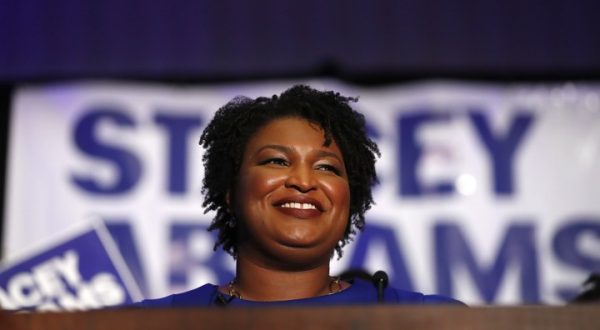
Ending years of speculation, Fair Fight CEO and former state House Minority Leader Stacey Abrams announced her 2022 bid for governor, an announcement timed on the day after the 2021 municipal runoffs. She is widely expected in the press to be the leading candidate in the May 24 2022 Democratic gubernatorial primary.
Despite her renown and the possibility that she could have no primary competition, Abrams will face an uphill battle against the eventual Republican nominee, whether it is incumbent Brian Kemp, former U.S. Senator David Perdue, or the conservative former Democratic state legislator-turned-Republican candidate Vernon Jones. The Abrams campaign currently expects an uncontested primary for governor, preferring that more of the primary infighting occurs on the Republican side in the coming months.
Abrams also faces an uphill battle against stagnant national poll numbers for President Joe Biden and downballot Democrats. History shows an emerging Democratic Party in Georgia which only began in recent years to rebuild itself in a new image.
16 Years in the Wilderness, Then a Path Forward
The last time that Democrats in Georgia ran for governor and state row offices under a Democratic president’s first midterm was in 2010, which resulted in a poor showing, with Republican former congressmember Nathan Deal defeating the Democratic former one-term governor Roy Barnes by 10 percentage points, and the downballot Democrats performing worse in their popular vote share. The 2014 gubernatorial election also saw a poor showing by Democrats, with Nathan Deal defeating Democratic state senator Jason Carter by 8 points.
On the other hand, 2006, which was a Democratic downballot wave year nationally, also saw Georgia Democrats massively underperforming the national environment from the governor downward, with Republican incumbent Sonny Perdue dealing a 19-point defeat to Democratic Lieutenant Governor Mark Taylor, the worst result for a Democratic gubernatorial nominee in Georgia history. The Democratic popular vote percentages for U.S. House, Georgia Senate and Georgia House all exceeded Taylor’s.
In general, the 2000-2016 period was a doldrum period for Democrats, only experiencing an infusion of energy beginning in 2017 with Trump-era special elections ending the Republican supermajority in the State Senate and a spirited push by then-candidate Jon Ossoff for Georgia’s 6th congressional district. At the same time, the vote share difference between the parties has declined in each successive gubernatorial contest since 2006, from that year’s 57.9 – 38.2 difference between Perdue and Taylor to 2018’s 50.2 – 48.8 difference between Kemp and Abrams.
Abrams in 2018 was the first Democratic nominee for Georgia governor who had neither any ties with the pre-21st century political establishment within the party nor any electoral experience prior to 2000. Barnes was a state senator from 1975-1991, state representative from 1993-1999 and governor from 1999-2003; Taylor served as state senator from 1987-1999 and Lieutenant Governor 1999-2007; and Carter is the grandson of former U.S. president Jimmy Carter, and shared the 2014 ballot with Michelle Nunn, who ran for U.S. Senate and is the daughter of former U.S. senator Sam Nunn (who served in the Georgia House from 1969-1973 and the U.S. Senate from 1973–1997).
Even the other state row offices have seen improvements. The last Senate-Governor year in a Democratic president’s first midterm (2010) saw Michael Thurmond bottom out with 39% of the vote for U.S. Senate, followed closely by Georganna Sinkfield for Secretary of State with 39.4%. The last Georgia state row office election in a Senate-Governor year (2014) saw Democrats’ worst-performing statewide candidates – Christopher Irvin for Agriculture Commissioner and Liz Johnson for Insurance and Safety Fire Commissioner – each gaining 41.7% of the vote. In contrast, the 2018 election saw Fred Swann improve on the state row office floor with 46.92% for Agriculture Commissioner.
The Political Environment in Georgia
The task before Georgia Democrats is to maintain the Trump-era momentum in the Biden era, overperform against national polls, and accomplish the difficult task of putting a Democrat in the governor’s mansion, but the national environment sometimes offers mixed surprises. 2010, while a disaster for downballot Democrats across most of the country, did see Democrats pick up governorships in five states, while Republicans took governorships in eleven other states. Similarly, in 2021, Democrats lost the Virginia governorship, but retained the governorship of New Jersey in that state’s first Democratic re-election win in 40 years, a mixed early national result for Democrats downballot heading into 2022.
And the current state-level environment offers early positive signs for Georgia Democrats, with self-identified Democrats flipping 48 municipal seats in 25 counties in 2021, including a close historic win for the Warner Robins mayorship, while Republicans flipped 6.
2022 will also be the first time since 2014 that both offices of governor and U.S. senator will be on the ballot in Georgia. The Democratic nominee for governor will likely campaign at the top of the Democrats’ Georgia ticket alongside the Democratic Senate nominee, widely expected to be the incumbent Raphael Warnock, who is running for a full six-year term in office. Warnock and his fellow senator Jon Ossoff both forced Republican then-incumbents Perdue and Kelly Loeffler into runoffs and pulled off wins in January 2021.
A slew of Democratic candidates have announced bids for all executive row offices to the press throughout the year, with likely competitive primaries for Lieutenant Governor, Attorney General, Secretary of State, and the Commissioners of Agriculture, Insurance and Labor. Surprisingly, only one Democrat, Cobb County Public Schools Board member Dr. Jaha Howard, has announced for State Superintendent of Schools, an office for which there is usually a competitive Democratic primary.