It would make sense for a decision in Rose v Raffensperger to come before Thanksgiving, which quickly precedes the start of the special legislative session on November 29. As stated in Saporta Report, this decision will be cited for decades. It will have an impact on voting rights, redistricting and other types of litigation, not only in the 11th Circuit but elsewhere.
But I go back to the VRA litigation saga from 2011-2016 against at-large FPTP elections in jurisdictions like Fayette County, GA, or to the 100+ court cases since 1982 in Georgia alone which replaced at-large districts with single-winner district elections for city councils, school boards, county commissions and legislative districts.
I would be very surprised if the 11th Circuit sided with Georgia on the PSC’s at-large election method. But the clock is ticking on the 11th Circuit to make a decision:
the special session on congressional and legislative districts starts on 29 November;
then a regular session to start in January 2024 for 40 days, which is a chance to change statute law regarding PSC elections;
then a general election to be held in November in which at least another PSC seat (District 5, held by Republican Tricia Pridemore) will be on the ballot (and maybe the two held by Echols and Johnson?), as well as a chance for voters to change Article IV Section 1 of the state constitution regarding the PSC.
On the flip side, the 11th Circuit could rule the case unjusticiable and remove itself from the case. Or they could rule for the plaintiffs but then the state could simply move the PSC to an appointed body instead (like most states). Who knows.
I couldn’t imagine this decision happening under this court, but I guess “bullying works” (sometimes). Plus, it’s a sign that SCOTUS’ right-wing majority may be more monstrous in Moore v Harper (independent state legislature theory), SFAI v. Harvard/SFAI v. UNC (affirmative action in higher ed), and Haaland v. Brackeen (Indian Child Welfare Act constitutionality), all to be announced this month.
Notable: Given it’s Pride Month, The National Black Justice Coalition may be the only LGBT rights organization to issue a statement in response to Allen v. Milligan. I would have expected The National LGBT Task Force, who organized the Queer the Census project for both 2010 and 2020, to have issued a statement as well. Even with the anti-LGBT backlash going on right now, this decision does have implications for Black LGBT people in the South, increasing somewhat the chances that they can run for and win higher office. Davante Lewis’ 2022 win in the runoff for Louisiana’s PSC was a big, understated victory for Black LGBT people in this region.
Impact(s)
What is happening or is most likely to happen nationwide, based on Election Twitter’s ideas:
Alabama legislature will be forced to redraw their congressional map to add a second VRA district.
Louisiana is asking SCOTUS for oral argument in their appeal against the Ardoin case regarding Louisiana’s own congressional map. Highly likely that SCOTUS will dismiss the appeal and force Louisiana legislature to redraw for a second VRA district.
North Carolina legislature likely to not go as hard as they wanted to go on obliterating most remaining Dems in congressional and legislative maps.
Florida’s state and federal cases regarding the former FL13 will be slightly supported by this decision, but not too much, since those cases rest on other laws, such as the federal 14th Amendment as well as the state constitution’s analogues to Section 2 and (the former) Section 5 of the VRA (citing Andrew Pantazi of the Jacksonville Tributary).
Dems were worried about their chances for winning back the House next year after the North Carolina Supreme Court gave Republicans multiple wins. After this, there’s a potential net gain of at least 2.5 seats. Or, if we want to go crazy with wishcasting, as many as +10-12. Maybe enough to wash the gains to be made by Republicans in North Carolina.
Very unlikely to see any redistricting in Arkansas, Mississippi, Oklahoma, Ohio or Wisconsin resulting from Allen.
There is ongoing litigation in North Dakota by Native American nations on Section 2 grounds regarding legislative maps.
Credit to U.S. Rep. Terri Sewell (D), who actively campaigned for a plurality-minority second district in Alabama and against packing Black voters into a single district, as highlighted in this 2021 Atlantic article.
Now on to Georgia:
It’s debatable how the Republican legislature could redraw their congressional map to do the bare minimum of complying with the Allen decision. The best-case scenario is perhaps restoring Lucy McBath and Carolyn Bordeaux’s old districts, restoring the 2020 status quo of 8 GOP-6 Dem. The shortest-term worst case is simply re-packing Black Metro Atlanta voters into four districts, but that would leave lots of other left-trending territory surrounding these districts vulnerable in the longer term to Dem candidates.
There is ongoing litigation (Georgia State Conference of the NAACP v. Georgia) challenging the 2022 congressional and legislative maps, filed by the NAACP state conference, GALEO, and Georgia Coalition for the Peoples Agenda. Also ongoing against these maps: Grant v. Raffensperger, Alpha Phi Alpha v. Raffensperger, Prendergrass v. Raffensperger. There’s ongoing VRA Section 2 litigation in 30 cases across 10 states, and there are more to come.
Public Service Commissions
Let’s talk about the PSC, both in Georgia and other states:
PSC At-large voting: There has been radio silence from the 11th Circuit on the state’s appeal in Rose v. Raffensperger since oral arguments last December. Hopefully the Allen decision will make an impact. At least two of the plaintiffs to whom I’ve talked, Rev. James Woodall and Wanda Mosley, are confident that this decision will help them prevail against the state. Also, I wonder if Judge Nancy Abudu, a Biden appointee who was just confirmed to the 11th Circuit, will join in or recuse herself from whatever ruling that comes out on the appeal.
PSC Redistricting: There’s a petition that has been filed by plaintiffs in Rose v Raffensperger with Judge Grimberg in the Northern District of Georgia to redraw the PSC map which had been approved in 2022 during qualifying week (which placed Democratic PSC District 2 nominee Patty Durand at odds with Raffensperger).
Dems filed a bill (HB 841) to change the PSC election method this past session, but it died before getting heard in committee.
See my prior posts about the GA PSC and VRA: 1, 2.
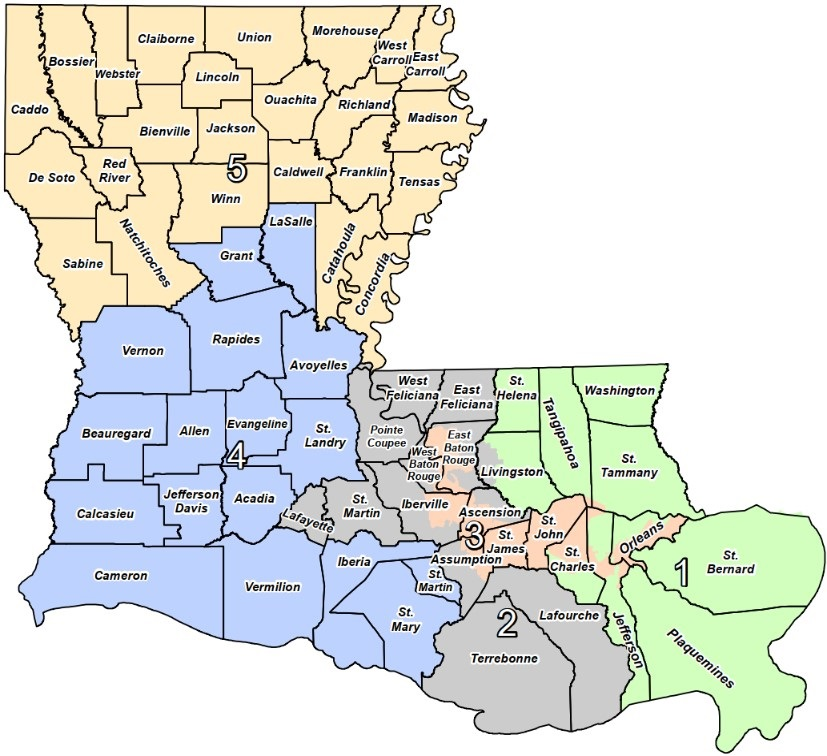
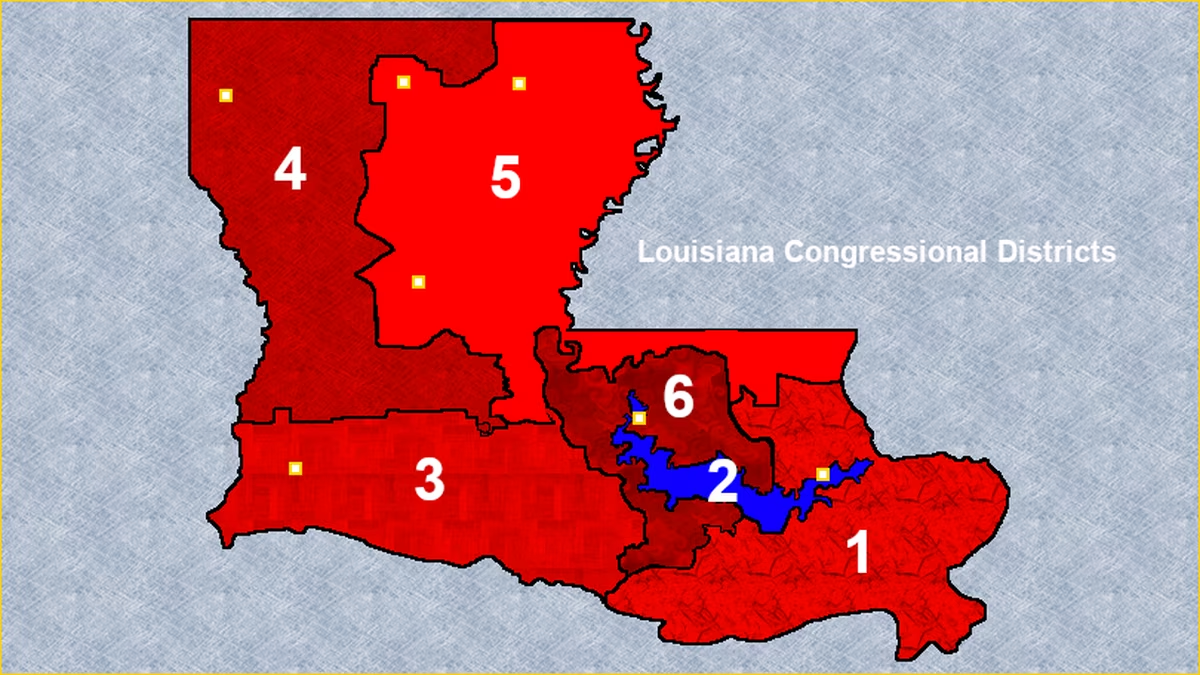
There’s also a question as to whether the Georgia PSC should be entirely drawn around entire counties. To compare, Louisiana’s PSC districts are mostly drawn around entire counties, except for Davante Lewis’ District 3, which, similarly to Troy Carter’s Congressional District 2, snakes through portions of Orleans Parish all the way into East Baton Rouge Parish. If, resulting from Allen, LA-CD2 may be redrawn in order to accommodate a second VRA opportunity district stretching from Baton Rouge up Louisiana’s border with Mississippi all the way to the northeast corner of the state (As proposed by FiveThirtyEight and in multiple proposals by both Democrats and Republicans last year), then what of Louisiana’s current LPSC map? Should Foster Campbell’s District 5 be redrawn into a second VRA-compliant LPSC district?
Louisiana’s current PSC mapLouisiana’s 2022 congressional mapMy idea of a VRA-compliant PSC map, districts highlighted
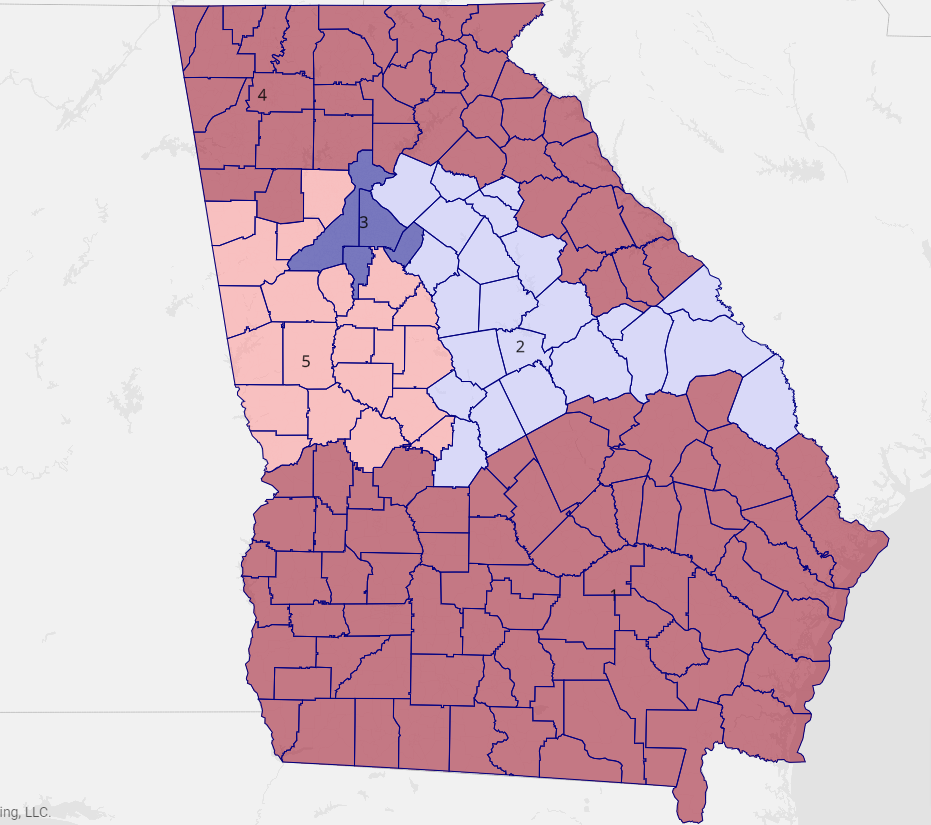
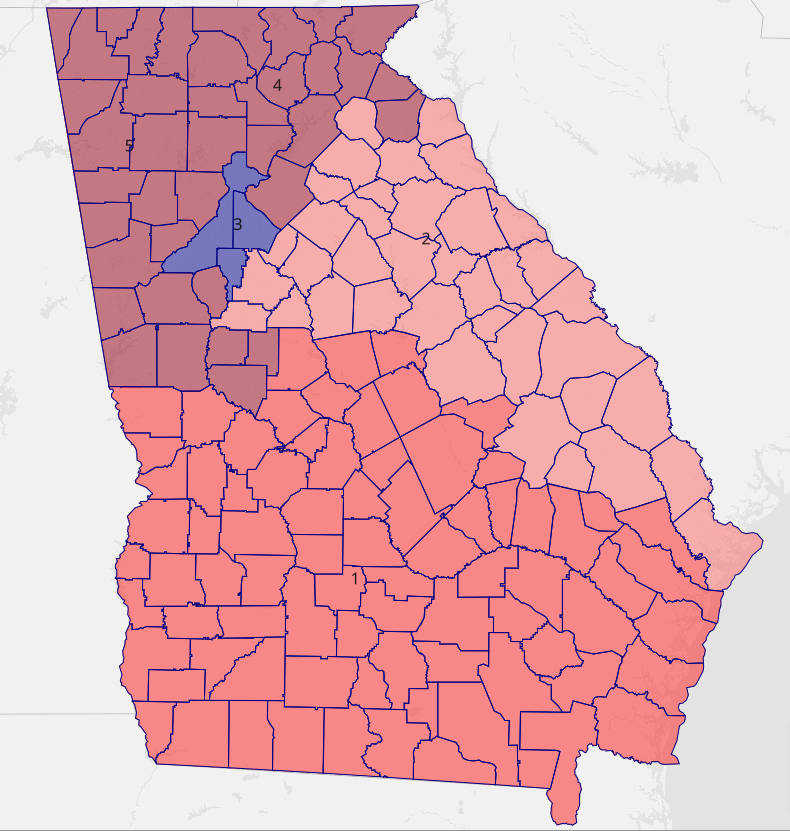
And if so, what of Georgia’s PSC map? Could Districts 3 and maybe 2 be redrawn to create VRA-compliant opportunity districts? District 3, centered around only Fulton, Clayton and DeKalb counties, could count as a racial packing of Black voters in a state where Black people account for 33% of the population. The legislative Democratic caucus submitted a map in which District 2 would obviously be an opportunity district with 33% Black VAP. And does District 3 really need to be contiguous with the core counties of Metro Atlanta? Lots of opportunities here.
the DPG’s proposed 2022 PSC mapThe approved Republican map
And finally, should Alabama’s PSC, an at-large body of 3 members with no districts, be given this treatment as well? If the plaintiffs prevail in Rose and force changes in Georgia, there is an opportunity for Black Alabamians to sue under Section 2.
A bit of history from the plaintiffs (likely written prior to the appointment of Fitz Johnson by Brian Kemp):
“Commissioners have been chosen by statewide election since 1906. Yet no African American has ever been elected to the Public Service Commission without having first been appointed by the governor. And even then, only one African American has ever served on the Commission.”
Why was the 1998 law passed?
The ruling by Judge Grimberg cites, among others, the 1998 reform of PSC elections from being fully-statewide to having to run statewide from residency districts. This summary from the 1998 session of the Georgia General Assembly cites that year’s HB 95 as that legislation.
The General Assembly passed HB 95 on April 7, 1998, and Governor Zell Miller signed the bill into law on April 23.
As documented here, HB 95 was co-sponsored in the House by speaker Tom Murphy (D), Reps. Terry Coleman (D), Newt Hudson (D), Larry Walker (D, the House Majority Leader), Jimmy Skipper (D, Majority Whip), and LaNett Stanley-Turner (D, Majority Caucus Secretary).
“In its original form, H.B. 95 would have prevented Commissioners Bobby Baker [R] and Dave Baker [R] from seeking re-election. The Senate, in a bipartisan effort authored by Senators Chuck Clay [R] and Charles Walker [D], amended the bill so as not to affect sitting Public Service Commissioners. Split along party lines, the House disagreed with the Senate, but in the last hour of the session accepted the Senate version.” The House version was blatantly partisan. I still question district qualification for a statewide office, but at least this version is fair to all involved,” said Commissioner Dave Baker. The legislation was first introduced in 1996 – just one year after Republicans for the first time became the majority on the PSC.”
So HB 95 seems like legislation which was not fully thought out by its authors, who also could not seek an amendment to the state constitution to establish actual districts and district-exclusive elections (since it takes 2/3 of both chambers to send a proposed amendment to the ballot). This seems like it was meant to protect Democratic incumbents on the commission from eventual defeat and (initially) force two Republican commissioners to run again for their seats, especially if Tom Murphy was involved as a sponsor.
Only in 1998 did Democrats decide to pursue this statutory change to end the fully-statewide election of PSC members, but only through a half-measure which ended up screwing over Democratic candidates for PSC in the 2000s as they hemorrhaged their remaining White rural voting base.
Will this change require a constitutional amendment or a statute law change?
Article IV Section I of the Georgia State Constitution states in full:
Paragraph I. Public Service Commission.(a) There shall be a Public Service Commission for the regulation of utilities which shall consist of five members who shall be elected by the people. The Commissioners in office on June 30, 1983, shall serve until December 31 after the general election at which the successor of each member is elected. Thereafter, all succeeding terms of members shall be for six years. Members shall serve until their successors are elected and qualified. A chairman shall be selected by the members of the commission from its membership. (b) The commission shall be vested with such jurisdiction, powers, and duties as provided by law. (c) The filling of vacancies and manner and time of election of members of the commission shall be as provided by law.
Define “by the people”. Can statute law interpret that “by the people” can apply to “the people of each district”?
The Georgia Public Service Commission shall consist of five members to be elected as provided in this Code section. The members in office on January 1, 2012, and any member appointed or elected to fill a vacancy in such membership prior to the expiration of a term of office shall continue to serve out their respective terms of office. As terms of office expire, new members elected to the commission shall be required to be residents of one of five Public Service Commission Districts as hereafter provided, but each member of the commission shall be elected state wide by the qualified voters of this state who are entitled to vote for members of the General Assembly. Except as otherwise provided in this Code section, the election shall be held under the same rules and regulations as apply to the election of Governor. The Commissioners, who shall give their entire time to the duties of their offices, shall be elected at the general election next preceding the expiration of the terms of office of the respective incumbents. Their terms of office shall be six years and shall expire on December 31.
In order to be elected as a member of the commission from a Public Service Commission District, a person shall have resided in that district for at least 12 months prior to election thereto. A person elected as a member of the commission from a Public Service Commission District by the voters of Georgia shall continue to reside in that district during the person’s term of office, or that office shall thereupon become vacant.
When will the General Assembly work on this change?
Usually, a special session may be called in the lame duck period between election and inauguration, so I wouldn’t be surprised by this. Or this could be handled in the 2023 session.
What changes could be made to PSC elections?
What I can think of:
Single-winner District-exclusive partisan elections (as done in Mississippi, Louisiana, Montana, Nebraska and New Mexico); or
Straight at-large election of all members and abolishing the residency districts (as done in Alabama, Arizona, Illinois, North Dakota, Oklahoma and South Dakota);
Partisan or non-partisan?
Remove PSC from directly-elected to governor-appointed?
Of course, New Mexico (a Democratic-majority government) passed a 2020 referendum which shrinks their Public Regulation Commission from five to three seats and shifts it from elected to gubernatorially-appointed, among other things. The changes take effect on January 1, 2023.
I can at least say that five statewide elections will be taken off the ballot, with voters having only one section reserved for PSC candidates rather than two (if they live in a district which is up for election).
Who won each district in past PSC elections?
Based on data, we do know that Democratic nominees David Burgess (2006), Stephen Oppenheimer (2012), and Lindy Miller (2018) would all have won District 3 under a district-based election method for PSC. However, I couldn’t say that District 2, the next-closest district, would see strong performances by Democratic nominees Mac Barber (2004), Keith Moffett (2010), or a hypothetical Democrat in 2016. Furthermore, the General Assembly’s removal of Gwinnett County from District 2 in 2022 would have foreclosed on a Democrat winning this district under a directly-elected system.
How will this affect independent and third-party candidates?
From my conversation with Colin McKinney, a Libertarian who was on the ballot for PSC District 2 until the election was cancelled, this will not be good for third-party and independent candidates. Libertarians, the only third party on the Georgia general ballot, usually only appear on statewide ballots for office because they are able to solicit enough petition signatures statewide to appear on the ballot in election years. This development means that Libertarians will be harder pressed to find petition signatures in each district.
How will the future PSC map comply with the VRA and other federal law?
The map will have to be drawn by Republicans to barely be compliant with the VRA, whether or not it they decide to comply with current state law mandating that PSC districts must be drawn around whole counties. How much does the 2022 map comply with the VRA’s requirements?
SCOTUS and other bodies controlled by the Federalist Society are hostile to the VRA. What do they gain from this case?
The Federalist Society cult (yes, “cult”) has a knack for using seemingly-innocuous rulings to build up larger assaults on society, and repeatedly doing so until they end up with a Shelby or Dobbs. Remember that this decision is a temporary ruling to force the 11th Circuit to reconsider their stay on Grimberg’s decision. We have no idea when SCOTUS could lift this ruling.
But we do know that the disdain for the VRA among conservatives will spur them to file cases attacking the legitimacy of the VRA. Stay woke and all that.
What will this mean for Georgia Democrats?
I expect that more Democrats (especially outgoing legislators in “safe blue” Metro Atlanta) will consider running for a PSC seat or two. Expect more competitive Democratic primaries for PSC in Metro Atlanta.
Democrats will have a few less statewide seats to compete for on the primary and general election ballot. Maybe that will help them focus on competing for 8 statewide executive seats and U.S. Senate, though.
Like, how do North Carolina Democrats, competing for U.S. Senate and 10 statewide executive seats, have such a better time competing for statewide executive elections than Georgia Democrats?
Possible that service on the PSC could me a springboard for higher office, since the PSC (currently) has larger districts than congressional or legislative districts. However, unlike Louisiana, this has not been the case for past GA PSC members. To date, only one GAPSC member has been subsequently elected governor. Those who retire early from the GAPSC often get jobs in the private sector.
There is still the possibility that the PSC could be moved from elected to appointed. In such a case, I would still see the silver lining of a stronger focus on 1+8 statewides.
Maybe this should be a time to enact stronger ethics and professional safeguards for this office.
What implications could this have for other cases?
There is a VRA case from Mississippi challenging the election of their State Supreme Court. While it’s not statewide, the current system requires that 3 justices each are elected at-large from only three districts (which also concurrently serve as the districts for their three-member Public Service Commission). As a result, only four African-Americans have ever served on the State Supreme Court in its history. With this ruling from Georgia, I wonder how this Mississippi ruling will play out.
Rose could also allow someone to challenge Alabama’s statewide at-large PSC elections. Alabama has seven statewide executive officers not including the three PSC members, but also a large Black population. Let’s see.