Tag Archives: gerrymandering

California and Other Blue States Should Declare a Congressional Redistricting Emergency

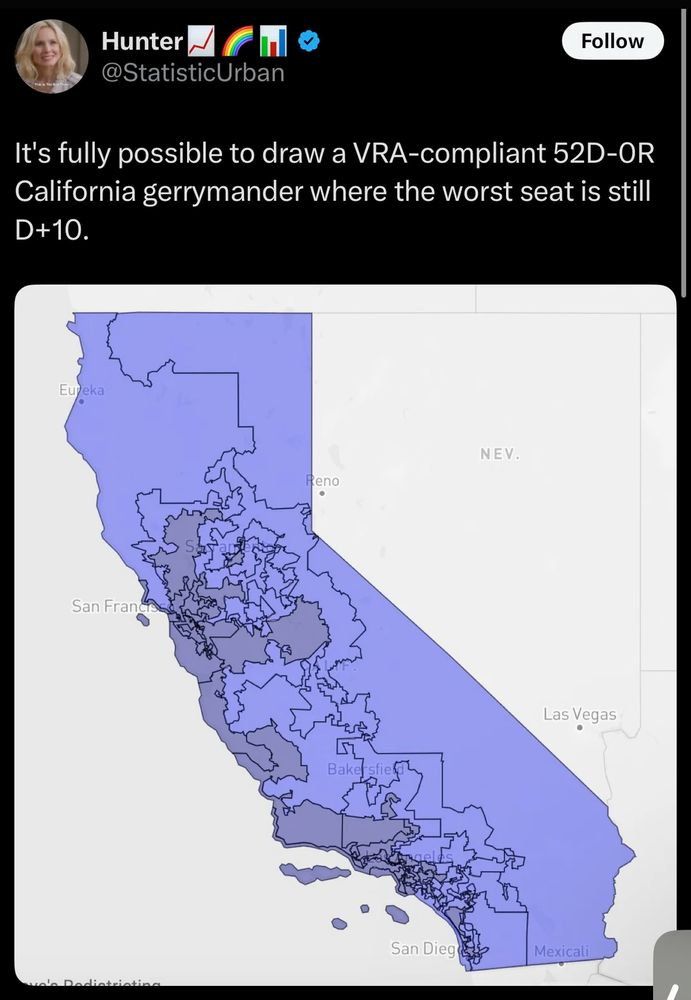
From Hunter @StatisticUrban: “It’s fully possible to draw a VRA-compliant 52D-0R California gerrymander where the worst seat is still D+10.”

In 2008, California voters established the California Citizens’ Redistricting Commission to redraw state legislative districts, and in 2010, extended its powers to redraw congressional districts.

Within portions of the California Democratic Party in 2025, the latter power to redraw congressional districts is widely perceived as an act of unilateral disarmament when it comes to the empowered Republican legislative majorities in Florida, Texas and North Carolina. And now that both Trump’s White House and the Texas Republican Party want to eliminate as many as five more Democratic-held metropolitan seats in Congress, the idea of Newsom calling a special legislative session to refer an amendment to the voters to restore partisan gerrymandering powers to the legislature is being trafficked to news outlets.

In my opinion, California should keep their citizens’ redistricting commission, but should amend their constitution to provide for a “congressional redistricting emergency” period for legislative redistricting of congressional districts until the majority of congressional districts nationwide (217 out of 435 seats), or more broadly, every state assigned three or more congressional districts through reapportionment after each census, are covered by state constitutions which provide for citizens’ redistricting commissions.

Based in part off of the 2016 Interstate Compact for Fair Representation Act (SB 0322), which was proposed by then-Illinois State Senator (now Illinois Attorney General) Kwame Raoul, and passed the State Senate before dying in committee in the State House, here’s how I would amend the California State Constitution Article XXI Section 1 to carve out this exception:

“(b) In the year following the year in which the national census is taken under the direction of Congress at the beginning of each decade and in which at least one state with three or more congressional districts at the time of redistricting has not enacted the terms of Article XXI in substantially the same form in their own state constitution as applies to the constitutional districts of their state, the Legislature shall retain the right to amend a map of congressional boundary lines as proposed by the Citizens’ Redistricting Commission and to approve said amendments by majority vote of both houses and approval by the Governor. The Legislature shall retain the right to amend said boundary lines in an intervening year if any state enacts a similarly-timed adjustment of congressional boundary lines which fails to espouse the terms of Article XXI. Such compliance with this subsection shall be determined by the Secretary of State, who shall declare a state of congressional redistricting emergency to terminate upon determination of such compliance.”

This way:

  • only a small portion of Article XXI would be amended to carve out the time-dependent congressional exception, since we’re wanting more states to adopt Article XXI in substantially the same form for their state government.
  • Furthermore, it would encourage more Democratic-led states to keep their congressional gerrymandering powder dry for when it is needed for when interstate and anti-presidential conflicts arise.
  • it would allow the Legislature to respond to mid-decade redistricting by another state if necessary.
  • Finally, it would empower the Secretary of State to determine if any state has failed to adopt the terms of Article XXI in their state constitution to trigger legislative intervention.

This power should not be held by the legislature in perpetuity. This should be an emergency power that is used to stabilize Congress in a time of interstate conflict. It would be a departure from unilateral disarmament, instead treating interstate relations as a theater in which to seek diplomacy, mutual defense and good government.

But I can see such a move irking those who have pushed for decades in the trenches to unilaterally enact citizen redistricting by ballot initiative or legislation. I also acknowledge that Republican-led states like Arizona and Montana would be within their right to adopt similar exceptions to nonpartisan redistricting for congressional gerrymandering. Yes, this could become a “race to the bottom” as put by State Assemblymember Alex Lee.

In the Anglophone hell that is our first-past-the-post, single-winner elections for legislative branches nationwide, unilateral disarmament is no virtue, and keeping your gerrymandering powder dry to force concessions from other states is no vice.

I encourage readers to read this Penn State Law Review paper by Zachary J Krislov as well as this University of Chicago Law Review paper by Samuel P. LeRoy for great breakdowns on these “interstate compact” trigger laws on redistricting, the histories of such proposals and their potential efficacy.

Wow. Allen v. Milligan Surprises Everybody.

Full Opinion from SCOTUS (PDF).

I couldn’t imagine this decision happening under this court, but I guess “bullying works” (sometimes). Plus, it’s a sign that SCOTUS’ right-wing majority may be more monstrous in Moore v Harper (independent state legislature theory), SFAI v. Harvard/SFAI v. UNC (affirmative action in higher ed), and Haaland v. Brackeen (Indian Child Welfare Act constitutionality), all to be announced this month.

Reactions:

Notable: Given it’s Pride Month, The National Black Justice Coalition may be the only LGBT rights organization to issue a statement in response to Allen v. Milligan. I would have expected The National LGBT Task Force, who organized the Queer the Census project for both 2010 and 2020, to have issued a statement as well. Even with the anti-LGBT backlash going on right now, this decision does have implications for Black LGBT people in the South, increasing somewhat the chances that they can run for and win higher office. Davante Lewis’ 2022 win in the runoff for Louisiana’s PSC was a big, understated victory for Black LGBT people in this region.

Impact(s)

What is happening or is most likely to happen nationwide, based on Election Twitter’s ideas:

  • Alabama legislature will be forced to redraw their congressional map to add a second VRA district.
  • Louisiana is asking SCOTUS for oral argument in their appeal against the Ardoin case regarding Louisiana’s own congressional map. Highly likely that SCOTUS will dismiss the appeal and force Louisiana legislature to redraw for a second VRA district.
  • North Carolina legislature likely to not go as hard as they wanted to go on obliterating most remaining Dems in congressional and legislative maps.
  • Florida’s state and federal cases regarding the former FL13 will be slightly supported by this decision, but not too much, since those cases rest on other laws, such as the federal 14th Amendment as well as the state constitution’s analogues to Section 2 and (the former) Section 5 of the VRA (citing Andrew Pantazi of the Jacksonville Tributary).
  • Dems were worried about their chances for winning back the House next year after the North Carolina Supreme Court gave Republicans multiple wins. After this, there’s a potential net gain of at least 2.5 seats. Or, if we want to go crazy with wishcasting, as many as +10-12. Maybe enough to wash the gains to be made by Republicans in North Carolina.
  • Very unlikely to see any redistricting in Arkansas, Mississippi, Oklahoma, Ohio or Wisconsin resulting from Allen.
  • There is ongoing litigation in North Dakota by Native American nations on Section 2 grounds regarding legislative maps.

Credit to U.S. Rep. Terri Sewell (D), who actively campaigned for a plurality-minority second district in Alabama and against packing Black voters into a single district, as highlighted in this 2021 Atlantic article.

Now on to Georgia:

  • It’s debatable how the Republican legislature could redraw their congressional map to do the bare minimum of complying with the Allen decision. The best-case scenario is perhaps restoring Lucy McBath and Carolyn Bordeaux’s old districts, restoring the 2020 status quo of 8 GOP-6 Dem. The shortest-term worst case is simply re-packing Black Metro Atlanta voters into four districts, but that would leave lots of other left-trending territory surrounding these districts vulnerable in the longer term to Dem candidates. 
  • There is ongoing litigation (Georgia State Conference of the NAACP v. Georgia) challenging the 2022 congressional and legislative maps, filed by the NAACP state conference, GALEO, and Georgia Coalition for the Peoples Agenda. Also ongoing against these maps: Grant v. Raffensperger, Alpha Phi Alpha v. Raffensperger, Prendergrass v. RaffenspergerThere’s ongoing VRA Section 2 litigation in 30 cases across 10 states, and there are more to come.

Public Service Commissions

Let’s talk about the PSC, both in Georgia and other states:

  • PSC At-large voting: There has been radio silence from the 11th Circuit on the state’s appeal in Rose v. Raffensperger since oral arguments last December. Hopefully the Allen decision will make an impact. At least two of the plaintiffs to whom I’ve talked, Rev. James Woodall and Wanda Mosley, are confident that this decision will help them prevail against the state. Also, I wonder if Judge Nancy Abudu, a Biden appointee who was just confirmed to the 11th Circuit, will join in or recuse herself from whatever ruling that comes out on the appeal.
  • PSC Redistricting: There’s a petition that has been filed by plaintiffs in Rose v Raffensperger with Judge Grimberg in the Northern District of Georgia to redraw the PSC map which had been approved in 2022 during qualifying week (which placed Democratic PSC District 2 nominee Patty Durand at odds with Raffensperger).
  • Dems filed a bill (HB 841) to change the PSC election method this past session, but it died before getting heard in committee.
  • See my prior posts about the GA PSC and VRA: 1, 2.

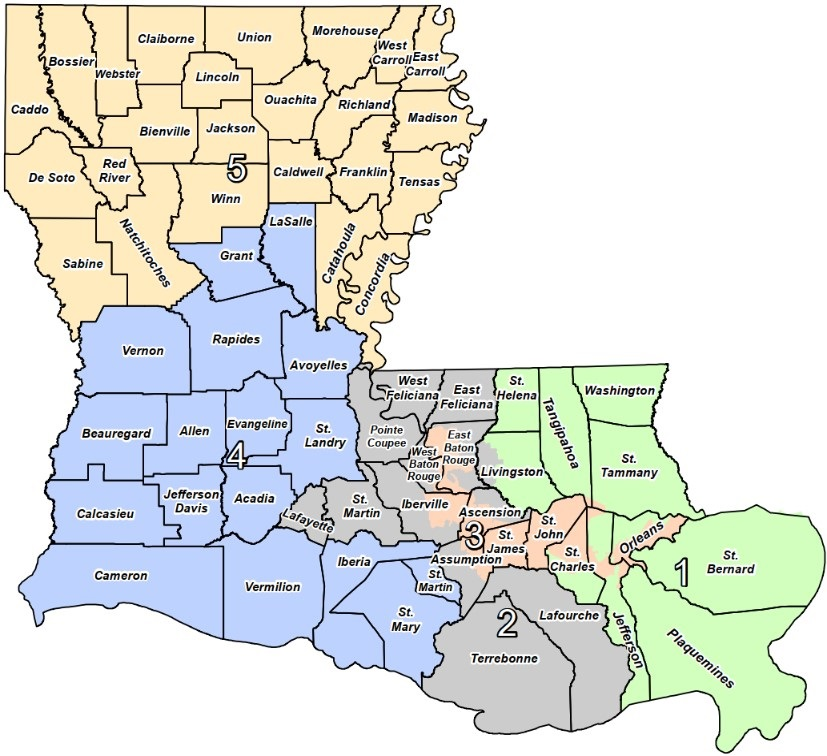
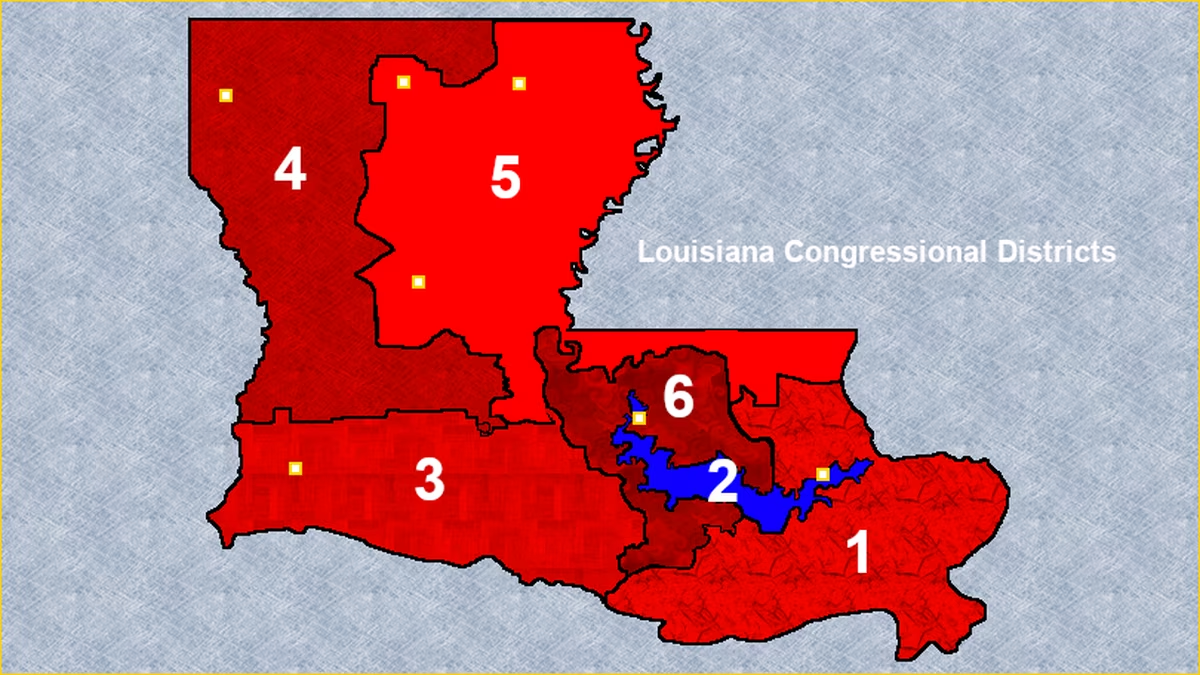
There’s also a question as to whether the Georgia PSC should be entirely drawn around entire counties. To compare, Louisiana’s PSC districts are mostly drawn around entire counties, except for Davante Lewis’ District 3, which, similarly to Troy Carter’s Congressional District 2, snakes through portions of Orleans Parish all the way into East Baton Rouge Parish. If, resulting from Allen, LA-CD2 may be redrawn in order to accommodate a second VRA opportunity district stretching from Baton Rouge up Louisiana’s border with Mississippi all the way to the northeast corner of the state (As proposed by FiveThirtyEight and in multiple proposals by both Democrats and Republicans last year), then what of Louisiana’s current LPSC map? Should Foster Campbell’s District 5 be redrawn into a second VRA-compliant LPSC district?

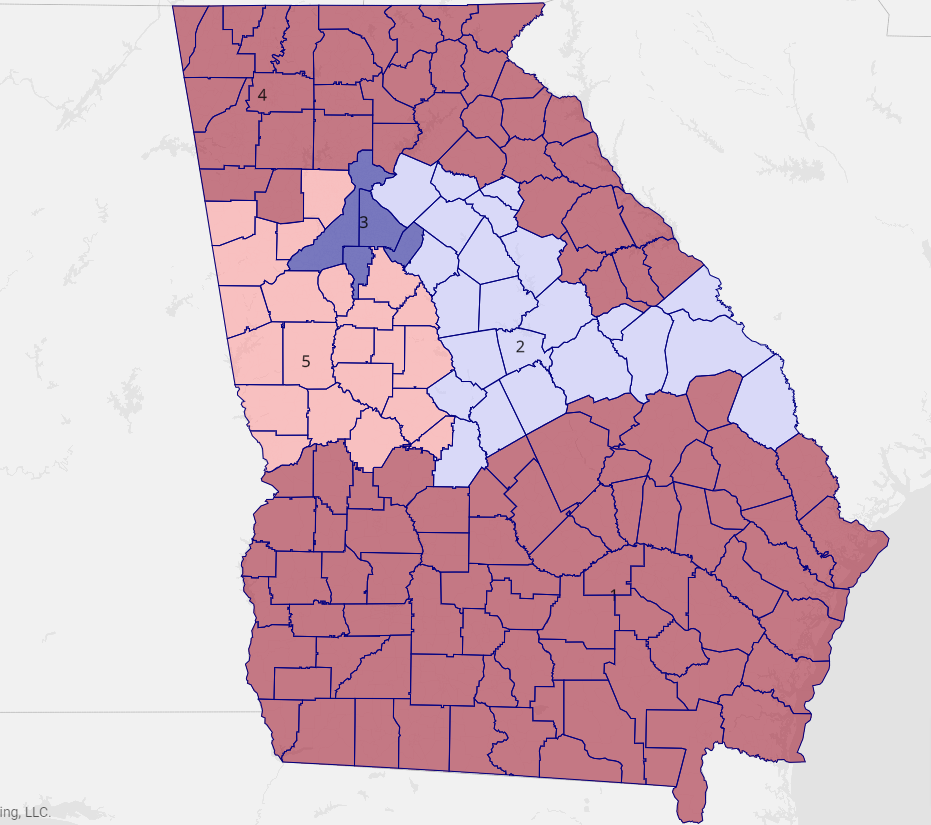
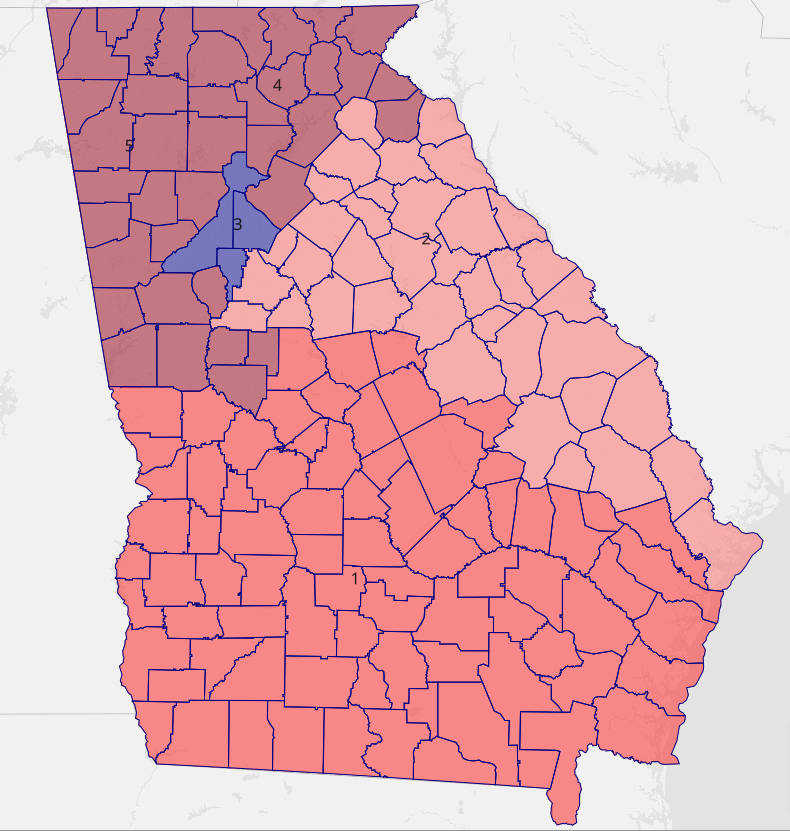
And if so, what of Georgia’s PSC map? Could Districts 3 and maybe 2 be redrawn to create VRA-compliant opportunity districts? District 3, centered around only Fulton, Clayton and DeKalb counties, could count as a racial packing of Black voters in a state where Black people account for 33% of the population. The legislative Democratic caucus submitted a map in which District 2 would obviously be an opportunity district with 33% Black VAP. And does District 3 really need to be contiguous with the core counties of Metro Atlanta? Lots of opportunities here.

And finally, should Alabama’s PSC, an at-large body of 3 members with no districts, be given this treatment as well? If the plaintiffs prevail in Rose and force changes in Georgia, there is an opportunity for Black Alabamians to sue under Section 2.

The United States as a Police State

I was just reading this article on JSTOR from right after Jean-Bertrand Aristide was first forced into exile by the Haitian military, and how one way to bring stability back to Haiti at the time is to create a police state, which had already been tried and failed (the other was to build democratic institutions in Haiti through party-list PR elections and an independent judiciary).

I wonder if this applies to us.

Is this how we maintain the semblance of peace while our elections system is below international standards, maintained by at least 50 election regimes who are in jealous, bitter legal conflict with each other, and threatened by a racist party which is willing to sell the postal service for parts and gum up the census returns to exclude noncitizen residents in order to, among other things, ensure their victory at the polls?

Does the larger body of those who have a monopoly on violence – military, reserve, law enforcement and armed partisan civilians – actually maintain a police state?

We have an incredible number of military bases per capita. I wonder if we have the most domestic military bases in the world, in addition to the most overseas military bases.

We have over 17,000 law enforcement agencies across the country, and we have the world’s largest prison population, maintained largely by at least 50 state governments.

We live with the legacies (and ongoing practices) of redlining and housing discrimination, draw up discriminatory districts for elections and for boards of education, segregate against multi-family housing through downzoning, and create whole cities from non-annexed land so that those apartment-dwellers don’t move near and hurt the property value.

We keep people apart by force, and have built our entire political system upon keeping people apart through geographical isolation of the undesirables. And we’re supposed to be OK with this when we see the destruction, waste and resentment caused by this forced isolation? When so many of us deride any semblance of overriding responsibility to other Americans in the name of convenience because we’re not one of those city people, only to be the recipient or cause of someone’s receiving of COVID-19?

When the Third Reconstruction comes, I hope it means we can opt out of being residents of any state and just be citizens of this country. I hope it means that we can abolish state prisons, create a federal voter roll for a single voter registration website, replace the U.S. House’s elections with party-list proportional representation (or, as a half-measure, ranked-choice voting), move to single-payer healthcare, and establish not only an affirmative right to vote, but also an affirmative right to participate in free and fair elections.