Originally posted here.
Latin America, which consists of all of the former American colonies of Spain, France (sans Quebec and the Mississippi Basin), and Portugal, is a region which is steeped in history and tradition, alot of which extends beyond the reach of Columbus and his “discovery” of the Americas.
However, ever since most of these countries gained their political independence back during the 1800’s, this region has also been steeped in a mire of political and military tradition and intrigue. Guns and armaments of all possible kinds have been in almost perpetually-abundant supply and distribution for almost 2 centuries in this geopolitical region. Battles, skirmishes, crackdowns, massacres, and bloodbaths all form an integral and permanent part of this region’s historical and political constitution.
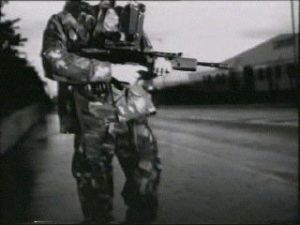
Thus, it comes as no surprise to many of us when the United States becomes involved. American arms, American training, American funding, American support, American everything-that-has-anything-to-deal-with-the-military: its all too commonplace in this region. Sure, the degree of U.S. involvement in any Latin American conflict may vary, depending of the size of that nation’s (or, for that matter, that insurgency’s) military. And usually, the side that is taken by the U.S. and its agents in that particular nation is usually avowedly politically conservative, economically bourgeois, and socially elitist.
In the midst of this perennial conflict, of course, the lives of innocent men, women, and children are bloodily sacrificed. People who wish that their livelihoods, families, and communities had no part, or played no role, in this conflict are among the first ones who are maimed, scarred, robbed, or murdered….
All for the sake of politics, economics, and history, three things over which these people have no control, three things by which these people are taken over.
Haiti can serve as a prime example of this: the coup which toppled President Jean-Bertrand Aristide and his government was backed/operated/conducted by the Miami-based Group of 184, a coalition of archconservative bourgeoisie of Haitian ancestry which had explicitly strong ties to both the Duvalier dictatorship and the former Haitian Army, which had been abolished by Aristide. Furthermore, it was supported by former members of the Tonton Macoutes and attaches who had overthrown Aristide back in 1991, the leaders of which received their military training at the School of the Americas in Fort Benning, near Columbus, GA.
In fact, let’s go further on Haiti: the leader of the Group of 184, Andre Apaid Jr., is a U.S.-born businessman who owns several sweatshops in Haiti; is a longtime opponent to Aristide; had ties to the Duvalier dictatorship and the former Haitian Army; and is known for stepping up his own personal vendetta against Aristide and his Fanmi Lavalas Party after Aristide not only imposed a national income tax, but also raised the minimum wage to US$1.50.
“It all begins with HDP’s director James Morrell, who was asked to leave the Center for International Policy (CIP), a “liberal” think-tank founded by former US Ambassador to El Salvador Robert White. The rumor on the Hill was that Morrell was forced out because of his open flirtations with Haitian right-wingers. This seems to be supported by HDP’s partnering with the right-wing Boulos family and the most reactionary elements of Haiti’s Chamber of Commerce. The pedigree of this pack of interventionists can be gleaned from its guest list the night it was founded in Washington D.C.
There were notable Haitians in attendance at the Haiti Democracy Project’s grand opening held in the Brookings Institute on November 19, 2002. Among them was founding member Rudolph Boulos. Boulos is infamous for once being summoned for questioning in February 2002 concerning the assassination of one of Haiti’s most popular journalists, Jean Dominique. Dominique publicly lambasted Boulos for having sold poisoned children’s cough syrup through his company Pharval Pharmaceuticals. Over sixty children died from diethyl alcohol contamination of “Afrebril and Valodon” syrups, the deadly concoction brewed in Boulos private laboratories.”
(Quotation from The Bush Administration’s Endgame for Haiti: Part 3 of a Series by Kevin Pina, The Black Commentator, Dec. 4, 2003, Issue 67)
Thus, Haiti’s is, for lack of a better description, a case of jumping from a frying pan under Jean-Bertrand Aristide into the fire itself under the Group of 184.
Sadly, this has been the case throughout Latin America for over 100 years since the U.S. began to expand its military muscles in Latin America, particularly during the Spanish-American War.
So what, exactly, is to be done to ameliorate this utter contradiction of U.S. “values” in foreign policy?
Well, the beginning of such seems to be easy: just take the militaries of Latin America out of the picture.
The U.S., since the Civil War, has shown an inclination toward perpetually-bellicose tendencies and language (especially with the Bush administration’s rhetoric), something which has only exacerbated most political conflicts on an international scale. No wonder the U.S. had 9/11!
One of those tendencies of the U.S. foreign policy is to make the military the primary (and, too often, the predominant) factor in dealing with any country or anti-government movement whatsoever. This involved the U.S. in Afghanistan back in 1980 (with the deja vu in 2001-02); in Iraq back in the 1960’s and 1980’s (and again in the 1990’s and 2000’s); in Iran during the Iran-contra affair of the Reagan administration; in Cuba during the Bay of Pigs fiasco and the Missile Crisis; in the Philippines during the Marcos dictatorship; in Vietnam, which is self-explanatory; in both Haiti and the Dominican Republic back in 1915; in China during the Boxer Rebellion (China, today, seems to still be pissed about that sting in its ass); in Uzbekistan in the midst of the developing opposition against the post-Soviet dictatorship there; in Angola during its civil war (which pulled in several characters, such as South Africa (apartheid-era), Cuba, the USSR, Zaire (now the DRC), and present-day Namibia); and various other, innumerable conflicts.
Its amazing, though, that the U.S. government, throughout all of that time, can still manage to talk through its teeth and still condone/support this behavior.
Now let’s see what happens to U.S. influence when these same countries abolish their own armies.
Let’s see what happens to the U.S. hand in Haitian affairs when the country has finally rid itself of its army and strong millitary tradition.
Let’s see what happens when we all realize that Lady Liberty is simply a gold digging broad who is out for the blood and money, and that the U.S. is only out for all the arms in the world.