Tag Archives: Ideas

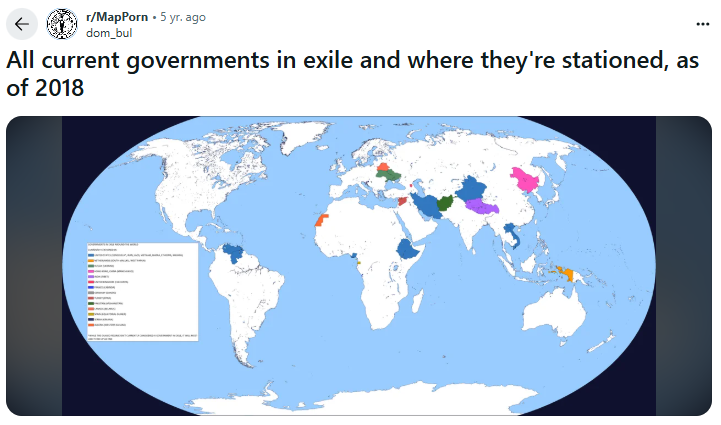
Civic Sedevacantism: A United States Government-in-Exile

Reading Josh Marshall’s recent post positing a theory of “civic sede vacantism“, which posits that American liberals/progressives need to narratively and linguistically treat the current regime – both in the executive and the judicial branches – is operating so much outside of the constitution that it cannot be expected to curtail or regulate its own abuse of power, and that it is up to libprogs to use state power to curtail federal power and restore constitutional government.

I find the idea interesting in how it comes around to effectively calling for progressive federalism in deed, but doing so from the position of reacting to a “fallen” political order which ought to be rejected in its legitimacy, curtailed from its uses of power, and corrected into a better relationship with its power.

You can find this sort of legitimism/sedevacantism in a number of cases:

  • Anyone who has ever maintained a government-in-exile after fleeing a country (i.e., the Second Spanish Republic government in exile from 1939 to 1977) or have maintained claims to a former monarchy;
  • Catholic sedevacantism, in which some Catholics reject the legitimacy of any pope since Pius XII due to the holding of the Second Vatican Council, and may instead elect antipopes with rival claims to the Roman papacy;
  • Irish republican legitimism, which posits that the pre-partition all-island Irish Republic declared in 1919 is still in existence and rejects both the 1921 Anglo-Irish Treaty and the existence of the modern Republic of Ireland;
  • Sovereign citizens who believe that the Fourteenth Amendment to the United States Constitution converted “sovereign citizens” into “federal citizens” by their agreement to a contract to accept benefits from the federal government, and that the United States stopped being a legitimate country afterward, instead becoming a “corporation” (the SovCit who originated this, of course, was a white supremacist);
  • Sovereign citizens in Europe (Russia, where some believe that the USSR continues; the Reichsburger movement in Austria and Germany; some in the Czech Republic who believe that the dissolution of Czechoslovakia was illegal, etc)

This can easily go down the road of conspiracy theory mongering, but I can respect the cognitive dedication to an alternate, rival status quo.

But if we’re departing from the status quo narrative, why start with Trump 2? Why even start with George W. Bush’s 2000 “election”?

Equal Rights Amendment

In fact, let’s date it to the moment when Congress erroneously inserted a ratification deadline to the Equal Rights Amendment.

Was it Congress’s authority to impose a statutory deadline on ratification? It’s debatable. Who’s idea was it to add a deadline? These questions have been brought up repeatedly in court.

One can argue that Congress abrogated its legitimacy as a branch of government by interfering with the ratification of a constitutional amendment after its legitimate proposal.

POTUS (Nixon and Carter) and SCOTUS also signed off on this deadline, so they get the chop too.

It’s also how this imposition of an illegitimate deadline, not only for the ERA (1979, then 1982) but also for the DC Voting Rights Amendment (1985), resulted in no further amendments being proposed by Congress after 1978 to this day.

This was supremely violative of the amendment process. It arbitrarily suppressed the relationship of the states with the constitution. It was the moment when the broader Second Reconstruction era ended as a constitutional movement and began to slowly recede, especially after William Rehnquist became Chief Justice in 1986 and John Roberts in 2005.

This abdication of legislative responsibility led to SCOTUS intervening for the right to abortion in Roe v. Wade (1973-2022) and subsequent progressive readings of 14th Amendment jurisprudence, all of which are now vulnerable to retirement. All of that should have been Congress’s responsibility to propose, and for the states to ratify at their pleasure.

So if the White House is constitutionally vacant, so is Congress and SCOTUS, all since 1972.

Civic, constitutional sedevacantism (legitimism?) should apply to all three branches and their actions since 1972, regardless of party or impact. I think that’s a good rupture point.

But what would this mean in practice?

A Progressive, Provisional Congress-in-exile

I’d argue that a sedevacantist position would take the following stances:

  • The Equal Rights Amendment was fully ratified by Virginia on January 15, 2020, and is therefore of legal effect nationwide.
  • The entire federal government since 1972, including all federal government elections and terms of Congress, all nine presidents (from Ford to Trump), all SCOTUS terms, and every statute, executive proclamation and federal judicial ruling, is illegitimate.
  • Yes, even the good laws and decisions, like Roe v Wade, Lawrence v Texas, Obergefell v Hodges, Bostock v. Clayton.
  • The D.C. Voting Rights Amendment, proposed by an illegitimate Congress, was also improperly abrogated by a seven-year deadline.
  • The pragmatic approach would be to engage with the illegitimate federal government, but with a political imagination as to blotting out the legitimacy of every action taken by the federal government against the Second Reconstruction agenda.
  • The more idealistic-but-isolative approach would be to establish a United States government-in-exile:
    • complete with all three branches of government
    • electing a Provisional president and provisional Congress
    • appointing a provisional Supreme Court
    • loyal to the Constitution as amended by January 15, 2020
    • recognizing the D.C. Voting Rights Amendment as still open to ratification by the states, and the statutory deadline of 1985 as invalid
    • open to proposing further amendments by two-thirds of the Provisional Congress
    • selectively supportive of certain statutes passed since 1972
    • diverging from the illegitimate federal government in foreign policy.

And how far could we go with the government-in-exile concept?

(Sidenote: What about state governments? I’d argue that the end of the First Reconstruction era in the South happened through illegitimate means at the state level, such as the forced resignation of Rufus Bullock, the liberal Republican governor of Georgia from 1868 to 1871, when he fled the state under threat from the Klan, which was followed by the significant, forced decline of equality under the law in Georgia. Or how Reconstruction was ended through bloodshed by the Klan. But that is for another post.)

Statutes under a government-in-exile would include most of what was unsuccessfully brought to the 111th and 117th Congresses (the two most recent Democratic trifectas):

  • For the People Act
  • Equality Act
  • American Dream and Promise Act
  • Paycheck Fairness Act
  • Washington D.C. Admission Act
  • Federal Death Penalty Abolition Act
  • Sabika Sheikh Firearm Licensing and Registration Act
  • Raise the Wage Act
  • Family and Medical Insurance Leave (FAMILY) Act
  • Trumka Protecting the Right to Organize Act
  • FAIR Act
  • U.S. Citizenship Act (including the NO-BAN Act)
  • Workplace Violence Prevention for Health Care and Social Service Workers Act
  • George Floyd Justice in Policing Act
  • Puerto Rico Admission Act
  • Farm Workforce Modernization Act
  • Eliminating a Quantifiably Unjust Application of the Law (EQUAL) Act
  • Assault Weapons Ban Act
  • Ensuring Lasting Smiles Act
  • SAFE Banking Act
  • CROWN Act
  • Recovering America’s Wildlife Act
  • Marijuana Opportunity Reinvestment and Expungement (MORE) Act
  • Augmenting Compatibility and Competition by Enabling Service Switching (ACCESS) Act
  • Local Journalism Sustainability Act
  • Averting Loss of Life and Injury by Expediting SIVs (ALLIES) Act
  • American Innovation and Choice Online (AICO) Act
  • Women’s Health Protection Act
  • Democracy Is Strengthened by Casting Light on Spending in Elections (DISCLOSE) Act
  • Fair Representation Act

But then I’d argue that even the most recent Democratic trifecta was playing it safe with the legislation it introduced. A Congress-in-exile would introduce bills to reform the federal government itself by statute, such as:

Finally, this Congress-in-exile can vote to approve by two-thirds for multiple, much-delayed proposals to amend the Constitution, sending them to the active state legislatures.

Conclusion

This is ultimately about changing the narrative about the federal government, away from a do-nothing entity encumbered by an ineffective Constitution, to one in which Congress fills in the gaps.

If it takes having to establish an alternative to this illegitimate status quo regime from abroad, so be it. If this is what it takes to repair the relationship between the United States and the world, so be it.

The deep wound inflicted by a wayward Congress against the Constitution since 1972 through a ratification deadline clause has to be resolved, even if by a Congress in exile.
Uncap the Senate and the House

I like that the Australian Senate fixes the issue of equal suffrage in a federal system by 1) electing 12 senators per state, using 2) multi-winner ranked-choice voting.

At the very least, the U.S. could resolve the relationship between rural-urban polarization and equal suffrage of states by raising the number of senators elected per state to at least 6 (giving us multi-winner senate elections every two years in every state), giving us a 300-member senate in which two members are elected every two years to six year terms from every state, and electing all senators using multi-winner RCV.

I initially thought that simply raising the number of senators per state to three would be sufficient, but the issues of (1) 6-year terms and (2) single-winner elections means that states holding elections every two years (rather than states currently taking one even-numbered year off, as per the Senate classes arrangement) would carry out more of the same polarization.

But raising the number above three per state would mandate at least one multi-winner election for each state within a six-year interval.

So not only should we uncap the House to at least 693 members using the cube root rule, but we should uncap the Senate to 300 members.

Delegates to the Senate?

And while adding senators to the Senate would require amending the constitution, I do have an idea that (voting) delegates could also be elected to the Senate by mere statute, without violating the equal suffrage mandate.

This could mean that, in at least two Senate elections per state (out of three total every six years), a senator and a delegate could be elected jointly using multi-winner RCV, while the third Senate election following would jointly elect two delegates, all for six year terms.

In summary, every state would have the following every two years using RCV:

  • Class 1: Senator and delegate
  • Class 2: Senator and delegate
  • Class 3: Delegate and delegate

Finally

Finally, what if the House is expanded to four-year terms, like in most other democracies? Then it would make it unfeasible to hold Senate elections in three classes divided by year, since there would be Senate elections which are held in non-House years. I would instead consider two classes of elections instead of three, extending Senate terms to eight years and splitting the federal elections in half into quadrennial cycles.

Granted, this would require amending the constitution, but still…

Idea: Remote state residency

As more people move out of (or are displaced from) California, maybe the state government should consider a type of state residency which can be exercised from other states.

Idea: a remote state residency.

  • Would allow for the following to apply as remote residents of the state without physical, permanent domicile in the state:
    • Non-residents
    • former residents
    • prospective transplants from other states
    • those born in the state of California 
    • Non-residents who apply for any state volunteer program
    • Non-residents who apply to study remotely or in-person at any California public college or university
  • Would allow for participation in in certain, but not all, activities and services accessible to active California residents
    • Would issue remote residency cards to successful applicants
    • Easier process for applying to CSU, UC and CCC colleges for remote study
    • Easier, discounted process for applying online to California-based public libraries for digital assets
    • Easier process for applying to California Virtual Academies (or state-operated online K-12 public school)
    • Invitations to voluntary programs
      • California State Guard (CSG)
        • Maritime Component
        • Army Component
        • Air Component
      • Programs of the Chief State Officer
        • College Corps
        • California Climate Action Corps
        • Youth Jobs Corps
        • AmeriCorps California
        • Disaster Volunteer Management
        • Alumni Network
    • Automatic application to remote residency for non-residents who volunteer for the above
    • Easier remote company formation, banking, payment processing, and taxation
    • Zoom marriages certified and officiated by California county clerks
  • Must be renewed every five years
  • Why:
    • Many people are driven out of California by the housing crisis
    • Many are hoping to leave other current states of residency due to policy
    • No state services are afforded to those who study online in CSU, UC or CCC systems
    • No state services are afforded to those who work remotely for California-based businesses and organizations
    • Remote work and service is an increasing reality, as is the growing interconnectedness of communications
    • The e-residency programs in Estonia and Lithuania offer a forward-looking attempt to extend the concept of citizenship to those who wish to do business in either country
    • This remote residency program would empower many more people to empower California, and would be an investment in our own future as a state

Links of interest 2/26/24

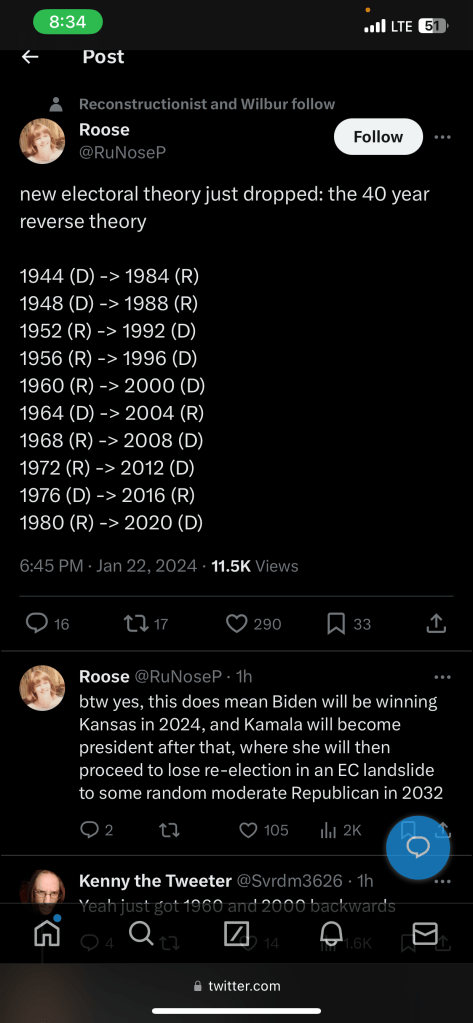
New Electoral Theory Just Dropped

“new electoral theory just dropped: the 40 year reverse theory…. 1944 (D) -> 1984 (R), 1948 (D) -> 1988 (R), 1952 (R) -> 1992 (D), 1956 (R) -> 1996 (D), 1960 (R) -> 2000 (D), 1964 (D) -> 2004 (R), 1968 (R) -> 2008 (D), 1972 (R) -> 2012 (D), 1976 (D) -> 2016 (R), 1980 (R) -> 2020 (D)”

“btw yes, this does mean Biden will be winning Kansas in 2024, and Kamala will become president after that, where she will then proceed to lose re-election in an EC landslide to some random moderate Republican in 2032”

Posted 6:45pm, Jan 22, 2024 by Twitter user @RuNoseP

As noted by someone, this gets 1960 and 2008 backward in terms of party. Also, it’s missing “1940 (D) -> 1980 (R)”, although it likely wouldn’t work for 1936 (D) -> 1976 (D).

but still. This is very interesting to think about. This could mean that Dems have eight more years in the White House.

But a bigger question: does that mean that Democrats are headed to winning full control of Congress in a 2034 Democratic Revolution? And does that mean that Democrats will win back the majority of state legislative seats by the 2040s?

Idea: A Trans-African Waterway

Perhaps more than any other Pan-African political or economic unification, I would think that a canal network linking the Congo, Zambezi and (maybe) Nile Rivers would be the biggest economic coup for the African continent.

Inland canals are perhaps one of the biggest reasons for the ridiculous amount of power of the United States. The Eastern portion of the United States is technically an island surrounded by ocean and sea on one side, rivers and canals on the other.

So linking the Congo to the Zambezi would essentially make southern Africa an island separate from the rest of the continent. Same for eastern Africa from Egypt to northern Mozambique if the Congo is linked to the Nile.

But if it is ever built, I have questions:

  • what inland cities would grow from this waterway? (DR Congo has quite a few inland port cities)
  • what environmental impact would likely happen?
  • how much traffic would it divert from the Suez Canal, or around the Cape of Good Hope, for those ships which want to cross into the Indian from the Atlantic?
  • how would this impact agriculture?
  • how would this impact mining?
  • how would this impact hydroelectric power, especially with Kariba Dam?

I’ve found some articles on the subject:

I’ve also had fantasy/scifi ideas about what Africa would look like with more islands (and maybe archipelagos) like East and Southeast Asia. Maybe this is the closest that we can possibly get to that idea.

For the Southern portion, I would call it “SADC Island”, after the Southern African Development Community, of which all the countries touching the – Angola, DR Congo, Zambia

Treat Government Like an App?

Thinking out loud:

Try thinking about law as the “source code” of an app called “government”.

It’s difficult to make a “hard fork” of the source code or write a new app from scratch that does “the same thing but better” with similar resources, but if the source code is a mess, the app is not going to work for all, or even most users.

The background, intention, language and timing of a contribution of source code and its contributor matters greatly in how that piece of source code is written and how it functions in the app. Trash in, trash out.

If one doesn’t plan out the goal or vision for the app and program the app with this vision in mind, you get an app that is messy and resource-intensive.

Just because the app presently attracts a commanding number of users doesn’t mean that the app is still the best in it’s class, only that it attracted its greatest number of users when it was the most viable compared to the other options. Now, most may only use it because it is what most of their friends and family may use or have used for a long time.

That app can always fail its users in some way, even if it’s a one-time massive screw-up. And if another app offers a better system at that moment, the formerly-dominant app will lose users and market share to the newer, better-featured app.

From Digg to Reddit. From Friendster to Myspace to Facebook. From IE to Chrome. From this government order to the next constitutional order.

Idea: National Voter ID Card

Hazardous Thought:

I’m seeing on Twitter that ardent Trumpists are very receptive to a “national ID card” as an anti-immigrant measure. They look a great deal at Mexico’s National Voter ID card as an inspiration.

A national ID card would go quite a ways to combat the “voter fraud” boogeyman.

I know that the ACLU is most consistent in opposing both national ID and voter ID.

But I’m wondering if we should support a National ID card while opposing the state-level Voter IDs.

Health Security

Idea: market “single-payer healthcare” as “health security” or “health defense”.

For some reason, things sound more tantalizing to American ears when “-security” is appended to the end of a word. I’ve heard “energy security” (or energy independence) used, I’ve heard “environmental security” used, so why not “health security”? All it would communicate is the fact that the health of our citizens is not only the priority of any civil society, but also a priority of national security, stability and sovereignty.

It would also communicate that without federal intervention through the efficiency of a single-payer system, we will continue to see the chaos and irregular conduct of healthcare and health insurance by various brackets or classifications of humanity.

So I hope that this term – “health security” or “health defense” -comes into use in the future on the part of advocates for healthcare reform in this country.

Pro-Polygamy advocacy group doesn’t like the idea of “gay polygamy”

OK, CNN International has a documentary on polygamy around the world while I’m writing.

But reading this was pretty hilarious. The automatic repudiation of the very thought of gays and lesbians sharing the now-publicly-unpopular institution of polygamy with straight polygamists is pretty obvious, particularly in the heavy usage of the word "homosexual" (nowadays more used by conservative anti-LGBT activists) throughout.

But then I wonder, if this repudiation and the accompanying ill-will is unfounded upon reason, then has the idea of gay polyandry or lesbian polygyny been explored yet?

Let’s think…