Billie Sweeney is a trans journalist who was an editor for the New York Times until last year. Here, she recalls her losing battle for the soul of the paper of record.
Source: Bias at NYT: Trans Former Employee Speaks Out — Assigned
Billie Sweeney is a trans journalist who was an editor for the New York Times until last year. Here, she recalls her losing battle for the soul of the paper of record.
Source: Bias at NYT: Trans Former Employee Speaks Out — Assigned

As of November 1, 20 prefectures and 150 municipalities in Japan have joined a sort of “interstate compact” for partnership registries, the “Partnership System Municipal Cooperation Network”. While multiple such agreements were established between cities and some between prefectures, this is the first to be advertised as one which any jurisdiction in Japan can join.
Outside of recognition by the national government and ongoing litigation in national courts on same-sex marriage, this network is the most high-profile effort at a national partnership registry for same-sex and unmarried couples in Japan to date. It is also the most serious attempt at such since the first partnership registry was established in Shibuya ward in Tokyo in 2015.
Should be interesting to watch progress on this network in 2025, despite what’s likely to happen in the United States.
Look at these maps.
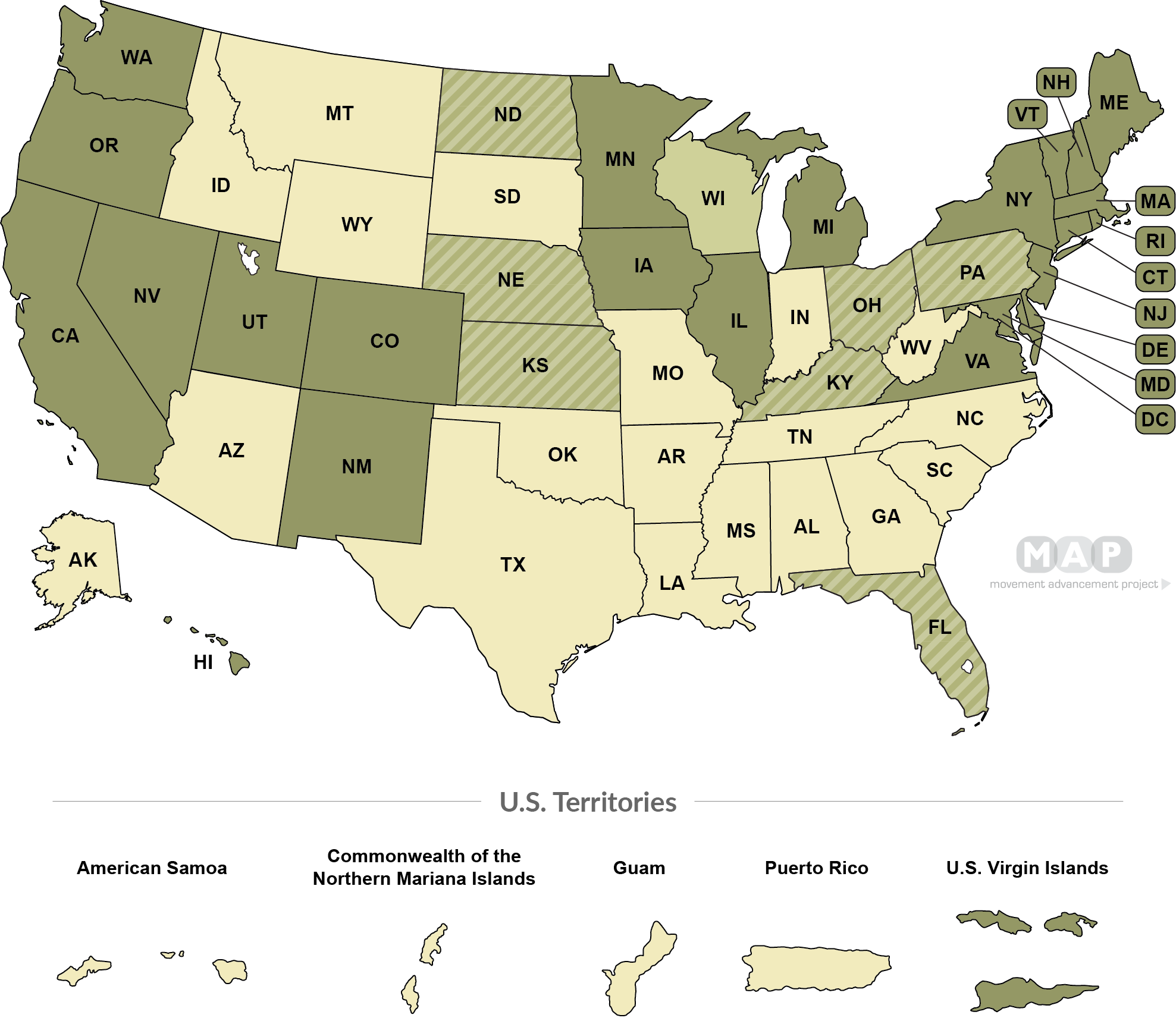

Not too many affordable areas for LGBT people to go for non-discrimination in housing. This is a problem.
Saw a few posts marking the one-year anniversary of the kiss between Luz Noceda and Amity Blight (aka “Lumity”) in The Owl House season 2 episode “Clouds on the Horizon”. Quite a cultural moment for animation and LGBT representation in mass media, particularly for the Disney behemoth. They fed the fandom with this one.

This moment, among others, netted The Owl House a 2023 nomination for a GLAAD Media Award for Outstanding Kids and Family Programming (Animated), even though it went to Netflix’s Dead End: Paranormal Park. I honestly wish that GLAAD Media Awards would allow for a first, second and third place winner for each category, now that they’ve expanded the nominee list for many categories to ten entries.
But still, Dana Terrace can say that she expanded Disney’s boundaries.
On August 29, 2019, over four years after the landmark Scotus ruling in Obergefell v. Hodges, Alabama followed through on a lingering threat to abolish marriage licenses. The resulting law is…..interesting, to say the least.
Under the new law, county probate judges are now required to record marriage certificates but are no longer required to issue licenses. Couples are no longer required to apply for a license, and only need to complete and send a marriage certificate to a probate judge, who is required to declare the marriage valid. A ceremony may be held for the wedding, but solemnization is no longer required for a recognized marriage in Alabama.
Coincidentally, this method is similar to how marriage is done in Australia. Over there, marriage licenses do not exist, and are instead carried out in the following manner:
The Alabama system seemingly discards the need for a celebrant of any type. It’s as close as Alabama might get to common-law marriage. Unironically, this makes sense, even with the Respect for Marriage Act codifying Loving v. Virginia and Windsor v. United States into law. Now, on the other hand….
I still think about how Utah’s SB 296 from 2015 has been hailed since as the “Utah Compromise” on LGBT rights. It was written to protect against discrimination in housing and employment for LGBT people. And now SCOTUS may further gut anti-discrimination laws in order to force this compromise on those states which have more comprehensive civil rights laws in place.
Only Indiana and Arkansas went so far as to pass their bills into law (Georgia and Arizona’s were both vetoed by Republican governors), and both did so without an LGBT nondiscrimination bill being considered by their Republican majorities.
The RFRA moment reached its crescendo in state legislatures in 2015-16 in the run-up to and aftermath of Obergefell v. Hodges, after which the religious right shifted its war-making in the direction of targeting public accommodations for transgender people.
What if this outgoing Congress had passed the Fairness for All Act, which adds the broad religious exemptions to LGBT rights protections sought by the LDS church? The ACLU criticized the bill in 2019 due to its singling-out of sexual orientation and gender identity for religious exemptions, its attempted undermining of then-ongoing court cases, and its undermining of child welfare protections.
I’m trying to find an example of a federal bill which would have advanced broad religious exemptions to all existing civil rights law, something like what Indiana’s SB 101 did. I’ve seen federal bills attempting to expand RFRA to vaccines and vaccine mandates during the height of the pandemic, but not yet something that would expand federal RFRA into a sledgehammer against all other federal civil rights law.
That’s the problem, IMO, with the Fairness for All Act being framed as a federal analogue to Utah SB 296. It specifically targets SOGI for exemptions, like bills filed during the pandemic by Ron Estes or Marco Rubio targeted vaccines, when the GOP could have gone whole-hog and targeted all civil rights law like Indiana SB 101 did. Meanwhile, Utah SB 296 only protected against discrimination in housing and employment, said nothing about SOGI in public accommodations, and was built into Utah’s extremely-broad religious exemptions for state civil rights law (even on race and color).
SCOTUS, these days, seems interested in carving out such exemptions on SOGI. The question is how far are they willing to wreck the Civil Rights Act(s) and Americans with Disabilities Act in the process.
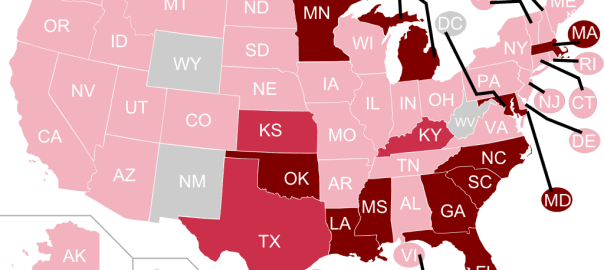
Maryland. Massachusetts. Michigan. Minnesota.
All four of these states start with M’s. All four have Democratic trifectas – Democrats controlling their governor’s mansions and both houses of their legislatures. And, as of 2023, all four have bans on gay sex on their books.
I can excuse Michigan and Minnesota (somewhat). Michigan only just gained a Democratic trifecta for the first time since 1983. Minnesota last had a trifecta in 2013-2014, but it was the first time they had such since 1978.
But Massachusetts and Maryland failing to repeal their bans on gay sex despite having two terms of “moderate” Republican governors and long-time Democratic supermajorities in both houses is inexcusable. Maryland had a bill in 2022 which passed almost unanimously in their House of Delegates but died in Senate committee. Massachusetts had a bill in 2022 which was renumbered, and renumbered again, before passing the Senate and then dying in a House committee.
Embarrassing. A waste.
And now a threat thanks to Clarence Thomas’ written attack on Lawrence v. Texas, which has not received any statutory backing federally since 2003 (save for when President Obama signed a repeal of a consensual gay sex ban for the military in the 2014 NDAA).
Meanwhile, trans-hating, gay-hating Alabama managed to repeal their own sodomy law in 2019 (while cleaning up their criminal code). Utah also did the same in the same year. Trans-hating, gay-hating Idaho repealed theirs last March (in response to a lawsuit).
Well, at least Michigan stands the likeliest chance to repeal theirs this year, but only because the larger law which criminalizes gay sex (Act 328 of 1931) also criminalizes abortion, blasphemy, adultery and more.
But the clock is now ticking on all four aforementioned blue trifecta states – Maryland, Massachusetts, Michigan and Minnesota – to repeal these stupid laws.
And, while I’m on it, it’s on Georgia’s Democratic legislators to show the give a shit about LGBT people by filing a bill to repeal O.C.G.A. § 16-6-2. What are you waiting for?
UPDATE: Here are the bills for this year:
Other unrelated bills I’m watching from these legislatures:
Bills from legislatures where I’m not expecting much good:
Despite some legal setbacks, many Japanese jurisdictions have moved ahead with strengthening recognition and registration of same-sex couples:
Mayor Skip Henderson, Councilmember Walker Garrett and former Atlanta City Council President Cathy Woolard all gave a good presentation on the ordinance.
I still remember five years ago, when I had driven up to what is now South Fulton to the State of Black Sci-Fi Convention. I got to meet Milton Davis, Darrell Johnson, Balogun Ojetade and several others, and was especially glad that we had someone (Darrell) writing LGBT-inclusive Black-oriented speculative fiction, for youth and YA even! And that Milton is from Columbus! Quite an experience, was wishing I could come back for Sunday but that was out of the question.
Got back home, got to sleep, woke up and saw the news of a mass shooting at an LGBT nightclub in Orlando the night before.
One of the worst mornings I’ve had in my life. Whiplash.
