Tag Archives: politics

Thoughts on the Last day of Veepstakes

I’m rooting for MN Governor Tim Walz to be VP Harris’ running mate. He has the rare experience of being in both federal legislative and state executive roles.

I would be surprised if PA Governor Josh Shapiro became VP Harris’ running mate. Not too disappointed, just surprised.

The last time either major party nominee selected a running mate with no federal legislative experience was Sarah Palin (R, 2008). The one before that was Sargent Shriver (D, 1972). Earlier:

  • Spiro Agnew (R, 1968, 1972, won, resigned in second term)
  • Earl Warren (R, 1948, lost, later became Supreme Court Chief Justice)
  • John W. Bricker (R, 1944, lost, later became a senator)
  • Henry A. Wallace (D, 1940, won)
  • Frank Knox (R, 1936, lost)
  • Charles G. Dawes (R, 1924, won)
  • Charles W. Bryan (D, 1924, lost)
  • Calvin Coolidge (R, 1920, won, later became president)
  • Franklin D. Roosevelt (D, 1920, lost, later became president)
  • Thomas R. Marshall (R, 1912, 1916, won)
  • John W. Kern (D, 1908, lost, later became a senator)
  • Theodore Roosevelt (R, 1900, won, later became president)
  • Garret Hobart (R, 1896, won)
  • Arthur Sewall (D, 1896, lost)
  • Whitelaw Reid (R, 1892, lost)
  • Chester A. Arthur (R, 1880, won, later became president)
  • Richard Rush (N-R, 1828, lost)
  • Daniel D. Tompkins (D-R, 1816, won)
  • Jared Ingersoll (F, 1812, lost)
  • Charles Cotesworth Pinckney (F, 1800, lost)

Just saying, it would be most wild for VP Harris to pick PA Governor Josh Shapiro, who does not have federal legislative experience, for this single reason. Only one person with no federal legislative experience becoming vice president since WWII is not a good sign, IMO.

Syllables

Another thing: the last time that a nominee for president had a running mate with more syllables to their last name than themselves was Bush-Cheney 2000 and 2004.

Others:

  • Gore-Lieberman (D, 2000, lost)
  • Mondale-Ferraro (D, 1984, lost)
  • Nixon-Cabot Lodge (R, 1960, lost)
  • Willkie-McNary (R, 1940, lost)
  • Smith-Robinson (D, 1928, lost)
  • Cox-Roosevelt (D, 1920, lost)
  • Taft-Sherman (R, 1912, lost)
  • Taft-Sherman (R, 1908, won)
  • Bryan-Stevenson (D, 1900, lost)
  • Cleveland-Stevenson (D, 1892, won)
  • Blaine-Logan (R, 1884, lost)
  • Hayes-Wheeler (R, 1876, won)
  • Grant-Wilson (R, 1872, won)
  • Grant-Colfax (R, 1868, won)
  • Cass-Butler (D, 1848, lost)
  • Polk-Dallas (D, 1844, won)
  • Clay-Frelinghuysen (W, 1844, lost)
  • White-Tyler (W, 1836, lost)
  • Jackson-Van Buren (D, 1832, won)
  • Clay-Sergeant (NR, 1832, lost)
  • Clay-Sanford (DR, 1824, lost)
  • King-Howard (F, 1816, lost)
  • Clinton-Ingersoll (F, 1812, lost)
  • Adams-Jefferson (DR, 1796, won)

Conclusion

The only reason why Shapiro may already be selected is that it would be awkward to announce someone who is not Shapiro at the Philadelphia rally meant to debut the ticket. But at the same time, prioritizing winning Pennsylvania to this extent seems silly when you’re trying to imagine working with this running mate for (hopefully) 8 years of your life.

But either way, unity is needed, no matter who the running mate may be.

Why the American system of candidate nomination has led us to fascism (again)

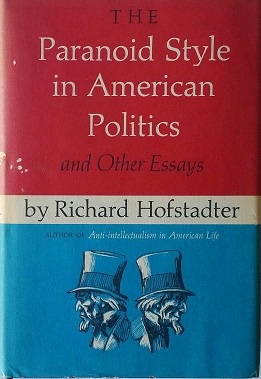
Cover of “The Paranoid Style in American Politics and Other Essays” by Richard Hofstadter
With regards to Richard Hofstadter

I very much favor how the Labour Parties in the UK and Australia nominate candidates for public office compared to the way that American parties nominate theirs, even though they have a parliamentary system compared to our presidential.

The primary and the caucus, which has been in increasing use by both major parties in the United States since the early 20th century but especially after the 1960s, are both paranoid, time-consuming, irresponsible, expensive garbage in comparison.

The primaries and caucuses have placed us in such a position that we are bowing down to:

  1. the millionaire and billionaire donors and barons who fund primary candidates’ campaigns and think tanks;
  2. the Republican, anti-democratic state governments who control the primaries;
  3. pollsters and TV talking heads who have a vested interest in the dramatic rot and instability of the republic for their ratings and ego.

Things should not be this over-engineered. We should not feel this helpless and listless. Democracy should not involve sacrificing any political party’s freedom of association for the sake of financial expediency and outsourcing of responsibility to people with conflicting and divergent interests.

We should not use primaries and caucuses, both of which necessitate the demand for more money and advertising unleashed by the Citizens United decision.

But this century-long snowballing disaster has come to dominate our political thinking, at the expense of democracy in the republic.

Getting Biden to withdraw will not begin to fix the fundamental rot caused by the primary as an extension of the general election.

Reforming our elections toward various flavors of nonpartisan blanket primary will not solve this rot, either. In fact, it may further it, I’m sorry to say.

We are not a multiparty system because the primary and caucus, combined, is treated as an extension of the first-past-the-post general election, as a public utility to be regulated by state governments, even if they are ran by rival parties.

And now, fascism and feudalism govern so many states – and maybe soon the White House again – because our two-party system does not allow for building a cordon sanitaire, a clean rope, against anti-democratic forces.

Europe’s parliamentary systems understand this. Latin America’s presidential but proportional systems (except for Argentina, I guess) are made starkly aware of this, even as those presidential systems lead to rival parties in control of either branch of government and coming to frequent blows against each other. Their citizens often know which parties to block from power.

They also, mostly, understand to let parties be parties, and to not outsource the responsibility of nominating candidates or authoring legislation for legislative or presidential office to the state or to think tanks.

But to Americans, such thinking is foreign. Parties have long been weakened and demonized as an institution at all levels of government by the paranoid majority for generations.

We have become ideologically polarized, but have not allowed ourselves to split parties, represent those who support us, and not appeal to anti-democratic constituencies.

Why didn’t we? Why haven’t we?

And are we too late?

How much longer do we this rot fester before we start treating parties as parties, respecting their role in society, and let them flourish on their own power?

Hopefully this election will lead to that reckoning, one which we thoroughly deserve.

Or, alternatively, we will experience further, misguided destruction of the republic.

Democrats Need Focus

Not interested in the present White House contest

I’m not interested in the present bullshit.

Remain focused on the state legislatures, governors and attorneys general. They are the true sources of power in this country. The Supreme Court is 6-3, and Congress is incredibly hamstrung, thanks to the votes and laws of multiple state governments over decades. The balloons which they trial often make it into law or increase in popularity with like-minded counterparts across the country, and then sometimes flow upward into federal policy.

You may fear SCOTUS and what more they may allow, or what Trump will bring if he is elected again, but so many of you live under decades-long dark-red state rule with no option but to wait for demographics to shift in your direction just a little bit more each year, or each decade.

And what has that brought you? Learned helplessness, stuck in the suburbs of some red state, stuck being disappointed by the latest flow of bullshit from your state legislature.

And you pontificate on switching out the incumbent president for another nominee from whatever state while the sand continues to shift under your (and their) very feet.

Learn your history. Get some perspective. Relocate strategically. Plan accordingly.

Why liberals and socialists are reacting with hair on fire

I don’t think it’s a “circle jerk”, as a friend described it, at least not a total circle jerk. I have several thoughts about it.

They’re turning inward and insular because they’re being starkly reminded of the fragility of their appearance-dependent relationship with the nationalized centrist-Esque media and their donors, and they have no seeming refuge atm beyond, what, MeidasTouch? Lincoln Project? YouTubers?

Too many liberals want to be loved by nationalized media, and to keep their current relationship with that same media. Just as they’ve been with the judicial and executive branches of government, they may want to turn against nationalized media for now because things are going bad, but they always come back and never build out their own comparable counterpart to the conservative parallel economy. And their donors, small dollar and large all, are flighty as hell.

And the nationalization of the media apparently happened during the same period as the growth of the local news(paper) desert and the growth of Republican capture of state legislative majorities.

And the center-left are also lacking yet again for a strong bench of unifying personalities from outside the nationalized media to countervail the prevailing narrative, or to even fill a portion of the power vacuum which will be left if Biden withdraws or (worse) 25th-Amendments his remaining (first) term.

We may not have a Macron at the helm, but we also definitely don’t have a (less-problematic) Melenchon to offer an alternative, polarizing populist vision or personality. In leadership, We have a bunch of institutionalists and up-and-comers with the personality or relatability of a wet paper bag outside of their constituencies, none of whom are helping to build the parallel polis to protect their interests and narratives.

So we now see a circle jerk for those who only have (or seek) some distance from the nationalized centrist media and its blowback, not a full-blown parallel polis to buffer them ideologically from centrist blowback in a multitude of ways like what Trump has at his disposal.

Not even pro-Bernie people, as resentful as they may continue to be about 2016 or 2020 DNC, or people further left have built out much of their own parallel polis, unfortunately.

Free advice to Biden’s campaign

In France this week, Macron’s own prime minister, Gabriel Attal, got him to stop talking publicly about the election for the rest of this last week, because Macron, in his 40s, kept firing his mouth off at the political left (especially rival Jean-Luc Melenchon) at a time when that is absolutely not needed.

Macron may have looked at the numbers and decided that it would be better for the RN to grab a majority, appoint a far-right prime minister and try their hand at governing in such a way that the French public would be turned off afterwards.

Attal, OTOH, is actually fighting against this apathy, this resignation to an RN majority, and is not fighting those to his left. He’s actually committing to this “Republican front” strategy, and actually hates the far right more than he disagrees with the far-left. He knows ball.

This “Republican front” may have helped reduce the likelihood of a majority for the far-right National Rally in the runoff tomorrow, as per polls from yesterday. (UPDATE: It did, and Attal announced his resignation effective Monday. UPDATE: Macron rejected his resignation, wants him to stay until after the Olympics.).

If this is what’s needed to keep Biden in the election and keep Dems viable, then do it. Have him talk with a voice assistant at all public events like Jennifer Wexton. Have his surrogates campaign for him instead where necessary.

His actual voice is a worthy sacrifice if he’s that serious about running.

But if you’re going to side with anyone:

  • it must be Harris
  • you must support Harris completely, with no reservations.

We don’t need primaries

Hot take: French and British political parties do not use publicly-funded, state-ran primaries to nominate their parliamentary candidates, nor do they perceive their nomination contests to be public, mass affairs or extensions of the general election season which should be open to all party members or even non-party members.

Maybe we in the U.S. should reconsider using primaries (closed or open) to nominate our candidates or inviting participation from independents. Primaries add unnecessary expenses and time to campaigns and are incredibly inflexible to quality control concerns.

We really don’t need primaries, let alone open primaries.

Legalize proxy voting

Hot take: Legalize proxy same-day in-person voting.

It may violate the secret ballot, but if you want high turnout without relying upon early voting, drop boxes or the postal service, you’d allow voters to waive their right to a secret ballot and formally, temporarily give their power of attorney to another registered voter.

If you’re the type who wants to know the results on the night of and would rather that people show up on the day of, then proxy voting is the way to go.

France shows that it can work.

Good news from the states so far this year

  • Delaware’s legislature passed a repeal of their *statutory* death penalty, which awaits signature. 
  • Delaware Supreme Court legalized no excuse permanent absentee voting and early voting, overruling a lower court.
  • California will have a total ban on slavery on the ballot in November.
  • Wisconsin’s Supreme Court voted on party lines to legalize ballot drop boxes for upcoming elections. 
  • Ohio’s Citizens Not Politicians dropped off 730k signatures from the majority of Ohio counties for their amendment to institute a nonpartisan redistricting commission, which now awaits vetting by the Review Board.
  • Arkansas voters dropped off 100k signatures for an abortion legalization amendment, which now awaits vetting by the Review Board
  • Nevada will have an abortion amendment on the ballot in November
  • Michigan and Minnesota passed bans on gay/trans panic defense
  • California, Colorado will vote on marriage equality amendments, while Hawaii will vote on repealing language allowing the legislature to restrict marriage to opposite sex couples.
  • Maryland and New York will vote on inclusive equal rights amendments. 
  • Colorado, Florida, Maryland, New York, Nevada and South Dakota will vote on abortion legalization amendments. 
  • Nevada and Oregon will vote on adopting ranked choice voting in blanket primaries. Campaigns in Washington D.C. and Idaho have submitted ballot signatures for pro-RCV measures, and a campaign in Colorado have until August to submit 125k signatures. 
  • Florida and South Dakota will vote on cannabis legalization amendments.  
  • Minnesota passed a State Voting Rights Act and banned prison gerrymandering.

On Florida

Matt Isbell, a stellar Florida-based political data analyst, posted this on Twitter for the doubters:

On Sheriffs, Counties and Connecticut

In regards to this October 2023 post from Democracy Docket about the non-necessity of elected sheriffs, I looked up which states abolished the role of sheriff. Turns out that there are few, but notable, examples:

  • Only Alaska and Connecticut lack an office of sheriff
  • Alaska does not have county governments.
  • Connecticut voters moved to abolish the office of sheriff in 2000, replacing the elected office with both state marshals and judicial marshals, which are both non-elected contractors.

But also, who runs the jails if not a sheriff?

Connecticut seems to be far ahead of most states on the question of the relevance of sheriffs, as well as the role of counties, to modern-day government and corrections. This also eliminates the nonsense of “constitutional sheriffs”, and the corruption and feudalism inherent to the office itself.

Imagine such abolition taking place in larger states. How much efficiency would this allow to state government when it comes to zoning, housing, infrastructure, and more?

Georgia Democrats Qualify for a Variety of Seats in a Presidential Year

Qualifying for the May 21 Democratic primary and nonpartisan election ended last Friday at noon.

Statewide:

  • John Barrow is running for Andrew Pinson’s seat on the Supreme Court. This is the first likely-substantial contest against an incumbent justice in years. This “nonpartisan” election is on May 21.
  • There will be a “nonpartisan” contest for an open seat on the State Court of Appeals. Attorney Jeff Davis will face off against Cobb County Magistrate Judge Tabitha Ponder. This “nonpartisan” election is on May 21.
  • The Public Service Commission elections have been cancelled again, and the current commissioners will remain on the ballot for the next two years. It’s likely that we will be voting on all five commissioners in 2026.
  • We are now running for 38 seats (2/3rds) in the Senate and 135 seats (3/4) in the House. To compare, since 1992, we’ve ran for at least 75% of the House in 1992, 1994, 1996 and 2020. 
  • We are running for District Attorney positions in 14 circuits. There will be Republican challengers in three circuits: Atlanta, Chattahoochee and Eastern.
  • Democrats are running for all 14 congressional districts. There will be Republican challengers in all but GA13.
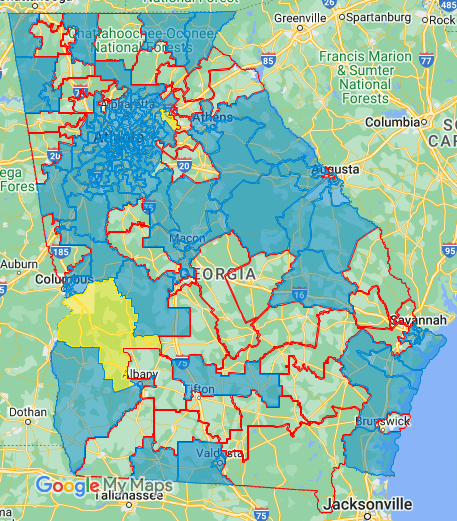
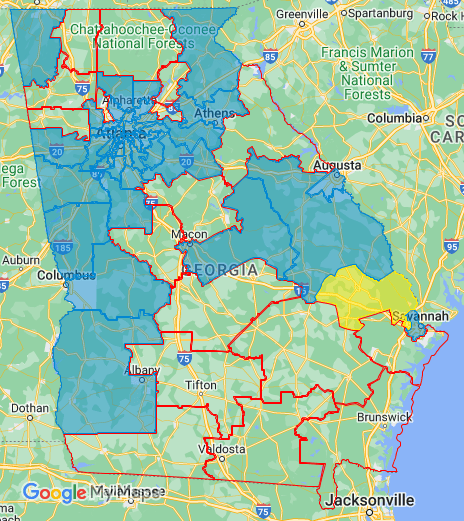
  • At the end of qualifying, we left HD104, a Biden district in Gwinnett County, HD151, a slightly-Trump voting district in Southwest GA, and SD4, a Biden district near Savannah, on the table. 

And now for local elections around Columbus:

  • We will have a Democrat, Carl Sprayberry, for HD139 (open).
  • We will have a Democrat, Ellen Wright, for SD29. 
  • Debbie Buckner in HD137 will have a primary challenge from Carlton Mahone Jr and a Republican challenger. 
  • Teddy Reese in HD140 will have a Democratic challenger in Alyssa Nia Williams. 
  • There will be a Democratic primary for the open seat in deep-red GA03. Val Almonord, who was the Democratic nominee in 2020 and 2022, will have a challenge
  • There will be a Republican challenger for GA02. 
  • We now have a Democrat running for District Attorney in Chattahoochee Circuit: criminal defense attorney Anthony L. Johnson. He has no primary opposition, and will be on the ballot in November against Republican and acting DA Don Kelly. We are also challenging a Republican for DA in Eastern Circuit as well. 
  • Our incumbent Sheriff Greg Countryman is running for re-election as a Democrat. He will be opposed in November by Republican Mark LaJoye.
  • Our incumbent state court solicitor Suzanne Goddard, who previously held office as a Democrat, is running for re-election as a Republican. We have a Democratic challenger in Shevon Sutcliffe Thomas. 
  • Buddy Bryan is running for re-election as Coroner as a Democrat. He will be opposed in the May primary by Royal Anderson. No Republican is running in November. 
  • Lula Lunsford Huff is not running for re-election as Tax Commissioner. David Britt is running as a Democrat for the position and is unopposed in May and November. 
  • We will likely not have a challenger to Gary Allen for Council District 6. A potential candidate fell through. I am sad about this as well since I live here.
  • Toyia Tucker will have a challenge in Council District 4. This “nonpartisan” election is on May 21.
  • There will be a four-way race for Council At-Large 10. This “nonpartisan” election is on May 21.
  • There will be a contest for Board of Education District 7, with Lakeitha Ashe challenging incumbent Pat Frey. This “nonpartisan” election is on May 21.
  • Incumbents unopposed in May and November: Danielle Forte (D) for Superior Court Clerk, Reginald Thompson (D) for Clerk of Municipal Court, Marc D’Antonio (D) for Judge of Probate Court. 
  • No contests for HD138 (Vance Smith (R)), HD141 (Carolyn Hugley (D)), City Council Districts 2, 6 or 8, Board of Education District 1, 3, 5, or At-Large 9, nor State Court Judge (Temesgen). 
  • In addition, there may be some party primary advisory ballot questions. 

Retirements:

  • Both Senate Minority Leader Gloria Butler (SD55) and House Minority Leader James Beverly (HD142) are not running for re-election to either house.
  • Other Senate Democratic retirements: Valencia Seay (SD34) and Horacena Tate (SD38).
  • Other House Democratic retirements: Doug Stoner (HD42), Roger Bruce (HD61), Mandisha Thomas (HD65), Pedro Marin (HD96), Gregg Kennard (HD107), Gloria Frazier (HD126), Patty Bentley (HD150).

Idea: Remote state residency

As more people move out of (or are displaced from) California, maybe the state government should consider a type of state residency which can be exercised from other states.

Idea: a remote state residency.

  • Would allow for the following to apply as remote residents of the state without physical, permanent domicile in the state:
    • Non-residents
    • former residents
    • prospective transplants from other states
    • those born in the state of California 
    • Non-residents who apply for any state volunteer program
    • Non-residents who apply to study remotely or in-person at any California public college or university
  • Would allow for participation in in certain, but not all, activities and services accessible to active California residents
    • Would issue remote residency cards to successful applicants
    • Easier process for applying to CSU, UC and CCC colleges for remote study
    • Easier, discounted process for applying online to California-based public libraries for digital assets
    • Easier process for applying to California Virtual Academies (or state-operated online K-12 public school)
    • Invitations to voluntary programs
      • California State Guard (CSG)
        • Maritime Component
        • Army Component
        • Air Component
      • Programs of the Chief State Officer
        • College Corps
        • California Climate Action Corps
        • Youth Jobs Corps
        • AmeriCorps California
        • Disaster Volunteer Management
        • Alumni Network
    • Automatic application to remote residency for non-residents who volunteer for the above
    • Easier remote company formation, banking, payment processing, and taxation
    • Zoom marriages certified and officiated by California county clerks
  • Must be renewed every five years
  • Why:
    • Many people are driven out of California by the housing crisis
    • Many are hoping to leave other current states of residency due to policy
    • No state services are afforded to those who study online in CSU, UC or CCC systems
    • No state services are afforded to those who work remotely for California-based businesses and organizations
    • Remote work and service is an increasing reality, as is the growing interconnectedness of communications
    • The e-residency programs in Estonia and Lithuania offer a forward-looking attempt to extend the concept of citizenship to those who wish to do business in either country
    • This remote residency program would empower many more people to empower California, and would be an investment in our own future as a state

Links of interest 2/26/24

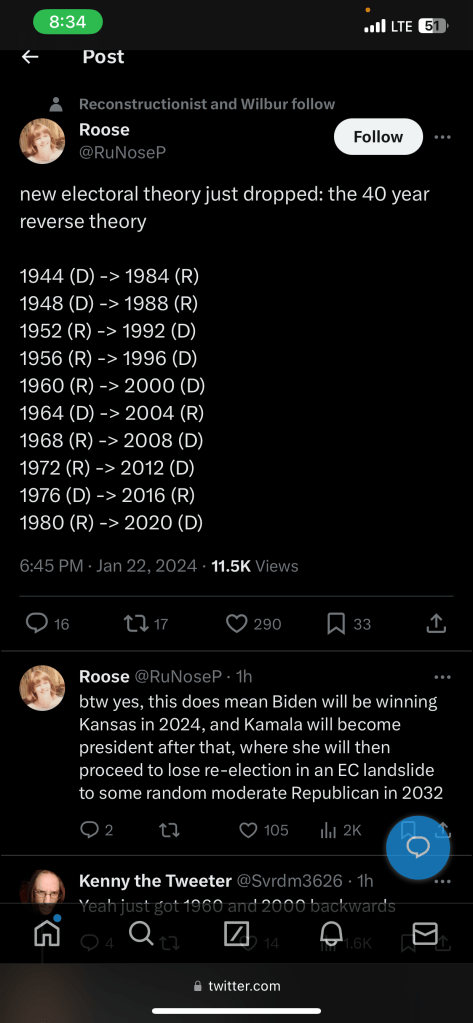
New Electoral Theory Just Dropped

“new electoral theory just dropped: the 40 year reverse theory…. 1944 (D) -> 1984 (R), 1948 (D) -> 1988 (R), 1952 (R) -> 1992 (D), 1956 (R) -> 1996 (D), 1960 (R) -> 2000 (D), 1964 (D) -> 2004 (R), 1968 (R) -> 2008 (D), 1972 (R) -> 2012 (D), 1976 (D) -> 2016 (R), 1980 (R) -> 2020 (D)”

“btw yes, this does mean Biden will be winning Kansas in 2024, and Kamala will become president after that, where she will then proceed to lose re-election in an EC landslide to some random moderate Republican in 2032”

Posted 6:45pm, Jan 22, 2024 by Twitter user @RuNoseP

As noted by someone, this gets 1960 and 2008 backward in terms of party. Also, it’s missing “1940 (D) -> 1980 (R)”, although it likely wouldn’t work for 1936 (D) -> 1976 (D).

but still. This is very interesting to think about. This could mean that Dems have eight more years in the White House.

But a bigger question: does that mean that Democrats are headed to winning full control of Congress in a 2034 Democratic Revolution? And does that mean that Democrats will win back the majority of state legislative seats by the 2040s?

Democrats Clean Up in Odd-Year Midterm

  • Virginia: Dems hold Senate, flip House of Delegates
    • Don Scott is likely speaker-designate, would be first African-American speaker in Virginia’s 400+ years of legislative history
    • Danica Roem wins Senate seat, becomes second transgender state senator in U.S. history, was already first transgender state legislator
    • Dems will likely refer constitutional amendments to 2026 ballot, depending on if they hold the House of Delegates majority in 2025. They have lots of options:
      • abortion rights (!)
      • marriage equality (!)
      • voting rights for ex-prisoners (!)
      • environmental justice/right to healthy environment
      • remove the 30-day limit on legislative sessions
      • allow governor to run for consecutive second term
      • move state elections to even-numbered years
      • prohibit slavery in the state constitution
      • have lieutenant governor elected on joint ticket with governor
  • Kentucky: Andy Beshear wins re-election as governor:
    • Beshear is only the third incumbent governor in Kentucky history to win a second consecutive term, seventh to win re-election overall
    • Beshear is the sole Democrat to survive this election statewide. No telling what will happen with the next Democratic nominee for governor in 2027.
  • Ohio: Issue 1 (abortion rights) and Issue 2 (marijuana) pass, legalizing both.
    • Republican leaders are seething and vowing to attempt repeal of Issue 1
  • Pennsylvania: Judge Dan McCaffrey wins seat on PA Supreme Court, keeping the Democratic majority 5-2.
    • Democrats flip several county commissions, including some like Dauphin which haven’t been held by Democrats in 100+ years.
  • Mississippi: Brandon Presley (D) came close but did not win the governorship.
  • Minnesota and Michigan: Ranked-choice voting had a very good night at the polls in several cities.