On the third try, the bipartisan Citizens Not Politicians Ohio campaign got their proposed ballot language approved by Republican Attorney General David Yost. This happened just days after the state’s partisan redistricting commission approved gerrymandered maps, with Democratic members voting in favor in order to protect their remaining seats.
Next step for the campaign: approval by the Ohio Ballot Board, which also has a Republican majority. If approved by the board, the campaign will begin to collect nearly 500,000 signatures from 44 counties across the state to place the question on the November 2024 ballot. If approved by the voters, the commission will be appointed and tasked with redrawing congressional, legislative and other state maps for the 2026 elections.
Obviously, this bipartisan campaign is the best bet for Ohio Democrats to end the GOP supermajority in legislative and congressional maps. In the last round of redistricting, the Democrats unsuccessfully proposed congressional maps that would end up 8R-7D.
At the very least, this would also prevent one party from unilaterally ramming ballot questions onto the ballot without buy-in from the minority party in either legislative chamber.
Also, the 2015 and 2018 ballot measures which established more elaborate regulations of redistricting failed to curb the GOP’s legislative veto of any unfavorable maps. CNPO’s ballot measure would finally end this legislative veto, as well as:
Ensure an equal balance of Democrats, Republicans and non-affiliated citizens, all of whom are removed as much as possible from the political process as possible;
End prison gerrymandering;
Make the Ohio Supreme Court the final arbiter on constitutionality of maps adopted by the commission
I look forward to Ohio passing this amendment next year.
Alabama’s legislature will approve a new congressional map with a second VRA district by July 21. The plaintiffs’ remedial map, which goes for a least-change approach, might be adopted, but several submissions have been sent.
SCOTUS rejecting Louisiana’s appeal defending their congressional maps is only a partial victory for fairer maps. The case was sent back to the 5th Circuit to decide whether to continue hearing Louisiana’s appeal or to send it back to the Middle District of Louisiana which already ruled against the map. We shall see, but either Louisiana or the 5th Circuit can draw this one out.
The denial of cert to Ohio’s case defending their shit maps is not a victory for fair maps at all. Unless Ohio defeats Issue 1, most other attempts at redistricting reform in that state are f**ked.
Still nothing regarding Rose v. Raffensperger from the 11th Circuit, beyond both plaintiffs and the state sparring in dueling letters to the court asserting Milligan and Gingles‘ applicability to the case immediately following the Milligan decision.
I tried redrawing a map with a second majority-Black district for Louisiana’s PSC. I don’t think it worked.
I couldn’t imagine this decision happening under this court, but I guess “bullying works” (sometimes). Plus, it’s a sign that SCOTUS’ right-wing majority may be more monstrous in Moore v Harper (independent state legislature theory), SFAI v. Harvard/SFAI v. UNC (affirmative action in higher ed), and Haaland v. Brackeen (Indian Child Welfare Act constitutionality), all to be announced this month.
Notable: Given it’s Pride Month, The National Black Justice Coalition may be the only LGBT rights organization to issue a statement in response to Allen v. Milligan. I would have expected The National LGBT Task Force, who organized the Queer the Census project for both 2010 and 2020, to have issued a statement as well. Even with the anti-LGBT backlash going on right now, this decision does have implications for Black LGBT people in the South, increasing somewhat the chances that they can run for and win higher office. Davante Lewis’ 2022 win in the runoff for Louisiana’s PSC was a big, understated victory for Black LGBT people in this region.
Impact(s)
What is happening or is most likely to happen nationwide, based on Election Twitter’s ideas:
Alabama legislature will be forced to redraw their congressional map to add a second VRA district.
Louisiana is asking SCOTUS for oral argument in their appeal against the Ardoin case regarding Louisiana’s own congressional map. Highly likely that SCOTUS will dismiss the appeal and force Louisiana legislature to redraw for a second VRA district.
North Carolina legislature likely to not go as hard as they wanted to go on obliterating most remaining Dems in congressional and legislative maps.
Florida’s state and federal cases regarding the former FL13 will be slightly supported by this decision, but not too much, since those cases rest on other laws, such as the federal 14th Amendment as well as the state constitution’s analogues to Section 2 and (the former) Section 5 of the VRA (citing Andrew Pantazi of the Jacksonville Tributary).
Dems were worried about their chances for winning back the House next year after the North Carolina Supreme Court gave Republicans multiple wins. After this, there’s a potential net gain of at least 2.5 seats. Or, if we want to go crazy with wishcasting, as many as +10-12. Maybe enough to wash the gains to be made by Republicans in North Carolina.
Very unlikely to see any redistricting in Arkansas, Mississippi, Oklahoma, Ohio or Wisconsin resulting from Allen.
There is ongoing litigation in North Dakota by Native American nations on Section 2 grounds regarding legislative maps.
Credit to U.S. Rep. Terri Sewell (D), who actively campaigned for a plurality-minority second district in Alabama and against packing Black voters into a single district, as highlighted in this 2021 Atlantic article.
Now on to Georgia:
It’s debatable how the Republican legislature could redraw their congressional map to do the bare minimum of complying with the Allen decision. The best-case scenario is perhaps restoring Lucy McBath and Carolyn Bordeaux’s old districts, restoring the 2020 status quo of 8 GOP-6 Dem. The shortest-term worst case is simply re-packing Black Metro Atlanta voters into four districts, but that would leave lots of other left-trending territory surrounding these districts vulnerable in the longer term to Dem candidates.
There is ongoing litigation (Georgia State Conference of the NAACP v. Georgia) challenging the 2022 congressional and legislative maps, filed by the NAACP state conference, GALEO, and Georgia Coalition for the Peoples Agenda. Also ongoing against these maps: Grant v. Raffensperger, Alpha Phi Alpha v. Raffensperger, Prendergrass v. Raffensperger. There’s ongoing VRA Section 2 litigation in 30 cases across 10 states, and there are more to come.
Public Service Commissions
Let’s talk about the PSC, both in Georgia and other states:
PSC At-large voting: There has been radio silence from the 11th Circuit on the state’s appeal in Rose v. Raffensperger since oral arguments last December. Hopefully the Allen decision will make an impact. At least two of the plaintiffs to whom I’ve talked, Rev. James Woodall and Wanda Mosley, are confident that this decision will help them prevail against the state. Also, I wonder if Judge Nancy Abudu, a Biden appointee who was just confirmed to the 11th Circuit, will join in or recuse herself from whatever ruling that comes out on the appeal.
PSC Redistricting: There’s a petition that has been filed by plaintiffs in Rose v Raffensperger with Judge Grimberg in the Northern District of Georgia to redraw the PSC map which had been approved in 2022 during qualifying week (which placed Democratic PSC District 2 nominee Patty Durand at odds with Raffensperger).
Dems filed a bill (HB 841) to change the PSC election method this past session, but it died before getting heard in committee.
See my prior posts about the GA PSC and VRA: 1, 2.
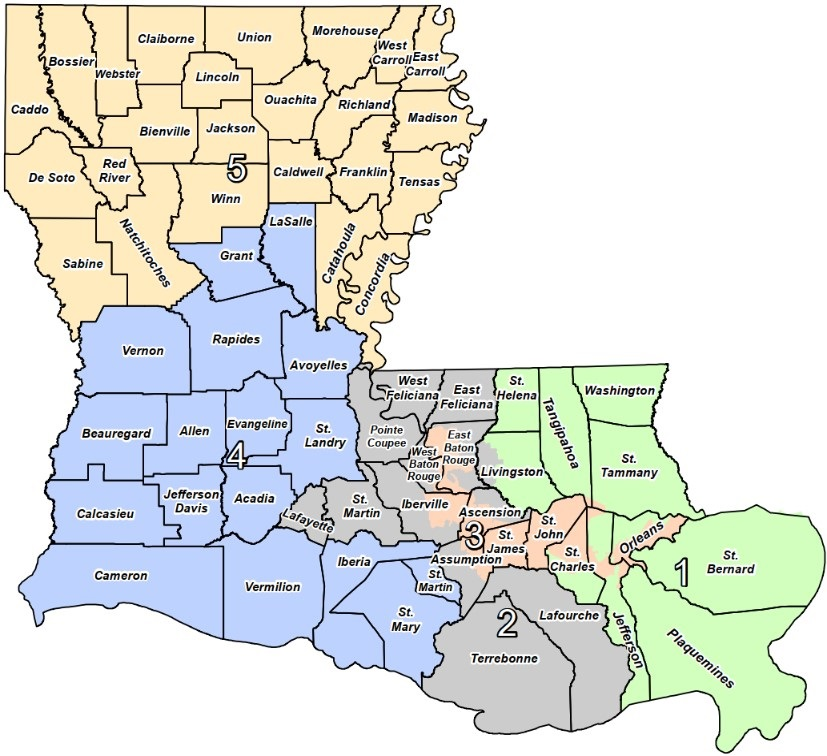
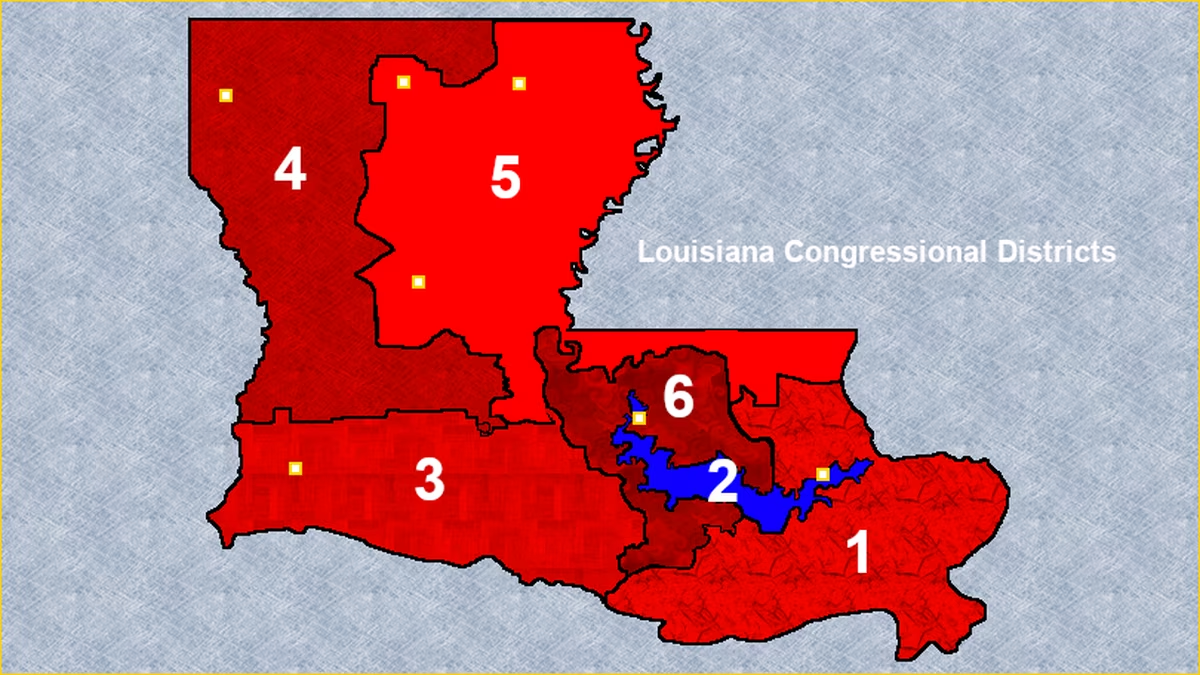
There’s also a question as to whether the Georgia PSC should be entirely drawn around entire counties. To compare, Louisiana’s PSC districts are mostly drawn around entire counties, except for Davante Lewis’ District 3, which, similarly to Troy Carter’s Congressional District 2, snakes through portions of Orleans Parish all the way into East Baton Rouge Parish. If, resulting from Allen, LA-CD2 may be redrawn in order to accommodate a second VRA opportunity district stretching from Baton Rouge up Louisiana’s border with Mississippi all the way to the northeast corner of the state (As proposed by FiveThirtyEight and in multiple proposals by both Democrats and Republicans last year), then what of Louisiana’s current LPSC map? Should Foster Campbell’s District 5 be redrawn into a second VRA-compliant LPSC district?
Louisiana’s current PSC mapLouisiana’s 2022 congressional mapMy idea of a VRA-compliant PSC map, districts highlighted
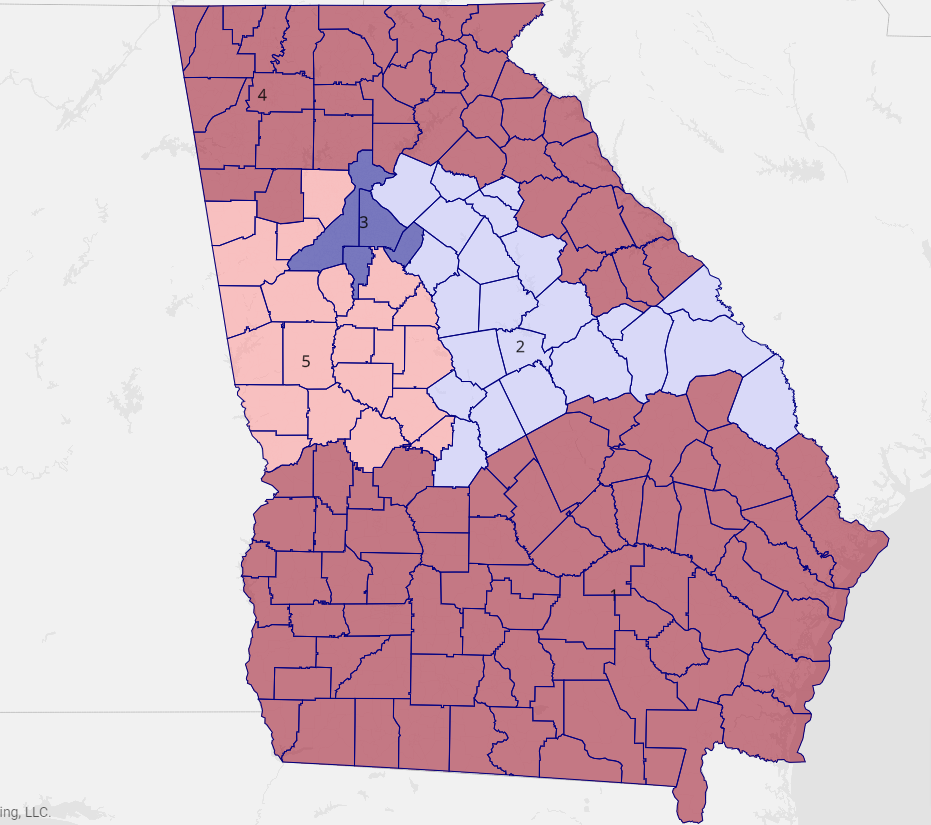
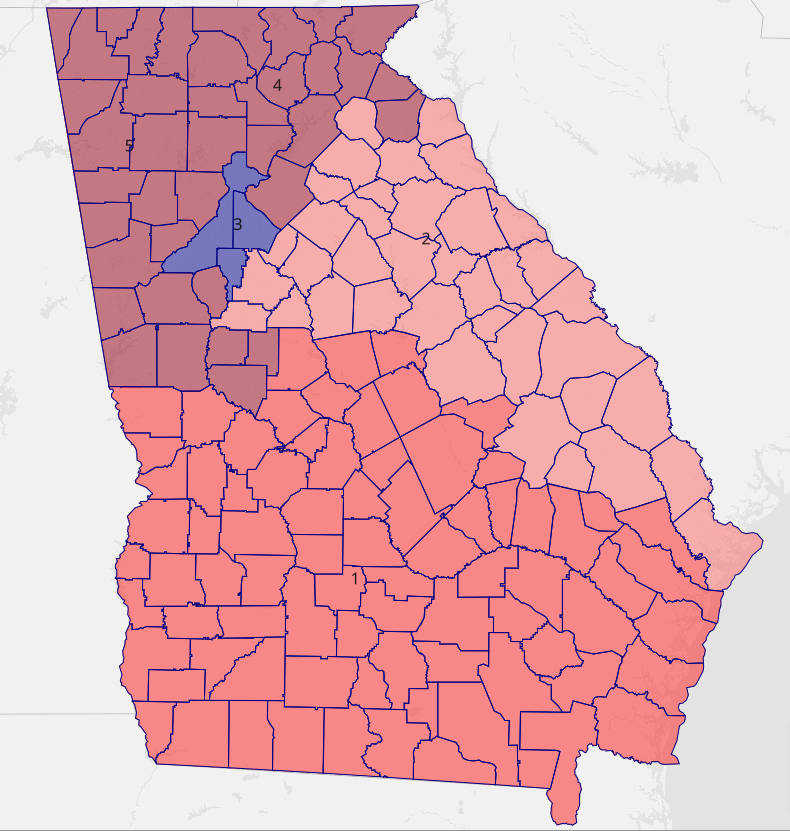
And if so, what of Georgia’s PSC map? Could Districts 3 and maybe 2 be redrawn to create VRA-compliant opportunity districts? District 3, centered around only Fulton, Clayton and DeKalb counties, could count as a racial packing of Black voters in a state where Black people account for 33% of the population. The legislative Democratic caucus submitted a map in which District 2 would obviously be an opportunity district with 33% Black VAP. And does District 3 really need to be contiguous with the core counties of Metro Atlanta? Lots of opportunities here.
the DPG’s proposed 2022 PSC mapThe approved Republican map
And finally, should Alabama’s PSC, an at-large body of 3 members with no districts, be given this treatment as well? If the plaintiffs prevail in Rose and force changes in Georgia, there is an opportunity for Black Alabamians to sue under Section 2.
Pennsylvania Dems held their one-seat lower-house majority in a special election, and Joanna McClinton remains Speaker.
Nevada Dems advanced their NPVIC amendment to the next legislative session. Needs another majority vote in both houses in 2025 before it goes to the ballot in 2026.
Washington State legalized building more apartments. Still some more work to do, and it may take some time before homelessness is less rampant in the Seattle area.
So, there’s a bill in the Florida rubber-stamp legislature, SB 1245, which would decertify any party that previously endorsed slavery. It was filed, obviously, by State Senator and former Florida Republican Party chair Blaise Ingoglia in response to liberal campaigns against Confederate statues.
In such a situation, what would be the options for liberals who live in such a state which decertifies an entire political party?
The judicial route:
They could sue on 1st Amendment freedom of speech, freedom of association, and anti-ex-post-facto grounds.
They could sue on the grounds that the law, as currently written, is too nebulous to be enforceable.
They could establish a new political party under another name, as the bill suggests. Plenty of bureaucratic headache if that were to take place.
The bill is poorly written, IMO. I mean, define this: “if the party’s platform has previously advocated for, or been in support of, slavery or involuntary servitude.”
A more serious (but still ill-fated) attempt would have the following:
specify the dates when these platforms were published
Be limited to Florida’s jurisdiction
Provide the details for how an offending party *corporately* endorsed these platforms (not just individual candidates for office under that party’s brand)
It’s also telling that the bill only extends to “slavery or involuntary servitude”. It does not mention, for example, the violent voter suppression campaign (also known as “Redemption”) to drive Reconstruction-era Republicans from office and cement one-party rule. It does not mention the poll taxes passed by said party, nor the intense apartheid restrictions placed upon the daily lives of Black residents by said party. All of the above would apply to the Democratic Party, of course, but why does slavery alone receive this mention in the bill?
It also begs the question of whether state governments have the power to regulate the names of political parties. California came close to attempting to regulate whether parties can use the name “independent” before Gov. Newsom vetoed said bill in October 2019, arguing that it was unconstitutional. If he had signed the bill, the far-right American Independent Party of California could have sued in federal court on aforementioned 1st Amendment grounds, and would likely have won. Furthermore, as noted by Richard Winger of Ballot Access News, “The bill violates the First Amendment. Communist Party of Indiana v Whitcomb, a unanimous decision from the US Supreme Court in 1974, said states can’t keep parties off the ballot based on the ideas of those parties. So even if the Democratic Party still supported slavery, the bill would be struck down if it passed.”
To play devil’s advocate, there may be at least one back-door way for state governments to regulate or influence party names in a way that avoids constitutional scrutiny regarding speech and viewpoint discrimination.
They could force annual recertification of political parties and repeatedly delay recertification without an official explanation, or even declare a sort of “at-will” decertification of political parties.
They could also publicly distribute a set of officially-unenforceable “best practices” for party names which would pressure political parties to conform.
Republicans could repeatedly jack up the filing fee, petition and party registration threshold by county (or worse) to block new parties from certification
OTOH, if the Federalist Society would rather overturn the Communist Party of Indiana case in order to strangle the First Amendment and support regional one-party rule, Republicans could use this newfound power to add further proscriptions against new political parties, such as “no party shall exist which holds views contrary to state law as written at this date”. They could also expand the definition of “slavery” to include anything that social conservatives hate and demonize, such as welfare and abortion (and they repeatedly “Godwin” themselves with this as it is).
In a time when social conservatives are dumping their alliance with right-wing libertarians and their sensibilities in the name of power and control, liberal minorities in red states must be prepared for how far their state governments will go to undermine their ability to politically organize.
(Note: Missouri’s June 2022 voter ID law (their third attempt at such, set to go into affect in January 2023 pending litigation) requires voters to identify on their voter registration forms with a party or mark themselves as “unaffiliated”).
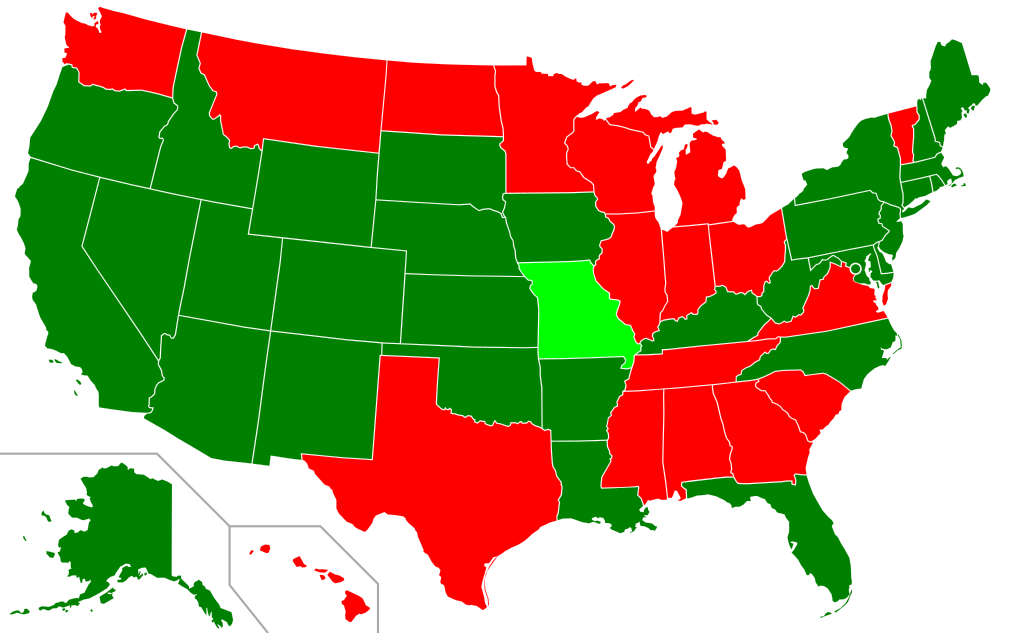
But I note that most Southern states, save for Arkansas, Florida, Louisiana and North Carolina, have not adopted partisan voter affiliation questions on voter registration forms. The majority of states with partisan voter affiliation (PVA) questions are largely located either west of the Mississippi or in the Northeast.
green: states with partisan voter affiliation questions, light green: set to take effect in 2023; red: states without
Save for Georgia, the other previously-mentioned states with Republican-led movements toward closed primaries are all deeply-red in terms of legislative share. The current one-party rule in these states increasingly resemble the one-party rule under the then-conservative Democratic Party in these same states. As I noted, only Tennessee, North Carolina and Virginia had uninterrupted instances of Republican legislative representation in both houses (much of it paltry) during the days of Jim Crow. But, unlike most other U.S. states outside of the South, most Southern states did not introduce PVA questions during that same era, and instead suppressed Republican and non-white suffrage through other, more notorious means (including the county unit system in Georgia up to 1963 and its state house-based equivalent in Mississippi up until 2021).
Appendix A in this 1985 study on party enrollment and identification shows that, sometime after publication of this study, Alaska (sometime prior to 1995), Arkansas (sometime prior to 2002), Idaho, and Utah all adopted PVA questions on their voter registration forms.
Without addressing the desire or need for closed primaries, the biggest question I have about the use of the PVA question is its intersection with race. Among those Southeastern states with PVA questions:
Arkansas, despite being a slave state prior to emancipation, has a smaller Black population (around 19%) than most other former Confederate states (save only for Texas at around 12%), and is perhaps the “whitest” state in the former Confederacy.
North Carolina, with a 22.5% Black population
Florida at 17.1%
Louisiana at 33.1%
Arkansas is the most inelastic of these four, while the other three see competitive turnovers from time to time in statewide elections. Louisiana may see competitive elections for governorships due to its jungle primary, while North Carolina and Florida see competitive elections due to their plurality elections. As of 2022, Louisiana currently gives the numeric advantage in PVA to Democrats, Florida (a closed primary state) to Republicans, and Arkansas and North Carolina both to independent/unenrolled voters.
What would Georgia’s PVA makeup look like if we had such a question on voter registration applications? Georgia has a 33% Black population (only less of a percentage than Mississippi and Louisiana), and over 80% of Black voters vote for Democrats, while over 70% of white voters regularly vote for Republicans.
And what of those who would mark “unenrolled”/”independent” on their PVA questions? How much would they constitute of Georgia’s population at this time if asked on their VR forms, and how would the unenrolled break down by race/sex/etc?
Finally, this isn’t the first time that Southern states have moved to adopt election-related ideas popular in the Northeast. Literacy tests were also adopted first in the Northeast for voter registration in the 19th century in order to suppress recent immigrants from voting, and were subsequently adopted by Southern governments to suppress African Americans from voting.
Compared to that, however, the main suppressive effect of PVA questions and closed primaries would be the exclusion of unaffiliated voters from determining party nominees. The big question is: who would be the unaffiliated?
This practice needs better documentation, and its wild that I can’t find much research on how partisan voter registration became a thing, or why it has increased among states, or why we seem to be the only country that does this. Why?
She’s wrong on the facts: Climate change is real, and the devastation it’s causing is not good. But politics requires stories about how things could keep getting better. We do have such a story. Unlike Marjorie Taylor Greene’s story, ours is true. It goes like this: By addressing the climate crisis, we are making the world better. With every policy step we take away from fossil fuels, we are cleaning up the air and water, creating new clean industries in which humans can thrive, making our cities greener, more beautiful, cooler, and full of life. People will live longer lives, evading heat waves and devastating storms. Indeed, our children could well have a future that is more pregnant with exciting possibility than the world we live in now.
All statewide questions on both ballots received a large majority response, with only one question (Republican Question 5) receiving a “No” response.
I wrote Democratic Questions 4 and 8. I’m proud. I only wish a few more of my questions were added. Thanks to Scout Smith for lobbying the DPG for these questions and helping me narrow down my shortlist to 7.
I consider an advisory question to be controversial if majority response is 80% or less. Few questions on the ballot in the history of advisory questions in Georgia primaries have ever fallen under 80% majority response.
Democratic Question 8 (which I authored) had the most controversial reception on the Democratic ballot, despite all counties voting in favor.
Athens-Clarke’s Democrats had the most lopsided response to Democratic Question 8. Baker County had the worst response.
Clarke and Forsyth had extra marijuana legalization questions for some reason.
Democratic Question 8 is the most complete survey on support for marijuana legalization carried out so far. However, this only covers the Democratic side of the ballot.
In 2018, separate Republican questions for medical marijuana and decriminalized recreational access were asked in Harris, Pierce and Ware, with only medical questions being asked in Gordon, Walker and Whitfield.
In 2020, Henry County Republicans asked a question on recreational legalization. This was the first to receive majority support from Republican voters, albeit much slimmer than on past Democratic ballots.
Past Democratic questions on legalization were offered in Cherokee (2014), Whitfield (2014), Glynn (2018), Forsyth (2018 and 2020), and Walton (2020), with a question on medical cannabis being asked in Richmond in 2014 and Catoosa in 2016.
Other Ballot Questions
Democratic Question 1, dealing with student loan debt forgiveness, was probably the second most controversial question on the Democratic ballot.
Democratic Question 4 shows support among the Democratic base for stronger direct democracy than what we currently have.
Republican Question 5, which was written exactly to elicit reactionary conservative disgust/hatred against transgender people, had the most lopsided response on the Republican ballot.
All of the other statewide Republican questions were garbage, and I would have wanted the opportunity to vote no on every single one of them on the same ballot as I voted yes to every single Democratic question. One can dream.
Many county-level questions dealt with local government and infrastructure questions.
Fulton and DeKalb’s Republican ballots both had anti-mask, anti-vaccine questions.
Carroll and Forsyth’s Democratic ballots had questions on diversity, equity and inclusion (DEI) in education, while DeKalb’s Republican ballot had a question on CRT.
Jackson’s Democratic ballot had an anti-Confederate monument question.
Oconee County had the only jointly-shared questions on the primary ballot this cycle, with Republicans going out of their way to spell out in bold “This question was drafted by the Democrat party and is being included on this ballot at the request of the Oconee County Republican Party.” behind both joint questions on their ballot.
Rockdale held a joint question in 2012, as did Pickens in 2018.
In case y’all forgot, Juneteenth’s official federal name is “Juneteenth National Independence Day”, not “Juneteenth Memorial Day”.
The addition of “independence” as an act of celebration is inviting commercialization in a vulgar-capitalist country like this. The marking of “Independence” is not a time for any type of Memorial Day-style reflection.
In another universe, Juneteenth’s official name would be “Juneteenth Labor Memorial Day”, rightfully marking how chattel slavery was brutal, multigenerational abuse of human labor. We would be visiting slave cemeteries. We would be treating it as a day of mourning and labor activism. Who would capitalize on a day of mourning?
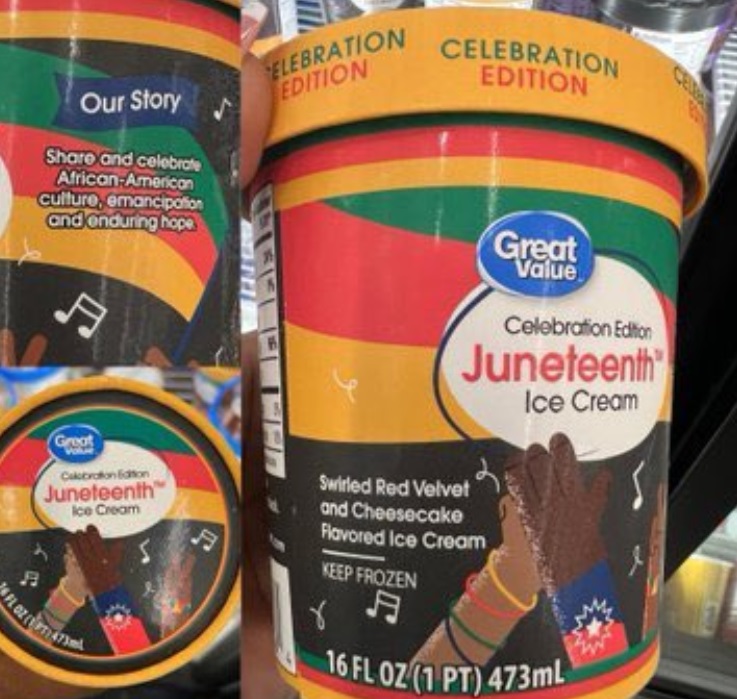
But instead we got Juneteenth with the parades and the “independence”. And now some are confused and frustrated that companies and establishments would capitalize on a new holiday with a Juneteenth-branded ice cream flavor, or that companies would afford time off to *everyone* for a federal holiday.
I don’t know why we’re supposed to be upset with a corny ice cream flavor from some big, dumb, anti-union corp. I don’t know what we expected. This is a package deal for an “independence day” in the United States.