Tag Archives: politics

Trumpist Hypocrisy

Trump supporters absolutely love to blame Obama for somehow “increasing division and racism”, or hanging his response to Trayvon and Ferguson and Alton Sterling and Eric Garner around his neck.

Does this presidential responsibility extend to Trump over the deaths of George Floyd? Oh no, that’s a blue state. How about Breonna Taylor in Kentucky? Oh no, they may have a Republican supermajority but they also have a Democratic governor. How about Ahmaud Arbery in Georgia, with no Democrats in state power? Well, that was just Ahmaud’s fault, can’t blame a government for that.

But what can you expect in responsibility from the same rubes who believe that voting-by-mail and wearing a mask in public are unmanly and fraudulent?

What can you expect in good faith from those who believe that everyone is out to take their property and historical dominance away?

What can you expect from them except nonsense? Disinfo? Lies? Infections? Hatred? Authoritarianism? Gaslighting? Entitlement? Shibboleths? Anti-urbanism? Half-baked plots for civil war? Fully-baked plots to further disenfranchise Americans?

Same old shit, same old excuses, same as it ever was.

Talking Heads was right.

U.S. States and Black Political Self-Perception

I have never met an African-American person who has ever worn their state of residence on their sleeve as a matter of political identity.

It’s not been successfully driven into us that the state one lives in can’t and shouldn’t adopt ideas and cultures and laws from other states.

It’s not been driven into us that borders between states should be so strict as they are.

It’s not been driven into us that states are countries unto themselves and can’t possibly be challenged on the merits of their governments’ actions by the national government.

It’s not been driven into us that federalism is, in any sense, a worthwhile method of governance.

I don’t think African-Americans will completely buy into the ideology of federalism, not when states and their governments give us so much unnecessary grief over our civil rights.

I’d like for someone to at least try to step into our shoes and convince people like me that federalism benefits Black people in this country, when it has failed so many states’ governments and their residents of all ethnicities.

Fair and Equal Michigan Finds a Way to E-Sign Ballot Petitions

I’ll be watching Fair and Equal Michigan’s electronic signature campaign for putting an LGBT anti-discrimination bill on the November ballot. Numerous other organizations have tried gathering signatures by mail or electronically, but many state governments which allow for petitions to put questions on general election ballots specifically mandate (like in Arizona’s constitution for example) that the circulator must witness voters signing the petition in person, and even what sort of ink to use. Courts in Ohio, Montana and Arizona have all ruled against ballot campaigns asking for electronic signatures for such issues as Redistricting reform, Cannabis decriminalization and voting rights expansion, all within the last month.

The Michigan campaign is doing an end run around this requirement by allowing Michigan voters to:

  1. use two-factor authentication
  2. submit their driver’s license or State ID number
  3. use DocuSign to sign twice, once as a signer and once as a petition circulator
  4. Have their identity checked against voter rolls by the campaign

Furthermore, the campaign cites that this is covered under both Michigan’s Uniform Electronic Transactions Act (UETA) as well as Executive Order 2020-41, both of which provide that e-signatures for legal documents shall have legal effect and shall not be denied enforceability. If they pull this off and can get the prerequisite number of signatures before May 27, this may be the first statewide ballot question in US history to ever be put on a general election ballot using electronic signatures. This could open a new chapter in direct democracy in the United States.

Let’s Not Go Back to Normal

I’ve read a few takes on why this disaster is an opportunity for change.

One was about how things should not “return to normal” for Black people when the previous normal sucked for us, another one was comparing this moment to the days after 9/11 when the Left failed to rise to the occasion and preempt the Bush-era growth of the surveillance state, and another one talked about how so many bad, exploitative practices against the working class were suddenly suspended in a cascade across multiple states and cities and why they should be permanently retired.

I somewhat agree. This is a moment of change, a moment to press against power, make powerful asks and root them in the language of “if you don’t do this, Americans will die and their blood will be on your hand”. This is already happening in the realm of voting rights, particularly regarding voter registration deadlines (like Wisconsin), primary delays (like Ohio) and absentee ballot request excuses (like Alabama).

While things are in such a state of flux, are we willing to take advantage of it?

Stacey Abrams is Right to Stay Away from the Senate Race

Pundits on Twitter are still pissed that Stacey Abrams abstained from a Senate run.

It’s not her fault that all our candidates for Senate suck at fundraising, or that idiot Democrat donors from out of state are burning their money on the twin pyres of McGrath (KY) and Harrison (SC).

Her eyes have been set on the governorship and nothing else. If she ran for Senate (or even House) in 2020, she would be trashed as an also-ran chasing any office like Beto was.

I also don’t think she should be a VP pick. What would be the benefit? She would be distracted from her political plans, and whoever wins the nomination would be attacked for picking a state legislator without federal experience.

The candidates who qualified for Perdue’s Senate last week just need to step their game up and/or clear the field ASAP. It’s getting a bit late in the day, and state’s out west and in NC are deciding their Senate nominees real soon. Similarly, these Dems running for Loeffler’s seat in the jungle primary need to get their shit together to avoid a lockout from a likely runoff.

Also, as an aside, I don’t care much for Maya Dillard Smith because she’s transphobic AF. Accomplished, but not on my shortlist.

Accusations of “Dual Loyalty”

Do Black people in this country know what it feels like to be accused of “dual loyalty”?

Maybe it’s a “privilege” of sorts to have gone 4 centuries without this accusation being leveled at us.

The accusation of “dual loyalty” is not usually directed against the convenient racial underclass, but against those ethnic groups who are perceived as “too powerful”, “too connected”, “too much of an economic threat to the previous, older elite”, “too much in thrall to their place or community of origin”, “too antagonistic to this country’s order”.

In contrast, the accusation against us has been that we violate someone else’s racial/cultural “honor”, “pedigree”, “property value”, “standards”, that our mere presence will spread the “ways” of poverty, crime and other “working class habits”.

At best, some of us may have been accused of being in thrall to Soviets during the Cold War. More recently, as in the case of the White Nationalist terror plot against Islamberg, New York, some of us have been accused of being in thrall to the Muslim Brotherhood movement.

But I perceive an assumption of class in these accusations of parasitism: we’re poor “parasites”, and others are “rich” “parasites”. I think these accusations show a bit of the priorities of the accusers more than those of the accused.

Reparations Comparisons

I’m going to be honest. There is something a bit odd about the comparison between #reparations for slavery and reparations for Holocaust victims.

Besides the fact that almost every German reparation to Jewish victims were only to those who had survived the Holocaust, one has to look to the specificities of the Reparations Agreement between West Germany and Israel and how the reparations were calculated in the 1950s.

The primary reparation was not for the slave labor of Jewish Holocaust victims, but for the cost of resettlement of over 500,000 survivors in Israel. The Israeli government, which at the time was in a deep economic crisis following the 1948 Arab-Israeli War, calculated that absorption of at least 500,000 survivors had cost 3,000 dollars per person ($28,958 in today dollars), so they were owed 1.5 billion dollars ($14,500,000,000 in today’s dollars) by (then-West) Germany. The question of a potential 6 billion dollars of property stolen from Jewish citizens of Germany and other states was placed on the backburner. The negotiation was carried out between Israel, West Germany and the Claims Conference, a non-profit which has worked for decades to secure property stolen from Jewish victims by Nazis.

Reparations have since been secured by the Claims Conference for actual slave labor victims: the Article 2 Fund, which is an income-limited lifetime pension to survivors of Nazi slave camps or those who fled into hiding from Nazi persecution; and the Program for Former Slave and Forced Laborers, which is a one-time payment whose application deadline has since expired.

But I wonder which reparations method we are talking about when German reparations to Jewish Holocaust victims are invoked for reparations for American slavery.

Because if we’re comparing to the Israel-West Germany Reparations Agreement of 1951, this would be almost equivalent to the United States having deported all African-American formerly-enslaved people to Liberia after 1865, and decades (or over a century?) later agreeing to pay reimbursement to Liberia of $3,000 for every person deported. Reasonably, Liberia, like Israel, would have successfully righted its economy (and maybe did better by Native Liberian citizens rather than treating them as second-class citizens prior to the 1980 coup).

By comparison, our ancestors who survived slavery lost their chance for “40 acres and a mule” as recompense when General Sherman’s order was overruled.

Even Ta-Nehisi Coates’ “Case for Reparations” rests more on compensating the survivors of Jim Crow and redlining rather than slavery.

So even after reading NCOBRA.org, I feel that if we’re going to specify the expanse of reparations for slavery, we will have to collect the family-tree receipts of those blood ancestors who were imported to this continent and their children who lived for 249 years under this regime (numbering over 4 million emancipated by 1865), and specify a price tag for their lifelong labor and for their familial losses.

Thanks to DNA and the few extant historical records we can obtain about historic plantation and slave market records, we may be closer to that goal, but as of this moment very few of us, like Aamir “Questlove” Jones’ family from the Clotilde in Alabama, the Quander family of Virginia-Maryland and the South Carolina descendants of Scipio Vaughn, can claim to know the name of an ancestor who was imported to this continent through a port of call like Charleston, Savannah, Baltimore or New Orleans, who may be the first to possess indelible receipts for reparations from this government.

But we definitely have millions of living, named ancestors who were victimized by white mob violence, Jim Crow, redlining and general American segregation in the last century, and reparations must happen for them.

If I’m in error, I’m open to comments.
Congressional Committees

Congress nerds: After reading articles from Politico and the American Prospect on the need for congressional committee reform, I have one question:

Why does the House Standing Committee on Energy and Commerce seem to have the same purview as the Standing Committee on Natural Resources: namely, regulating the Department of Energy?

In fact, the Committee on Energy and Commerce has jurisdiction over five Cabinet-level departments and seven independent agencies. It passes legislation regarding telecommunications, consumer protection, food and drug safety, public health, air quality and environmental health, the supply and delivery of energy, and interstate and foreign commerce. This means that Energy and Commerce has the most overbroad, but the least penetrative, of all the standing committees in the House.

If anything, it should be renamed to just the Committee on Commerce, with jurisdiction over telecommunications, consumer protection, and interstate and foreign commerce. The other jurisdictions should be resorted – air quality and the supply and delivery of energy should be sent to the Committee on Natural Resources; food and drug safety, public health and environmental health to a new Standing Committee on Health and Human Services with jurisdiction over the HHS Department.

The Standing Committee on Education and Labor should be split up to correspond more effectively to the DoE and DoL, respectively. Another new Standing Committee on Housing and Urban Development should be established for similar purposes over HUD.

Then you’ll have just as many House Standing Committees which correspond to federal departments as possible, with less overlap between committees.

If we want to strengthen the power of Congress, we need a Congress which is just as expansive and proactive as the executive branch and its agencies. I’m convinced that such an expansion is what’s missing from #HR1.

Post-Reconstruction White Republicans in the South

Fannin, Pickens, Gilmer and Towns counties in Appalachian Georgia are Deep-red counties which I can respect. They’ve consistently voted for Republicans since the 1870s, and their ancestors, like East Tennesseeans, were more sympathetic to the Union. Fannin, in particular, was the ONLY county in the entire Deep South and West South Central states to not vote for FDR, only voting for Democrats William Jennings Bryan (1900) and Jimmy Carter (1976) since 1868.

Similarly, East Tennessee – the most mountainous and least plantation-friendly region of the state – contained the most solidly-Republican congressional districts – CD-01 and CD-02 – in the ex-Confederate South. They have always elected Republican representatives – and never elected a Democrat – to Congress since 1870. They also had a history of seeking separation from Tennessee over the issue of Confederate secession.

They are literally the only counties whose white people can say “I’m a Republican because my great-great-great-great grandpapa voted Republican, none of them were slaveowners, the Confederate bastards killed my 3rd cousin x-times removed for desertion or draft resistance, and we resisted their children’s kleptocratic Dixiecrat rule by holding the only Republican primaries in the whole state”.

They were likely racist, too (of course!), but perhaps not to the extent that the Dixiecrats in plantation-land were. Maybe they didn’t feel so much of an impulse that poor white people should vote with the rich white people for the same party to preserve the Deep South’s pecking order.

So they were OG Southern Republicans – Appalachian folk who resisted outside governance and monied aristocrats alike – who voted that way loooooong before the Second Reconstruction made the Democratic brand less popular among the Dixiecrats’ descendants and made it hip to vote GOP.

My Hot Take: Split Georgia in Half

I’m going to be heartless like a liberal Ann Coulter (or more like Michael Tomasky?) in this post, so prepare to yikes:

I’m not going to blame black voters for this, be they rural or urban.

I’m going to blame white rural voters in Georgia, especially in rural South Georgia. They will never change their vote, not even for a conservative white “good-ole-boy” Democrat has-been who “won’t bite” like John Barrow.

I’m tired of this state. Split Georgia in half. Pull a “3 Californias” on it.

South Georgia is still outvoting Metro Atlanta statewide, no matter who we will put out there in 2020 or 2022 for Senate or any executive position. Stacey Abrams, if she runs for U.S. Senate, won’t replace David Perdue with this map.

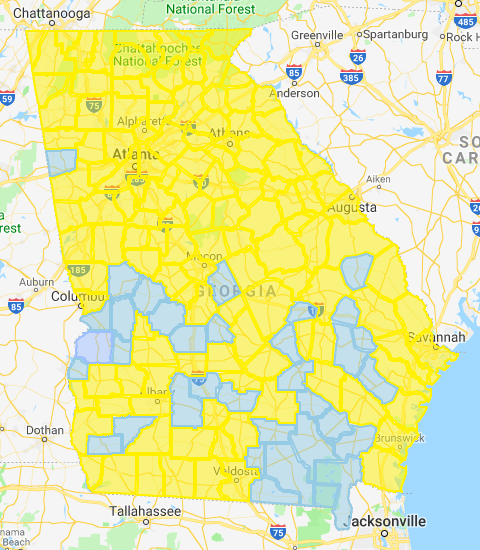
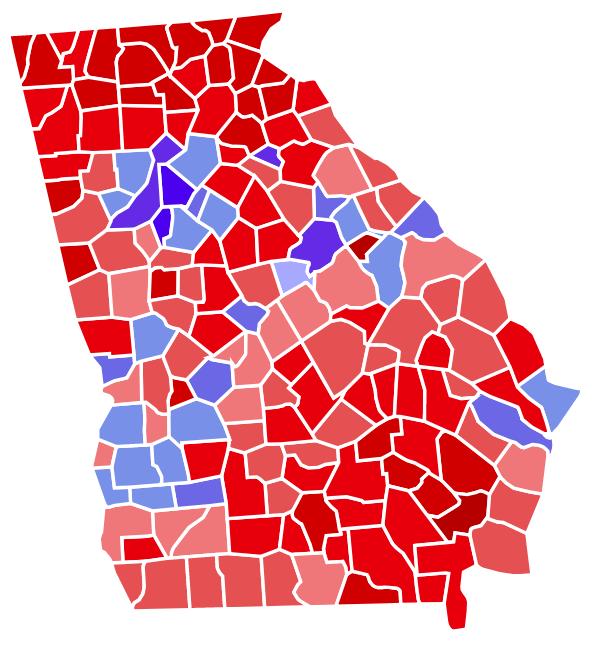
Meanwhile, this is the map of active and inactive Democratic county committees, and a map of how Georgia voted in the gubernatorial.

(Where are the county committees for Talbot, Stewart, Macon? They voted in the majority for Stacey Abrams, but there are no Democratic committees there.)

As far as looking at counties is concerned, I still don’t see the benefit of the “organize-organize-organize” strategy. People are voting the way they’re voting whether or not we are organizationally present. How many more votes can we squeeze out of Democratic voters that don’t fall victim to the next scummy Secretary of State Brad Raffensperger? South Georgians aren’t stupid and are voting for their culture and their beliefs, just like they always have (even when they prevented black people from voting). They’re voting so deeply red for a reason, making the rest of the state look like a joke, and that can’t be ignored or glossed over by assuming that they are stupid.

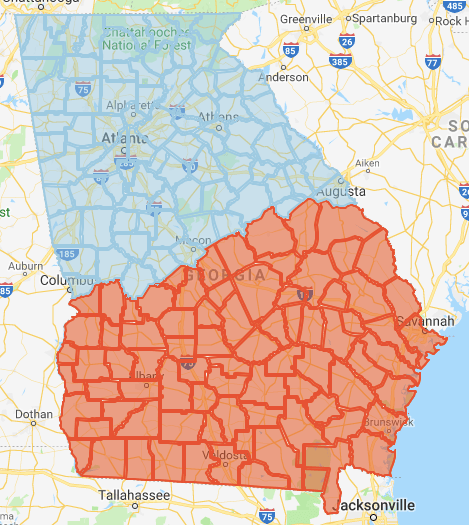
Republicans are adept at picking their voters (and justifying it, too!), just like their conservative Democratic parents were. I’m open to doing the same thing. Let’s pick our residents. Let’s cut off South Georgia, south of Augusta-Macon-Columbus, into its own state so that they won’t rule the rest of us with their messed-up choices anymore.

I want to win something at least one goddamn election. I want my values to at least be marginally represented in the governor’s mansion at least once every 100 years. We are too large, we have too many counties, and we are still paying the price for the Union not breaking up some Confederate states.

South Georgia ruled the rest of Georgia during the years of the County-Unit System, during the height of Jim Crow apartheid. Brian Kemp ignored urban and suburban Georgia and pulled the votes of rural white South Georgia. Almost all of his mandate comes from South Georgia. I want to bid them adieu so that we can go our own separate ways, so that my political values are more competitive in statewide elections. #2Georgias #BreakItUp