Tag Archives: religion

Civic Sedevacantism: A United States Government-in-Exile

Reading Josh Marshall’s recent post positing a theory of “civic sede vacantism“, which posits that American liberals/progressives need to narratively and linguistically treat the current regime – both in the executive and the judicial branches – is operating so much outside of the constitution that it cannot be expected to curtail or regulate its own abuse of power, and that it is up to libprogs to use state power to curtail federal power and restore constitutional government.

I find the idea interesting in how it comes around to effectively calling for progressive federalism in deed, but doing so from the position of reacting to a “fallen” political order which ought to be rejected in its legitimacy, curtailed from its uses of power, and corrected into a better relationship with its power.

You can find this sort of legitimism/sedevacantism in a number of cases:

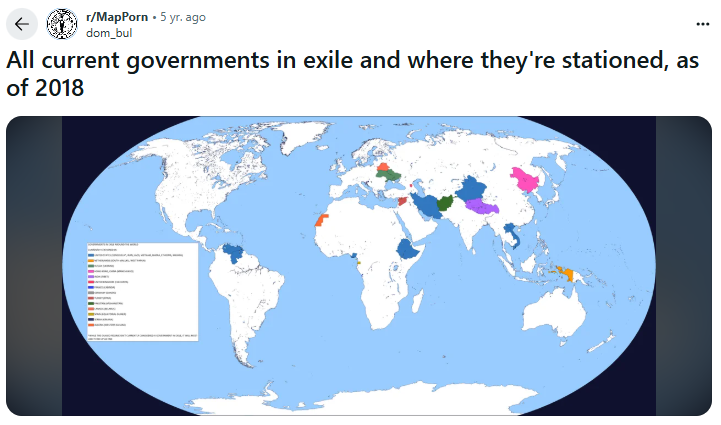
  • Anyone who has ever maintained a government-in-exile after fleeing a country (i.e., the Second Spanish Republic government in exile from 1939 to 1977) or have maintained claims to a former monarchy;
  • Catholic sedevacantism, in which some Catholics reject the legitimacy of any pope since Pius XII due to the holding of the Second Vatican Council, and may instead elect antipopes with rival claims to the Roman papacy;
  • Irish republican legitimism, which posits that the pre-partition all-island Irish Republic declared in 1919 is still in existence and rejects both the 1921 Anglo-Irish Treaty and the existence of the modern Republic of Ireland;
  • Sovereign citizens who believe that the Fourteenth Amendment to the United States Constitution converted “sovereign citizens” into “federal citizens” by their agreement to a contract to accept benefits from the federal government, and that the United States stopped being a legitimate country afterward, instead becoming a “corporation” (the SovCit who originated this, of course, was a white supremacist);
  • Sovereign citizens in Europe (Russia, where some believe that the USSR continues; the Reichsburger movement in Austria and Germany; some in the Czech Republic who believe that the dissolution of Czechoslovakia was illegal, etc)

This can easily go down the road of conspiracy theory mongering, but I can respect the cognitive dedication to an alternate, rival status quo.

But if we’re departing from the status quo narrative, why start with Trump 2? Why even start with George W. Bush’s 2000 “election”?

Equal Rights Amendment

In fact, let’s date it to the moment when Congress erroneously inserted a ratification deadline to the Equal Rights Amendment.

Was it Congress’s authority to impose a statutory deadline on ratification? It’s debatable. Who’s idea was it to add a deadline? These questions have been brought up repeatedly in court.

One can argue that Congress abrogated its legitimacy as a branch of government by interfering with the ratification of a constitutional amendment after its legitimate proposal.

POTUS (Nixon and Carter) and SCOTUS also signed off on this deadline, so they get the chop too.

It’s also how this imposition of an illegitimate deadline, not only for the ERA (1979, then 1982) but also for the DC Voting Rights Amendment (1985), resulted in no further amendments being proposed by Congress after 1978 to this day.

This was supremely violative of the amendment process. It arbitrarily suppressed the relationship of the states with the constitution. It was the moment when the broader Second Reconstruction era ended as a constitutional movement and began to slowly recede, especially after William Rehnquist became Chief Justice in 1986 and John Roberts in 2005.

This abdication of legislative responsibility led to SCOTUS intervening for the right to abortion in Roe v. Wade (1973-2022) and subsequent progressive readings of 14th Amendment jurisprudence, all of which are now vulnerable to retirement. All of that should have been Congress’s responsibility to propose, and for the states to ratify at their pleasure.

So if the White House is constitutionally vacant, so is Congress and SCOTUS, all since 1972.

Civic, constitutional sedevacantism (legitimism?) should apply to all three branches and their actions since 1972, regardless of party or impact. I think that’s a good rupture point.

But what would this mean in practice?

A Progressive, Provisional Congress-in-exile

I’d argue that a sedevacantist position would take the following stances:

  • The Equal Rights Amendment was fully ratified by Virginia on January 15, 2020, and is therefore of legal effect nationwide.
  • The entire federal government since 1972, including all federal government elections and terms of Congress, all nine presidents (from Ford to Trump), all SCOTUS terms, and every statute, executive proclamation and federal judicial ruling, is illegitimate.
  • Yes, even the good laws and decisions, like Roe v Wade, Lawrence v Texas, Obergefell v Hodges, Bostock v. Clayton.
  • The D.C. Voting Rights Amendment, proposed by an illegitimate Congress, was also improperly abrogated by a seven-year deadline.
  • The pragmatic approach would be to engage with the illegitimate federal government, but with a political imagination as to blotting out the legitimacy of every action taken by the federal government against the Second Reconstruction agenda.
  • The more idealistic-but-isolative approach would be to establish a United States government-in-exile:
    • complete with all three branches of government
    • electing a Provisional president and provisional Congress
    • appointing a provisional Supreme Court
    • loyal to the Constitution as amended by January 15, 2020
    • recognizing the D.C. Voting Rights Amendment as still open to ratification by the states, and the statutory deadline of 1985 as invalid
    • open to proposing further amendments by two-thirds of the Provisional Congress
    • selectively supportive of certain statutes passed since 1972
    • diverging from the illegitimate federal government in foreign policy.

And how far could we go with the government-in-exile concept?

(Sidenote: What about state governments? I’d argue that the end of the First Reconstruction era in the South happened through illegitimate means at the state level, such as the forced resignation of Rufus Bullock, the liberal Republican governor of Georgia from 1868 to 1871, when he fled the state under threat from the Klan, which was followed by the significant, forced decline of equality under the law in Georgia. Or how Reconstruction was ended through bloodshed by the Klan. But that is for another post.)

Statutes under a government-in-exile would include most of what was unsuccessfully brought to the 111th and 117th Congresses (the two most recent Democratic trifectas):

  • For the People Act
  • Equality Act
  • American Dream and Promise Act
  • Paycheck Fairness Act
  • Washington D.C. Admission Act
  • Federal Death Penalty Abolition Act
  • Sabika Sheikh Firearm Licensing and Registration Act
  • Raise the Wage Act
  • Family and Medical Insurance Leave (FAMILY) Act
  • Trumka Protecting the Right to Organize Act
  • FAIR Act
  • U.S. Citizenship Act (including the NO-BAN Act)
  • Workplace Violence Prevention for Health Care and Social Service Workers Act
  • George Floyd Justice in Policing Act
  • Puerto Rico Admission Act
  • Farm Workforce Modernization Act
  • Eliminating a Quantifiably Unjust Application of the Law (EQUAL) Act
  • Assault Weapons Ban Act
  • Ensuring Lasting Smiles Act
  • SAFE Banking Act
  • CROWN Act
  • Recovering America’s Wildlife Act
  • Marijuana Opportunity Reinvestment and Expungement (MORE) Act
  • Augmenting Compatibility and Competition by Enabling Service Switching (ACCESS) Act
  • Local Journalism Sustainability Act
  • Averting Loss of Life and Injury by Expediting SIVs (ALLIES) Act
  • American Innovation and Choice Online (AICO) Act
  • Women’s Health Protection Act
  • Democracy Is Strengthened by Casting Light on Spending in Elections (DISCLOSE) Act
  • Fair Representation Act

But then I’d argue that even the most recent Democratic trifecta was playing it safe with the legislation it introduced. A Congress-in-exile would introduce bills to reform the federal government itself by statute, such as:

Finally, this Congress-in-exile can vote to approve by two-thirds for multiple, much-delayed proposals to amend the Constitution, sending them to the active state legislatures.

Conclusion

This is ultimately about changing the narrative about the federal government, away from a do-nothing entity encumbered by an ineffective Constitution, to one in which Congress fills in the gaps.

If it takes having to establish an alternative to this illegitimate status quo regime from abroad, so be it. If this is what it takes to repair the relationship between the United States and the world, so be it.

The deep wound inflicted by a wayward Congress against the Constitution since 1972 through a ratification deadline clause has to be resolved, even if by a Congress in exile.

Some thoughts on Afro-Brazilian religion, syncretism and feminism

I watch videos of Umbanda ceremonies and read about how Umbanda arose out of a fusion of the black working-class’s practice of Candomble with the 19th century white middle/upper-class practice of spiritualism and spiritism. What has arisen over the last century . It discards the animal sacrifices, ritual Yoruba language (in favor of Portuguese vernacular), alcohol and tobacco use, and sometimes even the colorful necklaces and ritual dress.

What largely brings these Afro-American religions together in Brazil:

  • the resistance to slavery and racism,
  • the use of African-derived music and instruments
  • veneration for African deities such as the Orishas (and sometimes for Indigenous spirits)
  • the terreiros

I’m also interested in how Afro-Brazilian religion approaches LGBT participation and representation. While Candomble is by far better at welcoming LGBT people compared to Abrahamic religions (especially the Evangelical Christianity which has seized so much control over Brazilian politics), and Umbanda can profess to be even more egalitarian on sexual and gender minorities than Candomble (including the performance of same-sex weddings and inclusive initiation rites), research does show a masculine and cisgender bias in the practice of Afro-Brazilian religion which often ticks up depending on the terreiro involved.

Which brings to mind a few things:

  • my own experience going to an Episcopal youth study group one time when relational theology and queer theology were discussed. Very informative, especially as to discussions of egalitarian, ungendered religious language.
  • The debate and conflict within Euro-American nature religions like Wicca and Asatru on the role of gender and sexuality, which has resulted in the creation of even TERF sects such as Dianic Wicca, as well as opposite, egalitarian sects such as the Feri Tradition, Radical Faeries and more

Questions:

  • What would an Afro-Brazilian religion with a relational, queer theology look like?
  • How would the endemic religious language – of “mounting” by orishas, or of fertility, or of gender – change? Or even the language introduced from Kardecist spiritism?
  • It doesn’t seem that sheer inclusion of gay men is enough in a country like Brazil, which still reels from the domestic and political impact of machismo. What of lesbians and transgender people? Will they take a role to the merging of relational and queer theology into an Afro-Brazilian religion?

I could take this further into questions about evolution, about vegetarianism, about political organizing, as well. But I’ll leave it at that.

Notes on the United Methodist General Conference 2019

After the Vote

The hashtags of #gc2019 and #umcgc are sad to read right now, even to my humanist eyes.

But this one post from Lance Pressley of Mississippi is a warning to anyone inviting dissenting Methodists to UCC, TEC, ELCA, etc.

“There’s a #UMC in every rural community and every poor neighborhood, ministering with the community. There’s rarely an Episcopal congregation nearby.[…] Do you know how many UCC congregations are in this state? A grand total of 2. And they’re both in the Capitol. Tell a kid in Shannon, MS that they should go to church 200 miles away. I appreciate your invitation now, but your denomination hasn’t seen fit to invest in my home state. It leads me to suspect you only care when you can use that care to show how tolerant you are.”

It reminds me of how even the UCC has had a presence in Columbus, GA three separate times in its history, most recently when Forgiving Heart United Church of Christ became a UCC member. The nearest UCC members are small churches in Pine Mountain and Woodbury.

There’s a glut of UCC churches in Metro Atlanta, but where’s the UCC in Macon? Augusta? Albany? Valdosta? Athens?

How much investment is being made in progressive mainline Christianity in non-Atlanta Georgia? or in rural Georgia for that matter?

If progressive mainline Christianity is already having a hard time funding itself and broadening itself to rural areas, progressive Methodists will face a bit of an uphill climb if they leave the UMC.

But forming a new Methodist church may be the only option left.

United Methodism as Colonial Christian Hubris

If anything, #umcgc/ #gc2019 showed one of the hubrises of Western Christianity: the descendants of those who were missionarized in Africa during Europe’s colonization and in Eurasia flexed their weight rather spitefully against a great deal of the European and North American descendants of the colonizers and missionaries who now seek a different course for the UMC on the question of gender and sex than what was preached for over a century to Africans and Eurasians by European and American colonizers.

The minority, somewhat-wealthy White American Methodist right – through such groups as the Wesleyan Covenant Association and the Institute for Religion & Democracy – joined the above bloc and helped lead the charge as a means of taking power away from more progressive clergy.

The American section of the UMC – in the birthplace of the UMC – is now in a weird position. American Conservative Methodists, largely concentrated in the South and Midwest, can claim a victory, and are rubbing salt in the wounds of the Progressive Methodists on social media with the usual “pleasantries” directed toward LGBT people.

The Progressive American Methodists, most reflected in the Western Jurisdiction, will marinate on this and come to decisions in the coming days.

This decision reduces pro-LGBT church caucuses like the Reconciling Ministries Network from a somewhat respected caucus like IntegrityUSA (in the Episcopal Church) to an actively-opposed caucus like DignityUSA (in the Roman Catholic Church) or Affirmation (in the LDS).

Another big issue is whether disaffiliation will be made a lot easier for churches, namely for those who want separation. But it is hard to tell who wants the split of the UMC more: the conservatives or the progressives.

A lot of the progressives are pledging in religious language to stay (but it is far from unanimous, as numerous Twitter posts renounced membership within the minutes of the result), while the conservatives are hoping to drive the UMC harder to evangelicalism by driving out the progressives and also hoping that they demographically dwindle on the vine in a new, less-wealthy denomination for the sake of conservative vindication.

But given the PR crisis that has ensued from this – pitting young against old, rural against urban, nation against nation – I don’t think the conservatives have much else to gloat about than a seizure of power, money, property, and brand from progressive dissenters who they’ve wanted to railroad out of the denomination for decades.

Both sides are dressing their emotions in the religious language of the denomination. One side made a big power play against dissenters, and won. And many are gloating of their victory over “heretics”, “satanists” and “cultural relativists”, or, in less pointed language, professing “love” for LGBT people while maintaining their religious disdain for same-sex relations.

But the most hardcore progressive dissenting members and clergy are “grabbing the horns of the altar”, and refuse to walk out of their own accord at this moment. They’re also not taking, or are actively discouraging, invites to other mainline denominations for various reasons.

The politics of this decision reflect not only the effects of the historic colonialism of the UMC, but also an ecclesiastical system which reflects the crisis of American politics and economics. It may also affect the politics of the United States.

How would the schism of the UMC, the third largest denomination of Christianity in the United States, play out in the United States regionally, ethnically, in gender terms? How would it affect or manifest in American politics and partisan identity?

If the UMC becomes an evangelical denomination and drives as many of its progressive members out as possible, how close will this place the denomination into the realm of the Republican Party and its policies in states like Georgia?

This is important even for those who are not Methodists, or even Christians, or even theists. Whatever results from this crackdown will affect the rest of us.

The Digging-in of Heels

How can the progressive American Methodists dig in their heels when the UMC is becoming less American?

They clearly failed to convince the African and Eurasian delegates of the urgency of the One Church Plan. They failed to appeal to the hearts and minds of the African and Eurasian delegates, whose growing numbers come from countries whose Christian denominations are way too frequently antagonistic against LGBT people and who support state and corporalviolence against LGBT people. They are literally living the same ideology taught to them and their parents by Euro-American Methodists missionaries and colonizers, and their chickens came home to roost in St. Louis.

How did the progressive American Methodists think this was going to go down? Who were they seeking to convince? How do they expect to convince the African and Eurasian Methodists now?

I don’t think there will be convincing at this point.

Ebony on Religion in Haiti

In my travels around Haiti, I have come across many villages where there is no police presence and nor is there a clinic nearby for basic care, often leaving the Vodou priest or priestess( hougans and manbos) to serve every role from midwife to judge and jury. Yet Langlois and the Catholic Church he represents remain silent on the deeply imbedded inequality in Haiti and a Haitian government more interested in attracting foreign tourists by any means than providing basic social services to its people. He also fails to critique the international community who have little to show for $9 billion funneled through international contractors and NGOs in Haiti with little accountability since the 2010 earthquake.

Contrary to the Cardinal’s statement, Vodou is not Haiti’s problem; Christianity is. No push to spread Vodou ever wiped out entire “savage” indigenous peoples. Vodou has caused no wars due to a desire to convert as many people as possible. Vodou doesn’t tell “saved souls” that they must be complacent, accepting their lot on Earth for the potential of future salvation in heaven. Vodou never told Black people they were a curse or 3/5ths of a person.

via Haiti Doesn’t Have a Vodou Problem, It Has a Christianity Problem – EBONY

Compare and contrast between the SBC and the largest mainline denominations:

  • SBC – 16 million US members, six seminaries, 44 Unis and colleges – highly conservative on sexuality and socio-economic justice
  • United Methodist – 7 million US members, 13 seminaries, 100 Unis and colleges – moderate on sexuality, liberal on socio-economic justice
  • Evangelical Lutheran Church in America – 3.6 million US members – 10 seminaries, 27 colleges and universities – liberal on sexuality and socio-economic justice

Mainline Protestants constitute some 16% of the US population. SBC members are 5% of the US population, and constitute just under half of the Baptist population in the US.

How “Southern Baptist” Pastors Created the Modern Republican Party

Just read an article about how the Southern Baptist Convention is part-and-parcel of the #SouthernStrategy, as well as the SBC’s aid in the rise of Trumpism.

After reading this, I wonder how the SBC is able to retain so much political power that even the Roman Catholic Church, the only Christian organization with a larger parishioner size in the U.S. than the SBC, can find themselves at odds with them on several economic and immigration-related issues.

  • There are 33 million Baptists in the U.S., 16 million of whom are members of SBC-affiliated congregations throughout the U.S. (as of 2013) but the highest rates of which are concentrated in Texas, North Carolina, Georgia, Florida and Tennessee.
  • The SBC provides funding to six seminaries, and the SBC’s state convention affiliates provide funding to nearly 50 universities and colleges in 19 states.
  • At the same time that the South was going through the end of Jim Crow and its immediate aftermath, the SBC was in the throes of its Fundamentalist Takeover.

All of this is crucial in understanding where the SBC is right now.

Clash of Civilizations with a Side of Trade War

You know how difficult it is to be atheist, secularist and pro-migration right now?

The Euro-American Christian far-right are having their long-awaited post-9/11 moment against the general Muslim population in this heavily-unemployed majority-Christian country while the Muslim far-right are having their long-running moment against Christians and other religious minorities in heavily-unemployed majority-Muslim countries.

The Christian far-right wants to lower themselves to the Muslim far-right’s standards, and by whatever means necessary. Fears of sharia law, ISIS and the Muslim Brotherhood run rampant in the Christian far-right at the same time as fears of “Zionists” and “Crusaders” are trumpeted by the Muslim far-right in North Africa, West Asia and parts of Southeast Asia.

Meanwhile, they’re running roughshod over the lives and rights of both co-religionists and minorities, but mostly co-religionists who don’t follow their doctrines to a T.

I just wonder: are we going to do a clash of civilizations AND a trade war at the same time?

Anti-Queer Sentiment is Still Anti-Queer Sentiment

You know why most of us American LGBT people are not sold on cultural Christians spouting anti-Islamic rhetoric in regards to Muslim homophobia? Because we meet, know, are parented by, governed by, ostracized by, domestically-oppressed by, attacked by, and seek strategic allyship with more Christians than we are with Muslims.

To tell us American LGBT people that Muslims in other countries are the greater, more existential problem to our lives but not our fellow American citizens’ conduct and laws towards us here and now is pretty dishonest.

You never notice our organizational advocacy work with LGBT organizations abroad unless its regarding a historical “enemy state” like Russia during the 2010 Olympics.

You never notice that many of us advocate for the safety and safe refugee status of LGBT people in Iran and Iraq.

You never notice that we are angered and saddened by Saudi or Malaysian or Indonesian or Ugandan homophobia. “But ISIS throws you off buildings!” And?! What do you want us to do? If you were us, what would you do about defenestrations and beheadings and tortures? There is literally nothing more to do at this point except to dodge U.S. laws and join the Peshmerga or YPG at the front lines.

It’s a useless exercise to remind us about what ISIS does to gay men and boys. We know this. We can’t do anything about it except pressure for safe passage for LGBT refugees from the Levant to safer spaces abroad, as we have been doing since before you took notice of Muslim homophobia.

It’s a pointless critique of liberal U.S. LGBT people to distract us from the pressures we face at home. This mass shooting took place at home. We are fighting for equality, dignity and life at home. Hateful ideas attack us here at home.

Let’s take care of home first. Let us grieve. Let us build bridges. Let’s continue making this country better for LGBT people, and not settle for where we are now. #Orlando

That “All Lives Matter” protest

That “All Lives Matter” protest was led by *drum roll please* Glenn Beck and Chuck Norris. Auntie Alveda King tagged along.

I also noticed the pictures of Frederick Douglass. None of these individuals have the fortitude to read his 4th of July speech without putting revision to it, I’m pretty sure. But why only pictures of Douglass and Lincoln? Could someone have had a Malcolm X picture somewhere? Does he leave a sour taste in some mouths when he damned the fundamentals of this system? “Justice” “Courage” What about “Reparations”? What about “Human Rights”? And does their “Justice” come at the barrel of a police’s firearm?

This is very Christian. An assertion that everyone can only come together if they only complied to this “(Judeo-)Christian” framework of society. Not even race, #BlackLivesMatter. Not even class, #Sanders2016.

Religion, or should I say “FAITH” as the religious tribalists who run most local governments would assert and unconstitutionally mollify. And of course, the proceeds of this march didn’t go to any communities affected by police excess or to community institutions, but the current real-life cause celebre of the Christian victims of ISIS’ genocide in Syria and Iraq. Not the Yazidi victims, not the Shia victims, not the moderate Sunni victims, not the Kurdish victims, JUST SPECIFICALLY the Christian victims. Not even, arguably, the Christian minority affected by displacement from the Israeli-Palestinian conflict, who rank low in the hierarchy of Middle Eastern “save the Christians” needs. Just those a cozy distance away from the “rapture practice” zone of Israel/Palestine.

Everything about this march says a lot more about the inconsistencies of reactionary Christian U.S. politics toward ethnicity, foreign affairs, undermined populations, and their own comfort zones.

This is a funny march. Obtuse as shit, but funny. The fact that Glenn Beck organized it is just eyeroll-worthy. It doesn’t show the love that “All Lives Matter” asserts to high heaven.