In Uganda
In South Africa
In Kenya
In the Diaspora
In Uganda
In South Africa
In Kenya
In the Diaspora

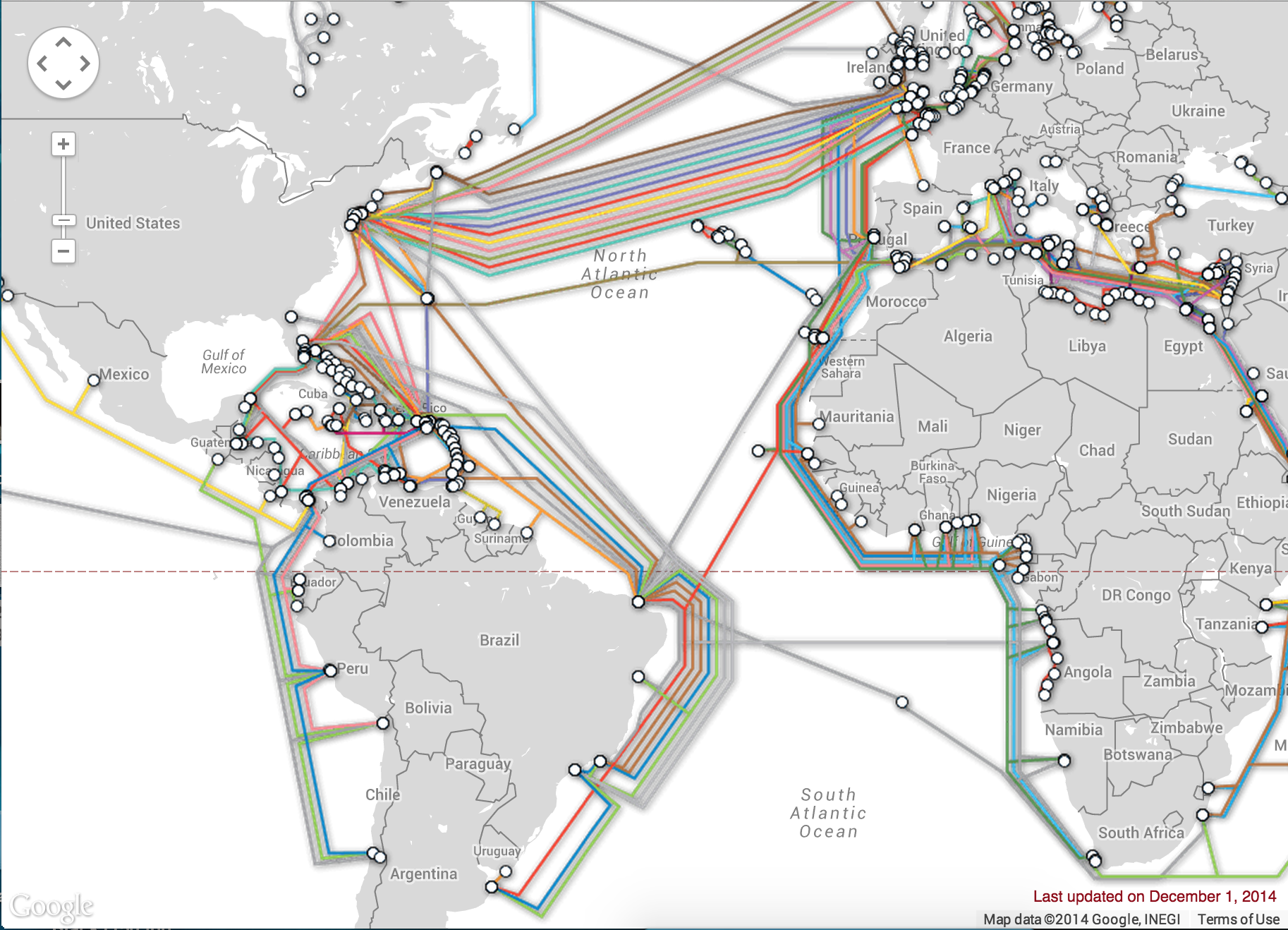
I think looking at the map on the right shows how stratified the layout of communication technology is for the Atlantic Ocean region. So much up top and spilling vertically down (on both sides), but so little between the bottom.
Why are there so few submarine cables between Africa and South America? Between Nigeria/South Africa/Angola and Brazil/Argentina/Venezuela?
Surely there would be lots of historical links to share between the two continents, such as post-colonial, post-slavery histories? Or especially the large portion of slaves from West Africa heading to the Portuguese colony of Brazil? Or the histories of exploitation of labor and natural resources? Or musical and artistic commonalities?
I mean, Brazil literally faces several African countries along the same set of latitudinal lines (more so than a good portion of North America faces Europe), but yet there are maybe one or two submarine cable lines between these countries.
Why is that? Is it neglect? Is it money? Is it racial anxiety (which would be weird gives how many Europe-to-Africa lines there are)? Is it linguistics?
And what would be gained if this were changed with the building of new lines between the two regions?
I think that more equitable trade, cultural ties, freedom of expression, and all institutions which depend upon these developments would only gain in strength and viability – while shrinking only in cost barriers and administrative burdens. It would also reduce the cost of communication between other regions which go through these regions (especially South Asia, which has several cables running to East Africa).
So I’m glad to read that there are two lines currently being built between the two regions: SACS (South Atlantic Cable System) between Fortaleza/Fernando de Noronha (Brazil) and Sangano (Angola) in 2016, and SAEx (South Atlantic Express) between Fortaleza and Windhoek (Namibia)/Mtunzini/Yzerfontein (South Africa)/St. Helena in 2017.
These lines will be the first to connect the two continents directly. I hope that they will help bridge the gap between these two superactors in the Global South.
It’s just that the Wikipedia article on the new party being formed by the former South African defense minister Mosiuoa Lekota has been copied verbatim onto the new party’s website. I started and almost entirely revised it by myself, with a few unregistered IP addresses which I used, even though this is an important event in South Africa’s history (why aren’t others from down there helping with it?). So I find it interesting – flattering, even – that this article was copied verbatim to the official website of the party, but they do need to format the sections of the article.
Maybe I should go into writing.
South Africa has been burning for almost two weeks now.
So yes, economically-driven anti-immigration nativism goes full-throttle with pumping adrenaline, and South Africa STILL plans to handle the 2010 World Cup.
Everybody’s condemning the violence, everybody’s shocked at the picture of a Mozambican man being immolated on the street with the covering of his own flame-saturated blanket, Zuma’s pissed that the nativists – from taxi drivers to miners – are using “his” 2007 hit song as a rallying anthem as they go searching for ‘dem furreners” shack-by-shack so that they can throw them out onto the street and burn their hovels to the ground (and maybe butcher them with a machete), the ANC is blaming everyone from the IFP to some unnamed pro-apartheid organization bent on discrediting it ahead of next year’s elections, and they’re being blamed by the DA, the IFP and the Zimbabwean diaspora community for shifting the blame and shirking more effective anti-violence measures against the rioting citizens.
What the fuck is new in this picture?
Oh, maybe the fact that the Zimbabweans are tucked between a rock and a hard place: they can’t go back but they can’t stay in South Africa (and they mostly can’t afford to head across the Atlantic or the Mediterranean. Otherwise, they might become fish food floating in a boat to God knows where.). So…stay and die or go and die?
But ooh, the Zimbabweans are fleeing from Mugabe, who’s trying to “liberate” his homeland from the clutches of the old Rhodies and big bad Britain, so the Zims who are fleeing must be part of the problem! Them Zims are taking our jobs! They’re sending valuable income back to their home country! They aren’t true black people! Let’s get ’em!
I name the three countries in the title because these are three countries which, within the last five years, have played host to political crises in which the largest opposition party’s supporters are willing to take their post-election grievances – often right after an election – and air them out onto the street in a manner that would force the incumbent government to reckon with the demands of the opposition.
Or at least, that’s what happened in Togo (2005, when the son of Gnassingbe Eyadema bypassed the President of the Senate in presidential succession following his father’s death, leading to anti-government violence and African Union sanctions, resulting in a general election) and Kenya (2007-2008, when the entire country exploded in random ethnopolitical violence after the incumbent was announced the winner of the election a few days before New Year’s Eve, leading to negotiations mediated and/or supported by the UN and AU and resulting in a currently-negotiating formation of a prime minister’s office for the first time in over 40 years).
So now in Zimbabwe, you have an obstinate incumbent who thinks he’s won, a persistent challenger who’s declared victory, an electoral commission that won’t release the results, a bunch of “war veterans” who’re raiding farms and knocking heads, several protesters who’re fed up with the incumbent, and everyone of these groups have drawn in their choice piece of air until they can hear anything from the High Court. Oh, and that diaspora that’s spread to quite a wide geographic range.
Either way that the High Court will lean, it is likely that there will be violence and bloodshed in reaction.
The main question to ask now is this: are South Africa and Botswana ready to welcome a flood of refugees from a familiar face?
And if this is to be the result, is it a sign that sub-Saharan Africa has entered into a new era in its political history, where the military has less of a role to play than it once did in similar crises during the 20th century?
I think that if the African National Congress claims to represent the post-apartheid era’s diversity (they already have the women’s league and youth league), then they should also accommodate those who have been sidelined even by the ANC until only fairly recently in the party’s history.
In my opinion, the lack of an LGBT-friendly presence of influence within the ANC’s organization speaks a bit about how the organization’s politics have stated a shallow, forced support for South Africa’s gays, lesbians, bisexuals and transgenders. It may also be a translation of the demeaned stature of LGBTs in South African society, as they have never been fully or truly accepted as human beings by the populace both before and after apartheid.
