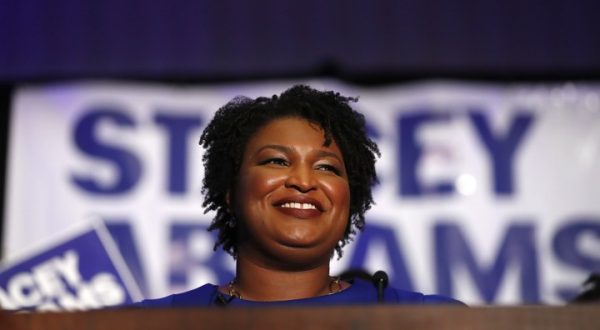
Ending years of speculation, Fair Fight CEO and former state House Minority Leader Stacey Abrams announced her 2022 bid for governor, an announcement timed on the day after the 2021 municipal runoffs. She is widely expected in the press to be the leading candidate in the May 24 2022 Democratic gubernatorial primary.
Despite her renown and the possibility that she could have no primary competition, Abrams will face an uphill battle against the eventual Republican nominee, whether it is incumbent Brian Kemp, former U.S. Senator David Perdue, or the conservative former Democratic state legislator-turned-Republican candidate Vernon Jones. The Abrams campaign currently expects an uncontested primary for governor, preferring that more of the primary infighting occurs on the Republican side in the coming months.
Abrams also faces an uphill battle against stagnant national poll numbers for President Joe Biden and downballot Democrats. History shows an emerging Democratic Party in Georgia which only began in recent years to rebuild itself in a new image.
16 Years in the Wilderness, Then a Path Forward
The last time that Democrats in Georgia ran for governor and state row offices under a Democratic president’s first midterm was in 2010, which resulted in a poor showing, with Republican former congressmember Nathan Deal defeating the Democratic former one-term governor Roy Barnes by 10 percentage points, and the downballot Democrats performing worse in their popular vote share. The 2014 gubernatorial election also saw a poor showing by Democrats, with Nathan Deal defeating Democratic state senator Jason Carter by 8 points.
On the other hand, 2006, which was a Democratic downballot wave year nationally, also saw Georgia Democrats massively underperforming the national environment from the governor downward, with Republican incumbent Sonny Perdue dealing a 19-point defeat to Democratic Lieutenant Governor Mark Taylor, the worst result for a Democratic gubernatorial nominee in Georgia history. The Democratic popular vote percentages for U.S. House, Georgia Senate and Georgia House all exceeded Taylor’s.
In general, the 2000-2016 period was a doldrum period for Democrats, only experiencing an infusion of energy beginning in 2017 with Trump-era special elections ending the Republican supermajority in the State Senate and a spirited push by then-candidate Jon Ossoff for Georgia’s 6th congressional district. At the same time, the vote share difference between the parties has declined in each successive gubernatorial contest since 2006, from that year’s 57.9 – 38.2 difference between Perdue and Taylor to 2018’s 50.2 – 48.8 difference between Kemp and Abrams.
Abrams in 2018 was the first Democratic nominee for Georgia governor who had neither any ties with the pre-21st century political establishment within the party nor any electoral experience prior to 2000. Barnes was a state senator from 1975-1991, state representative from 1993-1999 and governor from 1999-2003; Taylor served as state senator from 1987-1999 and Lieutenant Governor 1999-2007; and Carter is the grandson of former U.S. president Jimmy Carter, and shared the 2014 ballot with Michelle Nunn, who ran for U.S. Senate and is the daughter of former U.S. senator Sam Nunn (who served in the Georgia House from 1969-1973 and the U.S. Senate from 1973–1997).
Even the other state row offices have seen improvements. The last Senate-Governor year in a Democratic president’s first midterm (2010) saw Michael Thurmond bottom out with 39% of the vote for U.S. Senate, followed closely by Georganna Sinkfield for Secretary of State with 39.4%. The last Georgia state row office election in a Senate-Governor year (2014) saw Democrats’ worst-performing statewide candidates – Christopher Irvin for Agriculture Commissioner and Liz Johnson for Insurance and Safety Fire Commissioner – each gaining 41.7% of the vote. In contrast, the 2018 election saw Fred Swann improve on the state row office floor with 46.92% for Agriculture Commissioner.
The Political Environment in Georgia
The task before Georgia Democrats is to maintain the Trump-era momentum in the Biden era, overperform against national polls, and accomplish the difficult task of putting a Democrat in the governor’s mansion, but the national environment sometimes offers mixed surprises. 2010, while a disaster for downballot Democrats across most of the country, did see Democrats pick up governorships in five states, while Republicans took governorships in eleven other states. Similarly, in 2021, Democrats lost the Virginia governorship, but retained the governorship of New Jersey in that state’s first Democratic re-election win in 40 years, a mixed early national result for Democrats downballot heading into 2022.
And the current state-level environment offers early positive signs for Georgia Democrats, with self-identified Democrats flipping 48 municipal seats in 25 counties in 2021, including a close historic win for the Warner Robins mayorship, while Republicans flipped 6.
2022 will also be the first time since 2014 that both offices of governor and U.S. senator will be on the ballot in Georgia. The Democratic nominee for governor will likely campaign at the top of the Democrats’ Georgia ticket alongside the Democratic Senate nominee, widely expected to be the incumbent Raphael Warnock, who is running for a full six-year term in office. Warnock and his fellow senator Jon Ossoff both forced Republican then-incumbents Perdue and Kelly Loeffler into runoffs and pulled off wins in January 2021.
A slew of Democratic candidates have announced bids for all executive row offices to the press throughout the year, with likely competitive primaries for Lieutenant Governor, Attorney General, Secretary of State, and the Commissioners of Agriculture, Insurance and Labor. Surprisingly, only one Democrat, Cobb County Public Schools Board member Dr. Jaha Howard, has announced for State Superintendent of Schools, an office for which there is usually a competitive Democratic primary.
