The “lewd acts” include “watching porn and masturbation.” I didn’t know that NYC had this, but they were going to run into this sooner or later. Potential solutions: time-limits, content filters, and maybe a door for entry like the good ole days. Does one use one’s idNYC card with these kiosks? Question for NYC residents: have you used one of these yet? #LinkNYC #tech #InternetAsPublicUtility
Tag Archives: technology
pre-touch for touchscreen
I was reading that Apple has secured a patent for adding Force Touch to desktop mouses (which may see it added to the Magic Mouse 3), but then I see that Microsoft’s Research department has amazingly demonstrated “pre-touch” for touchscreen.
So now we’re talking about even more layers of multitouch interaction, both for touchscreens, trackpads and multitouch mice. 3D Touch, a more advanced version of Force Touch, is already in the iPhone 6s and 6s Plus, and adds a layer of shortcuts and actions to touchscreen actions.
Force Touch is already featured in the Apple Watch, MacBook Retina 2015, MacBook Pro Retina, and Magic Trackpad 2. But now “pre-touch” for touchscreens? Maybe we’ll finally get a hover function for alt-text on touchscreen browsers? Maybe we’ll be able to pinch and zoom without touching the screen? I can even imagine that pre-touch could enable 6DOF navigation of 3D interfaces, akin to 3dconnexion’s SpaceNavigator 3D mouse.
This will be the bee’s knees. What a time to be alive.
On Twitter, sometimes I feel like I’m less Black because my political ideals are in another universe, too ideal. I think so-called #BlackTwitter is a big, “shady”, clapback-ish in-joke that I’m not privy to. And as much as I post and retweet posts from Twitter, there is so much that I don’t understand about the mentalities of Twitter users and cliques. I’m on the receiving end of social media, not the dishing front. So I get exhausted. I got exhausted last night. Again.

Why are there so few submarine cables between Africa and South America?
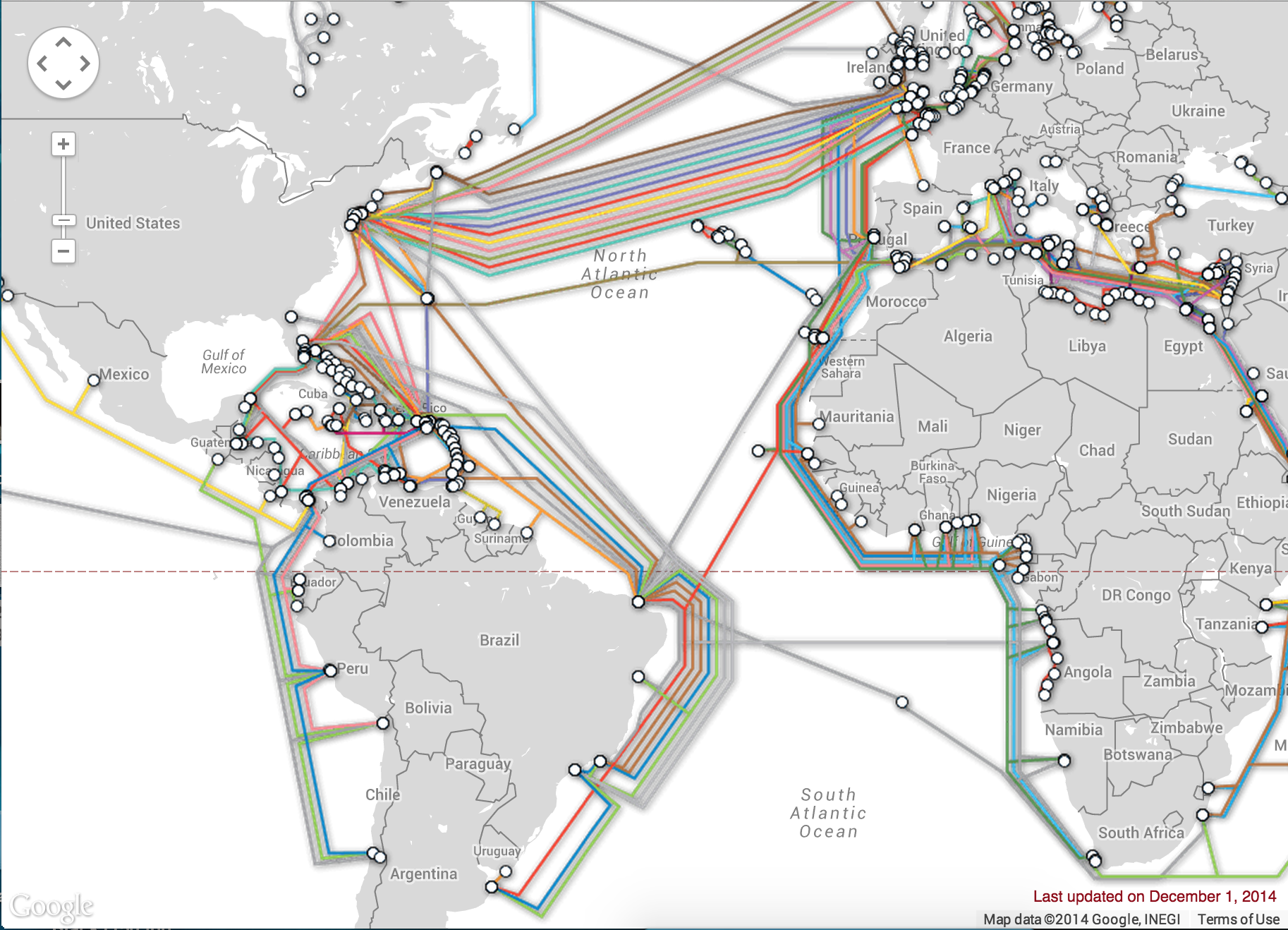
I think looking at the map on the right shows how stratified the layout of communication technology is for the Atlantic Ocean region. So much up top and spilling vertically down (on both sides), but so little between the bottom.
Why are there so few submarine cables between Africa and South America? Between Nigeria/South Africa/Angola and Brazil/Argentina/Venezuela?
Surely there would be lots of historical links to share between the two continents, such as post-colonial, post-slavery histories? Or especially the large portion of slaves from West Africa heading to the Portuguese colony of Brazil? Or the histories of exploitation of labor and natural resources? Or musical and artistic commonalities?
I mean, Brazil literally faces several African countries along the same set of latitudinal lines (more so than a good portion of North America faces Europe), but yet there are maybe one or two submarine cable lines between these countries.
Why is that? Is it neglect? Is it money? Is it racial anxiety (which would be weird gives how many Europe-to-Africa lines there are)? Is it linguistics?
And what would be gained if this were changed with the building of new lines between the two regions?
I think that more equitable trade, cultural ties, freedom of expression, and all institutions which depend upon these developments would only gain in strength and viability – while shrinking only in cost barriers and administrative burdens. It would also reduce the cost of communication between other regions which go through these regions (especially South Asia, which has several cables running to East Africa).
So I’m glad to read that there are two lines currently being built between the two regions: SACS (South Atlantic Cable System) between Fortaleza/Fernando de Noronha (Brazil) and Sangano (Angola) in 2016, and SAEx (South Atlantic Express) between Fortaleza and Windhoek (Namibia)/Mtunzini/Yzerfontein (South Africa)/St. Helena in 2017.
These lines will be the first to connect the two continents directly. I hope that they will help bridge the gap between these two superactors in the Global South.
Recumbent Solar Trikes for personal renewable transport
I like this, especially because this could be hitched to a bike trailer, making a precursor to an affordable one-person solar-propelled RV. Plus, this vehicle is completely off-the-grid and cost-effective, which is still not something which can be said for most solar multi-person vehicles.
The scummy, tone-deaf astroturf of Big Telecom, featuring “Onward, Internet”
ProPublica via Ars Technica covers the latest example of Big Telecom’s scummy tactics against Net Neutrality.
via Mysterious campaign appears to be latest salvo in net neutrality battle [Updated] | Ars Technica.
Drag Performance, Brand Pages and Personal Identities
The issue of the “Real Name” policy, whereby users are told to use “real” names (not necessarily actual names, but “real-sounding” names), is problematic for social networking services (SNS). It’s especially problematic when SNS operators refer users to use brand pages – profiles which are maintained and moderated corporately by one or more users for organized purposes such as promoting a brand or a movement – as alternatives to using pseudonyms on their personal profiles. The reason is that such a solution is half-baked on the sites which most emphasize the use of “real names” for users’ profiles, particularly Facebook (and formerly Google+).
Functionality issues
The suggestion by Facebook for preferably-pseudonymous users to use their pseudonyms on brand pages ignores the fact that pages on Facebook offer less interactivity than personal profiles. Facebook pages don’t allow pages – which are built to serve organizations rather than pseudonymous personalities – to form or join groups. In relation to this, Facebook also does not allow brand pages to automatically invite other users to events; compare this to Facebook groups, which allow for automatic invitations of all members to event pages.
Google+ Pages, in comparison, offer a bit more interaction, with the ability to create and join “communities” (equivalent to groups) as your brand page. In addition, G+ Pages can also add user profiles to circles (a more advanced version of Facebook’s “adding friends”) and invite followed profiles, circles of profiles and whole communities to events.
Presentation issues
However, in the case of pseudonymous users being “nudged” to create pages for their pseudonyms, G+ and Facebook both suffer from a high learning curve and a lack of tailoring toward personal identity pseudonyms.
Facebook’s “Create a Page” has six main options: “Local Business or Place”, “Company, Organization or Institution”, “Brand or Product”, “Artist, Band or Public Figure”, “Entertainment”, and “Cause or Community”. The closest to a means of controlling a personal pseudonymic identity is “Artist, Band or Public Figure”, which is limited alongside other Facebook pages in its interaction abilities.
By comparison/contrast, G+ only has “Storefront (Restaurant, Retail Store, hotel, etc.)”, “Service Area (Plumber, pizza delivery, taxi service, etc.)”, and “Brand (Product, sports team, music band, cause, etc.)”, which is even more confusing from the outset by the grouping of so many options into just three categories.
The ideal page
The ideal brand page system which would work perfectly for personal pseudonyms at the intimacy perhaps most desired by drag performers in an SNS, IMO, is a combination of Facebook’s presentation and G+’s functionality and interactivity:
- Having at least 6 page-creation options including “Artist, Band or Public Figure”, or even a 7th “Character or Pseudonym” option.
- Having the ability to follow/be followed by users and create/join groups “as” the brand page.
- Have the option to switch to a preferred brand page identity upon login to one’s personal user identity.
- Have the ability to restrict access to one’s personal profile while simultaneously operating a brand-page identity.
In such a system, performance artists such as drag performers would have the full ability to interact with their fans as their pseudonyms or public personas, to organize their fans into discussion groups (both public, private and secret) under their personas, and to easily invite fans to events (or even games and apps), all without revealing or exposing any of their personal profiles to the public.
When the brand pages are not fully baked, not fully conceptualized as alternative identities for both individuals and corporated groups, the ability to control your presence is hobbled. Performers like Sister Roma offer an opportunity for Facebook, G+ and the SNS sites of our era to not only listen more to their users, but to make their brand pages more useful for more people. The “Real Name” policy (as well as the restriction against multiple profiles on sites like LinkedIn) only hurts privacy, doesn’t help the quality of conversations on Facebook, and is not remedied by half-baked brand page tools.
Civic Hacking
The National Day of Civic Hacking – Columbus Ga Hackathon was very engaging.
I haven’t been around that many fellow techies since the last time I went to Linux group meets in Warner Robins (which is how I met Jeff Hatfield, Reginal Cross and others). Reminds me that I still need to learn Python. And I met many folks at the Hackathon, including Gil Strickland, Frank Braski, Wayne Summers, Patrick Smith, Brian Bolton, Geoffrey Gwdub Shoultz, Lucas Shaffer, Bryce Jackson, Fred Johnson, Savannah Sosa and Walker Randolph Smith.
Congrats to Patrick, Brian and Geoffrey for winning the competition, and I was really impressed by their app! It would definitely help with political literacy in Columbus.
I, however, came into the competition just out of curiosity, but I came out with a presentation which called for an overhaul of the city’s web infrastructure to an FOSS platform in order to facilitate transparency for residents. I was surprised that my presentation was so well-received. And after that, I went with Lucas and the winners of the competition to The Cannon Brew Pub.
Thank you, Lucas, for covering us. Anyway, an eventful two days to mark the beginning of summer 2014.
Ideas for e-books
I haven’t posted in a while, but I just wanted to share a few personal ideas for how e-books (specifically those in the ePub format) can be modified for a more attractive and functional visual reader experience. I may expand this list in the future with more items.
E-books as music/video albums: The publication of audio albums online (outside of iTunes) is nowadays conducted through the distribution of compressed archives (i.e., .zip), usually containing a collection of the album’s art alongside the tracks from the album in MP3 or other audio file formats, as well as a playlist file and album notes in plain text format; alternately, this same collection is distributed through peer-to-peer file-sharing networks such as BitTorrent as a .torrent file. However, while it is the most common means of digital publication and distribution of music albums, it is absent of the visual allure associated with the physical music album. As video and audio can be embedded into an ePub document (since a ePub file is simply a zip archive of numbered XHTML pages), I think ePubs can become “visual packages” for music files, in which each MP3 is embedded into any ePub “page”, with lyrics, topical images, and perhaps the associated music video being embedded above or below the music player control bar.
“Spines” or “page frames”: I dunno if this has been tried, but a graphic “spine” or “page frame” on either side of each page would, IMO, help bring visual unity to the ebook while it is being read. The graphic would be a vector graphic image (in SVG format) in order to be as reflowable as the e-book’s text.
With Google+, Facebook and Twitter all doing brand pages now, I wonder if it’s now time to create a “follow/like/add our brand page” icon that is agnostic to all such services like the Feed icon and the Share icon.
Right now, the more popular symbol is the + sign (on FB and Twitter). Problem is that I don’t know which agnostic word I would use to describe the action of “follow/like/add”. “Subscribe” is already taken by feed readers.
