Tag Archives: texas

California and Other Blue States Should Declare a Congressional Redistricting Emergency

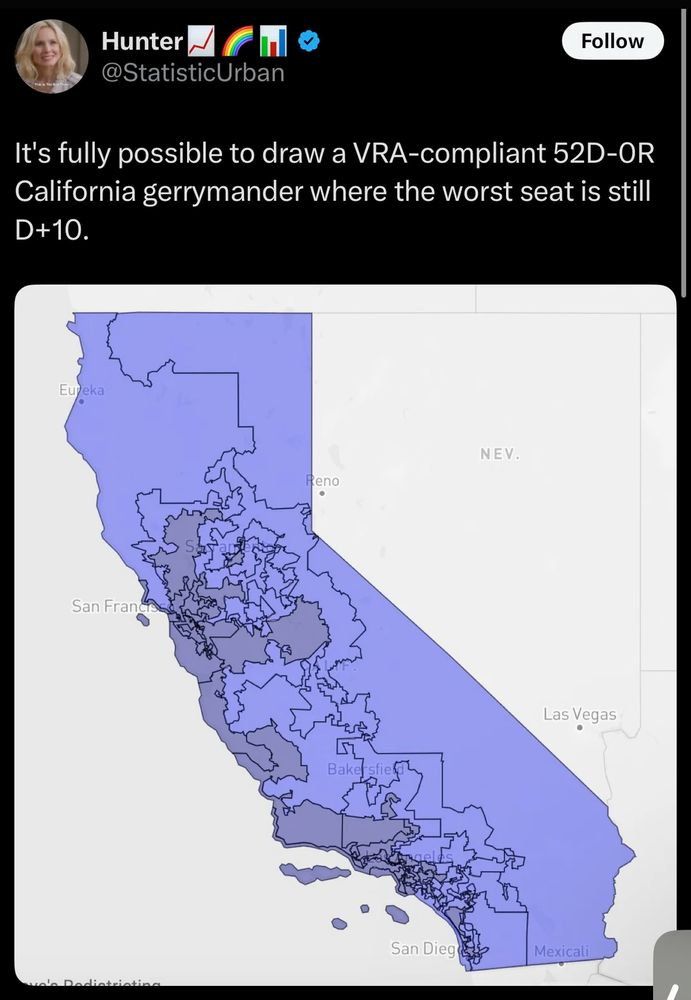
From Hunter @StatisticUrban: “It’s fully possible to draw a VRA-compliant 52D-0R California gerrymander where the worst seat is still D+10.”

In 2008, California voters established the California Citizens’ Redistricting Commission to redraw state legislative districts, and in 2010, extended its powers to redraw congressional districts.

Within portions of the California Democratic Party in 2025, the latter power to redraw congressional districts is widely perceived as an act of unilateral disarmament when it comes to the empowered Republican legislative majorities in Florida, Texas and North Carolina. And now that both Trump’s White House and the Texas Republican Party want to eliminate as many as five more Democratic-held metropolitan seats in Congress, the idea of Newsom calling a special legislative session to refer an amendment to the voters to restore partisan gerrymandering powers to the legislature is being trafficked to news outlets.

In my opinion, California should keep their citizens’ redistricting commission, but should amend their constitution to provide for a “congressional redistricting emergency” period for legislative redistricting of congressional districts until the majority of congressional districts nationwide (217 out of 435 seats), or more broadly, every state assigned three or more congressional districts through reapportionment after each census, are covered by state constitutions which provide for citizens’ redistricting commissions.

Based in part off of the 2016 Interstate Compact for Fair Representation Act (SB 0322), which was proposed by then-Illinois State Senator (now Illinois Attorney General) Kwame Raoul, and passed the State Senate before dying in committee in the State House, here’s how I would amend the California State Constitution Article XXI Section 1 to carve out this exception:

“(b) In the year following the year in which the national census is taken under the direction of Congress at the beginning of each decade and in which at least one state with three or more congressional districts at the time of redistricting has not enacted the terms of Article XXI in substantially the same form in their own state constitution as applies to the constitutional districts of their state, the Legislature shall retain the right to amend a map of congressional boundary lines as proposed by the Citizens’ Redistricting Commission and to approve said amendments by majority vote of both houses and approval by the Governor. The Legislature shall retain the right to amend said boundary lines in an intervening year if any state enacts a similarly-timed adjustment of congressional boundary lines which fails to espouse the terms of Article XXI. Such compliance with this subsection shall be determined by the Secretary of State, who shall declare a state of congressional redistricting emergency to terminate upon determination of such compliance.”

This way:

  • only a small portion of Article XXI would be amended to carve out the time-dependent congressional exception, since we’re wanting more states to adopt Article XXI in substantially the same form for their state government.
  • Furthermore, it would encourage more Democratic-led states to keep their congressional gerrymandering powder dry for when it is needed for when interstate and anti-presidential conflicts arise.
  • it would allow the Legislature to respond to mid-decade redistricting by another state if necessary.
  • Finally, it would empower the Secretary of State to determine if any state has failed to adopt the terms of Article XXI in their state constitution to trigger legislative intervention.

This power should not be held by the legislature in perpetuity. This should be an emergency power that is used to stabilize Congress in a time of interstate conflict. It would be a departure from unilateral disarmament, instead treating interstate relations as a theater in which to seek diplomacy, mutual defense and good government.

But I can see such a move irking those who have pushed for decades in the trenches to unilaterally enact citizen redistricting by ballot initiative or legislation. I also acknowledge that Republican-led states like Arizona and Montana would be within their right to adopt similar exceptions to nonpartisan redistricting for congressional gerrymandering. Yes, this could become a “race to the bottom” as put by State Assemblymember Alex Lee.

In the Anglophone hell that is our first-past-the-post, single-winner elections for legislative branches nationwide, unilateral disarmament is no virtue, and keeping your gerrymandering powder dry to force concessions from other states is no vice.

I encourage readers to read this Penn State Law Review paper by Zachary J Krislov as well as this University of Chicago Law Review paper by Samuel P. LeRoy for great breakdowns on these “interstate compact” trigger laws on redistricting, the histories of such proposals and their potential efficacy.

Are Alabama’s Democrats Ready? Are the South’s Democrats Ready?

I think about the following:

  • Out of the former Confederate states in the period between 1870 and 1901, only South Carolina sent at least two or more members to the U.S. House.
  • Georgia, Alabama, Louisiana, Mississippi, Florida, North Carolina and Virginia all sent one member at a time.
  • Texas and Tennessee never sent any members in the (post-)Reconstruction era
  • and Arkansas has never sent any African Americans to Congress to the present day

Now, Alabama will likely send two Black members to the U.S. House for the first time. And Louisiana is within spitting distance of doing the same for the second time in their history; the first time such a thing happened was in 1993, when William Jefferson (D-LA02 and Cleo Fields (D-LA04) went to the 103rd Congress.

The big question which sticks out for me is whether the Alabama Democratic Party will be prepared for this moment.

They certainly weren’t when Doug Jones won the once-in-a-blue-moon Senate special election in December 2017. In fact, the Alabama Democratic Party, the statewide Black Democratic club ran by Joe Reed, actively fought Jones for influence over the party’s bylaws and structure. The fight continues to this day, years after Jones lost his Senate seat to some bigoted football coach. And it seems like the DNC will have to pry some control of the ADP from the Conference. The Conference also tried to intervene twice in the Allen v. Milligan case to advocate for a more Black-majority 2nd and 7th district (to no avail), which went against the strategy of the plaintiffs as well as Rep. Terri Sewell in favor of two opportunity districts.

Now, however, with Sewell likely to win again in the 7th, the question remains as to the impact of whoever wins the 2nd congressional district. It’s most likely that the winner may be Black, or that whoever wins will have the support of the Black voting-age population in the 2nd district. But will the winner have more of a role in the Alabama Democratic Party? Will the campaign to defend both the 7th and the new 2nd district arouse the party out its current shape?

The same can be asked about Louisiana’s Democratic Party. It is heading to another era in the statewide wilderness with the terming-out of Governor John Bel Edwards and the likely election of a Republican governor. The party has been beaten down badly in other political aspects due to a massive decline in white rural support. Besides retaining Foster Campbell on the PSC in 2026 (he had his closest election in 2020), the other favorable political aspects above the state legislature have been:

  • the election of Davante Lewis to the PSC in 2022
  • the possible creation of a second opportunity congressional district around Baton Rouge for 2024

This is why I look forward to the impact of Allen v. Milligan on Southern elections. All of these issues can be challenged in federal court:

  • the potential second opportunity district in Louisiana
  • the reform of Mississippi’s State Supreme Court districts
  • Alabama’s Public Service Commission election method
  • Georgia’s Public Service Commission election method and maps
  • Texas’s Supreme Court election method
  • Texas’ State Board of Education maps
  • Texas’s Railroad Commission election method
  • Louisiana’s Supreme Court election method

Progress on Blue Trifecta Sodomy Repeal (End of April 2023)

As of 28 April 2023:

  • Maryland: HB0131, decriminalizing oral sex, is still waiting for governor’s signature
  • Massachusetts: H1640/S913 have been reconciled and are sitting in the Joint Committee on the Judiciary
  • Michigan: two House bills (HB4431 and HB4432), both introduced 4/19/23. Twitter user @LGBTmarriage notes that neither bill repeals “the ‘gross indecency’ laws that also ban consensual private gay and straight sex (750.338, 338a and 338b).” Hope to see this fixed.
  • Minnesota: HF91 making the rounds in committees. Companion SF70 is in second reading.

ONCE AGAIN, it really shouldn’t be taking this long to remove some archaic swords of Damocles from over the heads of LGBT people in blue trifecta states.

Somewhat honorable mention goes to Texas where a bill to repeal the state’s highly-discriminatory ban on gay sex has received majority sponsorship for potential passage. This is somewhat honorable because the bill (drafted by a Democrat) contains a “compromise” proviso preserving existing legislation stating that “homosexuality is not a lifestyle acceptable to the general public” (Christian bullshit as usual).

Dallas Revenge

I had said earlier that there was going to be a Timothy McVeigh-Terry Nichols type of reaction when LEOs shoot the “wrong type of people”.

I did not expect a retaliation of this magnitude, not over LEO murders of African-Americans, not in #Dallas. The shooter in the video, who is now dead, looks like he had training to shoot at remote targets from around corners. Snipers.

With his accomplices, he was able to kill 5 officers and wound 5 others. They could have killed many, untold numbers of civilian protesters after they were frightened by the shooting, but they didn’t. Just picking off the LEOs.

This wasn’t an ordinary clapback against police brutality. This was planned, the channeling of emotion from abject despondency to stone-cold revenge. The shooters wanted to make a seething nick in the skin of that institution.

“The end is coming”, he said in the garage. Apocalyptic. No one expected this. I thought there wasn’t going to be this sort of channeling. Just more protests, more arrests, more burning of buildings.

But this. THIS. Stone-cold, planned revenge. A selective propaganda of the deed.

Interestingly enough, I read that McVeigh and Nichols were trained and stationed here at Fort Benning in the late 80s. Maybe military training? I’m as mesmerized by what happened in Dallas as I am disgusted and despondent over ALL of the unjustified deaths of the last 96 hours.

NOTE 12/28/2017: This is NOT a justification for revenge killings of police, nor of anyone at all. Stop the killings.

Greg Abbott Wants a Convention to Undermine the Working Class

Spoiler alert: these amendments would solidify power in the hands of states which consider themselves mini-states and fiefdoms, like Texas.

Summary:

“Prohibit congress from regulating activity that occurs wholly within one state. Require Congress to balance its budget. Prohibit administrative agencies from creating federal law. Prohibit administrative agencies from pre-empting state law. Allow a two-thirds majority of the states to override a U.S. Supreme Court decision. Require a seven-justice super-majority vote for U.S. Supreme Court decisions that invalidate a democratically enacted law Restore the balance of power between the federal and state governments by limiting the former to the powers expressly delegated to it in the Constitution. Give state officials the power to sue in federal court when federal officials overstep their bounds. Allow a two-thirds majority of the states to override a federal law or regulation.”

Yet, none of this would be extended to cities. The gall of state-supremacists like Greg Abbott.

Aftermath of #HERO

I’ve seen some crap. Few things are as much of a travesty as how the #HERO vote went in Houston. One of the worst I’ve ever seen.

Some from the campaign were saying “Let’s not engage in Monday-morning quarterbacking”. Yet how can you not when the vote was so lopsided? How can you not when the turnout for the Houston vote was the highest in a city election since 2003? How can you not when the anti-HERO campaign was, and continues to be, particularly vicious toward transgender people?

Dan Patrick, Gary Abbott, the “Campaign for Houston”, “Texas Values” and the right-wing in Houston are pretty damn unbelievable in their “win” against transgender women.

They demand grace from Annise Parker, but are very ungracious, snidely and spiteful in their reaction to the result. The transgender people who were targeted explicitly by Patrick and Abbott as “men in women’s restrooms” in the campaign are nowhere to be found in their reactions. I wonder if, thanks to this vote, it will now be acceptable to assault, attack and harm transgender women in Houston. They were targeted hard by cartoons and vicious rhetoric throughout the state by the Christian right-wing, called “perverts” and “confused men” who would harm “6 year old girls”. This was statewide, and this was scary.

The target wasn’t even L, G or B people. None of them. It was the T. I will not be surprised when a transgender woman trying to use the restroom is violently attacked in Texas, and the Christian right clucks its tongue at the transwoman saying “That confused ‘man’ was wrong to go into the wrong bathroom and look like that, ‘he’ had it coming. No sympathy from me, he deserved it!” That rhetoric won last night. Those who spoke it are effluent in their gloating.

This is a bad way for Mayor Parker to leave office. This next year in Houston will be particularly bad for transgender women. In the name of getting a similar ordinance passed in Houston, any mention of “gender identity” may even be stripped out of the ordinance for expediency’s sake a la ENDA.

The optics of this are hard to overcome, and must be fought for years to come. But the lives of transgender people in Houston must be watched out for as the next few years unfold. I remain proud to have done what I did for HERO. I am ashamed of this tragedy. I am afraid for trans lives in Houston and Texas. #TransLivesMatter #BlackLivesMatter.