There is a legislative effort in Tennessee, Alabama, Georgia, Missouri , South Carolina and even Texas to close partisan primaries for elected office and require partisan voter affiliation questions on registration forms, and several individuals are sounding alarm bells about it.
(Note: Missouri’s June 2022 voter ID law (their third attempt at such, set to go into affect in January 2023 pending litigation) requires voters to identify on their voter registration forms with a party or mark themselves as “unaffiliated”).
But I note that most Southern states, save for Arkansas, Florida, Louisiana and North Carolina, have not adopted partisan voter affiliation questions on voter registration forms. The majority of states with partisan voter affiliation (PVA) questions are largely located either west of the Mississippi or in the Northeast.
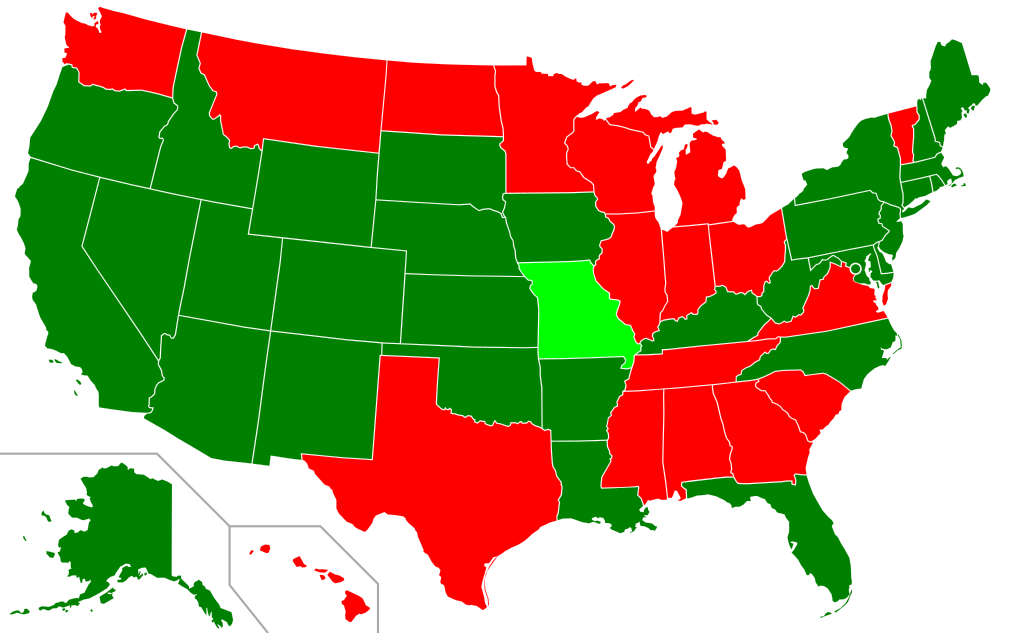
Save for Georgia, the other previously-mentioned states with Republican-led movements toward closed primaries are all deeply-red in terms of legislative share. The current one-party rule in these states increasingly resemble the one-party rule under the then-conservative Democratic Party in these same states. As I noted, only Tennessee, North Carolina and Virginia had uninterrupted instances of Republican legislative representation in both houses (much of it paltry) during the days of Jim Crow. But, unlike most other U.S. states outside of the South, most Southern states did not introduce PVA questions during that same era, and instead suppressed Republican and non-white suffrage through other, more notorious means (including the county unit system in Georgia up to 1963 and its state house-based equivalent in Mississippi up until 2021).
Appendix A in this 1985 study on party enrollment and identification shows that, sometime after publication of this study, Alaska (sometime prior to 1995), Arkansas (sometime prior to 2002), Idaho, and Utah all adopted PVA questions on their voter registration forms.
Without addressing the desire or need for closed primaries, the biggest question I have about the use of the PVA question is its intersection with race. Among those Southeastern states with PVA questions:
- Arkansas, despite being a slave state prior to emancipation, has a smaller Black population (around 19%) than most other former Confederate states (save only for Texas at around 12%), and is perhaps the “whitest” state in the former Confederacy.
- North Carolina, with a 22.5% Black population
- Florida at 17.1%
- Louisiana at 33.1%
Arkansas is the most inelastic of these four, while the other three see competitive turnovers from time to time in statewide elections. Louisiana may see competitive elections for governorships due to its jungle primary, while North Carolina and Florida see competitive elections due to their plurality elections. As of 2022, Louisiana currently gives the numeric advantage in PVA to Democrats, Florida (a closed primary state) to Republicans, and Arkansas and North Carolina both to independent/unenrolled voters.
What would Georgia’s PVA makeup look like if we had such a question on voter registration applications? Georgia has a 33% Black population (only less of a percentage than Mississippi and Louisiana), and over 80% of Black voters vote for Democrats, while over 70% of white voters regularly vote for Republicans.
And what of those who would mark “unenrolled”/”independent” on their PVA questions? How much would they constitute of Georgia’s population at this time if asked on their VR forms, and how would the unenrolled break down by race/sex/etc?
Finally, this isn’t the first time that Southern states have moved to adopt election-related ideas popular in the Northeast. Literacy tests were also adopted first in the Northeast for voter registration in the 19th century in order to suppress recent immigrants from voting, and were subsequently adopted by Southern governments to suppress African Americans from voting.
Compared to that, however, the main suppressive effect of PVA questions and closed primaries would be the exclusion of unaffiliated voters from determining party nominees. The big question is: who would be the unaffiliated?
Another note: this article from the American Political Science Review published in 1922 states that the number of states who switched to PVA questions on voter registration forms rose from 11 in 1908 to 26 by 1920.
This practice needs better documentation, and its wild that I can’t find much research on how partisan voter registration became a thing, or why it has increased among states, or why we seem to be the only country that does this. Why?
