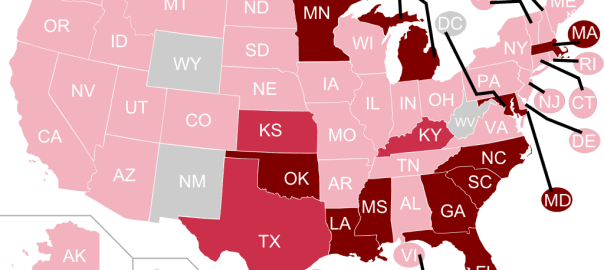
Maryland. Massachusetts. Michigan. Minnesota.
All four of these states start with M’s. All four have Democratic trifectas – Democrats controlling their governor’s mansions and both houses of their legislatures. And, as of 2023, all four have bans on gay sex on their books.
- Maryland: § 3-322. Unnatural or perverted sexual practice.
- Massachusetts: Chapter 272, Section 16: Open and gross lewdness and lascivious behavior; Section 26: Resorting to restaurants or taverns for immoral purposes; Section 29: Dissemination or possession of obscene matter; Section 35: Unnatural and lascivious acts; Section 53: Indecent exposure.
- Michigan: Act 328, Section 750.158: Crime against nature or sodomy; penalty
- Minnesota: Section 609.293: Sodomy.
I can excuse Michigan and Minnesota (somewhat). Michigan only just gained a Democratic trifecta for the first time since 1983. Minnesota last had a trifecta in 2013-2014, but it was the first time they had such since 1978.
But Massachusetts and Maryland failing to repeal their bans on gay sex despite having two terms of “moderate” Republican governors and long-time Democratic supermajorities in both houses is inexcusable. Maryland had a bill in 2022 which passed almost unanimously in their House of Delegates but died in Senate committee. Massachusetts had a bill in 2022 which was renumbered, and renumbered again, before passing the Senate and then dying in a House committee.
Embarrassing. A waste.
And now a threat thanks to Clarence Thomas’ written attack on Lawrence v. Texas, which has not received any statutory backing federally since 2003 (save for when President Obama signed a repeal of a consensual gay sex ban for the military in the 2014 NDAA).
Meanwhile, trans-hating, gay-hating Alabama managed to repeal their own sodomy law in 2019 (while cleaning up their criminal code). Utah also did the same in the same year. Trans-hating, gay-hating Idaho repealed theirs last March (in response to a lawsuit).
Well, at least Michigan stands the likeliest chance to repeal theirs this year, but only because the larger law which criminalizes gay sex (Act 328 of 1931) also criminalizes abortion, blasphemy, adultery and more.
But the clock is now ticking on all four aforementioned blue trifecta states – Maryland, Massachusetts, Michigan and Minnesota – to repeal these stupid laws.
And, while I’m on it, it’s on Georgia’s Democratic legislators to show the give a shit about LGBT people by filing a bill to repeal O.C.G.A. § 16-6-2. What are you waiting for?
UPDATE: Here are the bills for this year:
- Maryland HB0131 (SB0054)
- Massachusetts HD.1777/SD.203
- Michigan bills HB4006 and SB2 somehow miss the bans on sodomy, fornication, blasphemy, etc?
- Minnesota HF 91/SF 70 (would repeal abortion restrictions and possibly several sexual offenses)
Other unrelated bills I’m watching from these legislatures:
Bills from legislatures where I’m not expecting much good:

